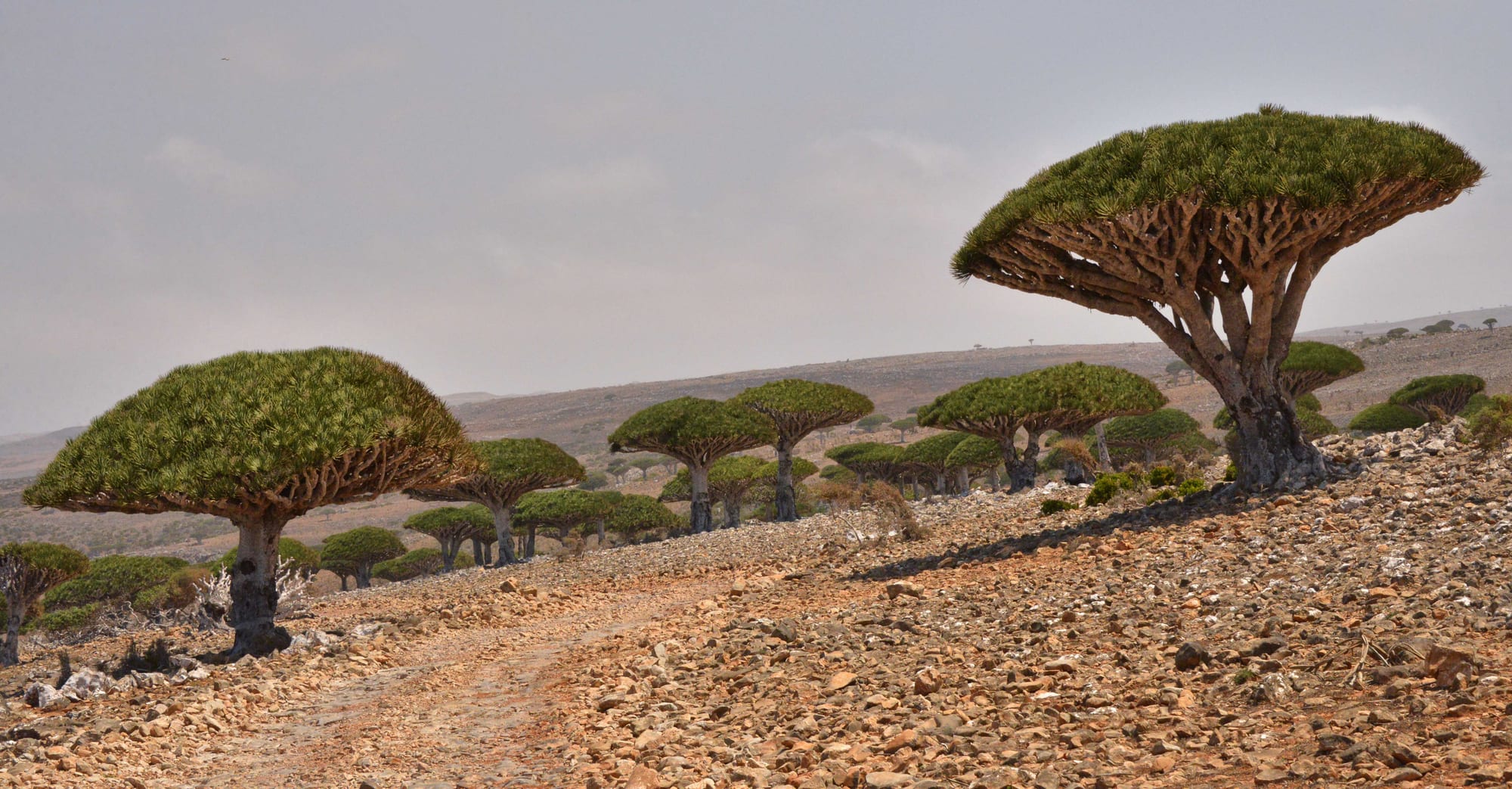
Umbrella-shaped trees with dense flat crowns and bare trunks scattered across a stony highland plateau

Yemen

Dragon's blood trees on the Diksam plateau of Socotra, an island in the Arabian Sea whose isolation has produced hundreds of species found nowhere else. (Rod Waddington / Wikimedia Commons · CC BY-SA 2.0)

A country of mountains, desert, and ancient walled cities on the southwest corner of Arabia — once "Arabia Felix", now one of the poorest Arab states and, since 2014, the site of a civil war and what the UN has called the world's worst humanitarian crisis. Most governments advise against all travel. The island of Socotra has been largely spared the fighting and sees a trickle of visitors, though access to it is unreliable.

Explore Yemen

History

Southern Arabia was the land the Romans called Arabia Felix, "Fortunate Arabia", rich from the trade in frankincense and myrrh and from control of the sea route to India. The kingdom of Saba (biblical Sheba) built the great dam at Marib around the eighth century BC, and its collapse centuries later passed into legend. Judaism and Christianity took root before Islam arrived in the seventh century, and a Zaydi Shia imamate was established in the northern highlands around 897, ruling in various forms for over a thousand years.

The Ottomans held parts of Yemen intermittently, and Britain seized the port of Aden in 1839 as a coaling station on the route to India, developing it into a major harbour and, later, a protectorate over the surrounding sultanates. In 1962 a coup and civil war ended the imamate in the north, creating the Yemen Arab Republic; when Britain withdrew from Aden in 1967, the south became the People's Democratic Republic of Yemen, the only communist state in the Middle East. The two Yemens united in 1990 under Ali Abdullah Saleh, who had led the north, though a southern secession attempt in 1994 was crushed.

Saleh's three-decade rule ended in 2011–12 amid Arab Spring protests. The Houthi movement — Zaydi revivalists from the far north — swept into Sana'a in 2014–15, and a Saudi-led coalition intervened to restore the internationally recognised government, with Iran backing the Houthis. The UN puts the dead at more than 150,000 in the fighting and more than 227,000 in all once famine and the collapse of healthcare are counted; millions have been displaced, and the country has been divided between rival authorities that each claim to be its government, producing what the UN has repeatedly called the world's worst humanitarian crisis.

A truce brokered by the UN in 2022 brought roughly four years of relative calm. Fighting resumed in July 2026, and in September an offensive along the Red Sea coast turned the Bab al-Mandab strait — the sea lane between the Red Sea and the Gulf of Aden — into a second contested choke point in the war that began when the United States and Israel attacked Iran in February 2026. The Houthis declared the strait closed to certain shipping, struck cities in southern Saudi Arabia, and tens of thousands of people were displaced within weeks.

  • Yemen: Arabia Felix and the Broken State — The fertile corner of Arabia the Romans called "the happy land" — home of the incense kingdoms and the Queen of Sheba, split into a northern imamate and a British colony at Aden, unified in 1990, and since 2014 the scene of a devastating war and humanitarian catastrophe

Culture & Customs

Yemen is tribal, conservative, and deeply religious, split between a Zaydi Shia tradition in the northern highlands and a Shafi'i Sunni majority elsewhere. Tribal law and mediation remain powerful, especially outside the cities, and the carrying of the jambiya, a curved dagger worn at the belt, is a mark of manhood and status for many men.

Hospitality is a strong obligation, and the qat chew — a long communal afternoon session in which men (and, separately, some women) chew the leaves of the mildly narcotic Catha edulis — is the central social ritual, despite the enormous toll it takes on water, farmland, family budgets, and productivity.

Yemeni craft and building traditions are distinctive: the multi-storey tower-houses of rammed earth, brick, and white gypsum tracery in Sana'a and Shibam, silverwork, and honey production. Socotra has its own Soqotri language and a herding and date-farming culture shaped by centuries of isolation.

  • Yemen: The Dagger, the Verse and the Welcome — A deeply Muslim country of Sunni and Zaydi traditions, where a guest is greeted with a blessing, a curved dagger marks a man's standing, and poetry is still composed aloud at weddings and in the settling of disputes

Daily Life

Around 35 million people live in Yemen, and the war has left the great majority dependent on humanitarian aid: the UN has counted some 24 million people, close to three quarters of the population, as needing help, and millions have been displaced. The economy has largely collapsed: public salaries often go unpaid, the currency has fractured, fuel and cooking gas are scarce and expensive, and basic services barely function.

Water is the country's deepest structural problem — Yemen was already one of the most water-stressed nations on Earth, and qat cultivation consumes much of what remains. In the towns and cities, life means queuing, power cuts, rising prices, and the constant background of conflict; in the countryside, subsistence farming and herding continue under the same strains.

Socotra, though poor and cut off, has been comparatively calm, its people living by fishing, herding goats, growing dates, and, increasingly, guiding the small number of tourists who fly in.

  • Yemen: A Day Measured Out in Water and Qat — A country of some 35 million people where more than a decade of war has made water the deepest daily worry, the working day still bends around the afternoon qat chew, and getting by has become a household project shared by everyone old enough to help

Food

Yemeni cuisine is rich and spiced. The national dish is saltah: a bubbling brown meat stew topped with hulba, a whipped fenugreek froth, and sahawiq, a spicy sauce of fresh herbs, garlic, and chillies, scooped up with flatbread. Fahsa is a similar stew of lamb and lamb broth, and mandi — meat and rice cooked together in a pit oven — is the celebration dish, shared from a communal platter.

Bread comes in many forms, from the tandoor-baked khubz to the homemade malooj and the sourdough flatbread lahoh. Aseed (a lump of cooked wheat dough, eaten with broth, butter, or honey), shafut (flatbread in spiced buttermilk), and zurbian (spiced meat and rice) round out the table. The sweet bint al-sahn is a layered honey cake.

Coffee is Yemen's gift to the world — the port of Mokha gave its name to mocha coffee — and the husks are brewed as a spiced infusion called qishr. Black tea is drunk all day, and the afternoon belongs to qat.

Attractions & Natural Wonders

Yemen's cultural sites are among the most striking anywhere and are, for the most part, currently unreachable. The old walled city of Sana'a, a UNESCO World Heritage Site, is a dense quarter of decorated tower-houses, mosques, and gardens, inhabited for more than 2,500 years. Shibam, in the Hadhramaut, is a grid of mud-brick tower blocks five to eleven storeys high, some of them over 30 metres, often called the "Manhattan of the desert" and also UNESCO-listed, as is the Tihama town of Zabid, once a great centre of Islamic learning. UNESCO put both Shibam and old Sana'a on its list of cultural heritage at risk in 2015.

Elsewhere the mainland holds the Marib dam and Sabaean temple ruins, the 1920s rock palace of Dar al-Hajar outside Sana'a, the terraced highland villages of the Haraz Mountains, the wadi oasis towns of the Hadhramaut, and the port and volcanic crater of Aden.

Socotra is the one part of Yemen that receives visitors: a UNESCO-listed island with a third of its plant life found nowhere else, including the umbrella-crowned dragon's blood tree, the best known of its endemic plants, along with white dunes heaped up by the monsoon winds, the Ramsar-protected salt lagoon of Detwah, the inscribed limestone cave of Hoq, and empty beaches, all seen on camping trips by 4x4.

  • Yemen: Four Attractions and Natural Wonders — A walled mud-brick city nicknamed the 'Manhattan of the Desert,' an island so evolutionarily isolated a third of its plant species exist nowhere else on earth, and an ancient capital of tower houses that has survived a millennium of history — described here for reference amid one of the world's most severe ongoing humanitarian crises

Planning basics

Budget

There is no functioning tourism economy on the mainland. The only travel that happens is to Socotra, on organised camping-based trips flown in on infrequent flights; these are sold as packages and are not cheap once flights, permits, guides, 4x4s, and cook are included.

Daily Budget Note
Socotra tours typically run to USD 150–300+/day all-in, including the charter flight amortised

Do not attempt mainland travel; for Socotra, book only through an established operator that arranges the charter flight and permits.

Visa Requirements

The visa situation reflects the country's division. A visa must in principle be obtained in advance from a Yemeni diplomatic mission — the visa-on-arrival scheme that once covered some 50 nationalities ended in January 2010 — and in practice mainland entry is controlled by rival authorities and is closed to ordinary visitors. For Socotra, tour operators arrange the entry paperwork along with the flight; independent arrangements are not possible.

Typical Validity
Socotra: a short permit-based entry arranged by the tour operator

Only travel to Socotra as part of an operator's package that handles the permit and flight; there is no route in otherwise.

Safety

Most governments advise against all travel to Yemen. The mainland has active fighting, air strikes, shelling, landmines, and a severe risk of kidnapping of foreigners by armed groups including al-Qaeda in the Arabian Peninsula; several foreigners have been abducted or killed. Houthi forces began attacking Red Sea shipping in late 2023 and drew US and UK air strikes; the attacks paused after the Gaza ceasefire of October 2025. When the United States and Israel went to war with Iran in February 2026, the Houthis threatened to resume them, and from late March they fired missiles at Israel. Fighting inside Yemen restarted in July 2026, after roughly four years of relative calm under a UN-brokered truce, and grew sharply in September, when an offensive along the Red Sea coast began the Bab al-Mandab crisis: the strait was declared closed to certain vessels, Saudi cities were hit by missiles and drones, and the International Organization for Migration counted more than 82,000 people displaced in the first weeks of the month. Socotra has been largely insulated from the fighting but remains part of a country in crisis, with no consular support and minimal medical care; in early 2026 a state of emergency closed the country's entry points and left hundreds of foreign visitors stranded on the island until they were flown out to Saudi Arabia.

Health
Cholera has affected more than a million people; malnutrition and disease are widespread; the health system has collapsed; on Socotra, care is very basic and evacuation is by charter only

Follow your government's advice and do not travel to the mainland; if visiting Socotra, go only with a reputable operator, carry comprehensive evacuation insurance, and bring all cash and medicines you will need.

Climate

Hot desert over most of the country, but the western highlands around Sana'a are temperate and can be cold at night, and the monsoon brings rain to the mountains in summer. The Tihama coastal plain and the Hadhramaut are extremely hot. Socotra is swept by strong monsoon winds from about June to September, when the sea is too rough for boats and some flights stop.

Highlands
Temperate, cool nights; summer monsoon rain
Coast And Socotra
Very hot; Socotra windy and largely closed Jun–Sep

Transportation

Sana'a and Aden airports operate limited, irregular flights amid the conflict, and Sana'a airport was hit by air strikes in July 2026. Socotra is reached by infrequent flights whose routes have changed with the conflict, normally booked as part of a tour package; on the island, travel is by 4x4 on rough tracks with a local driver and guide. Mainland roads cross front lines and are extremely dangerous.

There is no safe way to travel the mainland; Socotra travel is entirely dependent on the operator's charter and vehicles.

Best Time to Visit

For Socotra, October to April is the season — outside the summer monsoon — with the calmest seas and the trees at their greenest after the rains. The mainland is not a travel prospect at any time of year.

Events
Eid al-Fitr and Eid al-Adha; Socotri seasonal herding and date-harvest customs

Currency

The Yemeni rial has split in value between the areas held by the rival authorities — in early 2025 a US dollar bought about 2,150 rials in one and about 530 in the other — and notes printed since 2017 are not accepted in the north. It is a cash-only economy; banks and ATMs do not work for foreigners. US dollars in cash are essential, including on Socotra.

Symbol
﷼
Currency Code
YER — Yemeni rial

Language

Arabic is the official language, spoken in distinctive Yemeni dialects. Soqotri, an unwritten Modern South Arabian language distinct from Arabic, is spoken on Socotra, along with Mehri and other South Arabian languages in the far east of the mainland. English is understood by some, mainly older people in Aden and those in the small tourism trade.

Also Spoken
Soqotri, Mehri and other Modern South Arabian languages
Official Language
Arabic