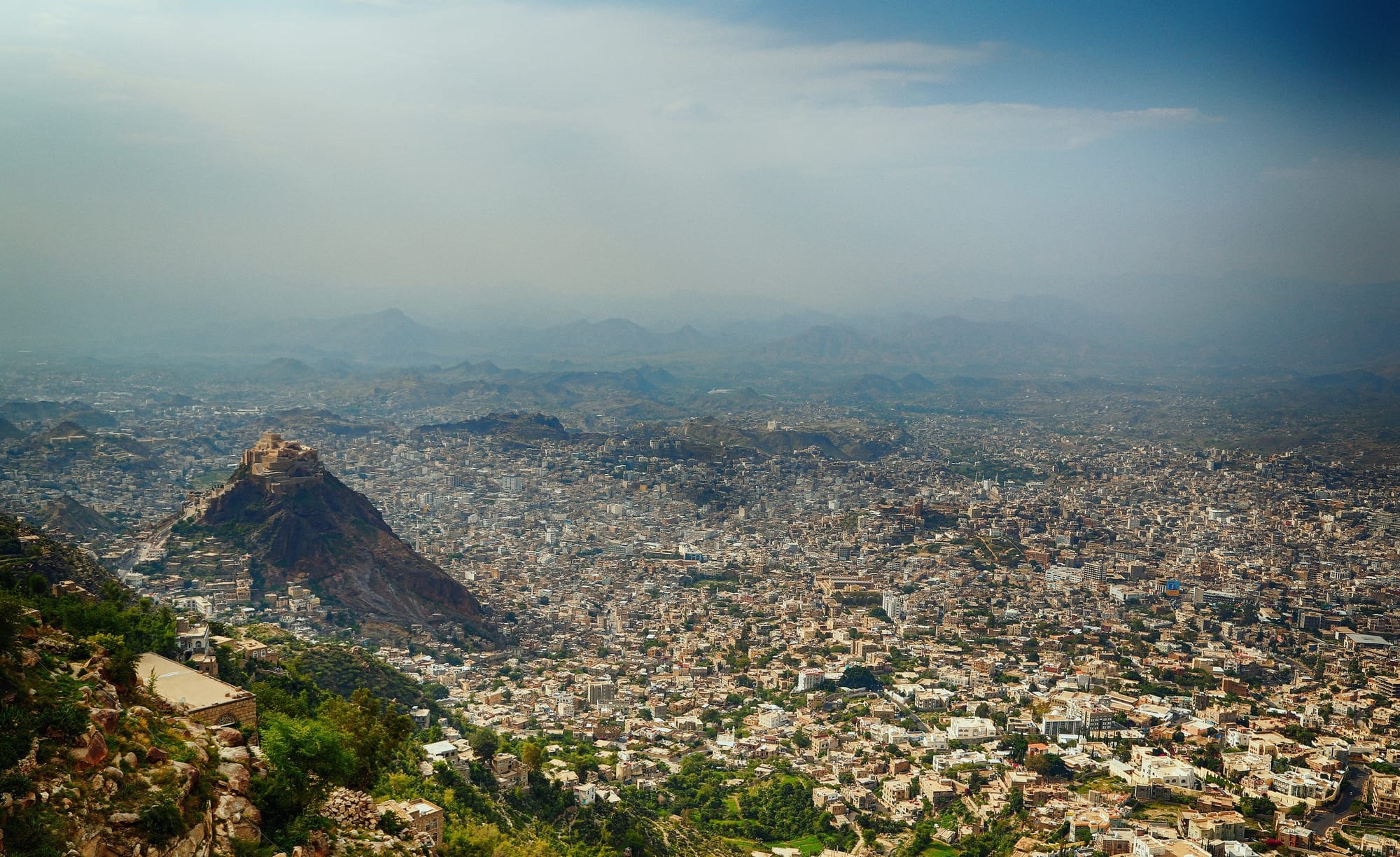
A dense hazy city spreading across a highland basin, with a fortress on a steep rocky crag rising from the middle of it

Taiz & the West Coast, Yemen

Taiz

Taiz seen from the slopes of Jabal Sabir, with the fortress of al-Qahira on its crag above the city. (المصور أنس الحاج / Wikimedia Commons · CC BY-SA 2.0)

A city of the south-western Yemeni highlands, built at about 1,400 metres on the slopes below Jabal Sabir, with the fortress of al-Qahira on a crag above it and Rasulid mosques and madrasas in the walled old town. Long regarded as Yemen's cultural and industrial capital, it has been divided by front lines since 2015. This page is written to explain the city, not to encourage travel.

Neighbourhoods

  • The old walled city
    • Historic district
    • Architecture

    The medieval core below the castle rock, entered through the gates of Bab Musa and Bab al-Kabir, holding the Rasulid mosques and madrasas, covered markets and lanes of tall stone and brick houses. Much of it has been damaged during the war.

    Open in Maps
  • Below Cairo Castle
    • Views
    • Historic district

    The steep ground on the southern edge of the city, where houses climb towards the fortress of al-Qahira and the old water cisterns and walls run up the rock. The views over the basin from here are the ones that define the city.

    Open in Maps
  • The modern centre
    • Offices and shops
    • Markets

    The commercial streets north of the old city, with banks, ministries' branch offices, hotels, the main markets and the bus stands. This is where most business and administration is done, and where traffic concentrates.

    Open in Maps
  • The slopes of Jabal Sabir
    • Quiet and residential
    • Scenery

    Villages and terraced farmland climbing the mountain directly above the city, cooler and greener than the streets below, long known for their markets run largely by women and for the qat and produce grown on the terraces.

    Open in Maps
  • The western and northern districts
    • Local life

    The newer quarters spreading along the roads towards Sana'a and Hudaydah, built up over recent decades with flats, workshops, the university and industrial plots; the front lines of the war have run through parts of this area.

    Open in Maps

Things to do

Landmarks of the old city

  • Cairo Castlelandmark

    The fortress of al-Qahira on a rock spur above the southern edge of the city, whose walls, cisterns and towers date in part to the 12th century and which was damaged by air strikes in 2015.

    Open in Maps
  • Al-Ashrafiya Mosquelandmark

    A Rasulid mosque and madrasa completed in the late 14th century, with a pair of white minarets and painted domes, among the finest medieval buildings in Yemen; one minaret was damaged by shelling in 2015.

    Open in Maps
  • Al-Mudhaffar Mosquelandmark

    A 13th-century mosque and madrasa named for the Rasulid sultan al-Muzaffar Yusuf, one of the largest in the old city and attached to the oldest working bath house in Yemen.

    Open in Maps
  • The old city gates and marketslandmark

    Bab Musa and Bab al-Kabir, the surviving gates of the walled town, open onto the market lanes where cloth, spices, silver and qat have been traded for centuries.

    Open in Maps

Mountains and views

  • Jabal Sabirviewpoint

    The mountain rising to about 3,000 metres directly above the city, its slopes terraced and dotted with villages, with long views over the highlands and towards the Tihama plain.

    Open in Maps

Short trips from the city

  • Al-Janad Mosquelandmark

    The oldest surviving mosque in Yemen, about 20 kilometres north-east of Taiz, founded by Mu'adh ibn Jabal, the companion sent to Yemen in the Prophet's lifetime.

    Open in Maps
  • Ibbneighborhood

    A highland city north of Taiz in some of the wettest, greenest country in Yemen, known for its stone-built old town and terraced valleys.

    Open in Maps
  • Jiblaneighborhood

    A small hill town near Ibb that was the Sulayhid capital, where Queen Arwa ruled for decades and where the mosque named after her still stands.

    Open in Maps
  • Mochaneighborhood

    The Red Sea harbour town that gave its name to mocha coffee, the chief outlet for the trade from the 16th century to the 19th, on the coast west of Taiz.

    Open in Maps

Arriving and leaving

  • Taiz International Airporttransit hub

    The city's airport on the plain to the south, without scheduled services since airlines suspended their routes in 2015.

    Open in Maps

Eat and drink

Long-standing places and food districts in Taiz. Hours, ratings and directions come from your maps app, always current.

Taiz classics

  • Saltah and fahsa kitchensneighborhood

    Lunch kitchens in the old city and along the central streets serve saltah, a broth of meat and vegetables topped with whipped fenugreek and brought bubbling in a black stone pot, and fahsa, its shredded lamb version.

    Open in Maps
  • Taizi smoked cheesemarket

    The city is known across Yemen for a smoked cheese sold in the markets and eaten with bread and honey or melted into cooked dishes.

    Open in Maps

Markets

  • The old city marketsmarket

    Lanes inside the gates sell grain, spices, dried fish from the coast, sweets, cheese and vegetables brought down from the terraces of Jabal Sabir.

    Open in Maps
  • Qat marketsmarket

    Qat grown in the surrounding countryside is sold daily near the old city gates, and the afternoon trade is one of the busiest parts of the city's economy.

    Open in Maps

Experience Taiz

History

Taiz grew up around the fortress of al-Qahira, which commands the pass between the highlands and the Tihama plain and was commissioned in the first half of the 12th century by a sultan of the Sulayhid dynasty. Its position on the route from the coast to the mountains made it a natural seat of power, and its altitude gave it a climate far kinder than the plain below.

The city's great age came with the Rasulid dynasty, which ruled much of Yemen from the 13th to the 15th century and made Taiz its capital alongside Zabid. The Rasulid sultans were builders and patrons of learning: al-Muzaffar Yusuf and his successors endowed mosques, madrasas, libraries and hospitals, and the Ashrafiya and Mudhaffar mosques, with their domes, minarets and painted interiors, survive from that period. Scholarship in law, medicine, agriculture and astronomy flourished under their court.

Ottoman forces took the region in the 16th century, and Taiz later passed to the Zaydi imams of the highlands. In 1948 Imam Ahmad moved his court here, and for fourteen years the city served as the effective capital of the kingdom, gaining roads, schools and the beginnings of industry before the revolution of 1962 shifted power back to Sana'a. Under the republic it became Yemen's main manufacturing and commercial centre and a byword for education.

Mass protests in Taiz were central to the uprising of 2011. Houthi forces entered the city in March 2015, and it has since been the scene of a long siege, with front lines running through and around it: water and power supplies have been cut for long periods, residential districts shelled, and much of the historic fabric, including parts of the castle and the old city, damaged.

Culture & Customs

Taiz has long been called the cultural capital of Yemen. It produced a disproportionate share of the country's writers, poets, singers, journalists and teachers, and its schools and, later, its university drew students from across the south and west. That reputation rests partly on trade and travel: the city has looked to Aden, the Red Sea and East Africa as much as to the highlands, and Taizi families have emigrated widely, sending back money and ideas.

Socially the city is Shafi'i Sunni, and its manners are those of the settled, mercantile south-west rather than the tribal north: descent matters less than schooling and business, and the jambiya dagger is worn less often than in Sana'a. Women have historically had a more visible public role here, running the mountain markets of Jabal Sabir and working as teachers and nurses, and Taizi women were prominent in the protests of 2011.

Daily sociability turns on the afternoon qat session, held in a top-floor room or on the terraces, where politics, poetry and business are discussed for hours. Music and song are strong local traditions, and weddings fill several days with processions, drumming and dance. Both Eids are the year's great gatherings. Years of siege have also produced their own culture of endurance, with volunteer groups, theatre, art and music used to keep ordinary life going in a divided city.

Daily Life

Before the war Taiz was among the largest cities in Yemen, with several hundred thousand residents and a metropolitan population larger still. Its economy rested on manufacturing — food processing, plastics, textiles and one of the country's best-known industrial groups — along with trade, transport between the coast and the highlands, and a concentration of schools, colleges and the university.

War has shaped daily life here more than almost anywhere in the country. Residents have lived for years with front lines through their city, blocked roads, long detours to reach relatives on the other side, shelling and sniper fire, and acute shortages of water, which is bought by the jerrycan or tanker in a city that was always short of it. Power comes from private generators and increasingly from solar panels on the rooftops.

Many factories closed or were damaged, and paid work now comes largely from small trade, transport, aid organisations, remaining workshops and money sent home by relatives abroad. Public salaries have often gone unpaid. Families grow vegetables and qat on the terraces of Jabal Sabir above the city, and its villages still supply the markets below. The day begins early, business pauses in the early afternoon for qat, and evenings are spent at home; schools and clinics work in reduced and improvised form.

Food

Taiz eats the highland food of south-western Yemen, built on bread from the tannur oven and a stew eaten at midday. Saltah is the standard lunch: a broth of meat and vegetables, thickened and crowned with hulba, whipped fenugreek froth, and served still bubbling in a black soapstone pot, scooped up with torn flatbread. Fahsa, its version with shredded lamb, is richer. Lahoh, a spongy fermented pancake, is eaten with stews and with honey.

The city's best-known product is its smoked cheese, made in the surrounding countryside and sold across Yemen, eaten with bread and honey or stirred into hot dishes. The terraces of Jabal Sabir supply vegetables, fruit, coffee and qat to the markets, and dried and salted fish comes up from the Red Sea ports on the plain below.

Sweets are rich with honey and ghee: bint al-sahn, the layered pastry soaked in honey and dusted with black seed, appears at celebrations and for guests. Drinks follow the coffee country around the city — qishr, the amber infusion of coffee husks with ginger and sometimes cinnamon, and sweet milky tea drunk at all hours — while the beans themselves have long been an export, sold as Yemeni Mocha after the harbour to the south-west. Alcohol is absent.

Planning tools

Budget

There is no functioning tourism in Taiz. The city has been besieged and divided for much of the war; hotels serve aid organisations, traders and displaced families, and prices in Yemeni rials swing with fuel shortages and the falling value of the currency.

Daily Budget Midrange
USD not applicable — the only foreigners present are mostly aid and UN staff under security arrangements
Daily Budget Shoestring
USD not applicable — the city is not open to ordinary visitors

Do not plan travel here; the only tourism in Yemen is to Socotra, on operator-run packages.

Best Time to Visit

There is no safe time to visit, and the Red Sea coast to the west has been an active front since September 2026. Before the war, visitors preferred November to February, when highland days are mild and clear and the heat of the Tihama below eases; summer brings afternoon storms to the slopes.

Suggested Number of Days

Length of stay is not a meaningful question here: the city is not open to ordinary visitors, and the foreigners present work under security arrangements that determine how long they stay and where they may go.

First Visit
Not applicable
With Surroundings
Not applicable

Transportation

Movement within Taiz is by shared minibus, shared taxi, motorcycle taxi and private car; there is no rail or metro system. Front lines and closed roads have divided the city for years, so residents make long detours to reach the other side of what is a small city, and fuel shortages repeatedly cut services. The roads to Sana'a, Aden and Hudaydah are interrupted by front lines and checkpoints, and journeys that once took hours have taken far longer on mountain detours.

There is no safe way to travel within this region; do not attempt overland journeys.

Airport & Station Connections

Taiz International Airport lies on the plain south of the city and has had no scheduled services since airlines suspended their routes in 2015. By road, Aden is roughly 250 kilometres to the south-east, Hudaydah about 250 kilometres north-west across the Tihama, and Sana'a some 250 kilometres north through the highlands, but all three routes cross front lines and many checkpoints. There is no ordinary way to arrive.

Walkability

The old city is compact and best seen on foot, with steep lanes rising towards the castle rock, and the central streets are walkable in the mild highland climate. Against that, the city is built on slopes, pavements are broken, traffic is heavy, and front lines, closed streets and the risk of shelling and sniper fire have restricted movement across the city for years. War debris and unexploded ordnance are a hazard.

Safety

Most governments advise against all travel to Yemen, and Taiz has seen some of the heaviest fighting of the war: the city has been divided and besieged for years, with shelling and sniper fire in residential areas and severe shortages of water and fuel. Kidnapping and detention of foreigners are real risks, unexploded ordnance and mines affect parts of the city and its outskirts, and health care is severely degraded. Fighting inside Yemen restarted in July 2026 and grew sharply in September, when an offensive along the Red Sea coast to the west reached the Bab al-Mandab strait and tens of thousands of people were displaced.

Do not travel to this region; there is no consular support and no reliable way out in an emergency. Check current official travel advice before travelling.

Climate

Altitude softens the climate of a city that lies just above one of the hottest coastal plains on earth. At about 1,400 metres Taiz is warm rather than hot, with cool nights, and the slopes of Jabal Sabir above it catch summer rain, turning the terraces green while the Tihama below stays parched. Rain falls mainly in spring and late summer, often as afternoon storms.

Summer
warm, around 30°C by day, with afternoon storms in the rainy weeks and cooler air on the mountain
Winter
pleasant by day, around 25°C, with cool nights

Local Customs

Taiz is a Shafi'i Sunni city with a reputation for education and for being more open than much of the country, but public life remains conservative: women are generally covered, and modest dress with covered shoulders, arms and legs is expected of everyone. Greetings are long and formal, the right hand is used for eating and giving, and shoes come off on entering a home. Afternoons are given to qat, chewed in company, and an invitation to a session is a mark of welcome. Photographing people, especially women, requires permission, and military positions, checkpoints and armed men should never be photographed.

Alcohol is illegal and effectively absent. During Ramadan, eating, drinking and smoking in public during daylight are avoided, and working hours shorten.

Common Payment Methods

The currency is the Yemeni rial, whose value has fallen sharply and which has circulated at different rates in different parts of the country during the war. Business is conducted in cash: card payment is not available in ordinary shops and international cards generally do not work. Money transfer offices handle the remittances that a great many households depend on.