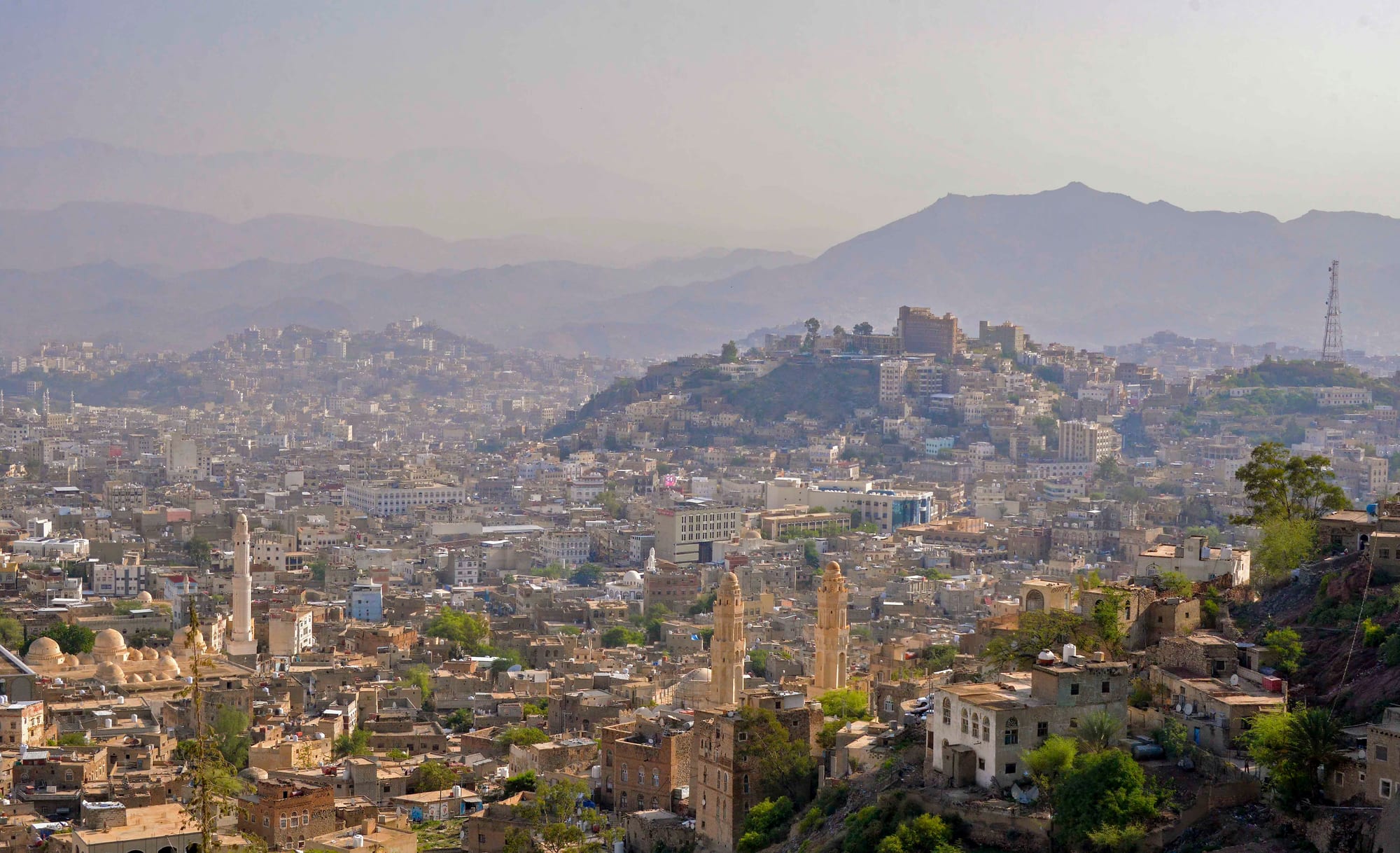
Hazy view over the low buildings of Taiz with twin white minarets in the foreground and mountains behind

Yemen

Taiz & the West Coast

The old city of Taiz spread across the foothills of the south-western Yemeni highlands. (Rod Waddington / Wikimedia Commons · CC BY-SA 2.0)

Yemen's south-western corner, joining the hot Tihama plain along the Red Sea — with the port of Hudaydah, the old scholars' town of Zabid and the coffee harbour of Mocha — to the mountain city of Taiz, long the country's cultural capital and one of the war's most contested cities. This page is written to explain the region, not to encourage travel.

Explore Taiz & the West Coast

History

The Tihama coast has always looked across the Red Sea as much as up to the mountains, trading with the Horn of Africa and the Hejaz. In 819 the Abbasid governor Muhammad ibn Ziyad founded Zabid, and the town became capital of the Ziyadid dynasty and, for centuries after, a centre of Sunni scholarship whose mosques and colleges drew students from across the Muslim world.

The Rasulid dynasty, which ruled much of Yemen from the 13th to the 15th century, made Taiz and Zabid its capitals, building the mosques and madrasas that still define the old city of Taiz. The Ottomans took the coast in the 16th century, and from the 17th century Mocha became the world's great coffee port, shipping beans from the highlands and, through Dutch, English and French traders, to Europe; Hudaydah rose in the 19th century as Ottoman rule returned and Mocha declined. Imam Ahmad moved his court to Taiz in 1948, and it became a second capital of the kingdom until the 1962 revolution.

In the current war Houthi forces entered Taiz in March 2015, and the city has since been the scene of a long siege, with front lines running through and around it; Hudaydah and the northern Tihama have stayed under Houthi control, while forces aligned with the government took parts of the southern coast, including Mocha, in 2017–18. A UN-brokered agreement in late 2018 halted the battle for Hudaydah.

Culture & Customs

The region is predominantly Shafi'i Sunni. Taiz was long known as the "cultural capital of Yemen". Qat grown in the surrounding countryside is sold in the Bab al-Kabir and Bab Musa markets.

The Tihama has a culture of its own, shaped by the heat and by centuries of exchange with Africa across the water; its very name is taken to mean severe heat and lack of wind. Straw huts and brick houses line the plain. Weekly markets move from town to town, as in Bayt al-Faqih, whose Friday market once handled much of the highland coffee trade. Weaving and jewellery-making are now the main trades of Bayt al-Faqih.

The muhamashin, or akhdam, a marginalised community often described as being of African descent, have faced long discrimination in the region's towns. They are Arabic-speaking Muslims like most other Yemenis, but are socially segregated and largely confined to menial jobs.

Daily Life

Taiz and Hudaydah each held several hundred thousand people before the war and were among the largest cities in the country; Zabid, Bayt al-Faqih, Bajil, Mocha and Al Turbah are the other main towns. Taiz's economy was built on trade, industry and education, while the Tihama lives from farming, fishing and the port.

The plain is farmed for grain and fruit, and fishermen work the Red Sea from small boats. Hudaydah's port matters to the whole of the north, which makes its fate a matter of national food supply.

War has shaped daily life here more than almost anywhere. Residents of Taiz have lived for years with blocked roads, water shortages, snipers and long detours around front lines to reach the other half of the city. On the Tihama, heat and power cuts make summers dangerous, and families rely on aid, fishing, small farms and money sent from relatives abroad.

Food

The coast eats from the sea. Fresh fish from Hudaydah and Mocha is grilled as samak mofa and eaten with flatbread.

Bread is baked in the tannur, the round clay oven found in many Yemeni kitchens. Taiz is famous for its smoked cheese, and in Taiz the highland dishes of saltah and fahsa are everyday lunch, with lahoh, a spongy fermented pancake, and bint al-sahn, the honey-soaked layered pastry, as treats.

Coffee is the region's historic product: Mocha gave its name to the beans that left its harbour, and the coffee grown on the western highland terraces is still sold as Yemeni Mocha, though little now leaves from the town itself. Qishr, the spiced coffee-husk drink, is drunk across the region, along with sweet milky tea, while Taiz is also known for its qat markets.

Attractions & Natural Wonders

Taiz sits at the foot of Jabal Sabir, one of Yemen's highest mountains, rising to about 3,000 metres directly above the city. Cairo Castle, al-Qahira, looms over the city from the south and has been fought over in the current war. Below it, the old walled city keeps the Rasulid al-Ashrafiya Mosque, with its twin minarets and painted interior, and the Bab Musa and Bab al-Kabir gates.

Down on the Tihama, Zabid is the region's other great monument: a walled town of brick houses, the Great Mosque and the al-Asha'ir mosque, both long centres of Islamic learning, and the remains of its old university. It was listed as a UNESCO World Heritage Site in 1993 and placed on the list in danger in 2000 because of decay and unplanned building.

The Red Sea port of Hudaydah was developed as a seaport by the Ottomans in the mid-19th century. Bayt al-Faqih's market lies inland, and Kamaran, the largest Yemeni island in the Red Sea, lies offshore. Mocha keeps the mosque of its patron saint, Ali bin Omar al-Shadhili. Inland from the plain, east of Bajil, the western slopes of Jabal Bura' are covered in dense tropical vegetation.

Cities in Taiz & the West Coast

Planning basics

Budget

There is no functioning tourism in this region. Taiz has been besieged and divided for much of the war, Hudaydah has been a front-line port, and prices in YER swing with fuel shortages and the falling value of the rial.

Daily Budget Midrange
Not applicable — the only foreigners present are mostly aid and UN staff under security arrangements
Daily Budget Shoestring
Not applicable — the region is not open to ordinary visitors

Do not plan travel here; the only tourism in Yemen is to Socotra, on operator-run packages.

Safety

Most governments advise against all travel to Yemen, and this region has seen some of the heaviest fighting. Taiz has been divided and besieged for years, with shelling and sniper fire in residential areas. Hudaydah and the Red Sea shore have been hit by air strikes, and Houthi attacks on shipping from 2023 to 2025 turned the nearby sea lanes into a war zone. Kidnapping and detention of foreigners are real risks.

Do not travel to this region; there is no consular support and no reliable way out in an emergency. Check current official travel advice before travelling.

Climate

Two climates share the region. The Tihama coast around Hudaydah, Zabid and Mocha is one of the hottest places in Arabia, with little rain and dusty summer winds. Taiz, at about 1,400 metres in the foothills, is milder and greener, and the slopes of Jabal Sabir catch summer rain.

Summer
on the coast, humid and above 40°C; in Taiz, warm, around 30°C, with afternoon storms
Winter
on the coast, warm, around 30°C; in Taiz, pleasant days and cool nights

Transportation

Hudaydah's port handles much of the food, fuel and aid entering northern Yemen, and its airport has been hit by air strikes. The roads from Taiz and Hudaydah to Sana'a and Aden are interrupted by front lines and checkpoints, and journeys that once took hours have taken far longer on detours through the mountains.

There is no safe way to travel within this region; do not attempt overland journeys.

Best Time to Visit

There is no safe time to visit. Before the war, visitors preferred November to February, when the Tihama's heat eases and the Friday markets of the plain were at their busiest.