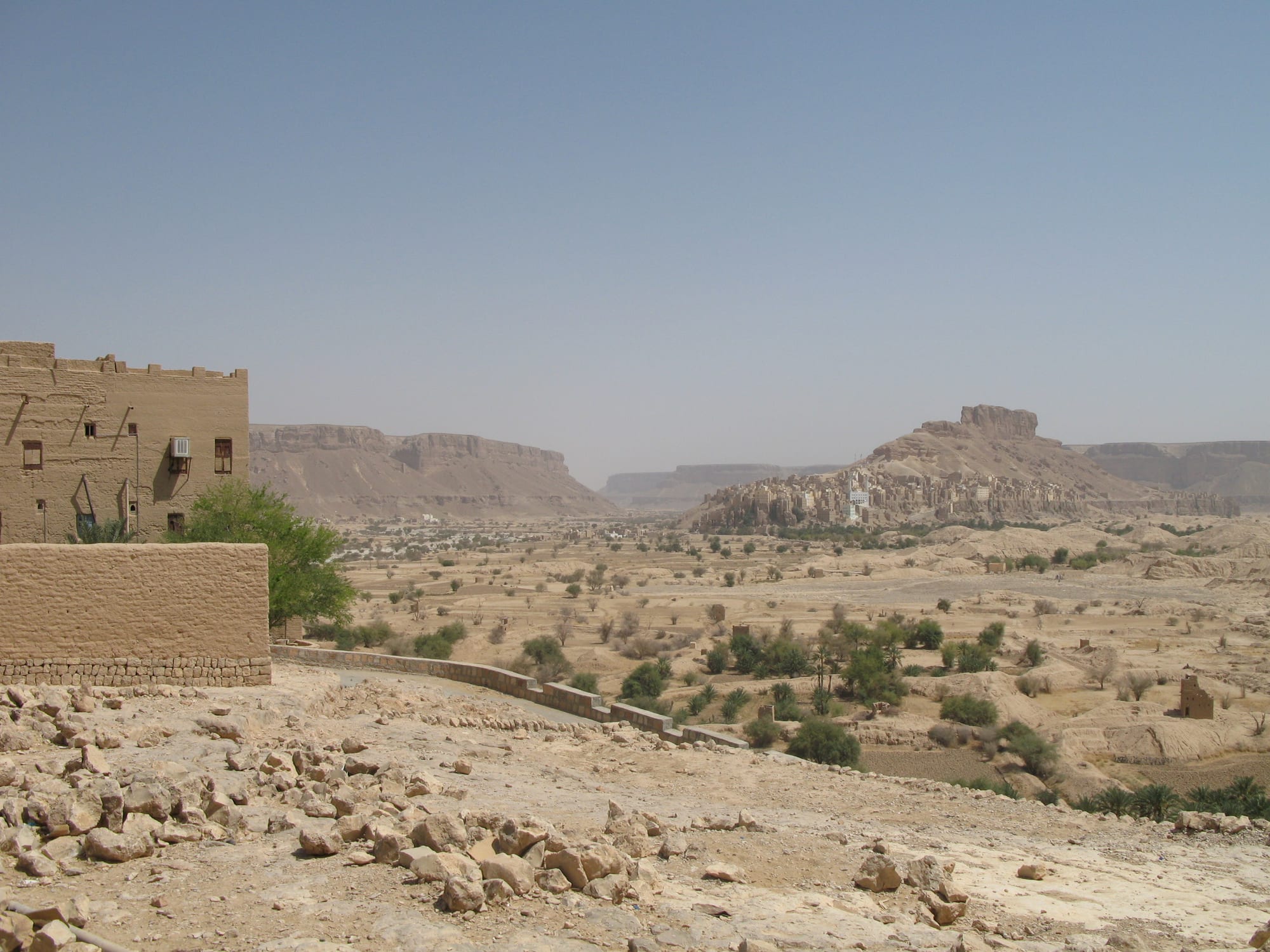
A wide dry valley dotted with green trees and palms, flat-topped cliffs behind, and a mud-brick village climbing a rocky hill on the right

Yemen

Hadramawt, Socotra & the East

Wadi Doan in Hadramawt, with the hilltop mud-brick village of Hajjarin across the valley floor. (Ljuba brank / Wikimedia Commons · CC BY-SA 4.0)

The vast, thinly peopled eastern half of Yemen — the Hadramawt valley with its mud-brick towns of Shibam, Seiyun and Tarim, the port of Mukalla, the deserts of Shabwah, the Mahra coast towards Oman and the island of Socotra, the one corner of the country that still receives a trickle of visitors. This page is written to explain the region, not to encourage travel.

Explore Hadramawt, Socotra & the East

History

The east was the land of the incense trade. The kingdom of Hadramawt, with its capital at Shabwa on the edge of the desert, controlled much of the frankincense harvest and taxed the caravans heading north, while its port of Qana, at today's Bir Ali on the Shabwah coast, shipped goods from India and Africa. The kingdom was conquered by Himyar late in the 3rd century AD.

Islam came early, and the Hadramawt valley became a stronghold of Sunni scholarship. From Tarim, the Ba 'Alawi sayyids — families claiming descent from the Prophet — built a Sufi tradition that emigrants carried across the Indian Ocean. Over the centuries, hardship drove Hadramis abroad in great numbers, to Hyderabad, East Africa, Singapore and the Dutch East Indies, and fortunes made in British India and South-East Asia paid for many of the mansions of Tarim.

In the 19th and 20th centuries two dynasties divided the region: the Qu'aiti sultans ruled from Mukalla and the coast, and the Kathiri sultans from Seiyun, both under British protection, while the Mahra sultanate governed the far east and Socotra from Qishn and the island. All were swept away in 1967, and the region became part of South Yemen. In the current war, the east has been held by government-aligned and southern separatist forces rather than the Houthis; al-Qaeda seized Mukalla in 2015 before being driven out in 2016. The UAE-backed Southern Transitional Council, which seeks southern independence, took over Socotra in 2020 and swept through Hadramawt and Al Mahrah in December 2025, before Saudi-backed government forces retook the mainland east in January 2026.

Culture & Customs

Hadramis have a strong identity of their own, shaped by the valley's scholars, its merchant families and a diaspora spread from Jakarta to Jeddah. Jeddah's money changers have historically been Hadramis, and the valley's towns carry traces of South-East Asia in their houses and food. Tarim is a centre of religious learning to which students still come from abroad, and visits to saints' tombs, such as that of the prophet Hud in the valley, remain part of local practice.

The Mahra in the far east speak Mehri, one of the Modern South Arabian languages spoken in southern Arabia before Arabic spread with Islam, and keep close ties with Dhofar across the Omani border. On Socotra, people speak Soqotri, a largely oral sister language with its own tradition of poetry and song. Herding, fishing and date farming shaped both communities, and their customs of hospitality and tribal mediation are strong.

Mud-brick building is the region's great craft: builders still work with sun-dried bricks and lime plaster, and Shibam's towers must be routinely re-coated with fresh mud to survive rain and erosion. Music and dance accompany weddings, and the coast keeps its own seafaring traditions.

Daily Life

Hadramawt is Yemen's largest governorate by area, yet the east as a whole is sparsely populated. Mukalla, with several hundred thousand people, is the main city; other towns include Seiyun, Tarim, Shibam and the coastal town of Ash Shihr; Ataq is the capital of Shabwah, Al Ghaydah of Al Mahrah and Hadibu of Socotra, whose population numbers in the tens of thousands.

Oil fields inland and the liquefied natural gas plant at Balhaf on the Shabwah coast, opened in the 2000s, made the east important to the national economy. Most people live from date palms, farming in the wadis, fishing, trade, camel and goat herding, and money sent from relatives in Saudi Arabia and the Gulf.

The east has been calmer than the west and north, but it shares the country's crisis: high prices, electricity shortages in Mukalla's humid summers, unpaid or eroded salaries. On Socotra, life follows the monsoon, which closes the sea and much of the tourist trade from June to September.

Food

Mandi is a favourite feast dish here: lamb or chicken slow-cooked over rice in a sealed pit or tannur oven, the fat and smoke seeping into the grains, and served on a shared platter. Hadramis also cook haneeth, lamb slow-roasted in a tannur and served on rice. Rice dishes show the pull of the diaspora, with spices and habits brought home from India and Java.

Honey is Hadramawt's prestige product. Wadi Doan is known for its honey, and Yemeni honey is prized as a delicacy and a status symbol. Dates from the valley's palm groves are eaten with coffee, and black tea is the everyday drink.

On the coast, Mukalla and Ash Shihr eat fresh and dried fish, and the Mahra coast lives on fish and on camel's and goat's milk. Socotri food is simple: goat, fish, rice, dates and milk.

Attractions & Natural Wonders

Wadi Hadhramaut is lined with the eastern region's great sights. Shibam's mud skyscrapers — some 500 tower-houses, some over 30 metres high, packed inside a wall on a mound above the wadi — earned it the name Manhattan of the desert and a place on the UNESCO World Heritage list. Seiyun, up the valley, is dominated by the Kathiri Sultan's Palace, part of it now a museum, and Tarim keeps dozens of mosques, the soaring minaret of the al-Muhdhar mosque and mansions built in styles from British India and South-East Asia. Side valleys such as Wadi Doan hold villages built into the foot of the cliffs.

On the coast, Mukalla's white harbour town faces the Arabian Sea beneath bare mountains, and Ash Shihr lies to the east. The ruins of Shabwa sit in the desert interior, and at Bir Ali the hill of Husn al-Ghurab marks ancient Qana. Further east, the Mahra coast runs past Al Ghaydah and Nishtun to the forested hills near Hawf, green in the monsoon season.

Socotra, a UNESCO World Heritage Site, is the region's natural wonder. The dragon's-blood trees and other endemic plants, the limestone plateaus of Diksam and Homhil, the Haggeher mountains, white coastal dunes, the Detwah lagoon near Qalansiyah and the Hoq cave make it one of the most unusual islands on Earth.

Cities in Hadramawt, Socotra & the East

Planning basics

Budget

The mainland east has no tourism economy, and prices in YER have climbed with the currency's collapse. Socotra is the exception: visits are sold as all-inclusive operator packages with flights, permits, 4x4s, guides and camping, priced in US dollars and far from cheap.

Daily Budget Midrange
Socotra: roughly USD 150–300+/day for an operator package including flights
Daily Budget Shoestring
Mainland: not applicable. Socotra: no true shoestring option — packages start around USD 150/day all-in

Do not plan mainland travel; for Socotra, book only with an established operator and bring all the US dollar cash needed, as cards and cash machines cannot be relied on.

Safety

Most governments advise against all travel to Yemen, including this region. The mainland east has seen al-Qaeda in the Arabian Peninsula control Mukalla in 2015–16, armed groups remain active, and kidnapping of foreigners is a serious risk. Control has shifted repeatedly: southern separatist forces seized Hadramawt and Al Mahrah in December 2025, and Saudi-backed government forces retook them in January 2026. Socotra, taken over by the separatist Southern Transitional Council in 2020, saw its ports closed and hundreds of tourists stranded under a state of emergency in early 2026; it has no consular support, very basic medical care and evacuation only by charter.

Do not travel to the mainland; if visiting Socotra, go only with a reputable operator and carry evacuation insurance, cash and all medicines needed. Check current official travel advice before travelling.

Climate

The Hadramawt valley and the Shabwah desert are extremely hot and dry in summer, with cooler winter nights. Mukalla and the coast are hot and humid. The far east of Mahra near Hawf catches the summer monsoon mists that also water Oman's Dhofar. Socotra is hot and dry at sea level, cooler on the Haggeher mountains, and battered by strong monsoon winds from about June to September.

Summer
in the valley and desert, above 40°C; humid on the coast; Socotra very windy with rough seas
Winter
warm days, 25–30°C, with cool nights in the Hadramawt valley; pleasant on Socotra

Transportation

Mukalla and Seiyun have airports with limited, irregular flights, and long desert roads link the east to Aden, Marib and the Omani border, crossing areas where armed groups operate. Socotra has had weekly scheduled flights from Cairo and Abu Dhabi, often cancelled in the monsoon, and in early 2026 a state of emergency closed its ports; on the island, travel is by 4x4 with a local driver on rough tracks, and camping is the norm.

There is no safe way to travel the mainland east; on Socotra, rely entirely on the operator's arrangements, vehicles and guides.

Best Time to Visit

The mainland is not a travel prospect at any time of year. For Socotra, October to April is the season, outside the summer monsoon, with calmer seas and the landscape greener after the rains.