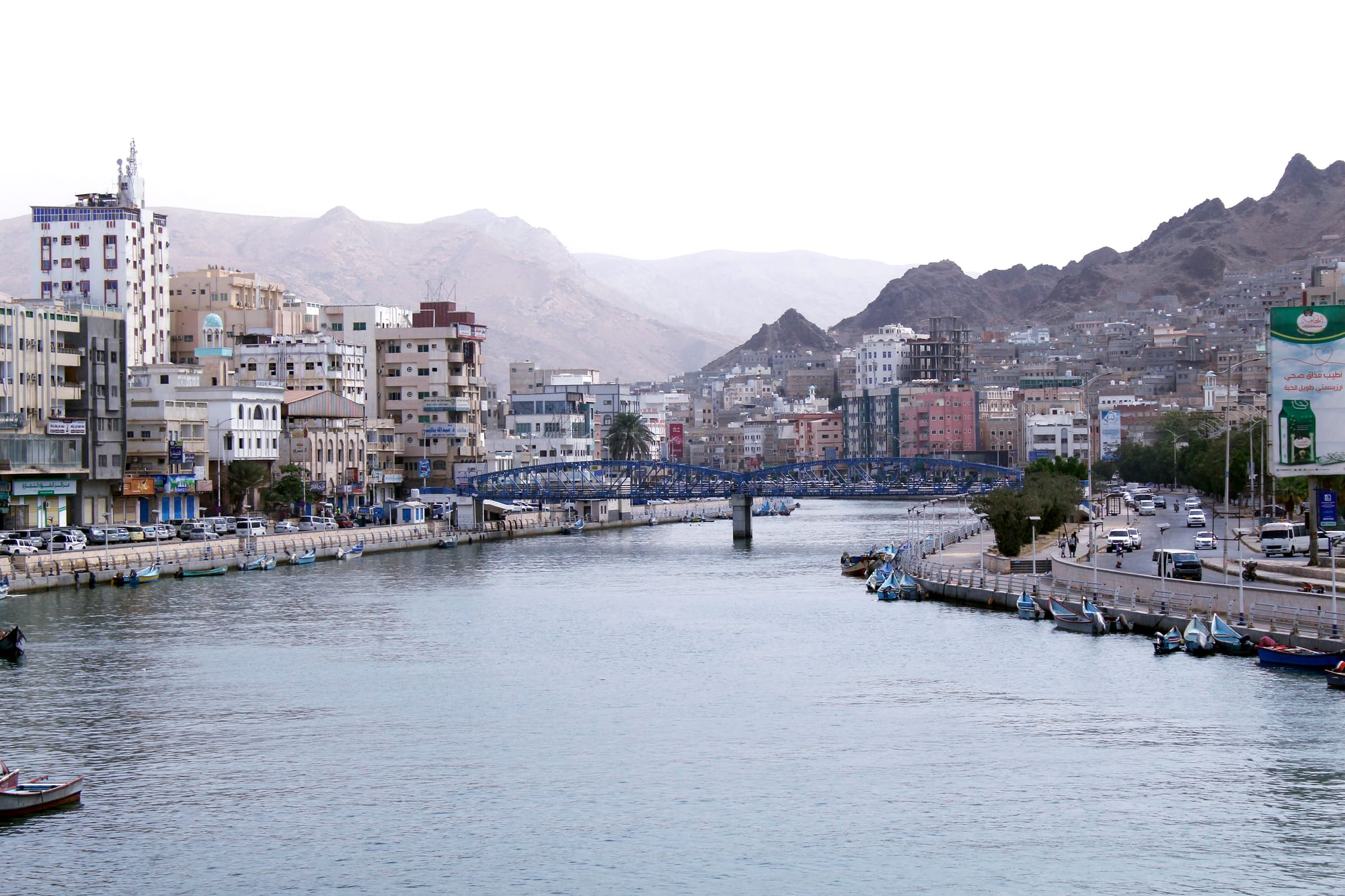
A wide tidal creek lined with white and pastel buildings and moored fishing boats, crossed by a blue steel bridge, with bare brown mountains rising behind

Hadramawt, Socotra & the East, Yemen

Mukalla

The tidal creek at Mukalla, with fishing boats along the quays and the bare Hadhramaut mountains behind the city. (Mohammed Omar Al-Aidaroos / Wikimedia Commons · CC BY-SA 4.0)

The main port of eastern Yemen and the capital of Hadhramaut Governorate, squeezed along a narrow shelf between steep bare mountains and the Arabian Sea. A fishing settlement that grew into the seat of the Qu'aiti sultans and the outlet for the whole Hadhramaut valley, it is a city of white houses, a tidal creek and a long corniche. This page is written to explain the city, not to encourage travel.

Neighbourhoods

  • The old town
    • Historic district
    • First-time visitors
    • Architecture

    The original settlement on the shore below the cliffs, a tight grid of white and pastel merchants' houses with carved wooden windows and balconies, the older mosques and the sultan's palace. It is the most walkable part of the city and the part that gives Mukalla its look.

    Open in Maps
  • The corniche and the creek
    • Waterfront
    • Evenings
    • Local life

    The seafront road and the tidal creek that cuts into the city, lined with quays, moored fishing boats and a bridge. Families walk here in the evening once the heat drops, and much of the city's trade in fish happens along the water.

    Open in Maps
  • Khalf
    • Close to the port
    • Trade

    The quarter towards the commercial port, east along the shore road beneath the cliffs, with warehouses, workshops and the traffic that serves the harbour. The road between it and the old town runs on a narrow shelf between the rock and the sea.

    Open in Maps
  • The inland districts
    • Quiet and residential
    • Markets

    Newer housing spread up the wadis and onto the plateau behind the city, where most of Mukalla's growth has gone since the old town filled. Offices, schools, markets and the university buildings are here, along wide, dusty roads.

    Open in Maps

Things to do

Museums and landmarks

  • Qu'aiti Sultan Palacemuseum

    The palace built in 1925 for the Qu'aiti sultans on the seafront, their residence until 1967 and now given over to the city museum.

    Open in Maps

Getting around the coast

  • Riyan Airporttransit hub

    The city's airport, on the coastal plain east of Mukalla, which has had limited and irregular flights during the war.

    Open in Maps

Short trips from the city

  • Ash Shihrneighborhood

    An old walled port town east along the coast, for centuries the main harbour of Hadhramaut before Mukalla overtook it, and still a fishing town.

    Open in Maps
  • Ghayl Ba Wazirneighborhood

    An inland town on the plateau north-east of the city, one of the district centres of Hadhramaut behind the coast.

    Open in Maps

Eat and drink

Long-standing places and food districts in Mukalla. Hours, ratings and directions come from your maps app, always current.

Mukalla classics

  • Fish grills on the seafrontrestaurant

    Kingfish, tuna and reef fish landed at the creek are grilled over charcoal or baked against the wall of a clay tannur oven and eaten with flatbread and sahawiq.

    Open in Maps
  • Mandi and haneeth kitchensrestaurant

    Hadhramaut's meat-and-rice dishes, cooked in sunken clay ovens, are the food for guests and celebrations and are served on shared platters.

    Open in Maps

Markets

  • The fish market and the quaysmarket

    The day's catch is sold beside the water, along with dried and salted fish, which has been traded along this coast for centuries.

    Open in Maps
  • The old town marketsneighborhood

    Streets of small shops selling dates, honey from the inland valleys, spices, cloth and household goods, in the quarter below the cliffs.

    Open in Maps

Experience Mukalla

History

Mukalla began as a fishing settlement on a narrow shelf of land where the mountains of the Hadhramaut plateau come almost to the sea, with a tidal creek behind it giving shelter to boats. Tradition dates the founding to the eleventh century, and for a long time it was overshadowed by Ash Shihr along the coast, the older and more important harbour of the region. The Arabian Sea trade in frankincense, dried fish, dates and, later, coffee and cloth passed up and down this shore, linking Hadhramaut with India, East Africa and the Gulf.

In the nineteenth century the Qu'aiti family, Hadramis who had made fortunes in the service of the Nizam of Hyderabad in India, took control of the coast and made Mukalla the capital of their sultanate. From the 1880s the Qu'aiti sultans ruled as a state in treaty relations with Britain, part of the Aden Protectorate, while the Kathiri sultans held the inland valley from Seiyun. Indian money and Indian Ocean taste show in the palace on the seafront and in the merchants' houses of the old town, and the port became the outlet for the whole Hadhramaut valley.

The sultanate was abolished in 1967, when the region became part of the People's Democratic Republic of Yemen, and Mukalla continued as the administrative centre of Hadhramaut after unification in 1990. It has grown quickly since, spreading along the coast and up the wadis. In the present war, al-Qaeda in the Arabian Peninsula seized the city in 2015 and was driven out in 2016; the eastern governorates have changed hands more than once since, and the city has lived through blockade, damage and economic collapse. In December 2025 two vessels docked at the port were hit in an airstrike.

Culture & Customs

Mukalla is a Hadrami city, and Hadrami identity is bound up with emigration. Families here have relatives in Saudi Arabia, the Gulf, Indonesia, Malaysia, Singapore and East Africa, and the movement of people and money in both directions has shaped the city for centuries. Returning merchants built the seafront houses, imported furniture and habits, and gave the local Arabic its loanwords; Hadrami communities abroad, in turn, carried the region's religious scholarship and its architecture across the Indian Ocean.

Religious life follows the Shafi'i school of Sunni Islam, and the Sufi tradition of the inland valley, centred on the schools of Tarim, is respected here too. Visits to saints' tombs, the chanting of religious poetry and the observance of the Prophet's birthday are part of the calendar. Weddings are large and public affairs with drumming, dancing and sung verse, and the coast keeps its own seafaring songs, sung to the rhythm of work on boats.

Everyday manners are those of Yemen as a whole: long greetings, coffee or tea pressed on any visitor, careful respect for age, and a sharp separation between men's and women's social spaces. Afternoons belong to qat sessions, which do the work of meetings and cafés alike. The city has a university and a professional class of teachers, doctors and civil servants, and pride in Hadramaut's distinct history sits alongside a wariness born of the past decade.

Daily Life

Around 595,000 people live in Mukalla, which makes it the sixth-largest city in Yemen and by far the largest in the east and the place where the region's administration, hospitals, university and trade are concentrated. The site allows very little room: the city runs in a long ribbon between the cliffs and the sea, and new building has had to climb the wadis behind or spread east along the coastal plain towards the airport.

Work is the port, fishing, government, trade and services, with oil and gas from the interior passing through the governorate and providing employment for some. Fishing is the visible daily activity — boats going out from the creek and the catch sold beside the water — and dried and salted fish is still traded inland. Money sent home from relatives in Saudi Arabia and the Gulf supports many households, and the war has added displaced families from other governorates to the city's population.

The crisis of the wider country shapes daily life: the rial's collapse has made imported food and fuel expensive, public salaries have lost much of their value, and power cuts in the humid summer heat are a recurring grievance and a recurring cause of protest. Water supply and sanitation are strained, and Cyclone Chapala destroyed much of the waterfront in 2015. The rhythm is early mornings, a quiet afternoon indoors, and a long evening when the corniche fills with families and the shops reopen.

Food

Mukalla eats from the sea. Kingfish, tuna, snapper and sardines come in at the creek, and fish is grilled over charcoal, fried, or slapped against the hot wall of a clay tannur oven and served with flatbread and sahawiq, the green sauce of coriander, chilli, garlic and tomato. Fish is also salted and sun-dried on this coast, a trade older than the city, and dried fish is sold inland to the valley towns. Lobster and squid are landed seasonally and go mostly for export.

The meat dishes are those of Hadhramaut. Mandi is meat, usually goat or chicken, cooked in a sealed pit oven above rice that takes up the fat and smoke; haneeth is lamb rubbed with spice and roasted in the same kind of oven until it falls apart. Both are eaten from a shared platter with the right hand, and both are the food of weddings and of guests. Everyday meals lean on rice, lentils, beans, eggs and vegetables, with bread from a tannur at almost every one.

Dates from the valley's palm groves and honey from the side wadis, especially the sidr honey of Wadi Dawan, are the prestige local products, sold in the markets and given as gifts. Tea is drunk black and very sweet through the day, often spiced with cardamom, and qishr, an infusion of dried coffee husks, is the other common hot drink. Sweets include bint al-sahn, a layered bread eaten with honey and clarified butter, and halwa sold in slabs.

Planning tools

Budget

There is no visitor economy in Mukalla. The hotels that operate serve officials, aid workers, traders and Yemeni travellers, and prices in rials have climbed steeply with the currency's collapse. Imported food, fuel for generators during power cuts, and the security arrangements any foreign movement requires are what drive costs.

Daily Budget Midrange
USD not applicable — foreign visitors are mostly aid, diplomatic and business staff travelling with security
Daily Budget Shoestring
USD not applicable — the mainland east is not open to ordinary visitors

Do not plan mainland travel; the only tourism in Yemen is to Socotra, on operator-run packages.

Best Time to Visit

The mainland is not a travel prospect at any time of year. On weather alone, the coast is most bearable from November to February, when the humidity eases; the summer months are hot, sticky and windy as the monsoon blows along the Arabian Sea.

Suggested Number of Days

The old town and the seafront are compact enough for a day or two, with another couple needed for the coast and the plateau behind. In practice the length of any stay is set by work and security rather than by sightseeing.

First Visit
1–2 days
With Surroundings
3–4 days

Transportation

The city is strung along the shore, so a single coastal road carries most traffic, with newer districts climbing the wadis behind. Shared taxis and minibuses do the work of public transport; there is no rail. Long desert roads run north to the Hadhramaut valley and west towards Aden, crossing areas where armed groups operate, and fuel shortages affect services.

There is no safe way to travel the mainland east; on Socotra, rely entirely on the operator's arrangements, vehicles and guides.

Airport & Station Connections

Riyan Airport, on the coastal plain roughly 30 kilometres east, is the city's air link and has had limited and irregular flights; air travel across the region has also been disrupted by the war that began in February 2026. Overland, roads lead north to Seiyun and the Hadhramaut valley, several hours across the plateau, and west along the coast towards Aden. The port handles cargo rather than passengers.

Walkability

The old town and the corniche are flat, compact and pleasant to walk in the cooler hours, and the whole waterfront can be covered on foot. Beyond that the city stretches for kilometres along the shore and up the wadis, pavements give out, and the heat and humidity make walking uncomfortable for much of the year.

Safety

Most governments advise against all travel to Yemen, including this coast. Armed groups remain active in the region, al-Qaeda held the city in 2015–16 before being driven out, and kidnapping of foreigners is a serious risk. Control of the eastern governorates has changed hands more than once during the war, roads are controlled by checkpoints, medical care is basic, and there is no consular presence.

Do not travel to the mainland; if visiting Socotra, go only with a reputable operator and carry evacuation insurance, cash and all medicines needed. Check current official travel advice before travelling.

Climate

Hot and humid all year, with very little rain, tempered slightly by sea breezes. The mountains behind the city trap the humidity, and summer is windy as the south-west monsoon blows along the Arabian Sea. Tropical storms occasionally reach this coast and bring flash floods down the wadis.

Summer
hot and very humid, often 33–38°C with warm nights and strong onshore winds
Winter
warm and more comfortable, about 25–30°C by day

Local Customs

Hadramis are Sunni Muslims of the Shafi'i school, and the city is conservative in dress and manners, though its long seafaring links made it used to outsiders. Men wear the wrapped futah or a long shirt, and most women cover in public. Hospitality is pressed on guests, greetings are long, and afternoons are given largely to qat, with business done in the morning and after sunset.

Dress modestly, ask before photographing people, and never photograph the port, airport, checkpoints or anyone in uniform. Alcohol is not available, and eating or drinking in the street during daylight in Ramadan gives offence.

Common Payment Methods

The currency is the Yemeni rial, whose value has fallen steeply, so prices change quickly and payments involve thick bundles of notes. Cash is used for everything; card acceptance and working cash machines cannot be relied on. US dollars hold their value and are changed through money changers in the markets.