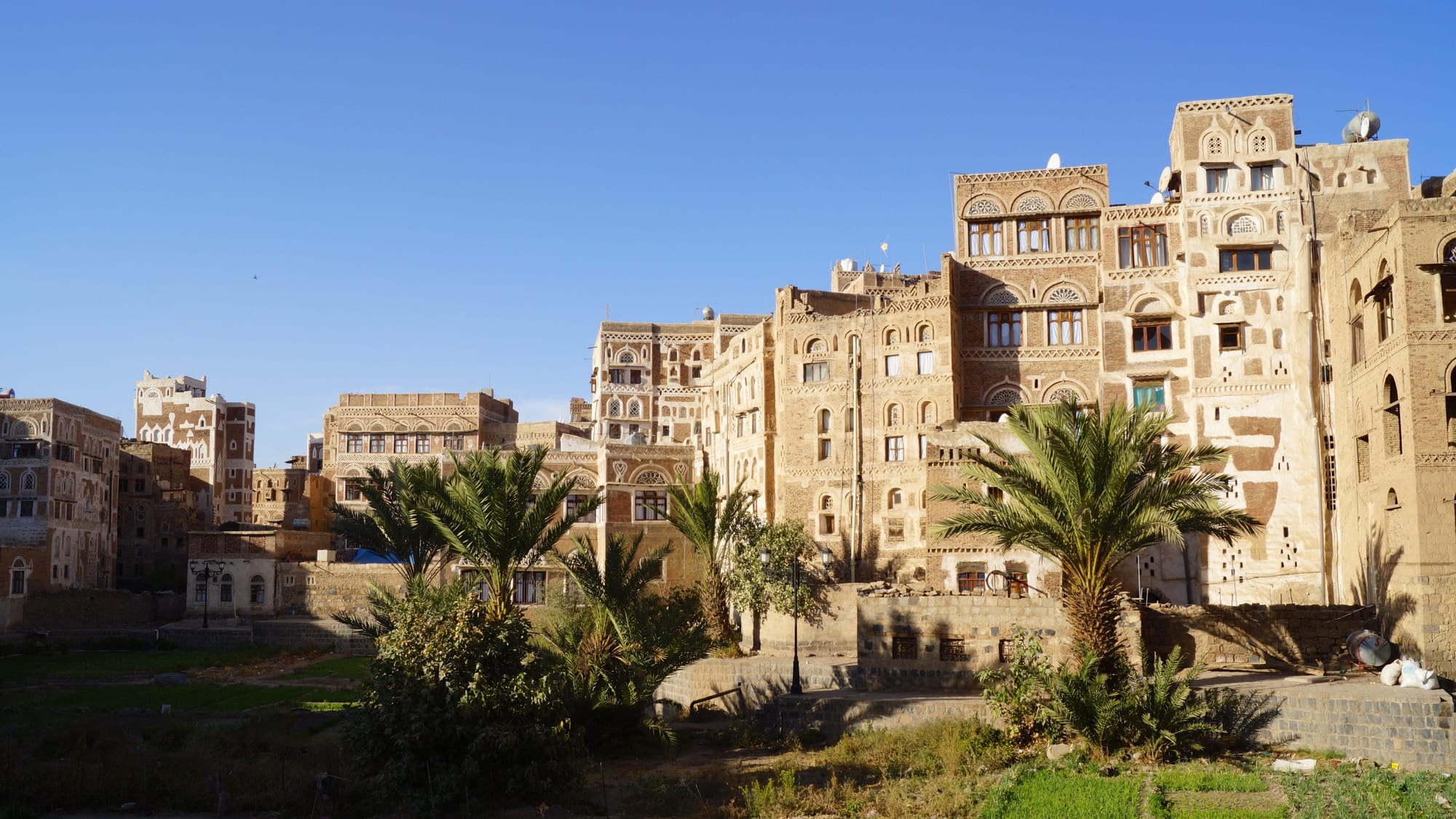
Tall brick tower-houses with white-outlined windows rising above palm trees and a walled garden in the old city of Sanaa

Sana'a & the Northern Highlands, Yemen

Sanaa

Tower-houses overlooking one of the walled market gardens of the old city of Sanaa. (Julian-G. Albert / Wikimedia Commons · CC BY 2.0)

Yemen's capital, set in a high basin at about 2,300 metres in the northern mountains and among the oldest continuously inhabited cities in the world. Its walled old city of decorated brick tower-houses, mosques and covered markets has been a UNESCO World Heritage Site since 1986. Years of war have damaged the city and swelled it with displaced families. This page is written to explain the city, not to encourage travel.

Neighbourhoods

  • The Old City
    • Historic district
    • Architecture
    • Markets

    The walled heart of Sanaa, a dense grid of lanes between several thousand tower-houses of brown brick and stone picked out in white gypsum, with more than a hundred mosques, bath houses and the covered markets around Suq al-Milh. Walled market gardens, the bustans, survive between the blocks.

    Open in Maps
  • Bir al-Azab
    • Historic district
    • Gardens

    The quarter laid out west of the old city in the Ottoman and imamic periods, once the district of officials and foreign missions, with lower garden villas rather than tower-houses. Much of it has been rebuilt, but stretches of old wall, orchards and mansions remain.

    Open in Maps
  • Al-Qa'
    • Historic district
    • Local life

    The quarter beyond Bir al-Azab, where Jews returning from exile were settled outside the walls in 1680 and which remained the Jewish quarter of Sanaa until the community emigrated around 1950. Its houses are lower and plainer than the tower-houses, and its streets are busy with small workshops and shops.

    Open in Maps
  • Tahrir and the central streets
    • Close to public transport
    • Offices and shops

    The modern centre west of the old city, around Tahrir Square, with ministries, banks, hotels and the main shopping streets. It is the busiest part of the city for traffic and where most administrative business is done.

    Open in Maps
  • Hadda
    • Quiet and residential
    • Embassies

    A newer district spreading south of the centre, with wide roads, villas, walled compounds, embassies and international organisations. It grew quickly in the decades before the war and is the least traditional part of the city.

    Open in Maps
  • Shu'ub and the northern quarters
    • Local life
    • Markets

    Old settlements just outside the north wall of the old city that have merged into it, keeping their own mosques, springs and markets, and giving the city one of its historic gates at Bab Shu'ub.

    Open in Maps

Things to do

The old city

  • Old City of Sana'aneighborhood

    The walled medieval city of tower-houses, minarets, markets and gardens that was inscribed as a UNESCO World Heritage Site in 1986 and placed on the list of World Heritage in Danger in 2015.

    Open in Maps
  • Great Mosque of Sana'alandmark

    One of the oldest mosques in the Islamic world, traditionally founded in the lifetime of the Prophet Muhammad and enlarged in the 8th century, where a celebrated cache of early Qur'anic manuscripts was found in the 1970s.

    Open in Maps
  • Bab al-Yemenlandmark

    The southern gate of the old city, the best known of its surviving gates and the main entrance to the market quarter.

    Open in Maps
  • Souq Al-Milhmarket

    The old city's market district, a warren of specialised lanes for salt, spices, silver, raisins, copper, pottery and qat, whose name means the salt market.

    Open in Maps
  • Al-Bakiriyya Mosquelandmark

    An Ottoman mosque of the late 16th century in the old city, domed in the Istanbul manner and quite unlike the flat-roofed Yemeni mosques around it.

    Open in Maps

Mosques and museums

  • Al Saleh Mosquelandmark

    The largest mosque in Sanaa, completed in 2008 in the south of the city, with six minarets and a stone-clad prayer hall.

    Open in Maps
  • National Museum of Yemenmuseum

    The country's principal museum, housed in a former royal palace near Tahrir Square, with South Arabian inscriptions, alabaster sculpture and ethnographic collections; it was closed from 2011 until 2023 and was damaged in air strikes in 2025.

    Open in Maps
  • Ghumdan Palacelandmark

    The site of the legendary many-storeyed palace of pre-Islamic Sanaa, described by early Arab writers as a wonder of Arabia and long since reduced to its foundations near the Great Mosque.

    Open in Maps

The modern city

  • Sana'a Universityattraction

    Yemen's first university, founded in 1970, whose campus in the west of the city has long set the tone of student life in the capital.

    Open in Maps
  • Sana'a International Airporttransit hub

    The capital's airport, north of the centre, which has handled only limited and irregular services during the war and was hit by air strikes in July 2026.

    Open in Maps

Short trips from the city

  • Dar al-Hajarlandmark

    The rock palace of Wadi Dhahr, a multi-storey house built on top of a stone pinnacle in an orchard valley about 15 kilometres from the city and enlarged as a summer residence for Imam Yahya.

    Open in Maps
  • Jabal an-Nabi Shu'aybviewpoint

    The highest mountain in the Arabian Peninsula at 3,666 metres, rising west of the Sanaa basin above terraced farmland.

    Open in Maps
  • Kawkabanlandmark

    A fortified village on a cliff-top plateau about 38 kilometres west-north-west of Sanaa, reached from the market town of Shibam below it.

    Open in Maps
  • Thulalandmark

    A walled stone-built town in Amran Governorate beneath a hilltop fort, among the best preserved historic towns of the northern highlands.

    Open in Maps

Eat and drink

Long-standing places and food districts in Sanaa. Hours, ratings and directions come from your maps app, always current.

Sanaa classics

  • Saltah houses of the old cityneighborhood

    Plain lunch kitchens around the markets serve saltah, a meat and vegetable broth topped with a whipped fenugreek froth called hulba and brought bubbling in a black stone pot, eaten with torn flatbread.

    Open in Maps
  • Bread from the tannurneighborhood

    Bakeries across the city slap dough onto the walls of a tannur, a round clay oven, producing malooj, khubz and the flat rounds that accompany every meal.

    Open in Maps

Markets

  • Souq Al-Milhmarket

    The old city's market quarter, where lanes are given over to spices, raisins, coffee husks, silver, copperware, pottery and qat, and where much of the capital still shops.

    Open in Maps
  • Qat marketsmarket

    Open-air markets sell bundles of the leaf that is chewed through the afternoon across the city; qat trading is one of the busiest parts of the daily economy.

    Open in Maps

Experience Sanaa

History

Sanaa is among the oldest continuously inhabited cities on earth, and local tradition credits its founding to Shem, son of Noah. It appears in South Arabian inscriptions as a fortified settlement of the Sabaean and later Himyarite period, dominated by the towered palace of Ghumdan, whose height and lantern-lit upper storey became a wonder in early Arabic writing. In the 6th century the Aksumite-backed ruler Abraha is said to have built a great church here, al-Qalis, in tradition intended to draw pilgrims away from Mecca. Islam reached the city in the Prophet's lifetime, and the Great Mosque, one of the oldest in the Muslim world, was founded then and enlarged in the 8th century.

For the next thousand years Sanaa passed between highland dynasties, Zaydi imams and outside powers. The Ottomans took it in the 16th century and again in 1872, building barracks, the Bakiriyya mosque and a new administrative quarter, before Imam Yahya made it the capital of an independent kingdom after the First World War. The old city's tower-houses, bath houses, caravanserais and markets took their present form over these centuries.

The revolution of 1962 made Sanaa capital of the Yemen Arab Republic, and after unification in 1990 the capital of Yemen. The city expanded far beyond its walls as villages were swallowed by new districts. UNESCO listed the old city in 1986 and added it to the list of World Heritage in Danger in 2015. The Houthi movement took the city in 2014–15, and it has since been struck repeatedly from the air; floods in 2020 damaged historic houses, and the resumption of fighting in July 2026 included strikes on the airport.

Culture & Customs

Sanaa has an urban culture distinct from the tribal countryside around it. The Song of Sanaa, a tradition of sung poetry accompanied by the lute and a copper tray struck as a drum, is recognised by UNESCO as intangible cultural heritage and was long performed at weddings and in the evening gatherings of the old city. Its poetry, the humayni, mixes classical Arabic with the spoken highland dialect.

Domestic life is organised around the tower-house. Families occupy several floors, with storerooms at the bottom and, at the top, the mafraj, a long room lined with cushions and lit by qamariya windows of stained glass set in gypsum tracery, where men gather through the afternoon to chew qat and talk. Women hold their own gatherings, the tafrita. The afternoon chew structures the working day, and much business, mediation and gossip happens there.

Craft traditions are strong: silverwork, once largely in the hands of the city's Jewish community before its emigration around 1950, the making of jambiya daggers with hilts and belts that signal status, gypsum window tracery, stone-cutting and the weaving of belts and shawls. Zaydi Shia and Shafi'i Sunni Yemenis have long prayed in the same mosques. Both Eids are the year's great gatherings, and weddings run for days with processions, drumming and dancing with the jambiya held aloft.

Daily Life

Sanaa is by far the largest city in Yemen, with a population put at about 3.3 million in recent estimates, swollen by people displaced from other parts of the country and difficult to count because no full census has been possible for many years. Neighbourhoods of concrete flats and walled villas spread across the basin, while the old city remains densely inhabited rather than preserved as a museum.

Water is the defining problem. The Sanaa basin's aquifer is being drawn down several metres a year, largely to irrigate qat, and many households buy water by tanker. Power cuts are routine and solar panels have appeared on rooftops across the city. Public-sector salaries have often gone unpaid, prices for fuel and flour swing with the war, and families rely on aid, remittances from relatives abroad and small trade.

The day starts early, with bread and sweet tea and the markets open soon after dawn; offices, schools and shops work through the morning, and by the early afternoon much of the city moves to the qat markets and then to private gatherings that last until evening. Friday is the day of rest and of the main congregational prayers. Universities, hospitals and ministries continue to function in reduced form, and the city has absorbed large numbers of displaced families into rented rooms and unfinished buildings.

Food

Sanaa's defining dish is saltah, eaten at midday: a broth of meat and vegetables, often built on a spiced stew called maraq, served bubbling in a black soapstone pot called a madhra and crowned with hulba, fenugreek seed soaked and whipped into a pale froth. Fahsa is its lamb version, richer and stringier with shredded meat. Both are eaten with the hands, using torn pieces of malooj, a leavened flatbread baked against the wall of a clay tannur oven.

Around them sits a wider highland table: shafut, flatbread soaked in spiced buttermilk or yoghurt with herbs and eaten cold as a starter; aseed, a stiff wheat dough served in a pool of broth or with honey and butter; bean dishes and grilled meats; and rice with lamb or chicken for celebrations. The great sweet is bint al-sahn, the "daughter of the plate", a pile of thin buttered pastry layers baked and poured with honey and black seed, brought out for guests and for Eid.

Drinks follow the coffee terraces of the highlands, though much of the bean crop is exported: the everyday cup is qishr, an amber infusion of coffee husks with ginger and sometimes cinnamon, while sweet tea, often with milk and cardamom, is drunk at all hours. The old city markets sell raisins, dates, almonds, honey from the eastern valleys, and the spice blend hawaij and the herb sauce zhug, which give Yemeni cooking its character. Alcohol is effectively absent.

Planning tools

Budget

There is no functioning tourism economy in Sanaa. Hotels that once served visitors have largely closed or now house aid workers, officials and journalists, and prices in Yemeni rials swing with the war, fuel shortages and the falling value of the currency. The few foreigners present travel on organised security arrangements whose costs bear no relation to ordinary travel budgets.

Daily Budget Midrange
USD not applicable — the only foreigners present are mostly aid, diplomatic and media staff on organised security arrangements
Daily Budget Shoestring
USD not applicable — the city is not open to ordinary visitors

Do not plan travel here; the only travel to Yemen that functions as tourism is to Socotra, on operator-run packages.

Best Time to Visit

There is no safe time to visit, and the war widened again in 2026. In the years before the war, visitors favoured October to March for clear, dry skies over the highlands, avoiding the short rains that fall in spring and late summer. Winter nights in the basin drop close to freezing.

Suggested Number of Days

Length of stay is not a meaningful question here: the city is not open to ordinary visitors, and the foreigners who are present are working to security arrangements that set how long they remain and where they go.

First Visit
Not applicable
With Surroundings
Not applicable

Transportation

Sanaa has no rail or metro system; movement within the city is by shared minibus, shared taxi and private car, and the old city is closed to most vehicles, so it is crossed on foot. Fuel shortages during the war have repeatedly cut transport and raised fares. Roads link the capital to Ibb, Dhamar, Sa'dah, Hajjah and Marib, but routes cross checkpoints run by different armed authorities and, towards Marib and Al Jawf, active or recent front lines; many mountain roads are narrow, unguarded and damaged.

There is no safe way to travel within this region; do not attempt overland journeys.

Airport & Station Connections

Sana'a International Airport, some 14 kilometres north of the centre, has handled only limited, irregular flights during the war and was hit by air strikes in July 2026. The overland approaches from Aden, the Red Sea coast and the eastern desert cross front lines and multiple checkpoints, and journeys that once took a few hours have taken far longer on detours through the mountains. There is no ordinary way to arrive.

Walkability

The old city is one of the great walking environments of Arabia — a dense grid of lanes, markets and small squares, largely free of cars, all of it on flat ground at high altitude, where newcomers tire quickly until they acclimatise. Beyond the walls the modern city is built for traffic, with wide roads, long blocks and uneven pavements. War damage, checkpoints and closed streets affect movement across the city.

Safety

Most governments advise against all travel to Yemen, and the capital has been at the centre of the war. The city has been hit by air strikes, including strikes on the airport in July 2026, and fighting resumed across the country in July 2026 after roughly four years of relative calm under a UN-brokered truce. Risks to foreigners include arbitrary detention and kidnapping; unexploded ordnance and landmines affect areas around the capital; health care is severely degraded; and water, power and fuel supplies are unreliable. Saudi air strikes in Yemen and Houthi missile and drone attacks on Saudi Arabia increased in September 2026.

Do not travel to this region; there is no consular support and no reliable way to leave in an emergency. Check current official travel advice before travelling.

Climate

Altitude, not latitude, sets the weather. At about 2,300 metres Sanaa has warm, dry, sunny days and cool nights throughout the year, with frost on some winter nights and thin, dry air. Rain comes in two short seasons, in spring and again in late summer, when storms can flood the streets and, as in August 2020, damage the mud-brick and stone houses of the old city.

Summer
warm rather than hot, generally 25–30°C by day, with afternoon storms in the rainy weeks
Winter
dry and sunny, around 20°C by day, with nights near freezing

Local Customs

Sanaa is conservative and devout. Women in public are generally covered, and modest dress with long sleeves and long trousers or skirts is expected of everyone; many men wear the jambiya, a curved dagger, in a decorated belt. Greetings are long and formal, the right hand is used for eating and giving, and shoes are removed on entering a home or mosque, which non-Muslims are often not able to enter. Afternoons belong to qat, chewed in the mafraj, the top-floor room of a tower-house; an invitation to join a session is a mark of welcome. Photographing people, and above all women, requires permission, and military sites, checkpoints and officials should not be photographed at all.

Alcohol is effectively absent and its sale is illegal. During Ramadan, eating, drinking and smoking in public during daylight are avoided, and the working day shortens.

Common Payment Methods

The currency is the Yemeni rial, whose value has fallen sharply and which has circulated at different rates in different parts of the country during the war. The economy is almost entirely cash-based: card payment is not available in ordinary shops, and international cards generally do not work because of sanctions and the state of the banking system. Money transfer offices and exchangers handle remittances, which many households depend on.