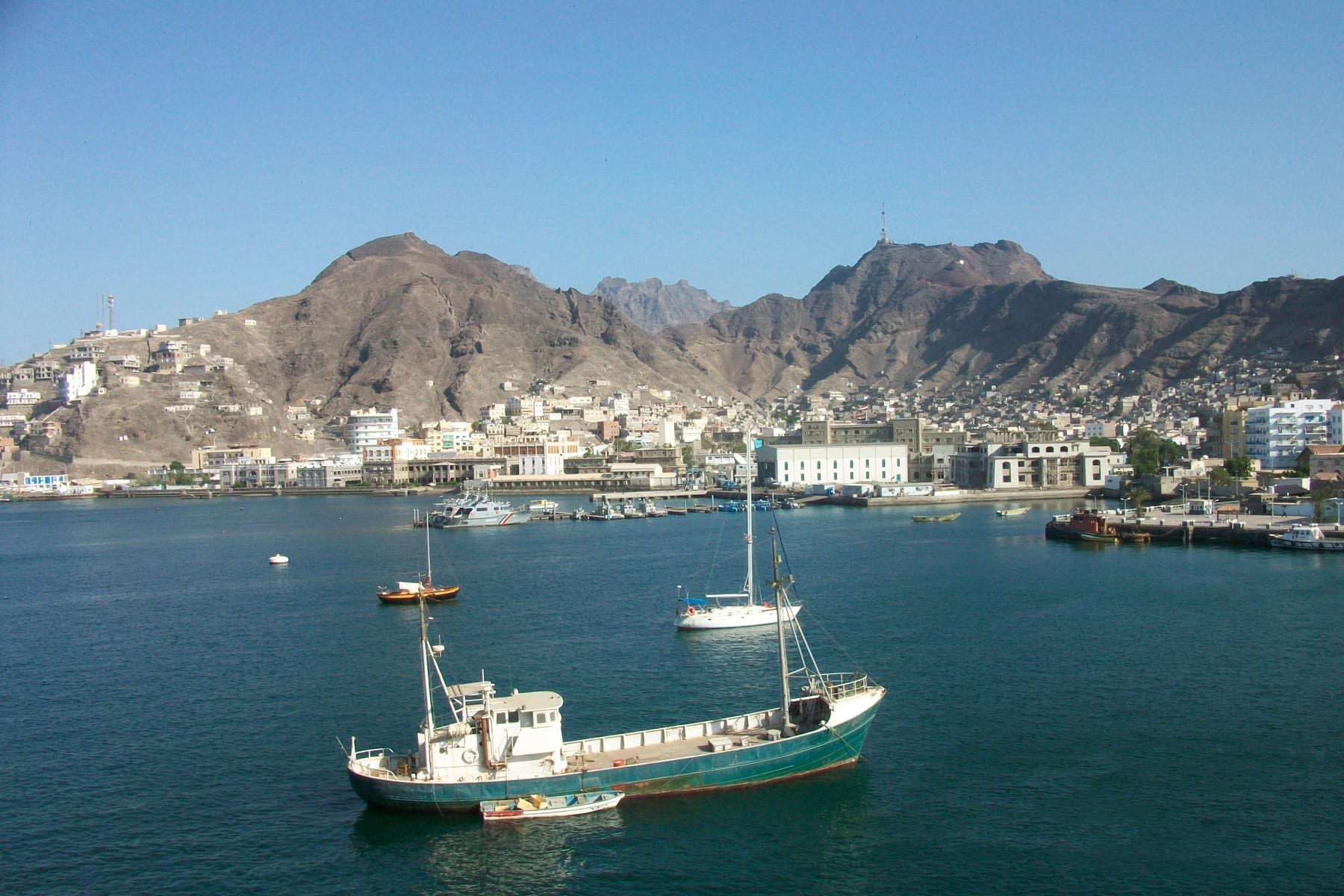
Aden's waterfront of low white and sand-coloured buildings across a calm blue harbour, with fishing boats moored in the foreground and bare brown mountains behind

Aden & the South, Yemen

Aden

Aden's inner harbour, with the city built along the shore beneath the bare ridges of the volcanic peninsula. (T3n60 / Wikimedia Commons · CC BY-SA 3.0)

Yemen's great southern port, built in and around the crater of an extinct volcano on the Gulf of Aden, with a vast natural harbour. A coaling station on the route to India under British rule and later the capital of South Yemen, it is a spread-out city of ridges, bays and salt flats. This page is written to explain the city, not to encourage travel.

Neighbourhoods

  • Crater
    • Historic district
    • First-time visitors
    • Markets

    The old town, laid out on the floor of an extinct volcano and ringed by jagged black ridges, with a single main road cutting through the rim. Its grid of older houses, mosques and markets holds the Cisterns of Tawila and the city museum, and the old harbour lies below at Sira.

    Open in Maps
  • Tawahi
    • Historic district
    • Harbour views

    The colonial-era port quarter on the western side of the peninsula, known in British days as Steamer Point, where liners landed passengers. Stone arcades, the old landing pier and a small clock tower survive along the waterfront, below the slopes of Jabal Shamsan.

    Open in Maps
  • Ma'alla
    • Close to the port
    • Local life

    A long strip of apartment blocks between the ridge and the inner harbour, built largely in the colonial and socialist decades to house port workers. Its straight main avenue runs beside the container berths and is one of the busiest streets in the city.

    Open in Maps
  • Khormaksar
    • Close to the airport
    • Beaches

    The flat isthmus joining the volcanic peninsula to the mainland, holding the airport, the university and long open beaches on either side. Much of it was built as a British military station, and wide roads and low modern buildings give it a different feel from Crater.

    Open in Maps
  • Sheikh Othman
    • Markets
    • Quiet and residential

    A mainland district north of the isthmus, grown up around old wells and gardens that once watered the peninsula. It is densely populated, with large street markets and much of the city's everyday trade.

    Open in Maps
  • Al Mansoura
    • Quiet and residential
    • Local life

    A planned mainland district of housing blocks and wide streets laid out in the twentieth century, now one of the larger residential parts of Aden and home to hospitals, schools and markets.

    Open in Maps
  • Little Aden
    • Quiet and residential
    • Industry and coast

    The second volcanic peninsula across the bay, built up around the oil refinery opened in the 1950s and its company township. Beaches and rocky coves line its outer shore, and the drive round the bay gives long views back to the main city.

    Open in Maps

Things to do

Famous landmarks

  • Cisterns of Tawilalandmark

    A stepped chain of stone-lined tanks cut into a ravine above Crater to catch rare floodwater, of uncertain ancient date and cleared and restored under British rule in the nineteenth century.

    Open in Maps
  • Sira Fortresslandmark

    A fortress on a rocky volcanic islet above Aden's old harbour, first built in the medieval period and long the key to the town's defence.

    Open in Maps
  • Aden International Airporttransit hub

    The city's airport on the Khormaksar isthmus, built on a former Royal Air Force station and the main air link to the south.

    Open in Maps
  • Port of Adentransit hub

    Yemen's largest port, on the deep natural harbour that made the city, sheltered by the volcanic mass of Jabal Shamsan and still handling cargo and fishing fleets.

    Open in Maps

The harbour, ridges and coast

  • Ma'allaneighborhood

    The harbour-side avenue of apartment blocks running beside the container berths, one of the busiest streets in the city.

    Open in Maps
  • Sheikh Othmanneighborhood

    The mainland district grown up around old wells and gardens that once supplied the peninsula with water, now a dense quarter of street markets.

    Open in Maps
  • Craterneighborhood

    The old town on the volcano floor, whose enclosing ridges and single road through the rim make it one of the more unusual town sites anywhere.

    Open in Maps
  • Tawahineighborhood

    The old Steamer Point waterfront, with colonial arcades and the landing pier where passengers from ocean liners once came ashore.

    Open in Maps
  • Little Adenneighborhood

    The refinery peninsula on the far side of the bay, with rocky coves, beaches and views back across the water to Jabal Shamsan.

    Open in Maps
  • Khormaksarneighborhood

    The low isthmus between two seas, with long sandy beaches, the airport and the university spread across it.

    Open in Maps

Short trips from the city

  • Lahejneighborhood

    The old seat of the Abdali sultans, about 30 kilometres inland, known for its gardens and farmland and for the Lahij song tradition.

    Open in Maps
  • Zinjibarneighborhood

    The capital of Abyan governorate, east along the coast beyond the Abyan delta, at the edge of a farming plain watered by seasonal floods.

    Open in Maps

Eat and drink

Long-standing places and food districts in Aden. Hours, ratings and directions come from your maps app, always current.

Aden classics

  • Zurbian and mandi housesrestaurant

    Aden's best-known dish is zurbian, spiced rice baked with lamb or chicken, potatoes and saffron; the same kitchens usually serve mandi, meat slow-cooked over rice in a sealed oven.

    Open in Maps
  • Adeni tea housescafe

    Shai adani is black tea brewed with milk and cardamom and served very sweet, poured all day in small cafés across the city and drunk most of all in the evening.

    Open in Maps
  • Fish grills and tannur bakeriesrestaurant

    Fish from the Gulf of Aden is grilled, fried or baked in a clay tannur oven and eaten with flatbread and sahawiq, a fresh green sauce of herbs, chilli and garlic.

    Open in Maps

Markets and food districts

  • Crater's marketsneighborhood

    The old town's streets carry the city's oldest trading quarter, with stalls of fish, vegetables, spices, dates and honey.

    Open in Maps
  • Sheikh Othman market streetsneighborhood

    The mainland district's busy street markets supply much of Aden with produce, qat and household goods.

    Open in Maps

Experience Aden

History

Aden's harbour, a deep inlet sheltered by the volcanic mass of Jabal Shamsan, has drawn shipping since antiquity, on the sea route between India, East Africa and Egypt. The Cisterns of Tawila above the old town, cut to catch the rare floods, show how carefully water had to be stored. In the Middle Ages Aden was among the great ports of the Indian Ocean, taxing goods passing between the Red Sea and the east, before declining.

In 1839 the British East India Company took Aden to serve as a coaling station on the route to India, and the Suez Canal, opened in 1869, turned it into one of the world's busiest bunkering ports. It grew into a cosmopolitan place of Arabs, Indians, Somalis, Jews and Europeans, governed from Bombay until 1937 and then as a Crown colony, with a free port, a refinery that began operating at Little Aden in 1954 and treaty states inland.

The armed struggle against British rule began in 1963 and ended with the withdrawal of 1967, after which Aden became capital of the People's Democratic Republic of Yemen, the Arab world's only Marxist state, whose ruling party tore itself apart in a short civil war fought in the city in January 1986. Unification in 1990 moved the capital to Sanaa, and the southern defeat of 1994 left lasting resentment that grew into the Southern Movement. Since 2015 Aden has served as the temporary seat of the internationally recognised government, through years of damage and power cuts. The separatist Southern Transitional Council held the city from 2017 until government forces drove it out in January 2026.

Culture & Customs

Aden has long thought of itself as the least provincial city in Yemen. The port years left a population used to outsiders, and the town once held churches, a Zoroastrian temple, Parsi traders and a Jewish quarter alongside its mosques. Most of those communities have gone, but the traces remain in the colonial arcades of Tawahi, in Indian words in the local dialect and in food that is spiced more heavily than in the highlands.

The socialist decades left their own mark. Under the PDRY, personal law was secularised, women worked in offices and factories in numbers unusual in the region, and the old sultans were swept away. Older Adenis still measure the present against those years. Since the 1990s, and far more since 2015, the southern question has dominated public life, and flags and rallies for southern independence are a recurring sight in the streets.

Everyday manners follow the wider Yemeni pattern: long greetings, careful hospitality, coffee and tea offered at once, and the afternoon qat session as the setting for conversation, business and dispute-settling alike. Music is important — the Adeni song tradition, shaped partly by the neighbouring town of Lahij and its poet-prince Ahmad Fadl al-Qumindan, is known across Yemen, and the oud is the instrument of choice. Football is followed keenly, and the evening corniche walk is the city's shared social habit.

Daily Life

About 1.2 million people live in Aden, spread through districts separated by volcanic ridges, bays and salt flats: Crater, Tawahi and Ma'alla on the peninsula, Khormaksar on the isthmus, and Sheikh Othman, Al Mansoura and Dar Sad on the mainland, with Little Aden across the water. The distances between them shape daily life, and a journey across the city takes far longer than a map suggests.

Work centres on the port, the refinery, government salaries, fishing, small trade and money sent home by relatives working in the Gulf. The collapse of the rial in government-held areas has made imported food and fuel expensive and eroded public-sector pay, and the price of a basic basket of goods changes from month to month. Electricity is the recurring grievance: cuts in the humid summer heat, when temperatures sit near 40°C, have repeatedly brought people onto the streets. Water and sanitation have also suffered, and the city saw serious cholera outbreaks during the war years.

The rhythm of the day works around the heat. Business and markets are busiest in the morning, the afternoon is quiet and given over to qat, and the city comes back to life after sunset, when families walk the seafront and the tea shops fill. The sea itself is part of daily life — fishing boats work out of the old harbour, and the beaches along the isthmus are where Adenis go on a Friday.

Food

Aden's cooking is the most outward-looking in Yemen, layering Indian, Somali and Gulf influences over a Yemeni base. Zurbian is the dish the city is known for: rice baked with lamb or chicken, potatoes, saffron and a heavy hand of spice, sometimes called the Yemeni biryani and cooked above all for weddings and feast days. Alongside it comes mandi, meat slow-cooked over rice in a sealed pit or tannur oven so that the fat and smoke work into the grains, and haneeth, lamb roasted until it falls apart.

Fish is everywhere in a city built round a harbour: kingfish, tuna and smaller reef fish grilled over charcoal, fried, or baked against the wall of a clay oven, and eaten with hot flatbread and sahawiq, the green sauce of coriander, chilli, garlic and tomato that sits on every table. Saltah, the bubbling stew topped with whipped fenugreek called hulba, is eaten here as across the country, though it belongs more to the highlands. Street food runs to mutabbaq, a folded flatbread stuffed with egg, meat or banana and fried on a griddle, and to sambusas at Ramadan.

Drinks are what visitors remember. Shai adani, Aden tea, is black tea boiled with milk and cardamom and sweetened heavily, and it is poured from morning to late evening. Coffee is drunk both as beans and as qishr, an infusion of the dried husks with ginger. Sweets include bint al-sahn, a layered bread eaten with honey and clarified butter, and slabs of halwa scented with rosewater. Yemeni honey, especially the sidr honey of the eastern valleys, is prized far beyond the country.

Planning tools

Budget

There is no visitor economy in Aden. The hotels that operate serve officials, aid workers and business travellers, and costs are shaped by the collapse of the rial in government-held areas, expensive imported food, and the generators, fuel and bottled water that shortages make necessary. Security arrangements, not hotel rates, are the largest expense for the few foreigners who come.

Daily Budget Midrange
USD not applicable — foreign visitors are mostly aid, diplomatic and business staff travelling with security
Daily Budget Shoestring
USD not applicable — the city is not open to ordinary visitors

Do not plan travel here; the only tourism in Yemen is to Socotra, on operator-run packages.

Best Time to Visit

There is no safe time to visit, and the fighting spread again in 2026. In calmer years, November to February brought the most comfortable weather to Aden, when the humidity drops and the sea breeze off the Gulf of Aden is steady.

Suggested Number of Days

The historic core is small enough to take in over two or three days, and four or five would cover the outer districts and the coast either side. In practice length of stay is decided by work and security, not by sightseeing.

First Visit
2–3 days
With Surroundings
4–5 days

Transportation

Aden is spread across ridges, bays and salt flats, and distances between districts are long: Crater, Tawahi, Ma'alla, Khormaksar and the mainland districts are linked by a few main roads that carry all the traffic. Shared minibuses and taxis do most of the moving about, there is no rail or urban rapid transit, and fuel shortages and power cuts affect traffic. Roads north to Lahij and east through Abyan pass checkpoints held by rival forces.

There is no safe way to travel within this region; do not attempt overland journeys.

Airport & Station Connections

Aden International Airport sits on the Khormaksar isthmus, a few kilometres from the city's districts, and has had sporadic commercial flights during the war. The port remains busy with cargo and aid, although shipping through the Gulf of Aden has been disrupted since fighting reached the Bab al-Mandab strait, at its western entrance, in September 2026. Most foreigners who arrive do so on institutional business, with transport arranged for them.

Walkability

Only within a district. Crater's grid and the Tawahi waterfront are flat and compact enough to cross on foot, and Ma'alla's avenue runs straight along the harbour. Between districts the ridges, the airport and the salt flats force long detours, and the heat and humidity make walking uncomfortable for much of the year. Pavements are uneven and street lighting unreliable.

Safety

Most governments advise against all travel to Yemen, and Aden is not a safe exception. The city has seen bombings, assassinations, repeated fighting between government forces and southern separatist forces, and attacks by al-Qaeda. Kidnapping of foreigners is a serious risk, and the wider war came closer in 2026, when fighting resumed in July and a September offensive along the Red Sea coast reached the Bab al-Mandab strait to the west, disrupting shipping into the Gulf of Aden.

Do not travel to this region; consular help is minimal or absent and evacuation cannot be relied on. Check current official travel advice before travelling.

Climate

Hot and humid all year, with very little rain. The volcanic rock holds the heat, the sea keeps night temperatures high, and the sea breeze is the main relief. Rain falls rarely but can arrive as a sudden flood, which is why the Cisterns of Tawila were cut above the old town.

Summer
very humid, with daytime temperatures of about 35–40°C and warm, close nights
Winter
warm and drier-feeling, around 25–30°C by day, with a steadier breeze

Local Customs

Most people in Aden are Sunni Muslims of the Shafi'i school, and dress is conservative by mainland Arabian standards though historically less so than in the northern highlands: men wear the wrapped futah or trousers, and most women cover in public. Afternoons are often given to qat, the leaf chewed in long sessions, and social life picks up in the evening when the heat breaks. Greetings are long and unhurried.

Dress modestly and cover shoulders and knees; ask before photographing people, and never photograph ports, airports, checkpoints or anyone in uniform. Alcohol is not publicly available, and eating or drinking in the street during daylight in Ramadan gives offence.

Common Payment Methods

The currency is the Yemeni rial, whose value in government-held areas has fallen steeply, so prices change quickly and large bundles of notes are normal. Cash is used for almost everything; card acceptance and working cash machines cannot be relied on, and the banking system is fragmented. US dollars are widely valued and changed through money changers.