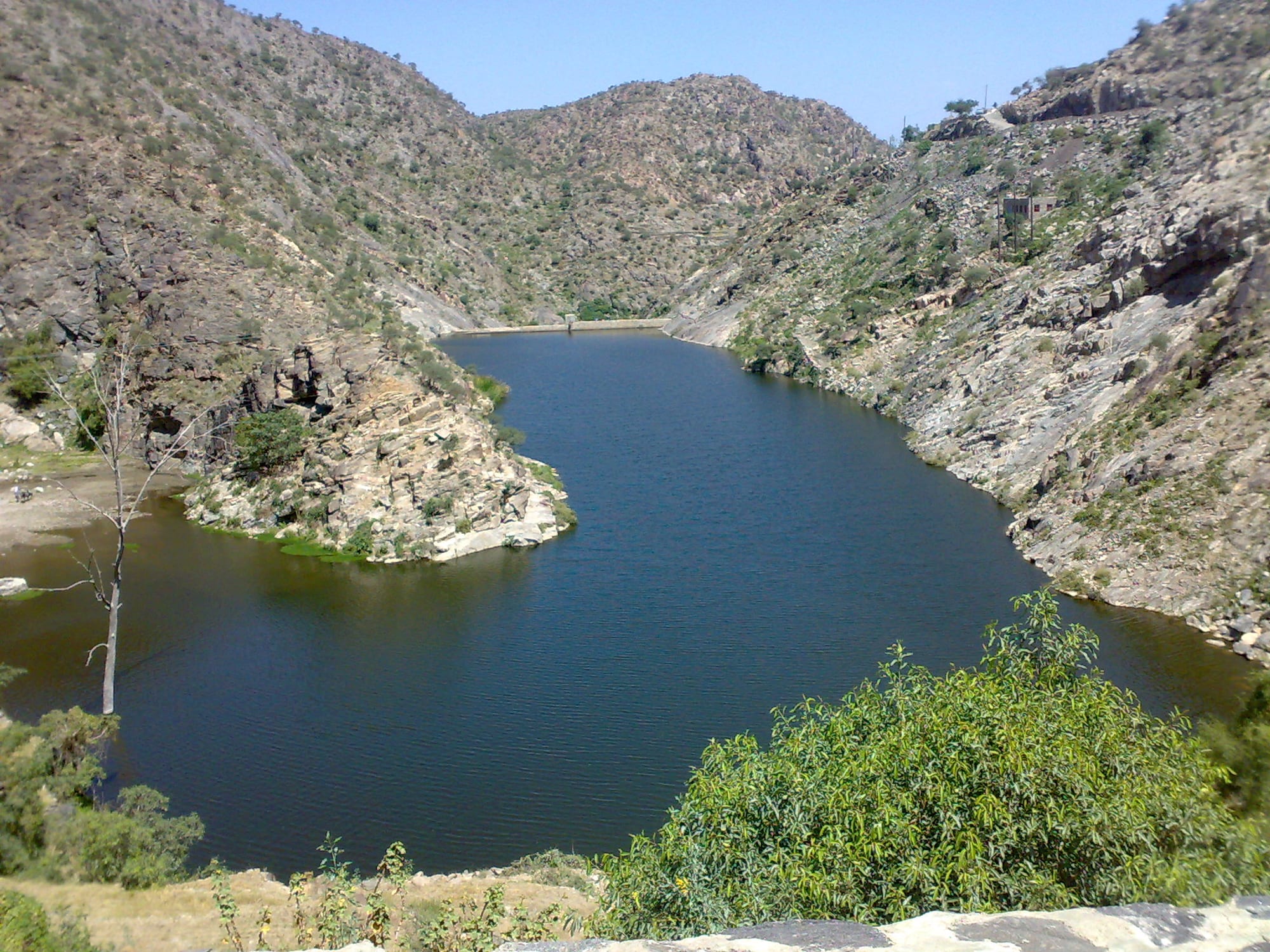
A long dark-blue reservoir held between bare rocky hills, with green bushes in the foreground and a low dam wall at the far end

Aden & the South, Yemen

Lahij

A dam and reservoir in the hills of Lahij Governorate, inland from the town of Lahij. (صادق عبدالجليل علي / Wikimedia Commons · CC BY 3.0)

An inland town about 30 kilometres north of Aden, set where the Tuban wadi spreads into an irrigated plain of gardens, palms and farmland. Known locally as Al-Hawtah, it was the capital of the Abdali sultans for more than two centuries and is remembered across Yemen for its jasmine and its songs. This page is written to explain the town, not to encourage travel.

Neighbourhoods

  • Al-Hawtah
    • Historic district
    • First-time visitors

    The town centre and the old seat of the Abdali sultans, a low-built quarter of markets, mosques and courtyard houses on the edge of the irrigated land. The name is used interchangeably with Lahij itself, and the shrine of al-Salih Muzahim Ja'far here draws pilgrims from across Yemen in the month of Rajab.

    Open in Maps
  • The Tuban gardens
    • Quiet and residential
    • Farming country

    The spread of palm groves, vegetable plots and field channels fed by springs and by the floods of the Tuban wadi, which surround the town on the plain. Villages and farmsteads are scattered among them, and the gardens are the reason the town exists.

    Open in Maps
  • The Aden road
    • Close to transport
    • Trade

    The southern approach, where the highway runs down across the plain towards Aden. Fuel stations, workshops, freight yards and roadside cafés line it, and it carries most of the traffic and trade between the coast and the interior.

    Open in Maps

Things to do

In and around the town

  • Tuban Districtpark

    The irrigated plain around the town, watered by springs and seasonal floods from the Tuban wadi, and one of the main areas of irrigated farming in southern Yemen.

    Open in Maps

Short trips from the town

  • Al Musaymir Districtviewpoint

    Hill country north-west of the town where the plain gives way to rocky ranges, a district of scattered villages and farmland.

    Open in Maps
  • Radfanlandmark

    The mountain district north of Lahij, remembered across Yemen as the place where the armed revolt against British rule began in October 1963.

    Open in Maps
  • Adenneighborhood

    The great southern port about 30 kilometres away, built in and around the crater of an extinct volcano, historically ruled from Lahij before 1839.

    Open in Maps
  • Ad Dali'neighborhood

    A highland town north of Lahij at about 1,500 metres, cooler than the plain and the capital of its own governorate.

    Open in Maps
  • Zinjibarneighborhood

    The capital of Abyan governorate, east beyond Aden, at the edge of another delta of flood-watered farmland on the Gulf of Aden coast.

    Open in Maps

Eat and drink

Long-standing places and food districts in Lahij. Hours, ratings and directions come from your maps app, always current.

Lahij kitchens and markets

  • The town marketmarket

    Produce from the surrounding gardens — vegetables, dates, milk and honey — is traded in the town's market streets, along with qat brought down from the hills.

    Open in Maps
  • Grills and mandi kitchensrestaurant

    Simple kitchens along the main roads serve mandi and haneeth, lamb or chicken cooked slowly over or under rice in a clay tannur oven, eaten from a shared platter.

    Open in Maps
  • Tea shops and tannur bakeriescafe

    Sweet black tea, and in this part of Yemen the milky cardamom tea of Aden, is drunk in small roadside shops; bakeries turn out flatbread from clay ovens through the day.

    Open in Maps

Experience Lahij

History

Lahij grew where the Tuban wadi loses itself in a plain of gravel and silt, and where springs and flood channels allowed gardens to be watered in a country with almost no rain. The settlement that became the town is known as Al-Hawtah, a word used in southern Arabia for a protected place under religious sanctuary; the town's shrine of al-Salih Muzahim Ja'far still draws pilgrims in the month of Rajab. Its importance came from that water and from its position on the road between the coast and the highlands.

In the eighteenth century the Abdali chiefs of the district broke away from the rule of the Zaidi imams in the north and established their own sultanate at Al-Hawtah, holding the port of Aden and the country around it. That arrangement ended in 1839, when the British East India Company took Aden by force, and the Abdali sultans then entered into treaty relations with Britain as one of the states of the Aden Protectorate, keeping their court at Lahij while the port grew into a world coaling station beyond their control. During the First World War Ottoman forces pushed down from the north and occupied the town, which they held until the end of the war.

In 1963 the sultanate was absorbed into the Federation of South Arabia, and it was swept away in 1967 with the British withdrawal and the founding of the People's Republic of South Yemen, later the People's Democratic Republic of Yemen. The sultan was expelled and the ruling family's land passed to the new state. Since unification in 1990 the town has been the capital of Lahij Governorate, and it has suffered badly in the war that began in 2015, with fighting, displacement and damage to schools, clinics and farms.

Culture & Customs

Lahij is best known across Yemen for its songs. The Lahji tradition, a style of sung poetry accompanied by the oud, was shaped in the early twentieth century by Ahmad Fadl al-Qumindan, a prince of the Abdali ruling family who was poet, musician and agricultural writer at once, and whose lyrics about the town's gardens and jasmine are still sung. Radio and recordings carried the style to Aden and beyond, and it remains one of the recognised schools of Yemeni music.

Jasmine belongs to the town's identity in the same way. The flower is grown in the gardens of the plain, sold in markets in Aden and other cities, and worn or carried at weddings, and it appears constantly in Lahji verse. Weddings are the great social occasions, with music, drumming and dancing, and they are when the old songs are most often heard.

Socially the district is more settled and agricultural than the tribal highlands to the north, and the sultanate's long connection with Aden left it more exposed to outside ideas than most of rural Yemen. Almost everyone is Sunni Muslim of the Shafi'i school. The afternoon qat session organises much of social and political life, and hospitality, long greetings and careful respect for age and standing govern how people deal with one another.

Daily Life

Lahij town is small — tens of thousands of people, rather than the hundreds of thousands of nearby Aden — and functions as the administrative centre of a governorate that is mostly farmland and mountain. Life runs on the land: the irrigated plain grows vegetables, fodder, dates and fruit, and livestock and dairying are widespread. The town holds the governorate's main jasmine market, where the flower is bought from growers and sent on to cities across Yemen. The proximity of Aden, about 30 kilometres away, means that the town supplies the city's markets and that many families have members working there.

The war has been hard on the district. Front lines ran across the plain, farms and irrigation channels were damaged, and many people were displaced to and from the area. The collapse of the rial in government-held areas has made fuel, seed and imported food expensive, public salaries have lost much of their value, and diesel prices directly affect the pumps that water the fields. Electricity and water supply are unreliable, and health services are thin.

The rhythm of the day follows the heat. Work in the fields and in the market is done early, the afternoon is quiet and given over to qat and rest, and the town comes back to life in the evening. Friday is the day of prayer and of family visits, and the road to Aden fills with shared taxis in both directions from early morning.

Food

The food of Lahij is the food of southern Yemen, shaped by the farmland around the town and by the kitchens of Aden down the road. Mandi and haneeth are the dishes for guests and feast days: lamb or chicken cooked slowly in a clay tannur oven, in the first case over rice that takes up the fat and smoke, and served on a shared platter to be eaten with the right hand. Zurbian, the spiced rice with meat, potatoes and saffron that Aden made its own, appears at weddings here too.

Everyday meals are simpler. Flatbread baked against the wall of a tannur is eaten with beans, eggs, vegetables or a stew, and with sahawiq, the green sauce of coriander, chilli, garlic and tomato found on every Yemeni table. Saltah, the bubbling stew topped with whipped fenugreek called hulba, is eaten as across the country. The gardens supply tomatoes, okra, onions and greens, and dates from the palm groves are eaten plain or with coffee.

Milk, buttermilk and clarified butter matter more here than on the coast, because the plain keeps cattle and goats as well as crops. Honey is the prestige product of Yemen as a whole and is sold by the comb in the market. Tea is drunk sweet and black through the day, often with cardamom or, in the Adeni manner, with milk, and qishr, an infusion of dried coffee husks, is the other common hot drink.

Planning tools

Budget

There is no visitor economy in Lahij. The town has no tourist accommodation of any standard, and costs for the few foreigners who come on institutional business are shaped by the collapse of the rial in government-held areas, expensive imported fuel and food, and the security arrangements that any movement in the region requires.

Daily Budget Midrange
USD not applicable — foreign visitors are mostly aid, diplomatic and business staff travelling with security
Daily Budget Shoestring
USD not applicable — the town is not open to ordinary visitors

Do not plan travel here; the only tourism in Yemen is to Socotra, on operator-run packages.

Best Time to Visit

There is no safe time to visit, and the fighting spread again in 2026. In calmer years, November to February brought the most comfortable weather to the plain north of Aden, when the heat eases and the humidity drops.

Suggested Number of Days

The town itself is small and can be seen in a day, with two or three needed to take in the surrounding farmland and the hill districts beyond. In practice length of stay is decided by work and security rather than by sightseeing.

First Visit
1 day
With Surroundings
2–3 days

Transportation

Lahij sits on the main road north from Aden, and shared taxis and minibuses running between the port and the interior are how most people move. Within the town and the surrounding villages, journeys are made by shared taxi, motorbike or on foot along the field tracks. There is no rail and no organised public transport network, and fuel shortages affect services. Roads north to Ad Dali' and east through Abyan pass checkpoints held by rival forces.

There is no safe way to travel within this region; do not attempt overland journeys.

Airport & Station Connections

The nearest airport is Aden International, roughly 30 kilometres south-east on the Khormaksar isthmus, which has had sporadic commercial flights during the war. Overland, the town is reached by the highway from Aden, an hour or so in normal conditions, or by the longer roads down from Taiz and Ad Dali'. Most foreigners who arrive do so on institutional business, with transport arranged for them.

Walkability

The centre is flat, low-built and small enough to cross on foot, and the field paths through the gardens make easy walking in the cooler hours. Pavements are limited, lighting is unreliable, and the heat of the middle of the day keeps most people indoors. Anything beyond the town means a vehicle.

Safety

Most governments advise against all travel to Yemen, and this part of the south is no exception. The area between Aden and the highlands has seen repeated front-line fighting during the war, along with checkpoints, unexploded ordnance in farmland and a serious risk of kidnapping for foreigners. The wider war came closer in 2026, when fighting resumed in July and a September offensive along the Red Sea coast reached the Bab al-Mandab strait.

Do not travel to this region; consular help is minimal or absent and evacuation cannot be relied on. Check current official travel advice before travelling.

Climate

Hot and dry, a little less humid than the coast because the town lies inland, with rain rare and mostly falling as short summer storms that run down from the mountains and feed the wadi. Nights cool more than they do in Aden.

Summer
very hot, with daytime temperatures often near or above 40°C and occasional flood-bringing storms
Winter
warm days of about 25–30°C with noticeably cooler nights

Local Customs

Almost everyone is Sunni Muslim of the Shafi'i school. Dress is conservative: men wear the wrapped futah with a shirt, and most women cover in public. Greetings are long and hospitality is pressed on guests, with tea or coffee offered immediately. Afternoons are largely given to qat, the leaf chewed in long social sessions, and business is done in the morning or after sunset.

Dress modestly, accept refreshment when it is offered, and ask before photographing anyone; never photograph checkpoints, military sites or people in uniform. Alcohol is not publicly available, and eating or drinking in the street during daylight in Ramadan gives offence.

Common Payment Methods

The currency is the Yemeni rial, whose value in government-held areas has fallen steeply, so prices move quickly and thick bundles of notes are normal. Everything is paid for in cash; card acceptance and working cash machines cannot be relied on. US dollars hold their value and are changed through money changers in the market.