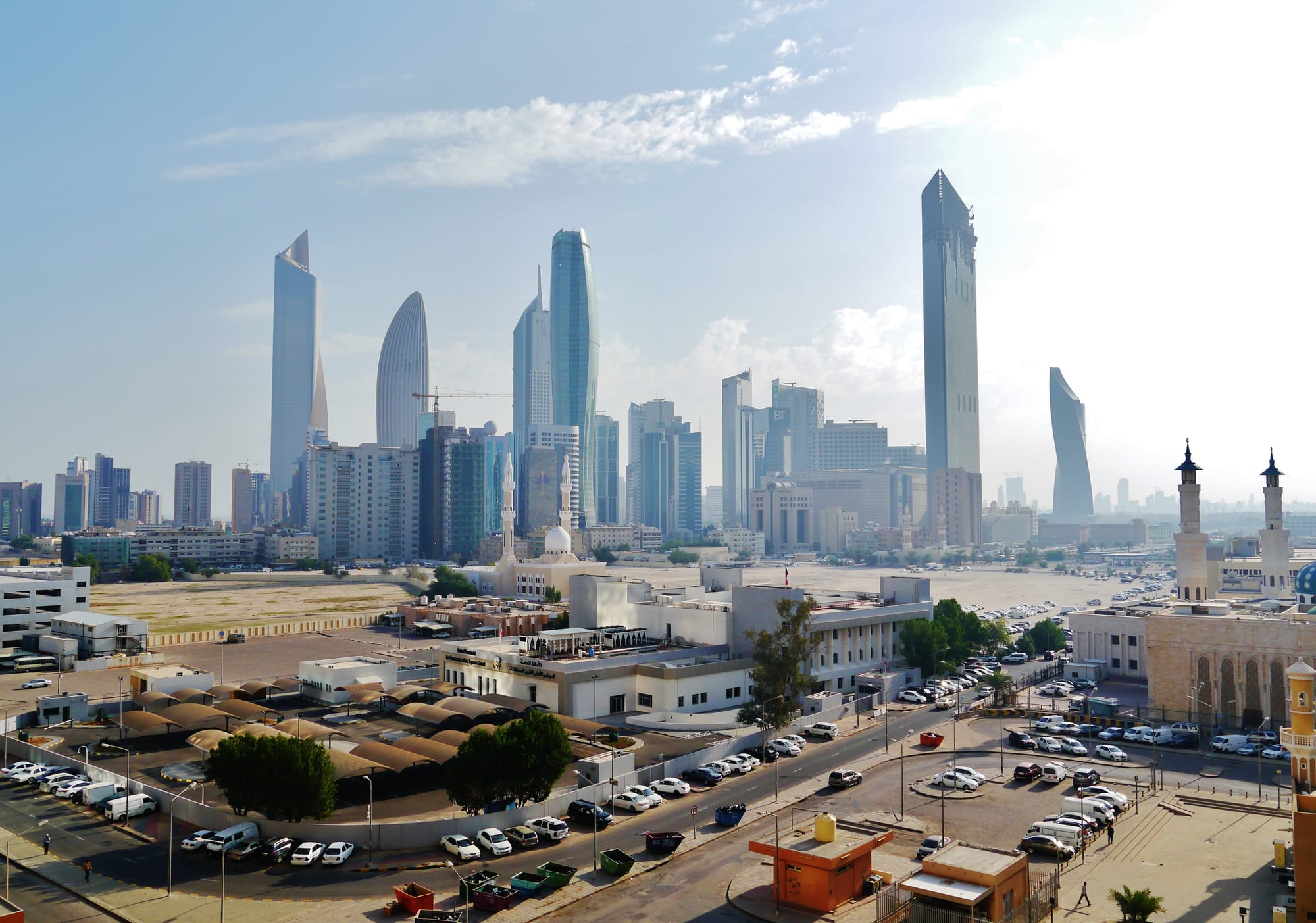
A line of high-rise towers along a waterfront, the pointed Al Hamra Tower prominent, seen across the Gulf under a hazy sky

Kuwait

The Kuwait City skyline on the Persian Gulf, with the twisting Al Hamra Tower — the country's tallest — at its centre. (Zairon / Wikimedia Commons · CC BY 4.0)

A small, very hot, oil-rich emirate at the head of the Persian Gulf — a former pearling port, invaded and liberated in 1990–91, with a strong tradition of political debate and an elected parliament suspended since 2024. Kuwait has come under aerial attack since February 2026 in the wider Iran war; flights, suspended when the war began, have run on a reduced schedule since late April.

Explore Kuwait

History

Kuwait began in the early eighteenth century as a settlement of Arab clans at a sheltered natural harbour ("Kuwait" comes from a word for a small fort). The Al Sabah family were chosen to lead it around 1752, and the town grew into a busy trading and shipbuilding port, its economy resting on pearl diving, long-distance dhow trade, and its role as an outlet for goods moving to and from inland Arabia and Mesopotamia.

Fearing Ottoman encroachment, the ruler signed a protection agreement with Britain in 1899; Kuwait remained a British protectorate until full independence in 1961, which Iraq immediately contested. The collapse of the pearl trade in the 1930s coincided with the discovery of vast oil reserves, and exports from 1946 transformed a poor town into one of the wealthiest states in the world.

In August 1990 Iraq under Saddam Hussein invaded and annexed Kuwait, citing border and oil disputes and Kuwait's refusal to forgive war debts. A US-led coalition liberated the country in the 1991 Gulf War; retreating Iraqi forces set hundreds of oil wells ablaze and looted the country. Kuwait rebuilt with its oil wealth and has since navigated repeated standoffs between its ruling family and its assertive elected parliament, which the emir suspended on 10 May 2024.

Since 28 February 2026 Kuwait has been drawn into the war between the United States, Israel and Iran. The country has come under a campaign of aerial attacks, with Iranian forces targeting Kuwait International Airport, the Ministries Complex, oil refineries and desalination plants; Kuwait, along with Saudi Arabia, the United Arab Emirates and Bahrain, struck Iran in turn after attacks on their territory. Kuwaiti airspace closed as the war began and flights resumed only in late April; a ceasefire agreed in April collapsed in July, and Iran's blocking of the Strait of Hormuz has disrupted Gulf shipping.

  • Kuwait: The Pearling Town That Struck Oil — A trading port at the head of the Gulf, ruled by the Al Sabah since 1752 — a British protectorate, a sudden oil-fuelled fortune, the Iraqi invasion of 1990, and the Gulf's most powerful parliament

Culture & Customs

Kuwait is a Gulf Arab, Muslim society — Sunni majority with a significant Shia minority — that is socially conservative but has a strong civic and intellectual tradition. Alcohol is banned, dress in public is modest, and Ramadan is strictly observed, but Kuwaitis are proud of a history of a free-ish press, a lively theatre and television industry watched across the Gulf, and open political argument.

The diwaniya is the country's defining institution: a regular evening gathering, historically male, in a room set aside for the purpose, where friends, family, and constituents meet to talk, and where much political business and networking actually happens. Family and tribe matter, hospitality is elaborate, and the weekend (Friday and Saturday) turns on family visits and, in winter, desert camping — a national pastime, with elaborate tented "spring camps."

Roughly two-thirds of residents are foreign workers, mainly from India, Egypt, other Arab countries, Bangladesh, and the Philippines, and Kuwait's cuisine, languages on the street, and daily rhythms reflect that mix.

  • Kuwait: Talking It Over in the Diwaniya — A Gulf state where Islam is the religion of the state, the evening gathering is a national institution, and customs from the henna night to the bisht are shared with the whole Arabian Peninsula

Daily Life

Almost the entire population lives in the built-up area around Kuwait City and its suburbs; the rest of the country is flat desert, some of it oil field, some reserved. The city is car-centred and mall-centred, with a corniche along the Gulf, the old souq at its heart, and residential districts spreading inland.

The economy is overwhelmingly oil — Kuwait sits on some of the largest reserves in the world, and the Kuwait Investment Authority is one of the oldest and biggest sovereign wealth funds — with generous public-sector employment, subsidies, and no personal income tax for citizens. Diversification has been slow, and political gridlock between the ruling family and parliament has stalled major projects for years.

Daily life runs early and late in summer to dodge the heat, with the working day, the diwaniya, the mall, and the mosque as its fixed points, and a distinct divide between the lives of citizens and of the expatriate majority. Since February 2026 the aerial attacks have damaged refineries, desalination plants and government buildings, straining the country's energy and water supply.

  • Kuwait: A Day Built Around the Heat — A small, wealthy Gulf state where summer heat can pass 50 degrees, outdoor work is banned by law at midday, and the evening diwaniya gathering still does as much political and social business as any office

Food

Kuwaiti cooking is Gulf Arab with strong Persian and Indian influence. The best-known dish is machboos — spiced rice, close to a biryani, with fish (often hamour or zubaidi) or lamb or chicken, cooked with dried lime (loomi), saffron, and other spices, and served with a tangy tomato daqoos sauce.

Murabyan (spiced shrimp and rice), mutabbaq samak (fish served over rice), jireesh (cracked-wheat porridge with meat), and harees in Ramadan are other staples. Balaleet — sweet vermicelli with a thin omelette — is a breakfast favourite, and gers ogaily (a cardamom-and-saffron sponge) and dates with cardamom coffee finish a meal.

There is no alcohol; strong karak tea, cardamom coffee (gahwa), fresh juices, and laban buttermilk are the everyday drinks.

  • Kuwait: Food and the National Dish — Spiced rice slow-cooked with meat or fish, a dish shared across the Gulf but claimed with real pride in Kuwait, built on a historic trading port's centuries of maritime connections

Attractions & Natural Wonders

Kuwait's landmark is the Kuwait Towers, the water-and-observation towers on a Gulf promontory, with a viewing sphere and a revolving café. Along the corniche are the Scientific Center with its large aquarium and dhow harbour, the Al Shaheed Park with its museums, and the huge Sheikh Abdullah Al Salem Cultural Centre complex, one of the largest museum projects in the region.

The old city core has the restored Souq Al-Mubarakiya, good for spices, textiles, and traditional cafés, the Grand Mosque, and the Sadu House textile museum. The Tareq Rajab Museum holds a fine private collection of Islamic art and manuscripts, and the Liberation Tower marks the end of the Iraqi occupation.

A short ferry ride away, Failaka Island has Bronze Age Dilmun and Hellenistic Greek ruins, alongside villages abandoned during the 1990 evacuation and left as they were — an eerie, war-scarred time capsule. In winter, the desert itself is the attraction, with Kuwaitis camping, riding, and picnicking across it under mild skies.

  • Kuwait: Eight Attractions and Natural Wonders — The blue-globed water towers on the Gulf, one of the last living traditional souqs in Arabia, a green park built over old defensive lines, and an island layered with Bronze Age and Greek ruins

Planning basics

Budget

Kuwait is mid-range to expensive by regional standards, cheaper than Dubai but with limited budget options. Hotels, taxis, and imported goods are the main costs; fuel is very cheap and local cafeteria food is inexpensive. Cards are accepted almost everywhere.

Daily Budget Midrange
USD 130–260 (4-star hotel, restaurants, car hire, museums)
Daily Budget Shoestring
USD 55–95 (simple hotel, cafeteria food, ride-hailing)

There is no alcohol and little nightlife, so evening spending is low; malls and restaurants are the social venues.

Visa Requirements

Many nationalities — including the US, the UK, the EU, and others — can obtain an e-visa online or a visa on arrival at Kuwait International Airport. Visas on arrival are commonly issued for three months, while the e-visa allows stays of up to 30 days. GCC citizens enter freely, and foreign residents of GCC countries can get a tourist visa on arrival.

Typical Validity
e-visa stays of up to 30 days; visa on arrival commonly up to three months

Check the official e-visa portal for your passport. Flights were suspended from late February to late April 2026 during the Iran war and still run on a reduced schedule, with closures possible at short notice, so check what is actually running before you plan anything.

Safety

Kuwait has been subject to a campaign of aerial attacks since February 2026, during the wider 2026 Iran war. Iranian forces have repeatedly targeted infrastructure including Kuwait International Airport, the Ministries Complex, oil refineries and desalination plants, causing significant damage; the US embassy was struck and closed indefinitely in March 2026. Kuwaiti airspace closed on 28 February 2026; flights resumed in late April on a reduced schedule, and closures can happen at short notice. A ceasefire agreed in April collapsed in July, and Iran said it targeted a Kuwaiti air base again in September. Aside from the war, Kuwait has low crime, and the standing hazards are the extreme summer heat, a high road-accident rate from fast and reckless driving, and, in the desert near the Iraqi border, unexploded ordnance left from the 1991 war. Political demonstrations are restricted.

Check current official travel advice before making any plan at all. Take the heat seriously, drive defensively, keep off unmarked desert tracks near the northern border, and observe the Ramadan ban on eating, drinking, or smoking in public during daylight.

Climate

One of the hottest countries on Earth. Summers, roughly May to September, are extreme — daytime highs of 45–52°C, among the highest reliably recorded anywhere in Asia — with hot nights and dust storms (toz). Winters, December to February, are mild at 10–18°C, with occasional rain and cold snaps.

Summer
45–52°C, dusty, dangerous for the unacclimatised
Winter
mild and pleasant, some rain; the desert-camping season

Transportation

Kuwait International Airport is the hub of Kuwait Airways and Jazeera Airways, though Kuwaiti airspace closed on 28 February 2026 and flights were suspended until Kuwait Airways and Jazeera Airways restarted from Terminals 4 and 5 on 26 April; drones badly damaged Terminal 1 in June, and schedules remain reduced. There is no passenger rail (a Gulf network and a metro are planned). Getting around means metered taxis and ride-hailing apps (Uber, Careem), cheap car hire on good roads, and a limited public bus network. The country is small — about an hour end to end.

Driving
On the right; fuel is very cheap and driving is fast and aggressive

Best Time to Visit

November to March, and especially December to February, when the weather is comfortable and Kuwaitis camp in the desert. Avoid May to September unless you are content to move between air-conditioned spaces. Ramadan changes daytime hours and closes daytime eateries.

Currency

The currency is the Kuwaiti dinar (KWD), pegged to a basket of currencies and the highest-valued currency in the world; it divides into 1,000 fils. Small purchases are priced in fils.

Cards
Accepted almost everywhere; keep a little cash for the souq and small cafeterias
Symbol
د.ك / KD
Currency Code
KWD — Kuwaiti dinar

Language

Arabic is the official language, spoken locally in a Gulf dialect. English is very widely used in business, signage, and daily life given the large expatriate population, and a visitor can get by entirely in English. Hindi, Urdu, Tagalog, and other Arab dialects are commonly heard.

Working Language
English, very widely spoken
Official Language
Arabic