Culture & Customs · Eritrea
Eritrea: Welcome in My House
Christians and Muslims in almost equal numbers, nine peoples with their own music and dances, greetings that are never rushed, and a guest who is treated as a blessing on the household
By Globeway Editorial · 30 September 2026
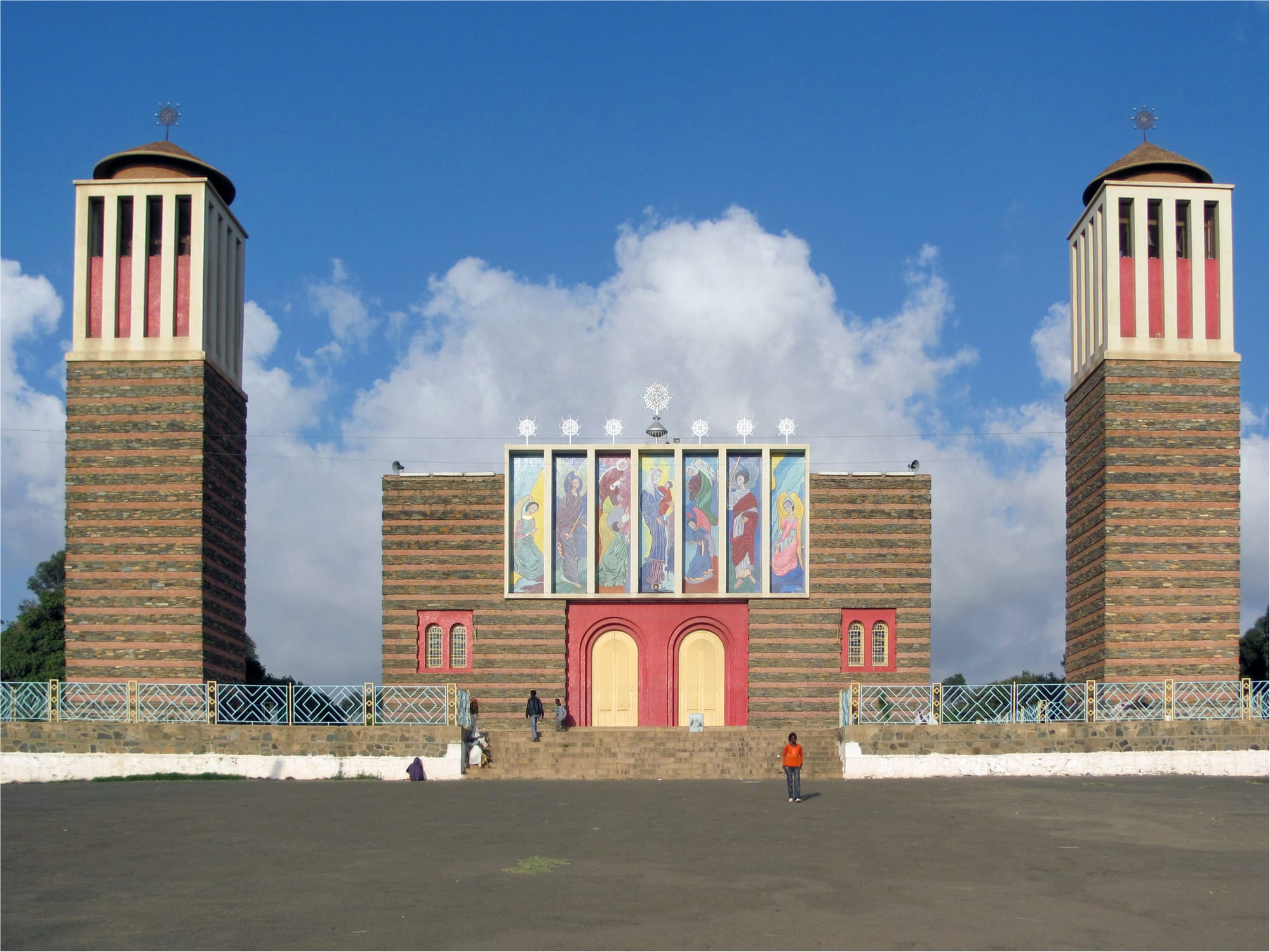
A visitor arrives at the door. Whoever it is, the first word is "merhaba", which carries the sense of "you are welcome in my house", and it is said to strangers as readily as to relatives. The host does not ask who the guest is or what brings them; that would be rude. Instead a mat is spread with fresh green grass, frankincense is lit, and raw coffee beans begin to crackle over the coals. In a household where eggs are normally sold to help pay the bills, a plate of eggs appears for the guest. The principle behind all this is simple: a guest is a blessing, and even when there is not enough for the family, the guest is given plenty.
Faith, identity and values
Eritrea is almost evenly divided between two faiths. The World Religion Database, cited by the US State Department, estimated the population in 2020 as 52 per cent Muslim and 47 per cent Christian; most Muslims are Sunni and most Christians belong to the Eritrean Orthodox Tewahedo Church, whose tradition in the country reaches back to the fourth century. Christians form the majority in the central and southern regions and Muslims in the north. The Tigrinya, about half the population and the largest of the country's nine ethnic groups, are predominantly Christian, while the Tigre, Saho, Afar, Bilen, Hedareb, Nara and Rashaida are predominantly Muslim; the Kunama complete the nine.
The state formally recognises four religious bodies: the Orthodox Church, Sunni Islam, the Catholic Church and the Evangelical Lutheran Church of Eritrea. Members of unregistered groups, the State Department reports, risk arrest. Within society, however, the same report finds religious tolerance widespread: people congratulate neighbours of other faiths on their holidays, most towns and ethnic groups include members of all the main religions, and there are no reports of sectarian violence.
The Orthodox Church shapes the highland year with its fasts and feasts, and its churches follow firm customs. Worshippers remove their shoes before entering, as Moses did on holy ground; women cover their hair, white netsela shawls are worn, and men and women stand separately inside. Food and drink are not taken into the church.
Beneath the faiths lie shared values. Respect for elders and for authority runs deep, and older relatives are traditionally cared for at home as a family duty. Public displays of affection between men and women are restrained, while male friends may walk hand in hand as a sign of friendship. Eating together carries moral weight too: families negotiating even an unhappy outcome, such as a divorce or restitution, are still expected to share a meal from the same plate.
Greetings and meeting people
A greeting in Eritrea is never just a quick hello. It is regarded as something close to sacred, and a person's character is judged in part by how they greet: a warm, unhurried greeting with questions about health and family shows care, while a brief one can make someone seem self-centred. Passing an acquaintance without stopping to greet them properly is not done.
The forms vary with region, age, gender and closeness. Women who know each other greet with loud kisses near the cheek, repeated three or four times, and more often the better they know each other. Handshakes are now standard, and so ingrained that someone whose hands are wet or who has been eating will offer an arm instead. In the highlands, people of the same sex also greet by touching shoulder to shoulder, sometimes several times, while holding hands or embracing; in the villages this light bump on the shoulder is the usual greeting. Where there is a difference in rank or age, the junior person bows lower, and elders are greeted first. In the lowlands, a greeting also serves to pass on news: not small talk about the weather, but a briefing on what is happening in the area.
A little care is needed with cameras. Photographing government buildings and military installations is illegal, and the British government advises asking permission before taking pictures anywhere near security personnel.
Hospitality and being a guest
Meals are shared, and the Tigrinya word meadi describes food served on a single communal plate; the Tigre call it metaagal. The family gathers around the plate and waits for a blessing, often given by the father or an elder, before the first piece of injera is torn. Traditional food is eaten with the right hand only, since the left is considered unclean. Each person keeps to the part of the plate in front of them, and taking food from beyond those unmarked boundaries was traditionally a serious breach of manners; eating with just the thumb and first two fingers was a sign of good upbringing. Refusing food offered by a host is considered rude. Meadi is also a unit of measurement: a full plate serves eight people, and families negotiating a wedding may count the expected guests in meadis, so that three meadi means twenty-four.
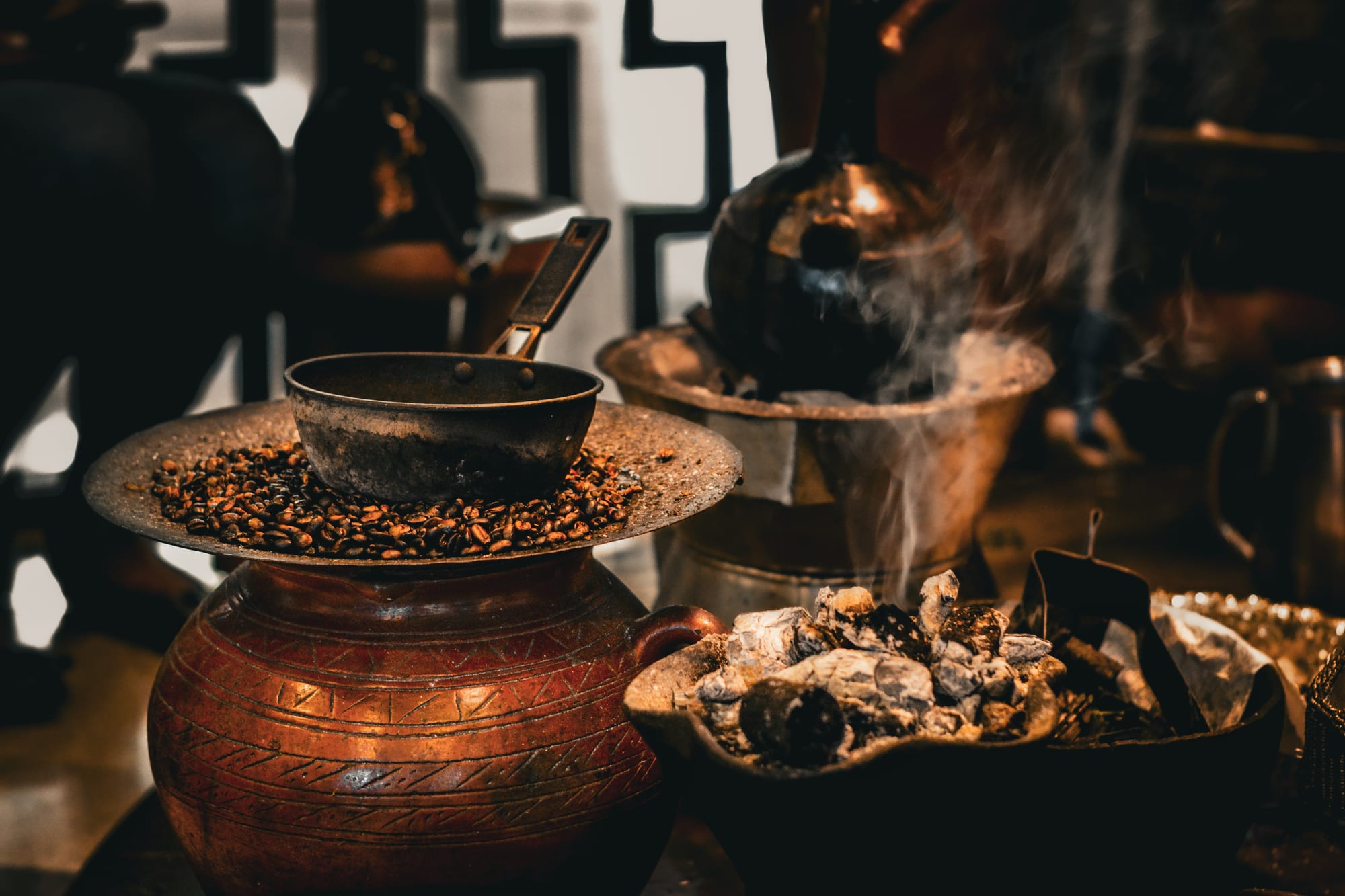
The coffee ceremony is the heart of Eritrean hospitality, and it has its own courtesies. The host spreads fresh grass over a mat, as a symbol of life and plenty, burns frankincense, and roasts green beans over charcoal, presenting the aromatic smoke to the guests before the beans are ground. The coffee is brewed in a round clay jebena with a single spout and poured in one unbroken stream from a height into small handleless cups, often flavoured with ginger, and served with roasted barley, popcorn or bread. There are three rounds: awel, the strong first cup that sets the tone for conversation; kalay, the second; and bereka, the mildest, whose name means blessing and which is served to wish the household peace and good fortune. Guests praise the coffee with the word for delicious, whatever the brew tastes like. In the hotter lowlands, coffee is served several times a day, with more ginger and in smaller cups.
Festivals and life's big moments
The Orthodox calendar brings two great public festivals. Timket, the Epiphany, on 19 January (20 January in leap years), commemorates the baptism of Christ. On its eve, the tabots, wooden slabs representing the Ark of the Covenant, are carried on the heads of priests from the parish churches to the water where the baptism will be celebrated, accompanied by hymns, popular songs, drums and the kirar. The next day the bishop blesses the water and the clergy sprinkle it over the crowds, many of whom take some home in bottles for sick relatives or for protection. In late September, Meskel brings prayers, singing and drumming around the lighting of the demera, a great bonfire, in the capital's main square.
For Muslims, Eid al-Fitr at the end of Ramadan begins with a morning prayer held in the open air. Men wear white jalabiyas and women their luwyets; new clothes are bought, biscuits and cookies baked at home, and the day is spent visiting relatives, with children given money known as hag'al Eid. Both Eids are also occasions for giving alms to the poor.
National days carry great emotional weight after a thirty-year war of liberation that ended in 1991. Independence Day on 24 May is the climax of a week of celebration that includes a street carnival, music and dance, exhibitions of painting, sculpture and handicrafts, and community events in squares and streets. Martyrs' Day on 20 June and 1 September, which marks the start of the armed struggle, are also public holidays.
Weddings are long and communal. Among Tigrinya Christians, the families spend weeks preparing, brewing suwa, a beer of millet and sorghum, and mies, a honey wine, and baking injera. The bride wears the white zuria, and the couple marry in church early in the morning before celebrations hosted first by the bride's family and then by the groom's, with ululation and the esele, the closing song, sung as the bride leaves after receiving the blessings of fathers, mothers and elders. Traditionally the couple then spend about 45 days at the groom's parents' home, receiving visitors who bring dishes such as a chicken cooked with twelve eggs in a spicy sauce, and are treated during this time as queen and king.
Death calls on the whole community. Among the Tigrinya, women go from door to door to tell the neighbourhood of a death, and families prefer to bury their dead in their home village, sometimes bringing them back from as far as North America. Mourning traditionally lasts about a week among Christians and three days among Muslims. Relatives and neighbours visit to sit with the family, bringing tea, coffee or food, and male and female relatives often sit in separate parts of the room as visitors come and go. A telephone call is not considered enough unless it comes from abroad. Among Christians, memorial services follow on the twelfth and fortieth days and after six months.
Arts, crafts and music
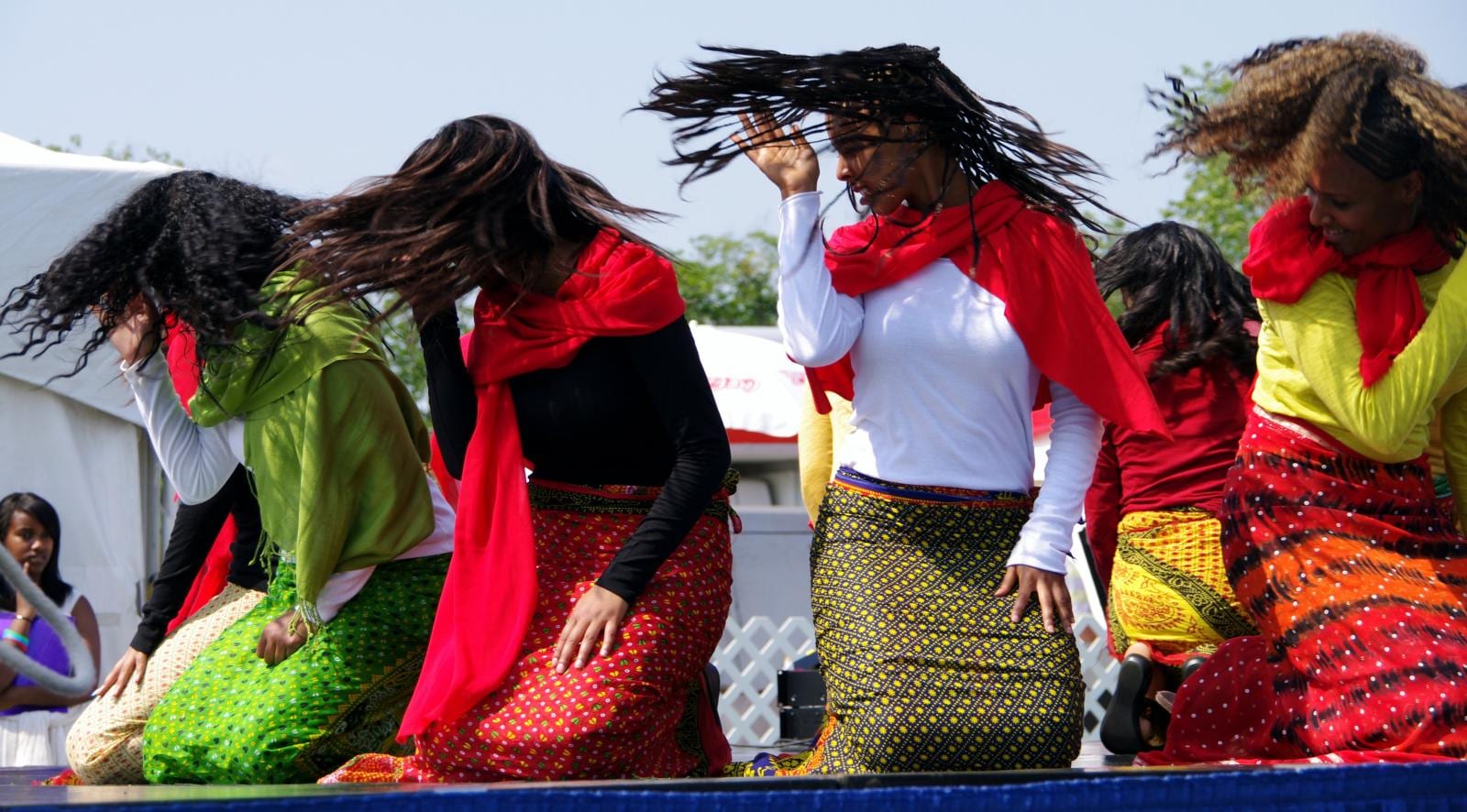
Each of the nine peoples has its own music and dances, performed above all at weddings and celebrations. The Tigrinya guayla is a circle dance for men and women that moves anticlockwise before breaking into fast shoulder movements as dancers turn to face a partner; the Bilen and Tigre dance related forms, and the Kunama and Hedareb are known for especially energetic dances.
The best-known instrument is the kirar, a lyre traditionally strung with five or six strings. Rhythm comes from the drum, known by a different name in almost every language, from kebero in Tigrinya and Saho to kabro in Afar and kalambura in Bilen. The chira-wata, a single-string fiddle played with a bow, is rooted in Tigrinya music, and the embilta, a metre-long tube played by blowing into it, is now rarely heard. Among modern performers, Bereket Mengisteab, a self-taught krar player, is one of the most celebrated for songs rooted in traditional tunes.
The finest domestic craft is the mesob, the woven basket that serves as the centrepiece of the shared meal. Made by women from palm leaves, coiled and bound with a needle from the centre of the base upwards and patterned with dyed fibres in bright colours, a single mesob can take a long time to complete. Its conical base supports a platter at the top, around which everyone eats as equals, and it is displayed in the living room as a mark of pride.
Dos and don'ts for visitors
- Do greet people warmly and at length, asking after their health and family; a curt hello can seem cold.
- Do greet elders first and show them visible respect.
- Do wait for the blessing before eating from a shared plate, eat with the right hand, and keep to the part of the plate in front of you.
- Do accept food and coffee when offered, and praise the coffee rather than commenting on how it could be better.
- Do remove shoes before entering an Orthodox church; women should cover their hair, and men and women stand apart.
- Do keep public displays of affection between men and women discreet.
- Don't photograph government buildings, military sites, bridges, ports, the airport or people in uniform, and ask permission before taking pictures near security personnel.
- Do visit a bereaved family in person if you know them; a phone call is not considered enough.
What to take away
Eritrean courtesy is built on time and presence — a long greeting, a shared plate, three cups of coffee, a visit in person to a grieving family — and a visitor who offers the same will be welcomed as the blessing a guest is meant to be.