Attractions & Natural Wonders · Seychelles
Why does the biggest seed in the world grow wild only in the Seychelles?
The coco de mer's giant seed is too heavy to float and too big for any animal to carry, so the palm never left two granite islands.
By Globeway Editorial · 2 November 2026
The short answer
The biggest seed in the world belongs to the coco de mer (Lodoicea maldivica), a palm that grows wild only on Praslin and neighbouring Curieuse in the Seychelles. Its seed weighs 10 to 25 kilograms, and that size is the reason it never spread. A ripe nut is too dense to float, so the sea cannot carry it to new shores, and there is no animal on the islands big enough to carry it inland. Most nuts simply drop at the foot of the parent tree and grow there.
The palm's ancestors probably reached the Seychelles long ago, either riding the granite fragment of the ancient supercontinent Gondwana that became the islands, or drifting in as smaller seeds that later evolved to giant size. Strictly speaking, the palm also grows outside the Seychelles today, but only where people have planted it, in a handful of tropical botanic gardens.
A seed built to stay at home
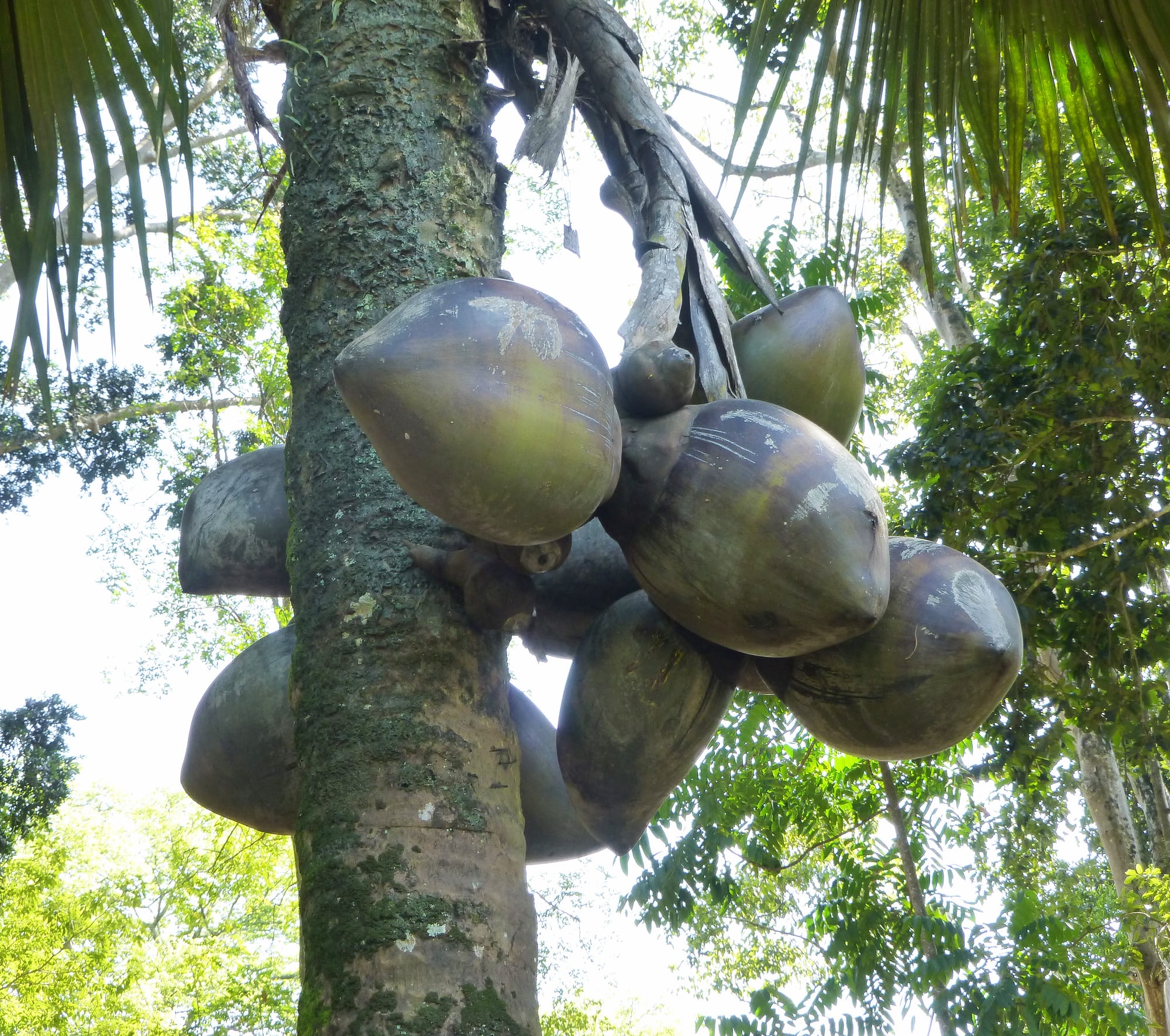
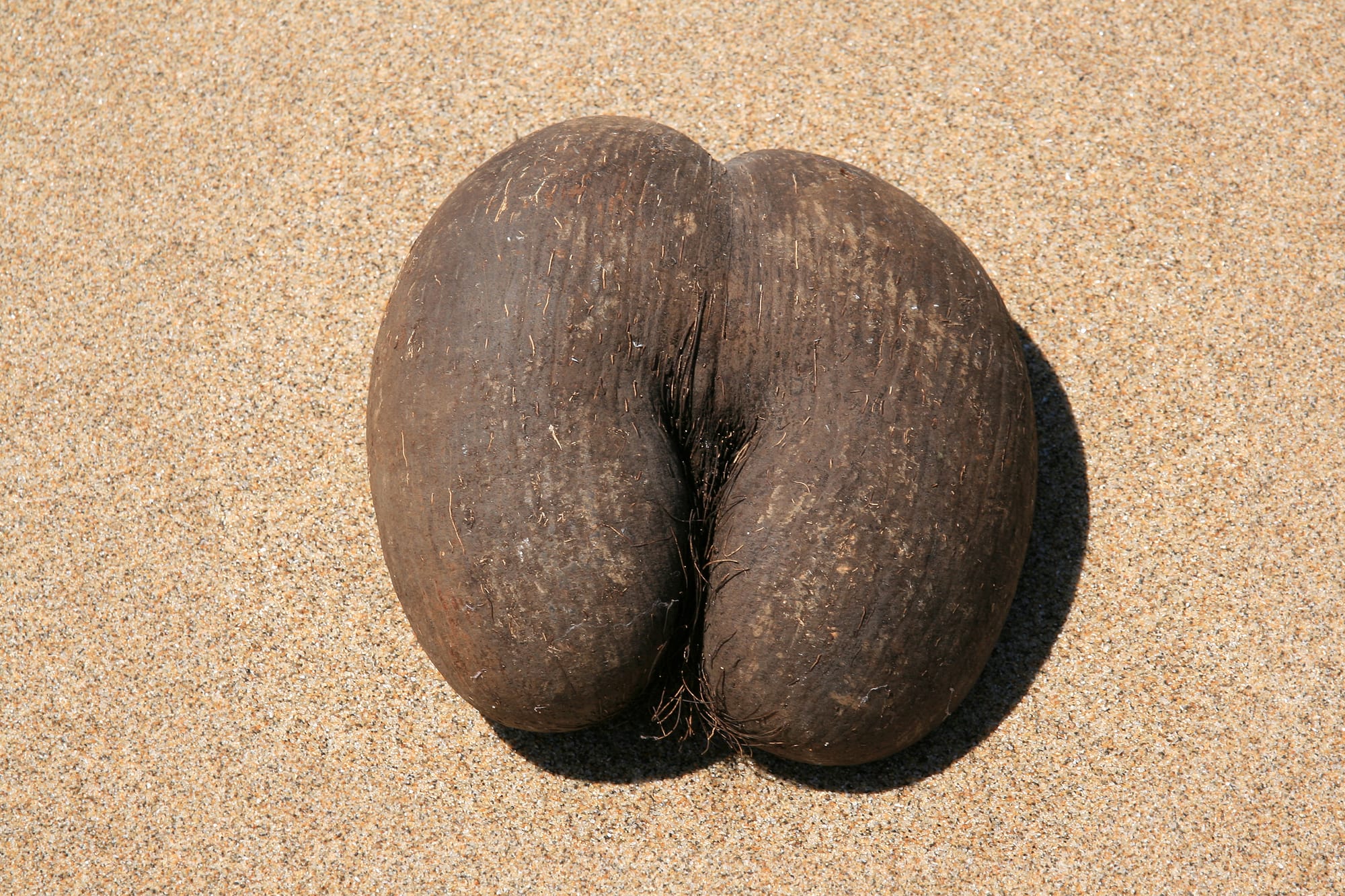
Most island plants got there by sea or by bird, and their seeds are made to travel. The coco de mer went the other way. Its fruit is 40 to 50 centimetres across and weighs 25 to 45 kilograms, the heaviest of any palm, and takes somewhere between six and ten years to ripen on the tree. Inside is usually one seed, occasionally two to four.
For a long time botanists assumed it was a drift seed, evolved to cross oceans. It is not. A living nut sinks. Only nuts that have already germinated or rotted out, leaving them hollow, can float, and those are no longer able to grow. With no current to carry it and no large animal to swallow or bury it, a fallen nut stays where it lands. Even germination is slow: about two more years, during which the seedling sends out a tube-like stalk, normally up to 4 metres long and occasionally as long as 10 metres, that links the young plant to the seed as the shoot works its way through the soil.
Why the seed grew so large
The coco de mer is described as the only true case of island gigantism among the flowering plants of the Seychelles: the tendency of some species isolated on islands to evolve to a much larger size than their relatives. Its closest living relatives, the Borassus palms of Africa and Asia, have far smaller seeds. Biologists have several explanations, and they may all play a part.
One is that the Seychelles had no ground-dwelling mammals to eat fallen fruit, so a big, food-rich nut could lie on the forest floor long enough to feed its seedling. Another is the soil, which on these islands is shallow and poor; the seedling spends a long time growing underground in the dark, unable to make food from sunlight, and lives off the seed's stores. A third points to the dim light of the forest floor, which favours seedlings that can quickly put out tall, wide first leaves to catch what light there is, something a large, food-rich seed makes possible.
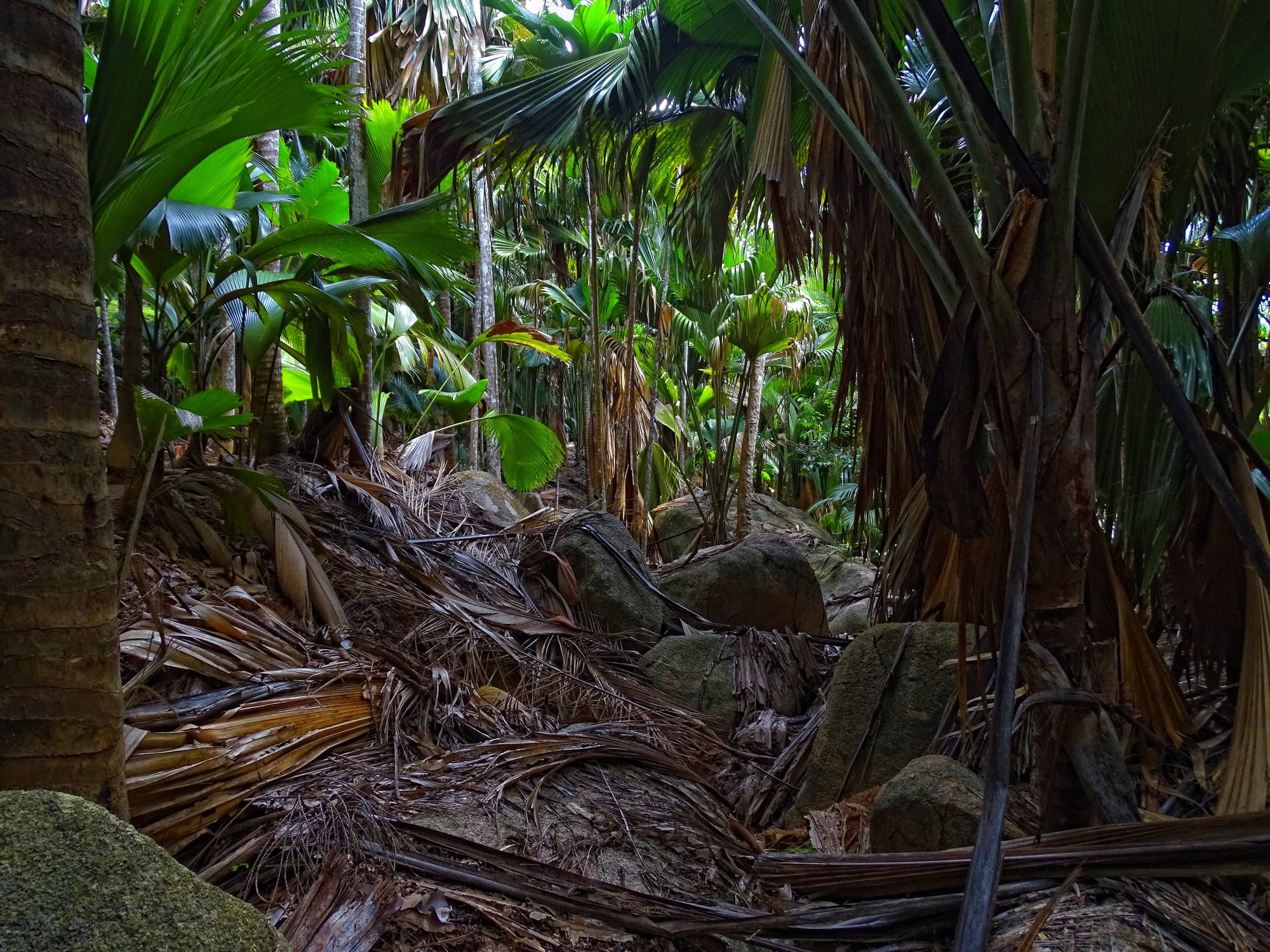
The adult tree helps its young in another way. Its stiff, fan-shaped leaves, up to 10 metres across, form a giant funnel that catches pollen and other debris and washes it down to the base of the trunk when it rains, enriching the ground where the next generation will grow.
A fragment of a lost supercontinent
The deeper question is how the palm's ancestors reached the Seychelles at all. Unlike most Indian Ocean islands, which are volcanic or coral, the main Seychelles islands are granite, part of a sliver of continent that broke away from India around 66 million years ago as Gondwana came apart. Genetic studies point to close relationships between the coco de mer and palms of South Asia.
One idea is that palm ancestors were already living on that land when it split off, and were marooned. Another, supported by a 2020 genetic study, is that smaller-seeded ancestors drifted across the sea from South Asia while the gaps between land masses were narrower, and the seed grew to its present size only after they arrived. A mix of both is possible. Either way, the palm has been evolving in isolation for a very long time.
The nut from the bottom of the sea
Long before anyone knew where it grew, the coco de mer was famous. Hollow nuts that fell into the sea were carried east by the currents, and many washed up in the Maldives, where they were gathered and traded as a valuable medicine and trade good. That is why the palm's scientific name still says "maldivica". Many people believed the nuts grew on a mythical tree at the bottom of the sea, and sixteenth-century European nobles had the shells polished and set with jewels for their collections. The true source was found only in 1768, when a French expedition reached Praslin.
That fame became a threat. The palm once grew on three small islets off Praslin as well, but has been lost from them. The IUCN lists it as endangered, with about 8,000 wild mature trees counted in 2019. Fires have swept parts of Praslin and Curieuse, and the collecting of nuts has almost stopped natural regrowth in the wild. Since 1995 a decree has controlled the trade in nuts, and new populations have been planted on Mahé and Silhouette to help secure the species.
Seeing the coco de mer today
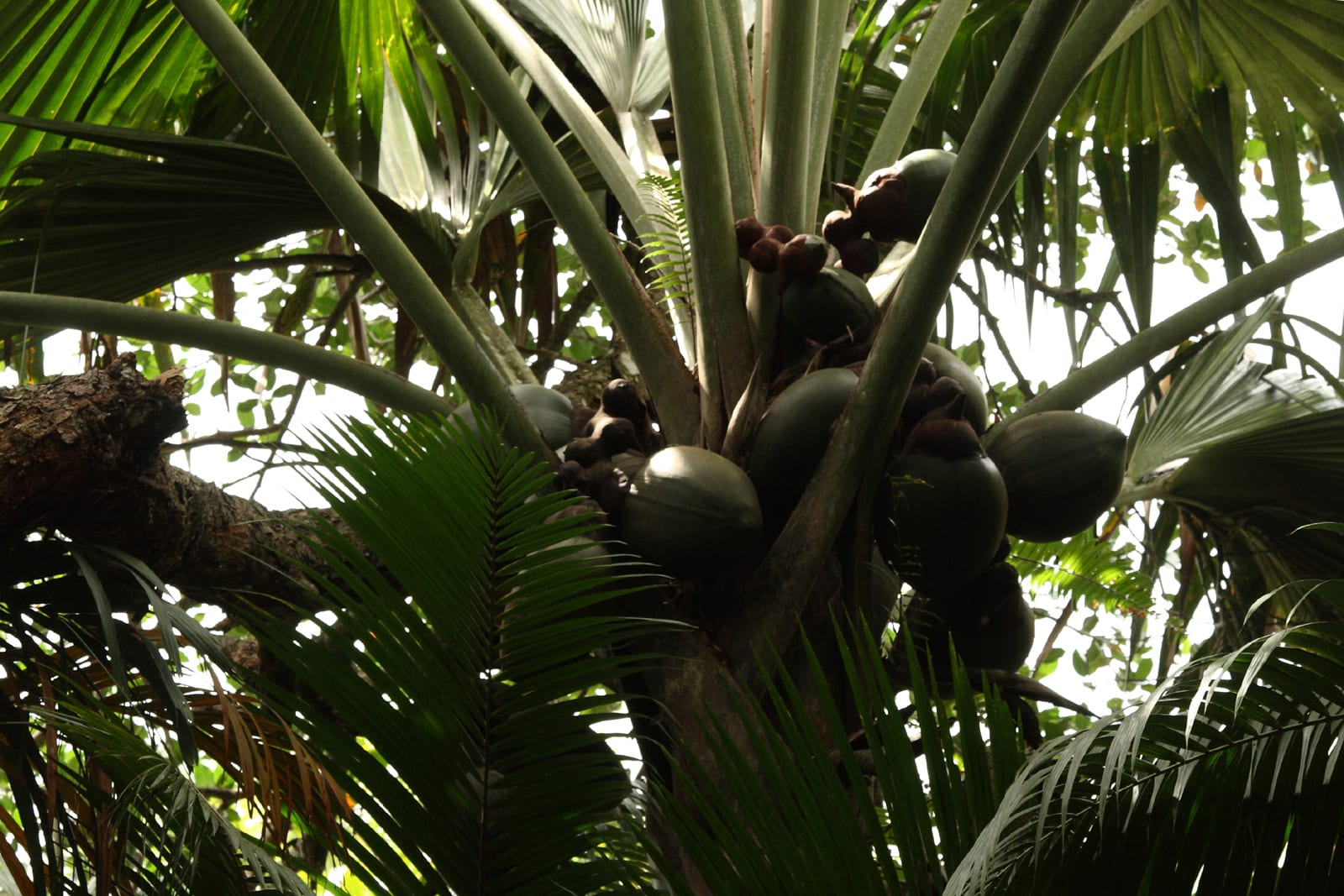
The best place to see the palm in its natural forest is the Vallée de Mai, a 19.5-hectare nature reserve in the middle of Praslin that became a UNESCO World Heritage Site in 1983, one of the smallest natural sites on the list. It is the palm's main stronghold, and all six of the Seychelles' endemic palm species grow together only in this reserve. Coco de mer trees reach 25 to 34 metres, and male and female flowers grow on separate trees; a palm may be 11 to 45 years old or more before it flowers and its sex can be told. The forest is also home to the rare Seychelles black parrot, the national bird, which feeds on the coco de mer's flowers.
On Curieuse, just off the north coast of Praslin, coco de mer palms grow in bare red earth beside a marine national park where more than 300 Aldabra giant tortoises roam. Outside the Seychelles the palm can be seen only in cultivation, in botanic gardens such as those in Sri Lanka and India, where a tree in Kolkata was artificially pollinated with success in 2015.