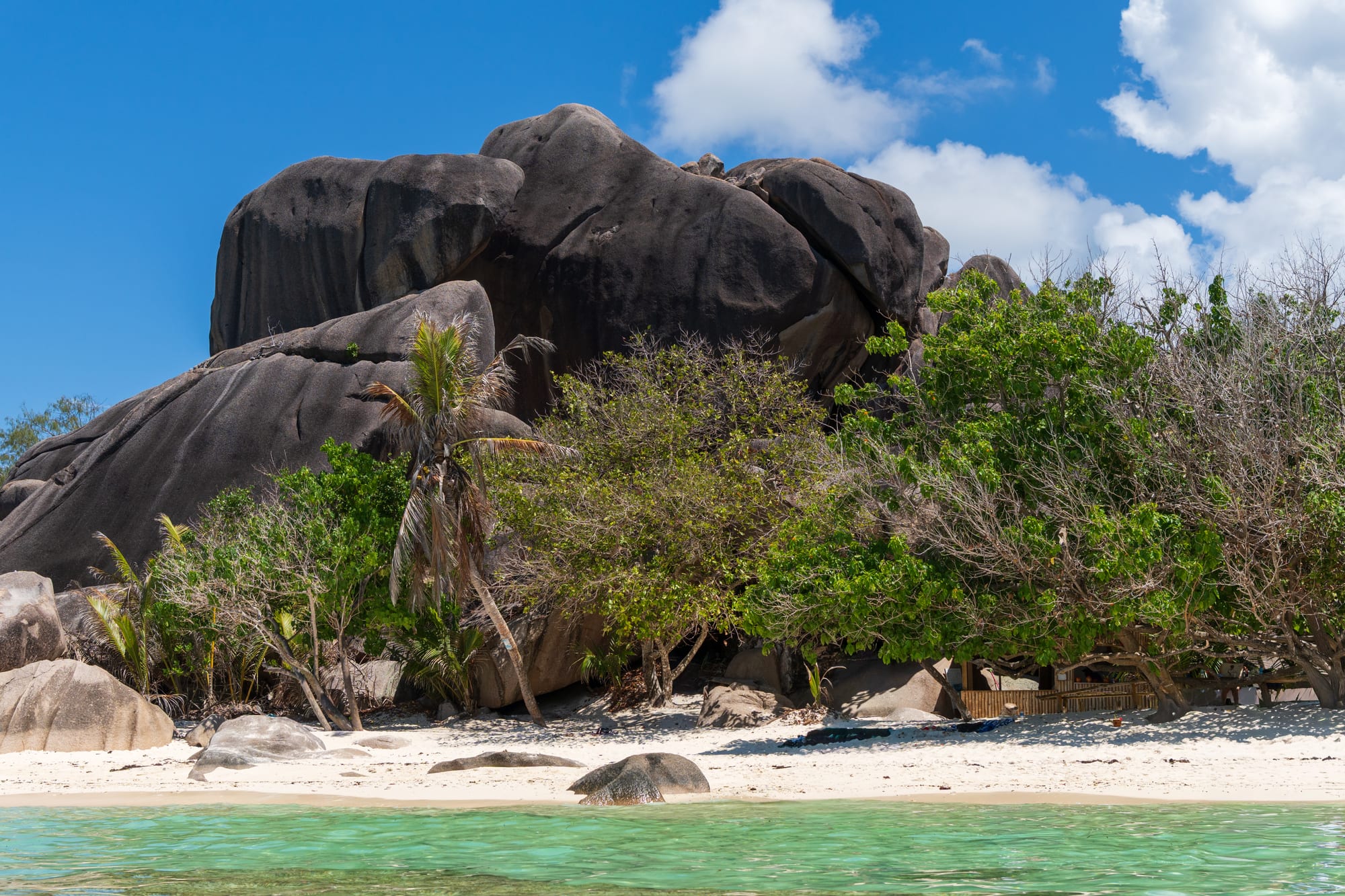
Huge smooth pink-grey granite boulders on a white-sand beach beside a bright turquoise lagoon fringed with palms under blue sky

Seychelles

Anse Source d'Argent on La Digue, the granite-boulder beach that is the emblem of the Seychelles. (Norbert Nagel / Wikimedia Commons · CC BY-SA 4.0)

An archipelago of some 115 islands in the western Indian Ocean — ancient granite peaks and low coral atolls, with no indigenous population — a Creole society, one of Africa's richest countries per head, and a byword for luxury beach travel and marine conservation.

Explore Seychelles

History

The Seychelles had no human population before France claimed the islands in 1756 and settled them from 1770, bringing enslaved Africans to work coconut, cotton, and spice plantations. Britain took the islands during the Napoleonic Wars, confirmed control in 1814, and abolished slavery in 1835, later settling "liberated Africans" freed from intercepted slave ships. A dependency of Mauritius until 1903, Seychelles then became a separate British colony.

Independence came in 1976 under James Mancham. The following year his prime minister, France-Albert René, seized power in a coup while Mancham was abroad and ruled for 27 years as a one-party socialist state, surviving a 1981 mercenary invasion attempt foiled at the airport. Multiparty politics was restored in 1993.

In 2020, the opposition candidate Wavel Ramkalawan, an Anglican priest, won the presidency in a peaceful transfer of power, ending 43 years of rule by René's party. He lost the election of September and October 2025 to Patrick Herminie of United Seychelles — René's old party — who took office on 26 October 2025, a second peaceful handover in five years. Seychelles has the highest income per head and the highest Human Development Index ranking in Africa, on the strength of luxury tourism and tuna, and is a leader in ocean conservation: it issued the world's first sovereign "blue bond" in 2018 to fund marine protection, committed to protecting 30 per cent of its exclusive economic zone, and sets aside around 42 per cent of its territory for conservation.

  • Seychelles: The Islands With No First People — A scatter of granite and coral islands in the western Indian Ocean, uninhabited until the 18th century — a French plantation colony, a British possession, a one-party socialist state after a 1977 coup, and now Africa's richest country per head

Culture & Customs

Seychellois society is Creole — a blend of African, French, British, Indian, and Chinese ancestry with no older layer — and Kreol is the language of home, music, and identity, celebrated with an annual festival. The islands are strongly Roman Catholic, and the church calendar, family, and music shape the social round.

That music is moutya, a slow, sensual drum-and-chant form descended from the songs of enslaved people and now on UNESCO's list, along with the livelier sega and the European-derived kontredans. Craft traditions include weaving from coconut and vacoa palm, and boat-building. The pace is unhurried, hospitality is warm, and the outdoors — the sea, the granite hills, fishing — is central to life.

  • Seychelles: A Drum Warmed by the Fire — A Catholic calendar, a Creole language spoken by almost everyone, and a drum once banned after dark that now stands on UNESCO's list — the customs of a society assembled from many shores

Daily Life

Almost the entire population lives on the three main granite islands — Mahé, with the small capital Victoria; Praslin; and La Digue — with the coral Outer Islands mostly uninhabited. Incomes are high for the region, and the economy rests on two pillars: high-end tourism, which brings more visitors each year than there are residents, and tuna, landed and canned in Victoria.

Offshore financial services and a little agriculture fill out the picture, but Seychelles imports nearly everything, which leaves it exposed to shipping costs, price shocks, and tourism downturns. Coral bleaching, beach erosion, and rising seas are treated as existential threats. Since February 2026 the war between Iran and the United States and Israel has disrupted shipping through the Strait of Hormuz and, since September, the Bab al-Mandab at the mouth of the Red Sea, and unsettled oil prices, aviation and tourism worldwide, which tells on a country that imports almost everything and flies its visitors in.

  • Seychelles: Life Spread Across Three Islands — A household built around the women who run it, a working day split between tourism and the tuna cannery, and an ordinary commute that, for many, means a ferry or a bicycle rather than a road

Food

Seychellois cooking is Creole, built on fish, rice, and coconut. Grilled or fried fresh fish — bourzwa, the red snapper, above all, and fish or octopus curry rich with coconut milk, are the everyday dishes, served with rice and often a lentil dal.

Ladob, plantain, sweet potato or breadfruit cooked in coconut milk with sugar, nutmeg and vanilla, is eaten as a dessert, and a salted-fish version of the same dish as a savoury one; shark chutney (satini reken), mashed with lime and bilimbi juice, is another speciality. Tropical fruit is abundant, and the local drinks are bakka rum, kalou (palm wine), and Seybrew and Eku beers.

Attractions & Natural Wonders

The beaches are the draw, and the most famous is Anse Source d'Argent on La Digue, where pink granite boulders the size of houses stand on white sand. Mahé has Beau Vallon and a string of coves, and Praslin has Anse Lazio and Anse Georgette. La Digue is explored by bicycle at ox-cart pace.

Praslin also holds the Vallée de Mai, a UNESCO-listed palm forest that is the last stronghold of the coco de mer, whose double-lobed seed is the largest in the plant kingdom and endemic to just two islands. Mahé's Morne Seychellois National Park covers the forested spine of the main island, with hiking trails, and Victoria has its botanical gardens, the Selwyn-Clarke market, and a clocktower modelled on London's Little Ben.

Far to the southwest lies Aldabra, one of the largest raised coral atolls in the world and a World Heritage Site, home to about 100,000 Aldabra giant tortoises in a near-pristine ecosystem — reachable only on rare, expensive expedition trips. Diving and snorkelling on the granitic reefs, and whale-shark encounters off Mahé, round out what the islands offer.

Planning basics

Budget

Seychelles is expensive, and everything is imported. Self-catering guesthouses on Mahé, Praslin, and La Digue, the local buses, and takeaway Creole food make an independent trip far cheaper than the resort image suggests; conservation and park fees add up.

Daily Budget Midrange
EUR 250–500 (mid-range hotel, restaurants, a hire car, Vallée de Mai and marine-park fees, a dive or island day trip)
Daily Budget Shoestring
EUR 90–150 (guesthouse, self-catering and takeaways, buses, ferry between islands)

Stay in guesthouses and use the cheap SPTC buses on Mahé and Praslin; budget separately for the Vallée de Mai, marine parks, and some beach entry fees.

Visa Requirements

Seychelles has no visa requirement for any nationality. Visitors must apply online for a Travel Authorisation before arrival and show proof of accommodation, onward travel, and sufficient funds; an initial stay of up to three months is granted, extendable to a year.

Typical Stay
Up to 3 months on arrival, extendable, with a pre-arranged Travel Authorisation

Safety

Seychelles is a very safe destination, with low violent crime and a stable democracy. The main issue is petty theft — break-ins to self-catering villas and hire cars, and thefts from bags left on the beach — so lock up and use safes. Occasional muggings occur after dark in Victoria and on quiet lanes.

Natural
Strong currents and rip tides on some beaches, especially in the southeast monsoon; equatorial sun; no cyclones or malaria

Never leave valuables on the sand or visible in a car, avoid isolated beaches and unlit areas alone at night, heed swimming advice, and carry insurance with evacuation cover as care beyond Mahé is limited.

Climate

Tropical, warm and humid all year, and outside the cyclone belt. The northwest monsoon (December–March) is hotter, wetter, and calmer on the popular west-coast beaches; the southeast monsoon (May–September) is cooler, drier, and breezier, with rougher seas and seaweed on some east-facing beaches. April and October–November are calm transitional months.

Temperature
24–32°C year-round
Calmest Months
April–May and October–November

Transportation

Seychelles International Airport is on Mahé. Ferries link Mahé, Praslin, and La Digue, and small planes fly frequently between Mahé and Praslin. On Mahé and Praslin there are cheap, extensive buses, taxis, and hire cars (drive on the left, on steep mountain roads). La Digue has almost no cars — bicycles are the way around.

Book inter-island ferries ahead in high season, and hire a bike rather than a buggy on La Digue.

Best Time to Visit

April–May and October–November bring calm seas, warm water, and the best diving visibility. The southeast monsoon (June–September) is good value and for wind sports; the northwest monsoon (December–March) is hot and humid but calm on the main beaches. Whale sharks gather seasonally off Mahé.

Events
Festival Kreol, the annual International Creole Festival; Independence Day, also kept as National Day (29 June); Constitution Day (18 June)

Currency

The currency is the Seychellois rupee (SCR). Cards are widely accepted at hotels, restaurants, and dive shops; carry some cash for buses, markets, and small guesthouses.

Symbol
SR / SCR
Currency Code
SCR — Seychellois rupee

Language

Seychellois Creole (Kreol Seselwa), a French-based creole, is the first language of about nine in ten people and an official language with its own literature and the working language of the National Assembly. English is also official, the language in which the laws are written, and is used in the courts and in business and widely and fluently spoken. French is the third official language, used alongside the other two in the press. Visitors get by entirely in English.

Official Languages
Seychellois Creole, English, French