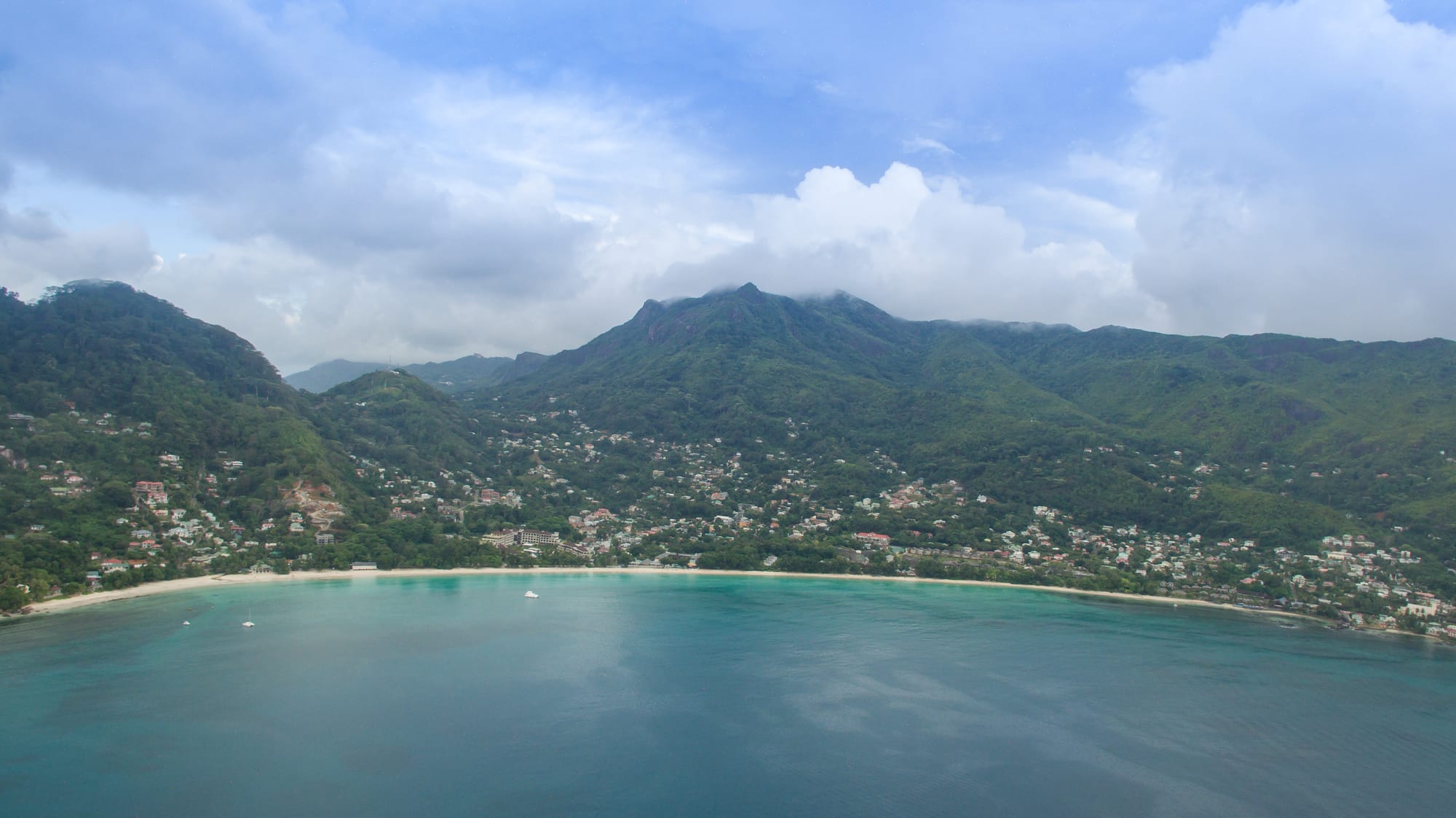
Aerial view of a wide bay with a pale beach, houses spread up forested hillsides and cloud-topped granite peaks behind

Seychelles

Mahé

Beau Vallon bay on the north-west coast of Mahé, backed by the forested peaks of the island's granite spine. (dronepicr / Wikimedia Commons · CC BY 2.0)

The largest island of the Seychelles and the seat of its capital, Victoria — a granite ridge of forested peaks rising straight from the Indian Ocean, settled by the French from the 1770s. It holds the international airport, the tuna port and most of the country's people, hotels and beaches, from busy Beau Vallon to the empty sands of the south.

Neighbourhoods

  • Victoria
    • First-time visitors
    • Markets
    • Local life

    The capital, on the north-east coast, compact enough to cross on foot. Government offices, the market, the museum, the cathedral and the tuna port are all here, and the bus network radiates from the central terminal.

    Open in Maps
  • Beau Vallon
    • Beaches
    • Best for food
    • Diving

    A long north-west bay a few kilometres over the hill from Victoria, with one of the island's most popular beaches, a base for diving and snorkelling, and a run of hotels and beachside restaurants. Sunsets face the open sea.

    Open in Maps
  • The south and Anse Royale
    • Quiet and residential
    • Beaches
    • Local life

    The southern half of the island is greener and far quieter, with village settlements, a scattering of small hotels and long beaches such as Anse Intendance and Anse Takamaka. A hire car or the bus is needed to reach it.

    Open in Maps
  • The west coast and Port Glaud
    • Quiet and residential
    • Nature

    A rugged strip beneath the mountains facing the marine park at Port Launay, with few buildings, mangroves and forest trails running inland. It feels remote although the capital is only a short drive across the ridge.

    Open in Maps
  • The mountain interior
    • Walks and viewpoints
    • Nature

    The forested spine of the island, much of it inside Morne Seychellois National Park, reached by the winding Sans Souci road. Tea grows on the slopes, mist sits on the ridges, and the viewpoints look down over Victoria and the offshore islands.

    Open in Maps

Things to do

Victoria and its landmarks

  • Sir Selwyn Selwyn-Clarke Marketmarket

    The capital's main market, built in 1840 and renovated in 1999, selling fish, fruit, spices and souvenirs in the middle of town.

    Open in Maps
  • Seychelles Natural History Museummuseum

    A small museum in Victoria, next to the main post office, with displays on the islands' botany, zoology, geology and anthropology.

    Open in Maps
  • Immaculate Conception Cathedrallandmark

    Victoria's Roman Catholic cathedral, built in 1874 in the French colonial style and standing near the Clock Tower and the Anglican cathedral.

    Open in Maps
  • National Botanical Gardenpark

    The garden at Mont Fleuri on the edge of Victoria, founded in 1901 as an agricultural station, which now cultivates over 60 per cent of the endemic flowering plants of the granitic islands.

    Open in Maps
  • Arul Mihu Navasakthi Vinayagar Templelandmark

    Victoria's colourfully decorated Hindu temple near the market and the Clock Tower, consecrated in 1992 and the only temple in the Seychelles with Ganesha as its presiding deity.

    Open in Maps

Beaches and the sea

  • Beau Vallonbeach

    Possibly the island's most popular beach, a bay on the north-west coast whose clear water and coral reefs make it a base for diving and snorkelling, with several hotels and restaurants.

    Open in Maps
  • Anse Intendancebeach

    A beach on the south-west coast in the Takamaka district, roughly 30 km from Victoria, and a significant nesting site for hawksbill turtles.

    Open in Maps
  • Anse Royalebeach

    A beach on the south-east coast in the district of the same name, where the University of Seychelles has its main campus.

    Open in Maps
  • Sainte Anne Marine National Parkpark

    A protected group of islands and reefs in the bay off Victoria, created in 1973 as the Indian Ocean's first marine national park and reached by boat in minutes.

    Open in Maps

Walks, gardens and viewpoints

  • Morne Seychellois National Parkpark

    The park covering nearly a fifth of the island, with steep forest, granite cliffs and boulders, remnant primary forest above 600 metres and some tea cultivation.

    Open in Maps
  • Morne Seychelloisviewpoint

    The highest point in the Seychelles at 905 metres, a steep forested summit at the heart of the national park.

    Open in Maps
  • Mission Ruins of Venn's Townlandmark

    The remains of an Anglican mission school for the children of Africans freed from slave ships, open from 1876 to 1889, at 450 metres in the Sans Souci hills; a National Monument and on the UNESCO tentative list since 2013.

    Open in Maps

Getting around and arriving

  • Seychelles International Airporttransit hub

    The country's only international airport, on the east coast about 11 km south-east of Victoria, with the domestic terminal for flights to Praslin.

    Open in Maps
  • Silhouette Islandattraction

    A steep, barely inhabited granite island about twenty kilometres north-west of Mahé, almost entirely national park and reached by boat.

    Open in Maps
  • Cerf Islandattraction

    A small inhabited island inside the Sainte Anne marine park, a short boat ride from Victoria, with beaches and a low forested hill.

    Open in Maps

Seasonal events

  • Festival Kreolonce a year

    The annual International Creole Festival, a celebration of Creole music, dance and culture that includes district and school kontredans competitions, and which absorbed the Carnaval International de Victoria, the Rio-style carnival first held in 2011.

  • National Daylate June

    Independence Day on 29 June is marked with parades and shows in Victoria, alongside Constitution Day on 18 June.

Eat and drink

Long-standing places and food districts in Mahé. Hours, ratings and directions come from your maps app, always current.

Mahé classics

  • Grilled fish and Creole curryrestaurant

    Whole grilled red snapper with a sharp satini chutney, octopus curry in coconut milk and rice are the standard meal in beach restaurants and takeaways alike.

    Open in Maps
  • Takamaka rumrestaurant

    The Trois Frères distillery at La Plaine St André, a colonial-era plantation estate in the south-east, makes Takamaka rum, the country's only commercial rum.

    Open in Maps

Markets and food districts

  • Sir Selwyn Selwyn-Clarke Marketmarket

    Victoria's market is the place for reef fish, tropical fruit, breadfruit, chillies, spices and local crafts.

    Open in Maps
  • Victoria's takeaway countersneighborhood

    Lunchtime in the capital runs on takeaway boxes of curry, grilled fish, rice and lentils sold from small counters around the market and the bus terminal.

    Open in Maps
  • Beau Vallon beachfrontneighborhood

    The strip behind the beach holds the island's densest run of restaurants, bars and evening food stalls selling grilled fish and skewers.

    Open in Maps

Experience Mahé

History

Mahé was uninhabited when a French expedition took possession of the island in 1756 and named the archipelago for Jean Moreau de Séchelles; the island itself carries the name of Bertrand-François Mahé de La Bourdonnais, governor of the Isle de France. The first settlers landed on neighbouring Sainte Anne Island in 1770 with enslaved Africans and Indians, and the settlement at the site of Victoria followed in 1778. Cinnamon, once a plantation crop, now runs wild through the island's lower forests.

Britain took control during the Napoleonic Wars and confirmed it in 1814. Slavery was abolished in 1835, and from the 1860s the Royal Navy landed Africans freed from intercepted slave ships; a mission school was opened for their children in the hills at Venn's Town in 1876. The settlement at the harbour, named Victoria in 1841, grew into the administrative centre of a dependency of Mauritius until the islands became a separate colony in 1903.

Coconut and cinnamon carried the economy until the opening of the airport in 1971 brought aviation and tourism, transforming the island within a generation. Mahé was the stage for the country's modern politics: independence in 1976, the coup of 1977, and the attempted mercenary landing at the airport in 1981. Land reclaimed from the sea has since added new islands to the country, among them Eden Island and Ile Perseverance.

Culture & Customs

Mahé is where Seychellois Creole culture is most concentrated and most public. Kreol Seselwa is the first language of nearly everyone; English and French are used in offices, law and church. The island keeps the country's institutions — the National Assembly and the University of Seychelles — and its cultural calendar peaks with the annual Festival Kreol, a celebration of Creole music, dance and culture.

The music is moutya, a slow drum-and-chant form descended from the songs of enslaved people and inscribed by UNESCO in 2021, alongside the faster sega and the European-derived kontredans. Roman Catholicism shapes the week, with full churches on Sunday and saints' days marked in the villages; there are also Anglican, other Christian and Hindu congregations, and Victoria's Hindu temples and mosques reflect the Indian and Muslim minorities.

Manners are gentle and unhurried. Greetings are exchanged before business, dress in town is modest by beach standards, and people are quick to point a stranger towards the right bus. Football is the most popular sport, fishing is both work and pastime, and craft traditions are kept up partly for visitors and partly out of habit.

Daily Life

About 86 per cent of the country's roughly 100,000 people live on Mahé, most of them in the north and east of the island, in Victoria and a chain of settlements along the coast. Houses climb the hillsides above the coast road, and the flat reclaimed land carries industry, the port and newer estates.

Work means government, tourism and fish. Tuna fishing and canning at Victoria's inner harbour are a major industry, the port handles the industrial fleet that works the Indian Ocean, and hotels, dive centres and boat operators absorb much of the rest. Offshore financial services and construction add more. Output per head is the highest in Africa, but so are prices, since nearly all food, fuel and materials arrive by ship.

The day starts early — buses are crowded by six — and ends early too; offices close in the afternoon and Victoria empties by evening, leaving the beach strips as the places that stay awake. Weekends are for family, church and the sea. Traffic on the narrow coast road, the cost of housing, coral bleaching and beach erosion are the recurring local concerns.

Food

Mahé eats Creole, which on the everyday plate means grilled or fried reef fish — bourzwa, the red snapper, above all — with rice, a lentil dal and satini, a sharp chutney. Octopus curry simmered in coconut milk is the dish visitors are most often told to try, and fish in a light tomato and onion sauce is the standard family supper.

Lunch in Victoria is a takeaway box bought from a counter near the market: curry, rice, salad and a piece of fried fish. The market itself sells the fish whole off the ice, along with breadfruit, mangoes, golden apples, vanilla pods and the small, ferocious chillies that season everything. Breadfruit appears fried as crisps or boiled as a starch, and sweet potato, cassava and plantain do similar work.

Desserts lean on coconut and nutmeg: ladob, in which plantain, sweet potato or breadfruit is cooked in sweetened coconut milk, has a savoury salt-fish twin of the same name. Shark chutney, mashed with lime and bilimbi juice, is a Seychellois speciality. The island drinks Seybrew beer, Takamaka rum from the distillery in the south-east, kalou (palm wine) where it is still tapped, and tea grown on the slopes of Morne Seychellois.

Planning tools

Budget

Mahé is the cheapest of the main islands to visit because it has the buses, the supermarkets and the widest choice of guesthouses. Almost everything is imported, so food and drink cost more than the setting suggests, and park and marine-reserve fees are extra.

Daily Budget Midrange
USD 270–540 (mid-range hotel, restaurant meals, a hire car, marine-park fees and a boat or dive trip)
Daily Budget Shoestring
USD 100–165 (guesthouse room, self-catering and takeaway Creole food, the SPTC bus)

Self-catering rooms and the cheap island buses cut the cost sharply; the beaches, the botanical gardens' surroundings and the mountain trails cost little or nothing.

Best Time to Visit

April–May and October–November are the calmest months, with warm, clear water and the best diving visibility. The southeast monsoon from June to September is breezier and cooler and pushes seaweed onto some east-coast beaches; the northwest monsoon from December to March is hot, humid and calm on the west coast, where Beau Vallon lies.

Suggested Number of Days

Three or four days covers the capital, the beaches on both coasts and a walk in the hills. A week or more suits a trip that adds Praslin and La Digue by ferry, or a diving course. Hiring a car shortens the time needed.

First Visit
3–4 days
With Surroundings
7–10 days

Transportation

The SPTC bus network is cheap and reaches almost every village, running from the terminal in Victoria, though services thin out in the evening. Taxis are metered, and hire cars are widely available; driving is on the left on narrow, steep and winding mountain roads. The inter-island ferry terminal and the domestic air terminal both serve Praslin and La Digue.

Fill the tank before heading south or over the mountains, as petrol stations are few outside the Victoria area.

Airport & Station Connections

Seychelles International Airport sits on the east coast about 11 km south-east of Victoria, linked to it by the Victoria–Providence Highway, and handles all flights into the country, mainly from the Gulf, East Africa, Europe and neighbouring Indian Ocean islands. Ferries to Praslin and La Digue leave from the quay in Victoria, and cruise ships berth at the same port.

Walkability

Victoria is small and flat enough to walk end to end, and the Beau Vallon beach road is easy on foot. Elsewhere the island is not built for walking: roads are narrow, often without pavements, and climb steeply between bays, so buses, taxis or a car cover the distances. Walking trails in the national park are a separate pleasure, steep and often muddy.

Safety

Mahé is safe by most measures, with little violent crime, but it sees more petty theft than the smaller islands — break-ins to self-catering villas and hire cars, and thefts from bags left on the sand. Occasional muggings are reported after dark in quiet parts of Victoria. Currents on the south and east coasts can be strong in the southeast monsoon.

Never leave valuables on the sand or visible in a car, avoid isolated beaches and unlit areas alone at night, heed swimming advice, and carry insurance with evacuation cover as care beyond Mahé is limited. Check current official travel advice before travelling.

Climate

Tropical and humid all year, between about 24 and 32°C, with the island lying outside the cyclone belt. The mountains are cooler and much wetter than the coast, and rain usually comes in short heavy bursts.

Summer
December–March, the northwest monsoon: hottest and wettest, around 27–32°C by day, with calm seas on the west coast
Winter
May–September, the southeast monsoon: cooler and drier at about 24–29°C, breezy, with rougher water on east-facing beaches

Local Customs

Kreol is the language of daily life, with English and French also official and widely understood. Greetings matter and the pace is unhurried. Beach dress stays on the beach: cover up in Victoria, in shops and in churches, which are busy on Sundays in a strongly Catholic country. Nudity is not acceptable on public beaches.

Tipping is not expected, though rounding up is welcome; ask before photographing people, and remove shoes at the Hindu temple.

Common Payment Methods

The currency is the Seychellois rupee. Cards are accepted at hotels, restaurants, dive shops and supermarkets, and tourist accommodation is often priced in euros. Cash is needed for buses, market stalls and small guesthouses; ATMs are in Victoria, at the airport and in the larger villages.