History · Palestine
Why is Bethlehem's Church of the Nativity one of the oldest churches still in use?
Built over a cave revered as Jesus's birthplace, rebuilt in the sixth century and spared by conquerors, it has never stopped being a working church.
By Globeway Editorial · 2 November 2026
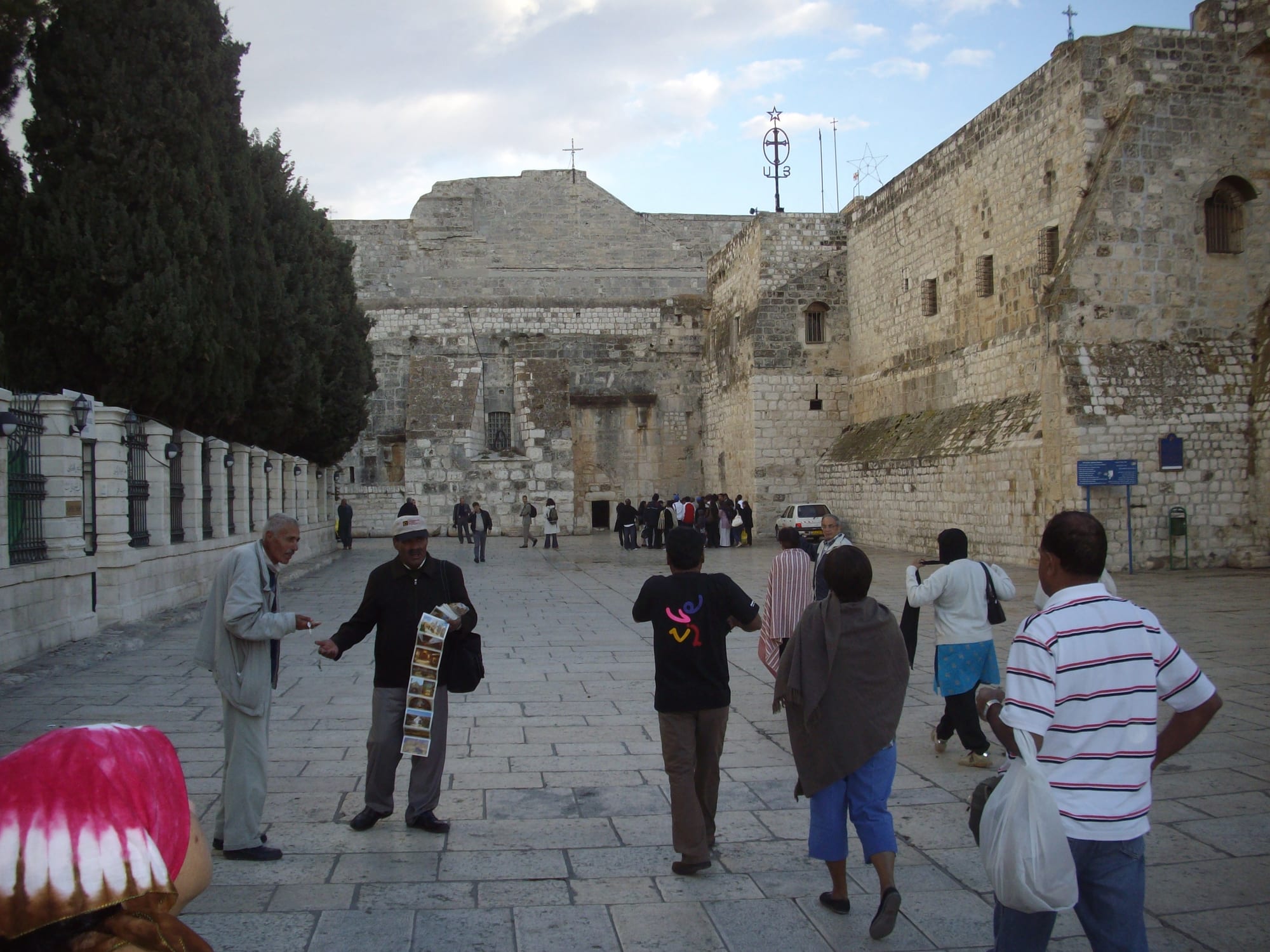
The short answer
The Church of the Nativity stands over a cave that Christians have honoured as the birthplace of Jesus since at least the third century. Emperor Constantine built the first basilica there in the 320s and 330s; after a fire in the sixth century, Emperor Justinian rebuilt it, and the church standing today is essentially that building, with timbers in its walls dated to between 545 and
- The grotto beneath it is considered the oldest site in continuous use as
a place of Christian worship, and the basilica is the oldest major church in the Holy Land.
It has survived because nobody ever stopped using it. A Persian army spared it in 614, later Muslim rulers let Christian clergy keep serving in it, and for centuries Greek Orthodox, Catholic and Armenian communities guarded it so jealously that none would let the others neglect it. Older church buildings exist, but most are ruins; at this one worship has continued, almost without a break, for some 1,700 years.
A cave remembered before any church
Two of the four gospels, Matthew and Luke, place the birth of Jesus in Bethlehem, and Luke describes the newborn laid in a manger. Local memory attached the event to a particular cave. Around AD 248 the Christian philosopher Origen of Alexandria wrote that in Bethlehem the cave where Jesus was born was pointed out to visitors, and that this was well known even among people who were not Christians.
The site had already been marked in a different way. In 135, after a Jewish revolt had been crushed, the Roman emperor Hadrian had the ground above the grotto turned into a place of worship for Adonis, a figure from Greek myth. The scholar Jerome later wrote that a sacred grove had been planted there.
After the Council of Nicaea, Constantine set out to build churches at the places linked to the life of Jesus. His mother Helena visited Jerusalem and Bethlehem in 325 to 326, and the emperor ordered a basilica over the cave. A pilgrim from Bordeaux saw it in use in 333, and it was dedicated on 31 May 339. Its east end had an opening about 4 metres across in the floor, through which worshippers could look down into the grotto below.
Justinian's church, the one still standing
The first basilica was burned during one of the Samaritan revolts of the sixth century, in 529 or 556. Justinian ordered a new church on the same plan, though the work was probably finished after his death in 565. He kept the long nave and four side aisles, added a porch, and replaced the old east end with a cross-shaped one ending in three apses.
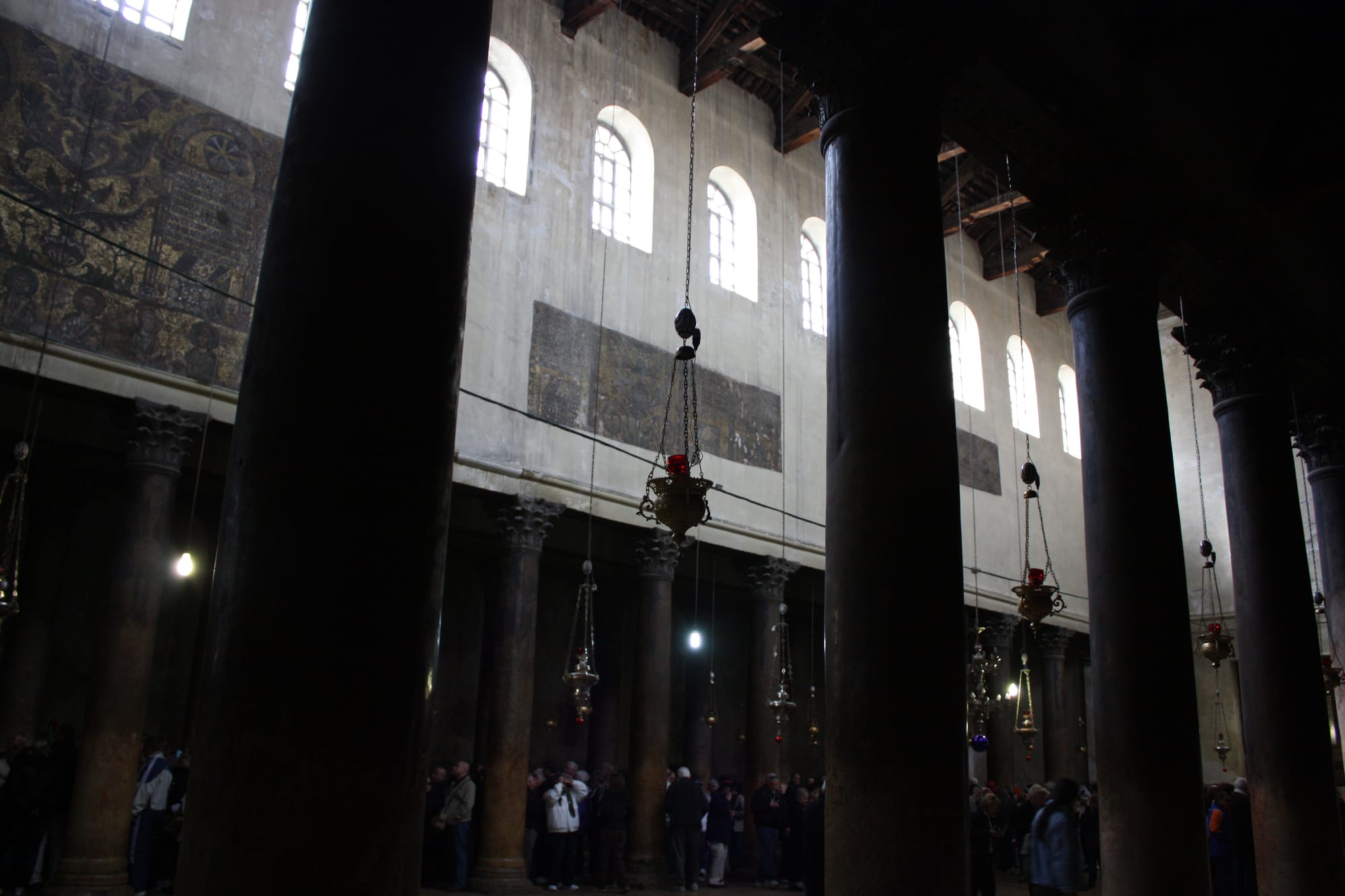
Forty-four columns divide the aisles. Some still carry painted saints added by Crusader-era donors, among them the Norwegian king Olaf II.
That building has remained basically unchanged ever since, and pieces of the first one survive inside it. Beneath trap doors in the floor lie sections of the mosaic pavement from Constantine's basilica, laid in the fourth century.
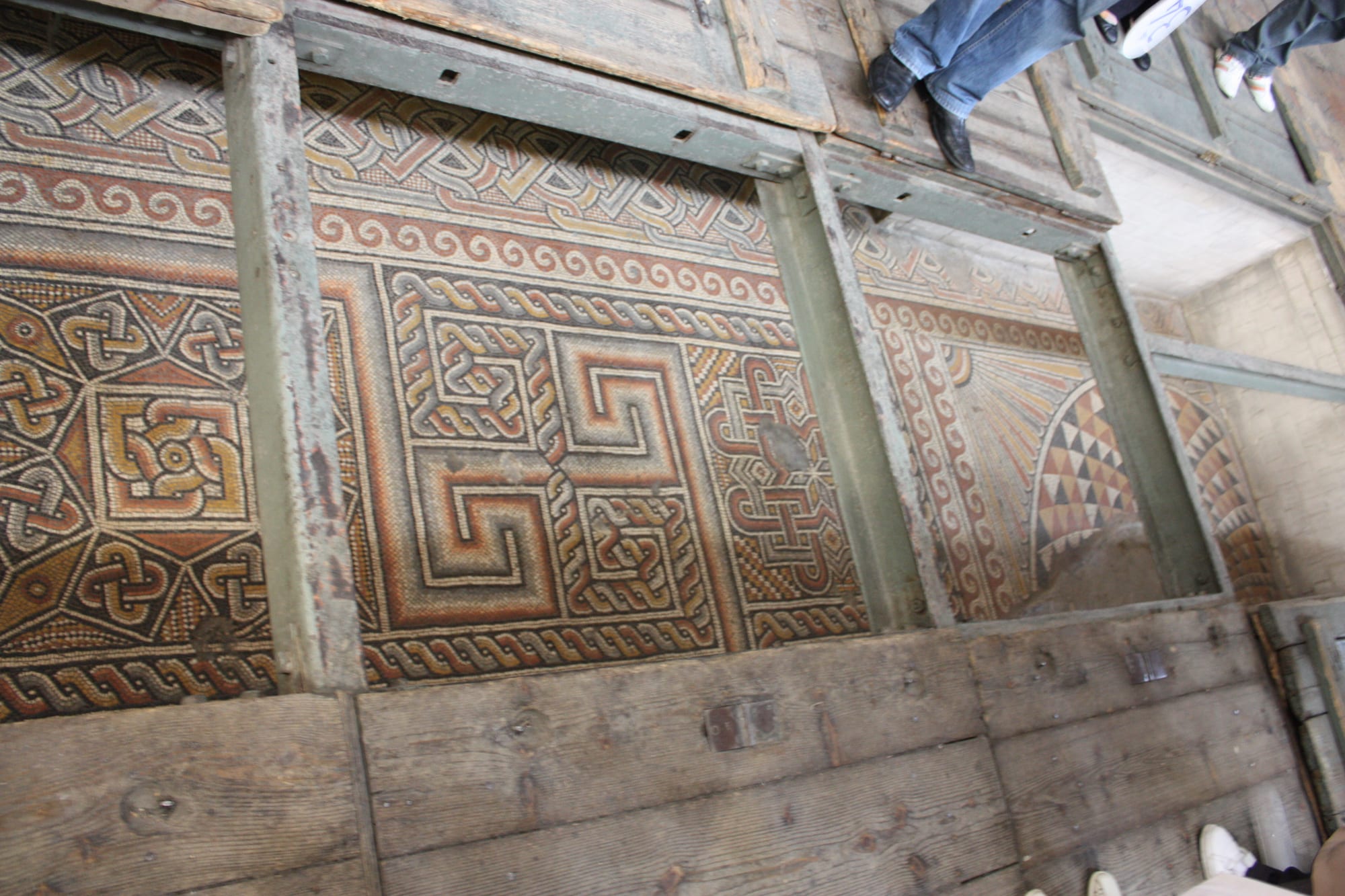
These patterns were set into the floor around 1,700 years ago.
Spared by conquerors
The church came through centuries of conquest intact. When the Persians under Khosrau II conquered nearby Jerusalem in 614, they left the church standing. According to legend, their commander Shahrbaraz saw a picture above the entrance showing the Three Magi, the wise men of the nativity story, dressed as Persian Zoroastrian priests, and ordered the building saved.
The Crusaders, who took Jerusalem in 1099, decorated the church rather than rebuilding it, adding wall paintings and, between 1165 and 1169, gold mosaics made in a rare collaboration between the Crusader king Amalric and the Byzantine emperor Manuel I Komnenos. When Saladin's Ayyubid dynasty took the region in 1187, the change had no consequences for the church: Greek clergy were allowed to serve there, and other Christian communities soon received similar rights.
Neglect was a greater danger than armies. From the late 13th century pilgrims complained that the marble facing was being stripped from the walls and floor. Rescue came from far away: in 1480 England supplied lead for the roof, Burgundy the timber and Venice the labour. Under Ottoman rule after 1516 the nave was largely abandoned and used for everyday purposes, and to stop people riding in with horses and cattle, the great entrance was walled up into a small door.
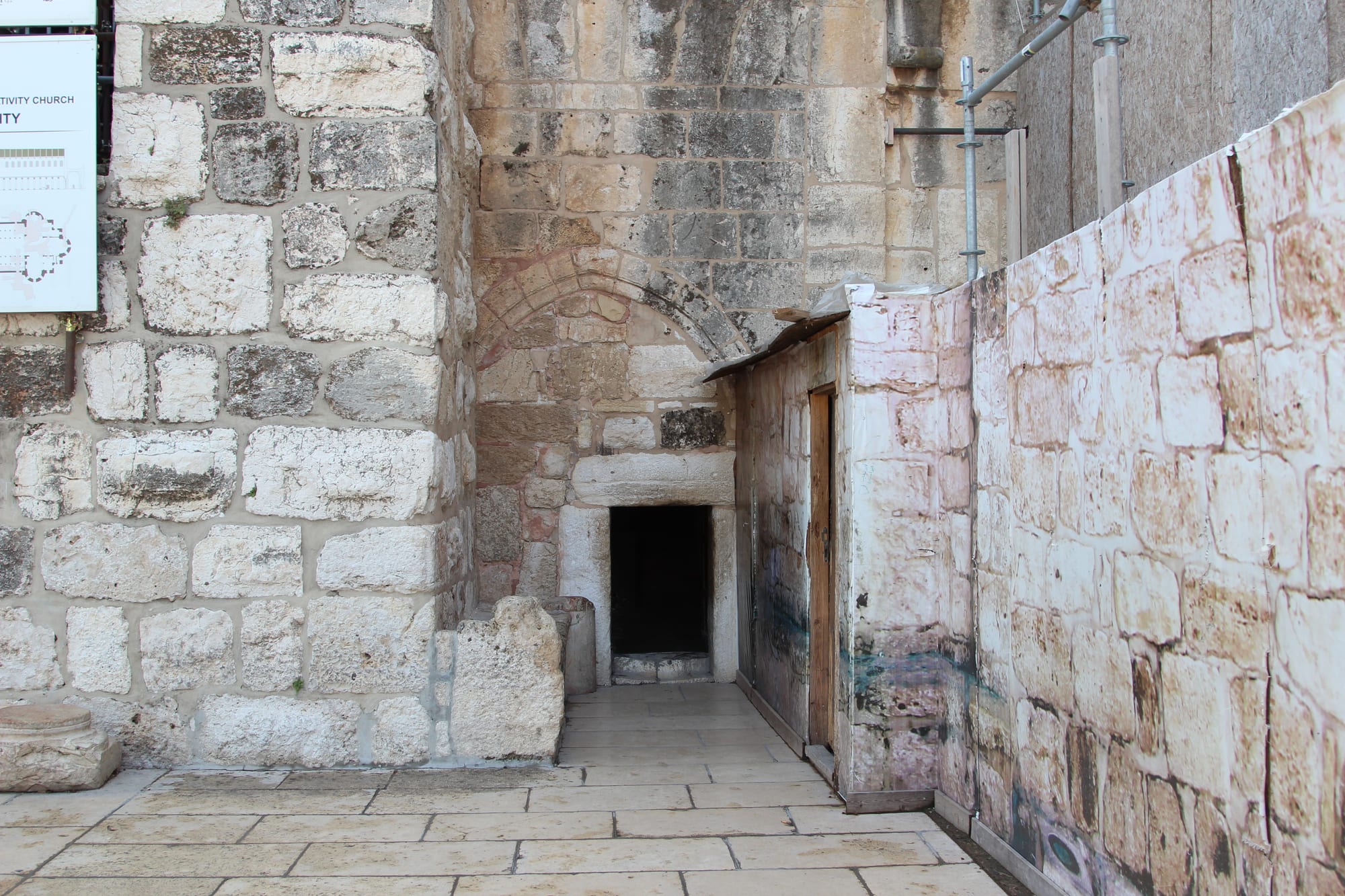
Visitors must stoop to pass through it, which is how it earned its name.
Three owners and a rulebook
The church's long survival owes much to the communities that share it, even when they quarrelled. Through the Ottoman centuries control swung between Greek Orthodox and Catholic clergy, while Armenians established a monastery beside it in the 17th century. In 1847 the silver star marking the spot of the birth, installed by Catholics in 1717, disappeared from the grotto, an incident that fed the rivalry between France and Russia over the holy places and, some historians argue, helped bring on the Crimean War.
The settlement that followed, known as the Status Quo, still governs the church. Fixed by an Ottoman decree in 1852, made official by the Treaty of Paris in 1856 and recorded by a United Nations commission in 1949, it divides ownership between the Greek Orthodox, who hold most of the building, and the Catholic and Armenian churches. Every lamp counts: of the 15 silver lamps around the star, six belong to the Greek Orthodox, four to the Catholics and five to the Armenians. The arrangement is rigid, but it has meant that the building always has keepers.
Still a working church
In 2008 the World Monuments Fund warned that rotting roof timbers and rainwater were threatening the building and its 12th-century mosaics. In 2012 the church became the first site in Palestine inscribed on UNESCO's World Heritage List, and it spent 2012 to 2019 on the list of sites in danger. A restoration beginning in 2013 replaced windows, repaired the roof and cleaned the mosaics, revealing a seventh mosaic angel under plaster in 2016. Work paused in 2021, and the grotto itself was still awaiting restoration in 2024.
Through all of it the services continue, and Christmas is celebrated three times. Catholics mark it on 24 and 25 December, the Greek Orthodox and several other churches on 6 and 7 January, and the Armenians on 18 and 19 January. On Christmas Eve crowds gather in Manger Square outside, and the Latin Patriarch of Jerusalem places a figure of the infant Jesus on the silver star. Since February 2026 a wider regional war has disrupted travel and tourism across the area, and conditions change quickly.