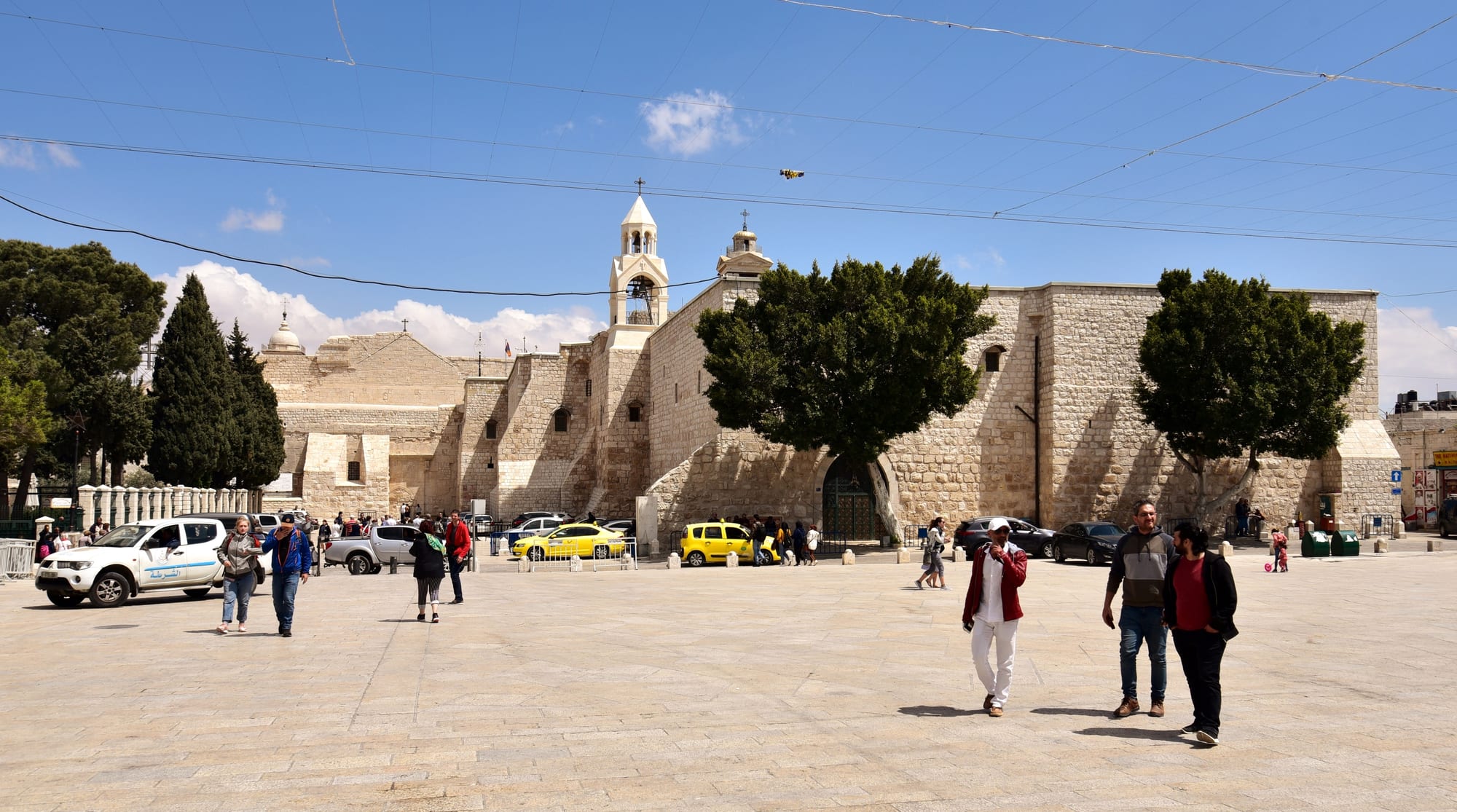
A fortress-like stone church with low doorways and a bell tower, fronting a paved square under a bright sky

Palestine

The Church of the Nativity in Bethlehem, built over the traditional birthplace of Jesus — one of the oldest churches in continuous use and a UNESCO World Heritage Site. (Bahnfrend / Wikimedia Commons · CC BY-SA 4.0)

The West Bank and the Gaza Strip, with East Jerusalem — the territory of a Palestinian state recognised by 157 of the 193 UN member states and holding UN observer-state status, under Israeli occupation since 1967, divided politically between the Palestinian Authority in the West Bank and, in Gaza, where Hamas dissolved its administration in July 2026 in favour of a transitional technocratic committee whose entry into the territory has been delayed, after the catastrophic war that began in October 2023. This page is written to explain the territory, not to encourage travel to it — Gaza is devastated and inaccessible, and governments warn against much of the West Bank.

Explore Palestine

History

The land — shared in its ancient and religious history with the account on the Israel page — was part of Ottoman and then British-administered "Palestine". A 1947 United Nations plan proposed separate Jewish and Arab states; the Arab leadership rejected it. In the 1948 war that followed Israel's declaration of independence, around 700,000 Palestinians fled or were expelled — the Nakba, or "catastrophe" — and the territory intended for the Arab state was divided: the West Bank came under Jordanian rule and the Gaza Strip under Egyptian control.

Israel occupied the West Bank, East Jerusalem, and Gaza in the 1967 war, and began building settlements, which most of the world considers illegal under international law (a view Israel disputes). The First Intifada broke out in 1987, and the following year the PLO declared Palestinian independence. The Oslo Accords of 1993–95 created the Palestinian Authority with limited self-rule in the towns (Area A) and some rural areas (Area B), while Israel kept full control of Area C, about 60 per cent of the West Bank. The Second Intifada (2000–05) was far bloodier, and Israel began building the separation barrier in 2002.

Israel withdrew its settlers and soldiers from Gaza in 2005. Hamas won Palestinian legislative elections in 2006 and, after a violent split with Fatah in 2007, took sole control of Gaza, while the Palestinian Authority governs parts of the West Bank; Israel and Egypt have blockaded Gaza since. Wars in Gaza followed in 2008–09, 2012, 2014, and 2021. In 2012 the UN General Assembly upgraded Palestine to a non-member observer state. A Hamas-led attack on Israel on 7 October 2023 killed about 1,200 people and took 251 hostages. In Israel's ensuing war in Gaza more than 75,000 Palestinians had been reported killed by late September 2026, according to the Gaza Health Ministry, almost the entire population was displaced and famine conditions set in; many UN bodies, human rights organisations and scholars have concluded that Israel's actions constitute genocide, which Israel and the United States deny. A ceasefire under a US-backed peace plan took effect on 10 October 2025, and in July 2026 Hamas dissolved its civil administration in favour of the internationally recognised National Committee for the Administration of Gaza, overseen by a Board of Peace chaired by the US president, though the committee's entry into the territory has been repeatedly delayed; an agreement that same month to disarm the armed factions was made conditional on Israeli withdrawal and reconstruction, and the plan has repeatedly stalled. The West Bank has meanwhile seen intensified settlement expansion, settler violence, and Israeli raids, and a lasting political settlement remains absent.

  • Palestine: A Contested Land — A small, much-conquered land at the junction of Africa and Asia — an Ottoman province, a British mandate, the site of two national movements claiming the same territory, and, since 1967, of an occupation and a stalled search for two states

Culture & Customs

Palestinian society is Arab, mostly Sunni Muslim, with a historic Christian minority concentrated around Bethlehem, Beit Jala, and Ramallah, and a tiny Samaritan community near Nablus. Attachment to land, and specifically to the family village and its olive trees, runs through the culture, and symbols such as the keffiyeh and the house key stand for the experience of displacement and the claim of return.

Hospitality is a strong obligation, and family and clan (hamula) ties are central. Living traditions include dabke line dancing, Palestinian embroidery (tatreez, on UNESCO's heritage list), the poetry associated above all with Mahmoud Darwish, and a large body of folk song and proverb. A significant share of the population are refugees, many still in camps in the territories and in neighbouring countries, and there is a worldwide diaspora, the shatat. The value of sumud — steadfastness, staying put — is often invoked.

  • Palestine: Embroidery, Coffee and Kinship — A society built around family and hospitality, where Muslim and Christian communities share an Arab heritage and where embroidery, dance, storytelling and soap-making are recognised as living traditions

Daily Life

Around five million Palestinians live in the territories — roughly three million in the West Bank including East Jerusalem, and more than two million in Gaza before 2023. In the West Bank, daily movement is shaped by checkpoints, the separation barrier, roads reserved for settlers, permit regimes, and periodic closures. The economy is heavily dependent on Israel — for labour permits, the shekel, and a customs union — as well as on foreign aid and remittances, and unemployment is high. Restrictions in Area C limit Palestinian building and access to water and grazing.

Palestinians in East Jerusalem hold Israeli residency but not citizenship, and can lose that status if they live elsewhere. Gaza before the war held more than two million people in 365 square kilometres under blockade, with electricity for only part of the day and undrinkable groundwater; since October 2023 much of it has been destroyed, with mass displacement and famine, and rebuilding it has been estimated to cost around 70 billion US dollars.

  • Palestine: Two Kinds of Waiting — Extended families sharing a shrinking home, a working week that opens on Sunday, and two territories where an ordinary day means checkpoints and permits in the West Bank and, in Gaza, rebuilding a life on rubble nearly a year into a fragile ceasefire

Food

Palestinian cooking shares the Levantine base of hummus, falafel, and grilled meats, with dishes of its own. Musakhan — chicken roasted with sumac and caramelised onions on taboon bread and doused in olive oil — is the national dish. Maqluba, an "upside-down" pot of rice, meat, and fried vegetables, is the classic family meal; maftoul is the Palestinian couscous; and the central West Bank and the south make mansaf, lamb and rice served on taboon bread under dried jameed yoghurt, a dish with Bedouin roots.

Nablus is famous for knafeh Nabulsiyeh, a hot cheese pastry soaked in orange-blossom syrup, and for its olive-oil soap. Za'atar and olive oil, freekeh, and stuffed vegetables (mahashi) are everyday staples. Coffee is strong and cardamom-scented, sage tea is common, and alcohol is made locally too — the Taybeh brewery in a West Bank Christian village and the Cremisan winery run by Salesian monks near Bethlehem.

  • Palestine: Food and the National Dish — Roasted chicken and sumac-spiced onions over flatbread, a dish tied to the olive harvest season and regarded as a symbol of Palestinian identity

Attractions & Natural Wonders

In practice, visiting means the West Bank. Bethlehem has the Church of the Nativity over the traditional birthplace of Jesus, Manger Square, the Milk Grotto, Shepherds' Field, and, by the separation barrier, the artist-decorated Walled Off Hotel. Jericho, among the oldest continuously inhabited towns on Earth, has the Tell es-Sultan mound (a UNESCO site), the Umayyad Hisham's Palace, and the cable car to the Mount of Temptation monastery, with the Dead Sea's northern shore and the Jordan River baptism site of Qasr al-Yahud nearby.

Hebron holds the Ibrahimi Mosque over the Cave of the Patriarchs, sacred to Jews and Muslims and sharply divided, and an Old City of narrow streets and old bazaars. Nablus has an Ottoman old town, soap workshops, and knafeh, with the Samaritan community and Roman ruins of Sebastia close by. Ramallah is the lively de facto administrative capital, where Yasser Arafat's tomb stands in the Mukataa compound. The Battir agricultural terraces near Bethlehem are a UNESCO World Heritage Site, listed as Land of Olives and Vines, the cultural landscape of southern Jerusalem — and the cliff-clinging Mar Saba monastery sits in the Kidron desert. Gaza's Byzantine mosaics, the Great Omari Mosque, and its Mediterranean beach are, for now, damaged or destroyed and entirely out of reach.

  • Palestine: Six Attractions and Natural Wonders — The traditional birthplace of Jesus, one of the oldest continuously inhabited cities on earth, and a stretch of the lowest shoreline on the planet — sites of deep historical and religious weight in a territory living under active conflict and occupation

Planning basics

Budget

The West Bank is inexpensive by regional standards: shared "servees" taxis and buses cost little, budget hotels in Bethlehem and Ramallah are cheap, and street food is very cheap. Guided tours and private drivers cost more. Gaza has no visitor economy and is not accessible.

Daily Budget Midrange
ILS 400–800 (mid-range hotel, restaurants, a private driver or guide for the day)
Daily Budget Shoestring
ILS 150–280 (guesthouse or budget hotel, falafel and market food, servees taxis)

Base in Bethlehem or Ramallah, use the shared servees taxis between towns, and hire a local guide for Hebron and the harder-to-reach sites.

Visa Requirements

There is no Palestinian passport control for tourists. You enter through Israel — Ben Gurion Airport or the land crossings — or from Jordan over the Allenby / King Hussein Bridge, and Israeli immigration governs and can restrict or refuse your entry, sometimes if you state an intention to visit the Palestinian territories. Since 1 January 2025 travellers from visa-exempt countries must also hold an electronic travel authorisation (ETA-IL) before arriving. Once inside, the West Bank needs no separate visa. Gaza is sealed; entry requires Israeli and Egyptian coordination and is effectively impossible for visitors.

Typical Stay
Governed by the Israeli entry record you receive on arrival — a printed card rather than a passport stamp (visa-free stays are commonly up to 90 days)

The Allenby Bridge from Jordan is the route that avoids Ben Gurion; keep your entry slip, and be aware that questioning at the border can be lengthy.

Safety

Governments advise against all travel to Gaza, which is devastated, closed to visitors and held under a ceasefire that took effect in October 2025, and against all or non-essential travel to much of the West Bank; some distinguish the main towns — Bethlehem, Ramallah, Jericho — which are more routinely visited, from flashpoint areas such as Hebron's H2 zone, the areas around settlements, the refugee camps, and the separation barrier. Risks include crossfire and military operations, tear gas and live fire at protests and checkpoints, settler violence (rising sharply), arbitrary detention, and closures that can strand you. Since 28 February 2026 the wider war between the United States and Israel on one side and Iran and its allies on the other has disrupted aviation and tourism across the region; Israel declared a nationwide state of emergency, aid crossings into Gaza have been closed at times, United Nations humanitarian movements have been suspended, West Bank roads have been blocked, and settler violence against Palestinians has increased under the movement curbs. Conditions change fast.

Health
Medical care is limited; serious cases go to Israeli or Jordanian hospitals; carry comprehensive insurance

Check your government's advisory immediately before any trip, avoid all demonstrations, checkpoints under tension, refugee camps, and the vicinity of settlements, travel with a reputable local guide, keep your passport and permits on you, and do not travel at all during periods of escalation.

Climate

Mediterranean in the hill towns — Ramallah, Bethlehem, Hebron — with warm dry summers and cool wet winters that bring occasional snow. The Jordan Valley around Jericho and the Dead Sea is hot and dry, pleasant in winter and furnace-like in summer. Gaza is coastal Mediterranean.

Hills
Warm dry summers, cool wet winters
Jordan Valley
Very hot in summer; warm and pleasant in winter

Transportation

From Jerusalem, Arab (blue-plate) buses and shared servees taxis run to Ramallah, Bethlehem, and other towns; between West Bank cities, servees and buses are cheap and frequent. A hire car with Israeli plates can enter Areas A and B, but check the insurance and note that some routes are barred and Palestinian-plated cars cannot enter Israel. Checkpoints — Qalandia above all, and the approaches to Hebron and Nablus — can add long, unpredictable delays. There is no functioning airport.

Use servees taxis and local buses; if you drive, use an Israeli-plated rental, avoid driving after dark, and allow hours, not minutes, for checkpoints.

Best Time to Visit

Spring (March–May) and autumn (September–November) for comfortable weather in the hill towns; the olive harvest is October to November; Christmas in Bethlehem — celebrated on 25 December and by Orthodox churches on 7 January — is a major occasion. The security and political situation frequently overrides the season, and travel should not be planned during any period of escalation.

Events
Christmas in Bethlehem (25 December and 7 January); the olive harvest (October–November); Nabi Musa (spring); Ramadan and Eid; Holy Week for Christian pilgrims

Currency

The Israeli new shekel is the main currency; Jordanian dinars and US dollars are also widely used, especially for larger sums and rent. Cards work in the cities; carry cash for taxis, camps, and villages.

Symbol
₪
Currency Code
ILS — Israeli new shekel (JOD and USD also used)

Language

Arabic, in its Palestinian dialect, is the everyday language. English is widely spoken in Bethlehem, Ramallah, and the tourism trade, and Hebrew is understood by many, especially those who have worked in Israel.

Also Spoken
English in tourism; Hebrew understood by many
Official Language
Arabic