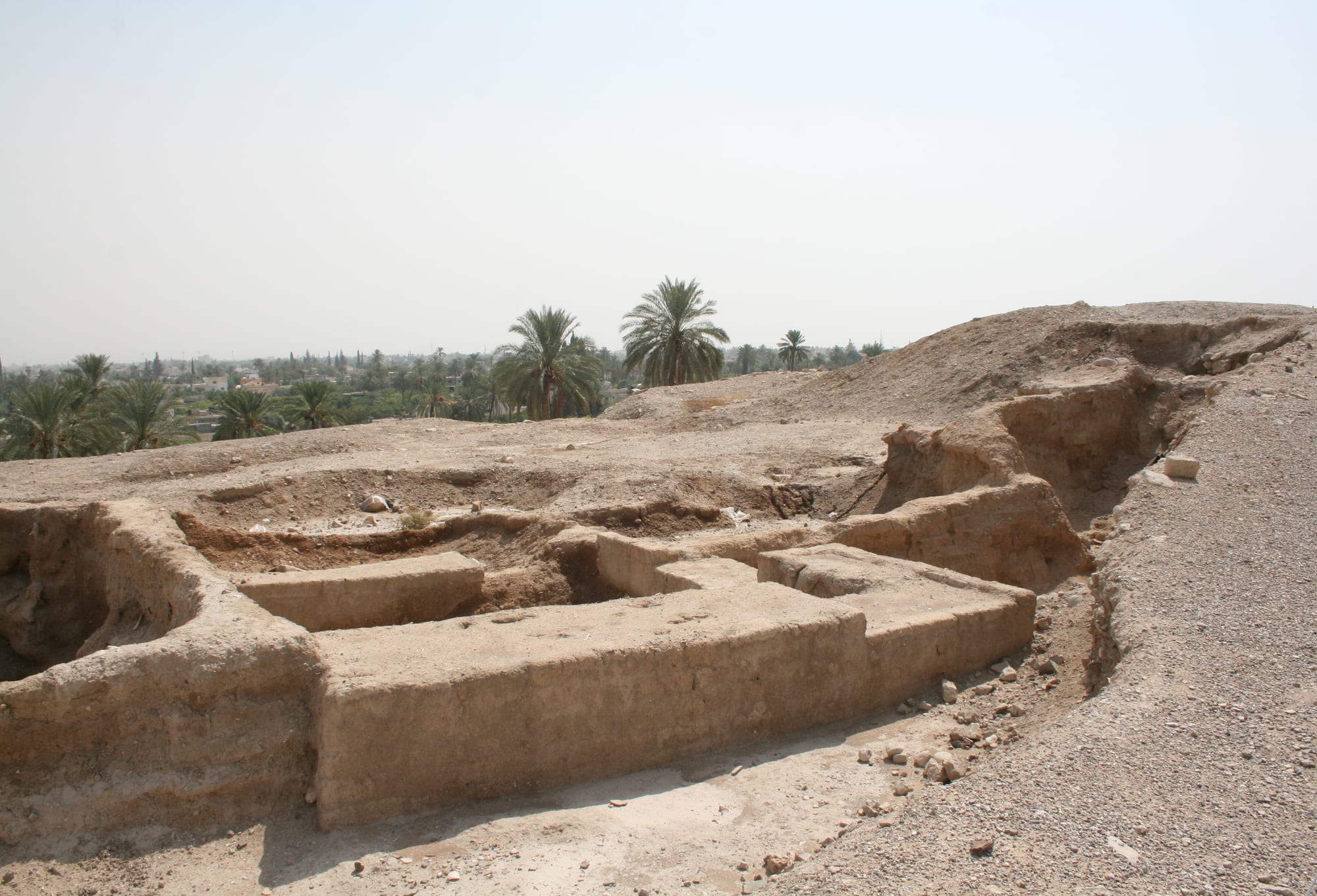
Excavated mud-brick walls and trenches on the dry mound of Tell es-Sultan, with date palms and the town of Jericho spreading behind

Palestine

Jericho

The excavated mound of Tell es-Sultan above the palm groves of Jericho. (Diego Delso / Wikimedia Commons · CC BY-SA 3.0)

An oasis town in the Jordan Valley, about 258 metres below sea level, the lowest city in the world and among the oldest continuously inhabited places on earth. Springs feed date palms, banana plantations and citrus groves around the excavated mound of Tell es-Sultan, and the desert cliffs behind hold monasteries and an Umayyad palace. This page is written to explain the city, not to encourage travel.

Neighbourhoods

  • The town centre
    • First-time visitors
    • Markets
    • Close to public transport

    A small square ringed by cafés, juice stalls, bakeries and souvenir shops, with the municipality, the servees ranks and the vegetable market a few steps away. Almost everything a visitor needs is within a short walk, and the streets are shaded by trees.

    Open in Maps
  • Ein as-Sultan
    • Historic district
    • Archaeology

    The north-western edge of town around the spring that made settlement possible, beside the mound of Tell es-Sultan and the lower station of the cable car. Hotels, restaurants and a refugee camp of the same name are all close by.

    Open in Maps
  • The palm and banana groves
    • Quiet and residential
    • Farms

    The irrigated belt north and east of the centre, where low houses stand among date palms, banana plantations, citrus and vegetable plots. Farm shops sell dates and fruit at the roadside, and the air is heavy and still in summer.

    Open in Maps
  • The Dead Sea road
    • Beaches
    • Day trips

    The southern approach, running down through desert towards the Dead Sea shore and the Jordan River crossings, with roadside stalls, fuel stations and the turning for the baptism site at Qasr el Yahud.

    Open in Maps

Things to do

Ancient sites

  • Tell es-Sultanlandmark

    The mound of ancient Jericho, with a stone tower and wall from about the eighth millennium BC among the earliest known monumental building, inscribed by UNESCO in 2023.

    Open in Maps
  • Hisham's Palacelandmark

    An Umayyad desert estate of the eighth century north of the town, known for its bath hall, the Tree of Life mosaic and one of the largest continuous mosaic floors in the world, open to the public since 2021.

    Open in Maps
  • Shalom Al Yisrael Synagoguelandmark

    A sixth or seventh-century synagogue whose mosaic floor carries a menorah and a Hebrew inscription, in the north of the town.

    Open in Maps
  • Elisha's Springlandmark

    The perennial spring beside the tell that waters the oasis, named in tradition for the prophet Elisha.

    Open in Maps

Monasteries and viewpoints

  • Mount of Temptationviewpoint

    The cliff above the oasis identified in Christian tradition with the temptation of Jesus, with a wide view over the Jordan Valley from its terraces.

    Open in Maps
  • Monastery of the Temptationlandmark

    A Greek Orthodox monastery of the 1890s built into the cliff face over earlier hermit caves, reached by a steep path or the cable car.

    Open in Maps
  • Jericho cable carattraction

    A gondola line opened in 1998 that runs from near Tell es-Sultan up to the terrace below the Monastery of the Temptation, descending to well below sea level.

    Open in Maps

Short trips from the town

  • Monastery of St George of Chozibalandmark

    A cliffside monastery founded in the fifth century in Wadi Qelt, west of the town, reached on foot down a gorge path from the road.

    Open in Maps
  • Nabi Musalandmark

    A domed pilgrimage complex in the desert south-west of the town, built under the Mamluks around the site Islamic tradition identifies as the tomb of Moses.

    Open in Maps
  • Qasr el Yahudlandmark

    The baptism site on the west bank of the Jordan River, about 8 kilometres east, where pilgrims enter the water within sight of Jordan.

    Open in Maps
  • Dead Seabeach

    The salt lake at the lowest point on the earth's land surface, whose northern shore begins a short drive south of the town.

    Open in Maps
  • Qumranlandmark

    The settlement beside the caves where the Dead Sea Scrolls were found from 1947, about 13 kilometres south along the shore.

    Open in Maps

Seasonal events

  • Date harvestSeptember to October

    The medjool palms around the town are picked, and dates are sold fresh and packed at farms and roadside stalls.

  • Nabi Musa pilgrimagespring

    A procession and gathering at the desert shrine south-west of the town, a Palestinian tradition dating from the Mamluk period.

  • Winter seasonDecember to February

    Warm winter weather draws Palestinian and other visitors down from the cold hill towns for weekends in the oasis.

  • Epiphany at the JordanJanuary

    Orthodox churches hold services at the baptism site on the river east of the town.

Eat and drink

Long-standing places and food districts in Jericho. Hours, ratings and directions come from your maps app, always current.

Jericho classics

  • Town centre restaurantsneighborhood

    Grills and mezze houses around the main square serving hummus, salads, chicken and lamb, with tables outside under the trees.

    Open in Maps
  • Jericho marketmarket

    Vegetables, bananas, citrus and dates from the surrounding farms, alongside spices, olives and bread.

    Open in Maps
  • Date and fruit farm stallsmarket

    Roadside stands in the groves selling medjool dates, date syrup, bananas and oranges grown in the oasis.

    Open in Maps

Cafés

  • Cafés around the main squarecafe

    Places for cardamom coffee, sweet tea with mint and fresh fruit juice, busiest in the evening when the heat drops.

    Open in Maps

Experience Jericho

History

Jericho's claim is depth of time: excavation at Tell es-Sultan has found a Natufian settlement beside the spring from around 9000 BC, and a stone tower and town wall of the Pre-Pottery Neolithic period, about the eighth millennium BC, among the earliest monumental structures known anywhere. Successive settlements rose and fell on the same mound for thousands of years, which is why it stands some twenty metres above the plain. The site was dug by Ernst Sellin, then by John Garstang, and most influentially by Kathleen Kenyon in the 1950s, whose stratigraphy reshaped the archaeology of the region.

The Hebrew Bible describes the city's walls falling before Joshua, and the relationship between that account and the excavated layers has been argued over for a century. Under Herod the Great a winter palace complex stood beside Wadi Qelt, and the Gospels place Jesus here with Zacchaeus and Bartimaeus. Byzantine monasteries filled the cliffs, and after the Muslim conquest the Umayyad caliphs built the estate now called Hisham's Palace, whose bath-hall mosaics survived the earthquake that wrecked it; the floors were opened to the public in 2021.

The town shrank to a village under later Islamic rule, revived a little under the Ottomans, and grew sharply after 1948, when refugee camps — Aqbat Jaber and Ein as-Sultan among them — were built beside it and for a time held tens of thousands of people, most of whom left after the 1967 war. Israel occupied the town that year. In May 1994 Jericho and Gaza were the first areas handed to Palestinian self-rule under the Oslo process. UNESCO inscribed Tell es-Sultan in 2023.

Culture & Customs

Jericho lives by being the warm place. Hill-town families have wintered here for generations, and the town's older hotels, restaurants and shaded gardens were built for that trade rather than for foreign visitors. In winter the centre fills at weekends with Palestinians from Ramallah, Bethlehem and Hebron eating long lunches under the trees, and in summer it empties into siesta and stillness.

Pilgrimage is the other strand. Orthodox monks have lived in the cliffs of Wadi Qelt and the Mount of Temptation since the Byzantine period, and Christian groups come for the baptism site at the Jordan; Muslim pilgrims gather at Nabi Musa in spring, a tradition begun under the Mamluks and later a major Palestinian national occasion. The town's own population is overwhelmingly Muslim, with a small Christian community and a few Greek Orthodox institutions.

Manners are Palestinian and rural: greetings take time, guests are fed, and refusal is taken as politeness rather than as an answer. The oasis has its own identity within the West Bank — slower, hotter, less political in daily talk, proud of its dates and its antiquity, and conscious that the town sits in Area A while most of the surrounding Jordan Valley is under full Israeli control.

Daily Life

About 20,000 people live in Jericho, with several thousand more in the neighbouring refugee camps of Ein as-Sultan and Aqbat Jaber, making it the largest town in a governorate of roughly 50,000. It is a low-rise place of walled gardens and flat-roofed houses among palm groves, with the desert beginning abruptly at the edge of the irrigated land.

Agriculture and tourism carry the economy. Dates, above all the medjool variety, are the signature crop, along with bananas, citrus, vegetables grown under plastic for the winter market, and flowers; the harvest depends on spring water and on wells, and water allocation is a constant grievance. The archaeological sites, the cable car and the hotels employ many others, and the casino built beside the town in 1998 is closed, though the hotel on the site still takes guests. Jordan Valley farmland and access roads are largely under Israeli control, which limits expansion.

The day is arranged around heat. Work and school start early, the middle of the day is spent indoors from late spring to autumn, and life returns to the streets after sunset, when families sit out and the juice stalls and cafés open. Winter reverses this, with the warmest hours the most sociable. Movement to Ramallah or Jerusalem depends on checkpoints, and the crossing to Jordan a few kilometres east is the town's window on the wider world.

Food

The oasis supplies the table. Medjool dates are the town's best-known product — large, soft and sold fresh at the roadside in autumn — and turn up stuffed with walnuts or almonds, pressed into date syrup, and baked into ma'amoul cakes. Bananas, oranges, lemons and grapefruit from the plantations are pressed into juice at stalls around the centre, and winter vegetables from the valley reach markets across the West Bank.

Cooking is Palestinian, with the hill-town dishes served in the valley's restaurants: musakhan, chicken with onions, sumac and oil on taboon bread; maqluba, the upturned pot of rice, aubergine and meat; mansaf with lamb and jameed yoghurt for celebrations; and stuffed vegetables and vine leaves. Grilled meat is the default at the garden restaurants, preceded by hummus, mutabbal, tabbouleh, pickles and warm bread. Fish from farms in the valley appears on some menus.

Drinks match the climate: fresh juice, lemonade with mint, tamarind and carob cordials in summer, and cardamom-heavy Arabic coffee and very sweet tea with sage or mint all year. Sweets are the usual Palestinian ones — knafeh, baklava, ma'amoul — often eaten late in the evening. Alcohol is uncommon in the town's restaurants, though some hotels serve it.

Planning tools

Budget

Jericho is cheap even by West Bank standards: small hotels and guesthouses cost little, food in the town is inexpensive, and shared servees taxis to Ramallah or Jerusalem are a few shekels. The costs that add up are entry tickets to the archaeological sites, the cable car, and hiring a car or driver to reach the monasteries and the Dead Sea.

Daily Budget Midrange
USD 100–200 (mid-range hotel, restaurant meals, a private driver or guide for the day)
Daily Budget Shoestring
USD 35–70 (guesthouse room, falafel and market food, servees taxis)

A driver shared between a few people is the practical way to combine Hisham's Palace, Wadi Qelt and the Dead Sea in one outing.

Best Time to Visit

Winter, roughly November to March, is the season here: warm, dry and pleasant when the hill towns are cold and wet, which is why Jericho has been a winter resort since antiquity. Spring and late autumn are hot but manageable. Summer, from June to September, is punishing, and sightseeing on the tell or the cliff path is best avoided.

Suggested Number of Days

The town's main sites can be seen in a single day, and many people visit from Jerusalem, Bethlehem or Ramallah. Staying two or three nights makes sense for the desert sites and the wider valley, or simply for the warm winter weather.

First Visit
1 day
With Surroundings
2–3 days

Transportation

Shared servees taxis and minibuses link the town with Ramallah, Jerusalem and Bethlehem, leaving from the centre when full. Within Jericho, yellow taxis are cheap and quick, and the flat centre is easy to cover on foot or by bicycle. Reaching Hisham's Palace, Wadi Qelt, Nabi Musa or the Dead Sea needs a taxi or a hire car, as there is no useful public service.

Agree fares before setting off, and arrange a return time with the driver when visiting sites in the desert, where there is no passing traffic.

Airport & Station Connections

Jericho lies about 40 kilometres east of Jerusalem, an hour or so by road when the checkpoints are clear, and roughly 30 kilometres from Ramallah over the hills. Travellers from Jordan cross the Allenby / King Hussein Bridge a few kilometres east of the town, the nearest land crossing; everyone else arrives through Israel, usually at Ben Gurion Airport. Israeli immigration governs entry and questioning can be lengthy.

Walkability

The centre is small and flat, and walking between the square, the market and the hotels takes minutes. Tell es-Sultan and the cable-car station are a walk of around two kilometres from the middle of town, pleasant in winter and hard in summer heat. Everything else — the palace, the monasteries, the river — is too far to walk, and shade is scarce.

Safety

Jericho is one of the West Bank towns more routinely visited, and ordinary crime is low, but governments advise against all or non-essential travel to much of the territory. Risks include military operations and raids, tear gas and live fire at protests and checkpoints, settler violence in the Jordan Valley, arbitrary detention, and closures that can strand travellers. Since 28 February 2026 the wider war between the United States and Israel on one side and Iran and its allies on the other has disrupted aviation and tourism across the region, West Bank roads have been blocked, and settler violence against Palestinians has increased under the movement curbs. Heat and dehydration are a real hazard in summer, and unmarked minefields exist near parts of the Jordan River. Conditions change fast.

Official advisories should be checked immediately before any trip; all demonstrations, checkpoints under tension, refugee camps and the vicinity of settlements are to be avoided, a reputable local guide is worth having, passports and permits should be carried at all times, and travel during periods of escalation is not advised at all. Check current official travel advice before travelling.

Climate

Hot desert climate, made extreme by the depth of the Jordan Valley: this is one of the hottest inhabited places in the region. Rain is scarce and falls only in winter, and the oasis exists because of its springs rather than its rainfall.

Summer
very hot and dry — daytime highs often around 38–40°C and sometimes higher, with warm nights
Winter
warm and mild — daytime highs around 20°C, with a little rain and rare frost

Local Customs

Jericho is a Muslim town with a long Christian presence and a steady flow of pilgrims, and it is more relaxed than the hill towns about visitors, though modest dress remains expected — covered shoulders and knees, and a headscarf for women in mosques and at shrines. Monasteries enforce their own rules, and Mar Saba and some other houses do not admit women. Hospitality is generous and coffee is offered everywhere.

Ask before photographing people, never photograph soldiers, checkpoints or military installations, dress for both the heat and modesty, and carry water on any walk.

Common Payment Methods

The Israeli new shekel is used for everything, with Jordanian dinars and US dollars accepted near the bridge and in the tourist trade. Cards work in hotels and larger restaurants; the market, taxis, farm stalls and site entrances are cash. ATMs are in the centre of town.