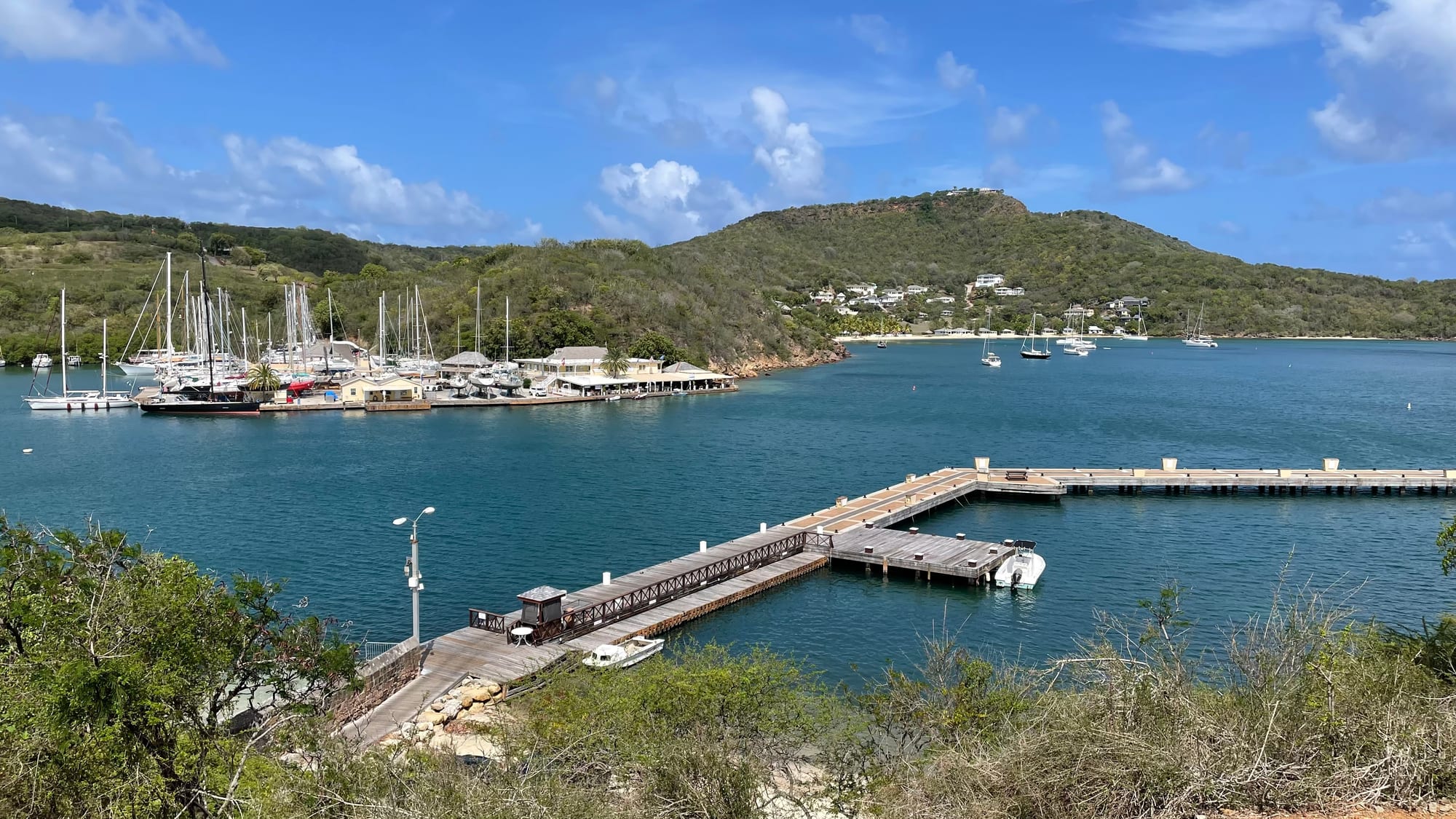
A wooden pier in a blue bay, with yachts moored at a boatyard across the water and green hills rising behind

Antigua and Barbuda

English Harbour

English Harbour seen from a pier of Nelson's Dockyard Marina, with the Antigua Slipway boatyard across the bay. (Vincent van Zeijst / Wikimedia Commons · CC BY-SA 4.0)

A small town and natural harbour in the far south of Antigua, where the Royal Navy established its base for the area in the 18th century. Restored as Nelson's Dockyard and inscribed as a UNESCO World Heritage Site in 2016, it is now a yachting centre beside Falmouth Harbour, overlooked by the hilltop fortifications of Shirley Heights.

Neighbourhoods

  • Nelson's Dockyard
    • First-time visitors
    • Historic district
    • Yachting

    The restored Georgian naval yard on the western side of the harbour, its stone storehouses and officers' houses now holding two hotels, a museum, craft and food shops, restaurants and a large marina, where yachts moor.

    Open in Maps
  • Falmouth
    • Yachting
    • Restaurants

    The neighbouring town at the head of horseshoe-shaped Falmouth Harbour, once a naval and sugar-export port and now part of the wider English Harbour district, with marinas, restaurants, inns and beaches.

    Open in Maps
  • Middle Ground
    • Beaches
    • Walks

    The hilly peninsula between the two harbours, part of the national park, with Pigeon Point beach on its western side, Fort Berkeley at its tip and a trail running from the fort to the dockyard.

    Open in Maps
  • Shirley Heights and Dow Hill
    • Views
    • Historic sites

    The high ground east of the harbour, fortified from the 1780s, where ruined barracks, magazines and a restored lookout look down over English Harbour and Falmouth Harbour.

    Open in Maps

Things to do

The dockyard and its history

  • Nelson's Dockyardlandmark

    Described as the only continuously working Georgian-era dockyard in the world, abandoned by the Royal Navy in 1889 and restored as a marina; the Dockyard Museum occupies the Naval Officer's and Clerk's House of 1855.

    Open in Maps
  • Clarence Housemuseum

    A house built in 1804 for the naval commissioner on the hillside above the bay, later the governor's country home, restored in 2012 after hurricane damage in the 1990s.

    Open in Maps
  • Dow's Hill Interpretation Centremuseum

    A museum opened in 1989 on Dow's Hill, overlooking English Harbour, presenting Antiguan history and leading tours of the nearby ruins.

    Open in Maps

Forts and viewpoints

  • Shirley Heightsviewpoint

    A military compound built from 1788 to guard the dockyard, whose restored lookout is known for its Sunday gathering with live music, food and drink over the view of the harbours.

    Open in Maps
  • Fort Berkeleylandmark

    A fort built in 1704 on the spit at the mouth of English Harbour and enlarged in the mid-18th century, reached by a walk along the Middle Ground peninsula.

    Open in Maps

Beaches

  • Galleon Beachbeach

    A white-sand beach on Freeman's Bay in English Harbour, best reached by car or water taxi and a nesting site for sea turtles.

    Open in Maps
  • Pigeon Pointbeach

    A tree-lined crescent of white sand at the mouth of Falmouth Harbour, a popular weekend beach with showers, a playground and a beach bar.

    Open in Maps

Harbours

  • Falmouth Harbourattraction

    The horseshoe-shaped natural harbour west of English Harbour, with the small port town of Falmouth on its northern shore.

    Open in Maps

Seasonal events

  • Antigua Sailing Weeklate April to early May

    A week-long regatta founded in 1967 in the waters off English Harbour, with about a hundred yachts and five main races, ending with a prize-giving presided over by the governor-general.

  • Antigua Classic Yacht Regattadates vary

    A regatta for classic yachts held at Nelson's Dockyard, counted among the region's most reputable sailing competitions.

  • Antigua Charter Yacht MeetingDecember

    One of the largest charter yacht shows, held every December for some sixty years, bringing superyachts from around the world to Antigua.

Eat and drink

Long-standing places and food districts in English Harbour. Hours, ratings and directions come from your maps app, always current.

English Harbour classics

  • Shirley Heights Lookoutrestaurant

    A restaurant in the restored military lookout buildings above the harbour, known for its Sunday event with live music, food and drinks.

    Open in Maps
  • Nelson's Dockyard restaurantsneighborhood

    Restaurants, cafés and food shops in the old naval buildings around the marina.

    Open in Maps

Food districts

  • Falmouth Harbourneighborhood

    The restaurants of the neighbouring harbour town, whose economy turns on tourism and yachting.

    Open in Maps

Experience English Harbour

History

The Royal Navy began using English Harbour as a safe haven in the 17th century, valuing a deep, enclosed anchorage that could shelter ships from hurricanes. Fort Berkeley was built on the spit at its entrance in 1704, the Antigua legislature gave the harbour to the King for naval use in 1725, and a naval yard grew up on the eastern shore in the 1730s, then across the bay on the western side, where Nelson's Dockyard stands, in the 1740s. By the end of the Napoleonic Wars there were twin dockyards, a victualling yard, an ordnance yard and a naval hospital, and the commissioner lived at Clarence House on the hillside.

Captain Horatio Nelson arrived in July 1784 commanding HMS Boreas and stayed until 1787; he called the harbour an "infernal hole". Governor Shirley planned the fortification of the heights to the east in 1782, and Shirley Heights was built between 1788 and 1793. After 1815 the base declined: the garrison left in 1854 and the dockyards finally closed in 1889. The land returned to the Antigua government in 1906, and the buildings fell into ruin.

A 1948 study found the main buildings worth saving, and in 1951 Governor Kenneth Blackburne launched a restoration that raised £40,000; the dockyard opened to visitors in 1961. In 1984 it became part of Nelson's Dockyard National Park, and in 2016 the Antigua Naval Dockyard and Related Archaeological Sites became a UNESCO World Heritage Site.

Culture & Customs

Sailing defines the place. Antigua Sailing Week, founded in 1967, brings about a hundred yachts and thousands of sailors and spectators to the waters off English Harbour at the turn of April and May, and the Antigua Classic Yacht Regatta, the December charter yacht show and youth championships for Optimist dinghies also use the dockyard. Between events, the two harbours remain a centre of boating and yachting.

Heritage is the other thread. The restored dockyard, Clarence House, the Dow's Hill Interpretation Centre and the ruins of Shirley Heights make up much of a UNESCO World Heritage Site, and the Dockyard Museum tells the story of the base. In the 1980s the old military lookout on Shirley Heights was restored as a restaurant, and its Sunday gathering, with live music, food and drink, draws locals and visitors alike.

Away from the marinas, English Harbour is a small Antiguan community. Most residents are Methodist or Anglican, with Pentecostal and Catholic congregations as well, and church remains at the centre of village life.

Daily Life

English Harbour had 570 residents at the 2011 census, and the wider area includes the neighbouring communities of Cobbs Cross, Marsh Village and Dow Hill as well as Falmouth. About three-quarters of residents were born in Antigua and Barbuda, with others from the United States, Jamaica, the United Kingdom and Guyana.

It is one of the most prosperous parts of the country and a major regional service centre. Most people work for private employers, and the economy turns on yachting: marinas, boatyards such as the slipway on the eastern side of the harbour, provisioning, hotels, restaurants and the tourism of the national park. Land is a recurring issue, and in 2018 politicians urged long-standing squatters to take up a plan letting residents of ten years or more buy their plots for a nominal sum.

The year follows the sailing calendar: busy from December to the regattas of April and May, quieter through the hot, humid hurricane months.

Food

Eating in English Harbour mixes Antiguan cooking with food for the yachting crowd. Restaurants and food shops fill the old naval buildings of the dockyard and the waterfront at Falmouth, and the Sunday gathering at Shirley Heights brings food and drink with live music above the harbours.

The local table is the island's: fungie and pepperpot, the national dish of a cornmeal-and-okra dish similar to polenta with a slow-cooked stew; saltfish for breakfast, often with eggplant, known here as troba; ducana, a sweet dumpling of grated sweet potato and coconut boiled in a wrapping of leaves or foil; and seasoned rice. Antiguan butter bread, a soft buttery loaf from small bakeries, is eaten at breakfast and throughout the day, often with cheese, and souse, a fiery pork soup, is a street food of festival time.

Rum and beer are made locally, including Wadadli beer and English Harbour Rum, and local soft drinks include tamarind, hibiscus and passion fruit juices, mauby and ginger beer.

Planning tools

Budget

English Harbour is one of the most prosperous corners of Antigua and one of its dearest, with prices set by the yachting crowd, above all from December to April and during the regattas. Self-catering and the bus from St. John's keep costs down; the beaches and the dockyard grounds cost little.

Daily Budget Midrange
USD 220–450 (hotel or small resort, car hire, restaurants, a boat trip)
Daily Budget Shoestring
USD 100–150 (guesthouse, buses, casual local food)

Rooms fill and prices climb in Sailing Week; May, June and November give better value with good weather.

Best Time to Visit

December to April is the dry, calm sailing season and the busiest time, ending with the regattas of late April and early May. May and June are a good compromise. Rain peaks from September to November with the hurricane season.

Suggested Number of Days

Two or three days are enough to take in the harbour area at an easy pace. Staying longer, or visiting during a regatta, makes it a good base for the south of the island; those arriving by yacht often stay much longer.

First Visit
2–3 days
With Surroundings
4–6 days

Transportation

The dockyard, Falmouth and the beaches are close together, joined by short roads and water taxis. Minibus No. 17 runs from the West Bus Station in St. John's and takes about an hour, leaving when it is full. Taxis run from St. John's, and a hire car is useful for the rest of the island.

Agree taxi fares before setting off, and ask about the water taxis across the harbour.

Airport & Station Connections

Visitors fly into V. C. Bird International Airport near St. John's, at the other end of the island, and continue by taxi, hire car or minibus. Many arrive by yacht, mooring in English Harbour or Falmouth Harbour.

Walkability

The dockyard is compact, and Falmouth Harbour is close by. A trail crosses the Middle Ground peninsula from the dockyard to Fort Berkeley. Shirley Heights stands on the high ground above the harbour, and a taxi or car is the easier way up.

Safety

Antigua and Barbuda is generally safe, with low levels of violent crime against visitors. The usual precautions apply against petty theft and opportunistic burglary of villas and rooms.

Lock valuables away, keep hatches and doors secured when away from a yacht, and follow storm advice in the hurricane season. Check current official travel advice before travelling.

Climate

Tropical and warm all year, with fairly low rainfall and steady north-east trade winds.

Summer
July to November is hotter and more humid than the 73–84°F of the dry season, with heavier showers and the hurricane season
Winter
December to April is cooler and drier, around 73–84°F with steady trade winds

Local Customs

English Harbour is a mix of long-established village families and an international yachting community. Most residents are Protestant, above all Methodist and Anglican. Most Antiguans speak Creole at home, and nearly everyone also speaks English.

Beachwear belongs on the beach and boats; dress modestly in the villages and at church.

Common Payment Methods

The currency is the East Caribbean dollar, pegged at 2.70 to the US dollar, and US dollars are accepted almost everywhere. Cards are widely used at the dockyard, but some sites up at Shirley Heights do not take them, so cash is useful.