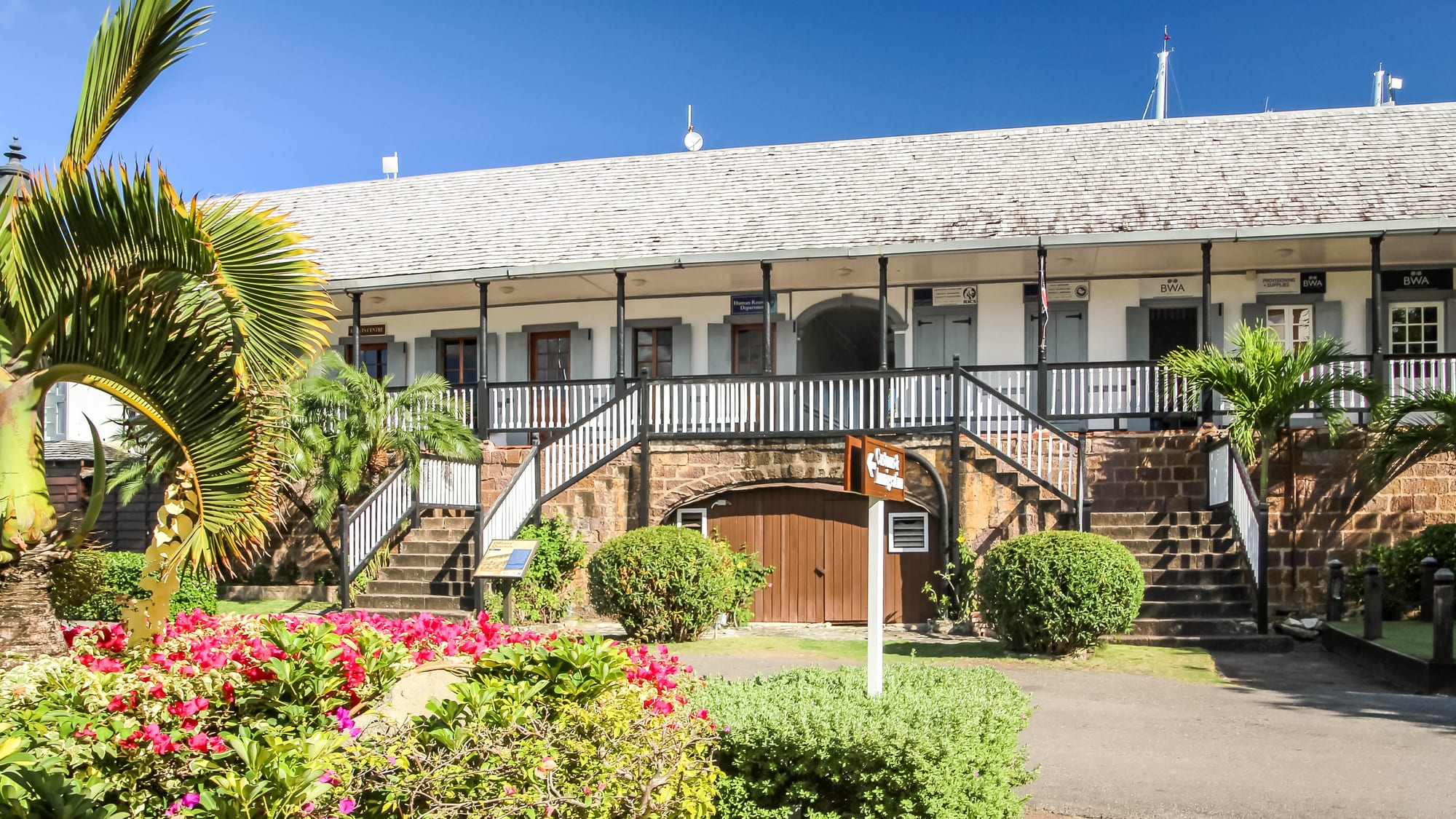
Restored Georgian stone buildings and yacht masts around the sheltered inlet of English Harbour, green hills behind

Antigua and Barbuda

Nelson's Dockyard at English Harbour, a restored 18th-century Royal Navy base and a UNESCO World Heritage Site. (Dr. Thomas Liptak / Wikimedia Commons · CC BY 4.0)

A twin-island nation in the eastern Caribbean built around deep natural harbours, a Georgian naval dockyard, and a coastline of low-key beaches — famously one for every day of the year.

Explore Antigua and Barbuda

History

The islands were settled first by Arawak and later Kalinago (Carib) peoples. Columbus sighted Antigua in 1493 and may have named it Santa Maria la Antigua, after an icon in Seville Cathedral. The English settled in 1632 and turned Antigua into a sugar island, clearing the land for plantations worked by enslaved Africans; Betty's Hope, the estate of the Codrington family, was the first large-scale sugar estate on the island. Barbuda was granted to the same family, who held it as absentee owners from 1685 to 1870.

Antigua's deep, hurricane-safe harbours made it strategically valuable, and from the 1720s the Royal Navy built up the dockyard at English Harbour as its main base in the eastern Caribbean. Horatio Nelson was stationed there in the 1780s. When slavery was abolished in 1834, Antigua freed its enslaved population immediately, without the "apprenticeship" transition imposed elsewhere.

Sugar declined over the following century. The islands moved through the Leeward Islands federation and "associated statehood" with Britain in 1967 to full independence on 1 November 1981, as a single country with Barbuda given a degree of local self-government. The economy pivoted to tourism, with offshore finance and a citizenship-by-investment programme alongside it. Politics has been dominated by two parties and, for decades, by the Bird family.

Culture & Customs

The culture is Afro-Caribbean, shaped by the plantation past and by emancipation. Carnival, held in late July and early August, marks the 1834 abolition of slavery with calypso and soca competitions, steel bands, and costumed "mas" troupes filling the streets of St. John's.

Cricket is close to a national faith. A country of around 106,000 people produced Sir Vivian Richards, Sir Andy Roberts, Sir Richie Richardson, and Sir Curtly Ambrose, and Test matches are played at the stadium named for Richards. Sailing is the other sporting identity: Antigua Sailing Week and the Classic Yacht Regatta draw crews from around the world to English Harbour every spring.

Christianity is central — Anglican, Moravian, and Methodist congregations date to the plantation era — and church, family, and village are the anchors of social life. Barbudans hold a distinct identity, tied to a long tradition of communal rather than private land ownership, which has become a sharp political dispute since Hurricane Irma.

Daily Life

Most people live on Antigua, in and around the capital St. John's or in the villages spread across the island. Tourism and government are the main employers, and the working week bends around the arrival of cruise ships and the flow of stopover visitors. Barbuda, with about 1,600 residents in the single village of Codrington, is far quieter, living mostly on government jobs and tourism, with lobster fishing its main export.

Getting around means the privately run minibuses that ply fixed village routes by day, the market in St. John's for produce and fish, and Sunday given over to church and family meals.

Water and electricity can be unreliable — neither island has enough fresh groundwater for its needs — and the hurricane season is a yearly reckoning. Hurricane Irma destroyed more than 90 per cent of Barbuda's buildings in September 2017 and the whole population was evacuated to Antigua; most residents had returned by February 2019, and Barbuda now holds more people than it did before the storm.

Food

The national dish is fungie and pepperpot: fungie is a firm cornmeal-and-okra polenta, and pepperpot is the long-simmered stew of meat and vegetables eaten with it. Saltfish is a common breakfast, often with seasoned rice or with eggplant, known here as troba. Antiguan butter bread — a soft, buttery loaf baked in small neighbourhood bakeries — is a staple at any hour, usually with cheese.

Local specialities include ducana, a sweet dumpling of grated sweet potato and coconut boiled in a leaf; seasoned rice; conch; souse, a fiery pork soup sold by street vendors at Carnival; and the small "Antigua Black" pineapple, said to be the sweetest variety there is, grown on the southwestern coast. On Barbuda the prized foods are spiny lobster and venison from the island's fallow deer.

Rum is the national drink — the award-winning English Harbour Rum is distilled here — usually taken with fruit juice or in a rum punch, alongside the locally brewed Wadadli beer. Fresh juices from tamarind, sorrel, ginger, and passionfruit are everywhere.

Attractions & Natural Wonders

The centrepiece is Nelson's Dockyard National Park, a UNESCO World Heritage Site and the only Georgian-era naval dockyard still working anywhere in the world. Its restored stone warehouses and capstans sit around English Harbour, and the ridge above holds the Shirley Heights fortifications, where a Sunday-evening lookout party with a steel band and a view over the harbour is an island institution.

Beaches are the other reason people come — Antigua is reputed to have 365 of them, one for every day of the year. Half Moon Bay on the Atlantic side, Ffryes on the calmer southwest, and Dickenson Bay, with its Runaway Beach, in the northwest are among the best known. Devil's Bridge, a natural rock arch on the Atlantic coast east of Willikies and a national park since 2008, has Atlantic swell blasting through blowholes beside it.

Beyond Antigua, boat trips run to Great Bird Island and the reefs and mangroves of the northeast — Great Bird Island was until recently the only home of the Antiguan racer, one of the world's rarest snakes, which has since been reintroduced to Rabbit, Green and York islands. Barbuda's Codrington Lagoon, the largest saltwater lagoon in the eastern Caribbean, holds the largest magnificent frigatebird colony in the world, best seen by small boat, and the island is known for its Pink Sand Beach. On the uninhabited island of Redonda, a former guano rock, a restoration programme cleared the goats and rats from 2016 and the island's plants and seabirds are coming back.

Planning basics

Budget

This is a resort destination and prices reflect it, especially from December to April. Independent travel using guesthouses, buses, and local restaurants is possible and far cheaper than the all-inclusive hotels, but nothing here is a bargain. Cards are widely accepted; US dollars pass everywhere.

Daily Budget Midrange
USD 220–450 (hotel or small resort, car hire, restaurants, a boat trip)
Daily Budget Shoestring
USD 100–150 (guesthouse, buses, casual local food)

High season (mid-Dec to mid-Apr) carries the top rates; May–June and November offer better value with good weather.

Visa Requirements

Citizens of the United States, Canada, the United Kingdom, the EU, and most Commonwealth countries are visa-exempt. Everyone else needs an Electronic Entry Visa (EEV) arranged before travel, although holders of a valid Schengen, UK, US or Canadian visa or residence permit can get a visa on arrival for up to 30 days. An onward or return ticket and proof of accommodation may be requested.

Typical Stay
Visa-free for most Western and Commonwealth passports; the length of stay is set on arrival

Check the visa-exempt list for your nationality before booking; if you are not on it, apply for the Electronic Entry Visa in advance.

Safety

Antigua and Barbuda is generally safe, with low levels of violent crime against visitors. The usual precautions apply against petty theft and opportunistic burglary of villas and rooms. Take care in parts of St. John's after dark, and respect strong currents on Atlantic-facing beaches.

Natural Hazards
Hurricanes are the serious risk; Barbuda was evacuated entirely after Hurricane Irma in 2017, though most residents had returned by February 2019.

Lock valuables away, don't leave belongings unattended on the beach, and follow storm advice in season.

Climate

Tropical, warm all year, and drier than much of the Caribbean — Antigua has historically struggled with water supply. The cooler, drier season runs December to April; it is more humid and wetter from July to November, which is also the Atlantic hurricane season.

Dry Season
Dec–Apr, around 73–84°F, low rainfall, steady trade winds
Wet Season
Jul–Nov, hotter and more humid, heavier showers
Hurricane Season
1 June to 30 November, with the greatest risk August to October

Transportation

V. C. Bird International Airport on Antigua is a regional hub with direct flights from North America and Europe, and connects the country to more than fifty destinations. Barbuda is reached by ferry from St. John's or by a short hop to Burton-Nibbs International Airport. On Antigua, privately run minibuses cover fixed routes cheaply; taxis are not metered, and standard fares are set by zone.

Driving
On the left; a temporary local driving licence is required
Getting Around
Minibuses, taxis at standard zone fares, or a rental car

Budget for taxis, especially after dark, and agree the fare before you set off.

Best Time to Visit

December to April is the reliable window — sunny, comfortable, and calm seas — but also the busiest and most expensive. May and June are an excellent compromise. Sailing events cluster around Antigua Sailing Week at the end of April and the start of May, and the Antigua Classic Yacht Regatta.

Avoid
September and October if you are wary of storms.
Events
Antigua Sailing Week (end of April to early May); Carnival (late July to early August)

Currency

The currency is the East Caribbean dollar (XCD), shared across several eastern Caribbean states and pegged to the US dollar at a fixed rate of 2.70. US dollars are accepted almost everywhere, though change is often given in EC dollars.

Peg
Fixed at 2.70 XCD = 1 USD
Symbol
$ (EC$)
Currency Code
XCD — East Caribbean dollar

Language

No Act of Parliament names an official language, but English is the working language of government, business, and schools, and in May 2026 the Cabinet designated Spanish the country's official second language. In everyday speech most people use Antiguan and Barbudan Creole, an English-based creole, shifting toward standard English with visitors.

English
Universal
Everyday Speech
Antiguan and Barbudan Creole
Official Language
English in practice; Spanish designated an official second language in 2026