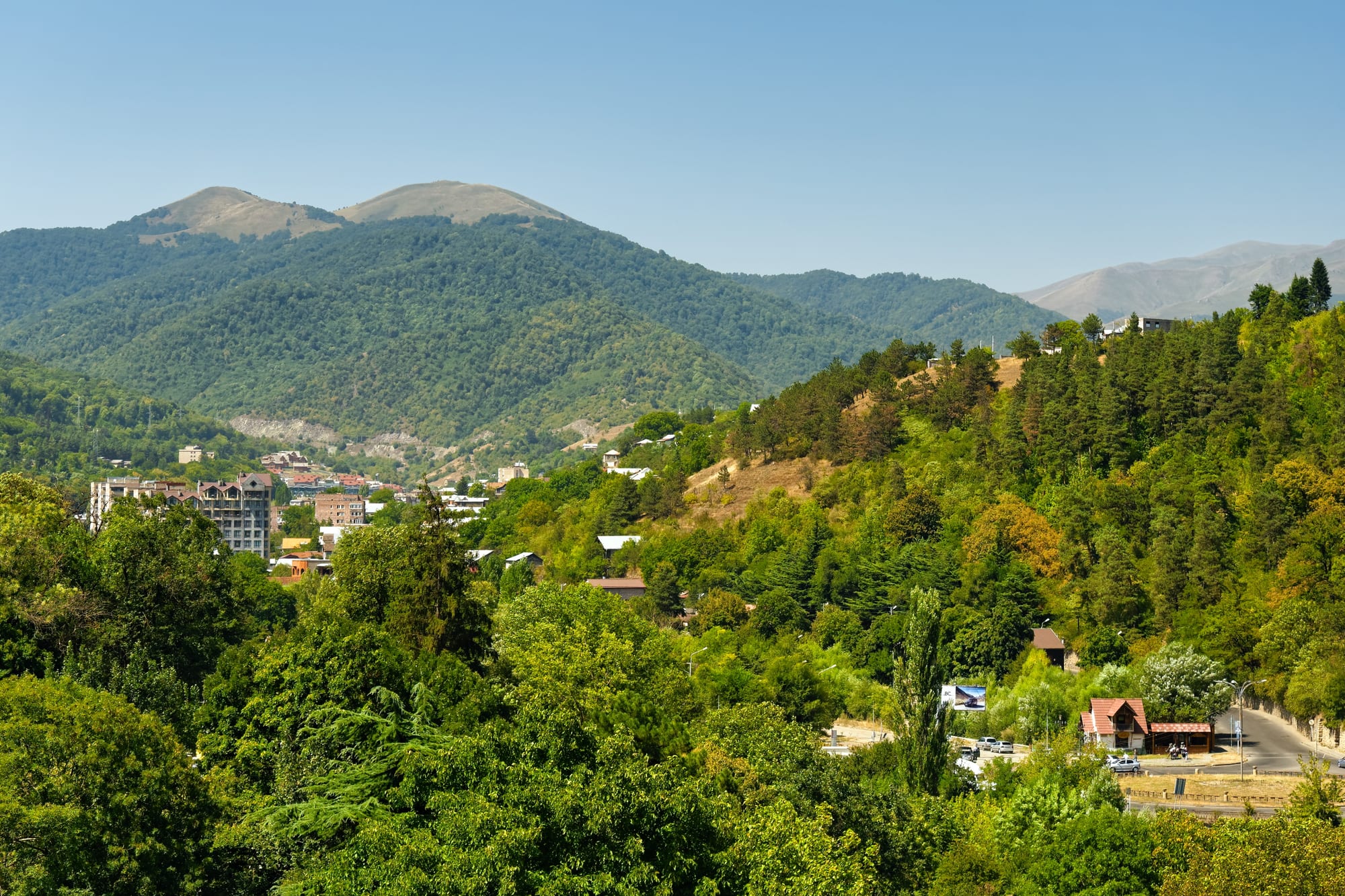
A small town of low buildings in a green valley, surrounded by densely wooded hills rising to bare ridges under a clear sky

Armenia

Dilijan

Dilijan in its wooded valley in Tavush Province, seen from the hillside above the town. (Alexxx1979 / Wikimedia Commons · CC BY-SA 4.0)

A small resort town in the forested mountains of Tavush Province, north-east of Yerevan on the far side of the Sevan pass. Long known for its mineral springs, sanatoriums and rest houses for Soviet writers and composers, it sits inside Dilijan National Park, with a restored street of nineteenth-century craft workshops and the monasteries of Haghartsin and Goshavank in the valleys around it.

Neighbourhoods

  • Old Dilijan and Sharambeyan Street
    • First-time visitors
    • Historic district
    • Crafts

    A short restored street of nineteenth-century houses with carved wooden balconies, running downhill from the centre. Workshops, small galleries, a craft museum and a hotel occupy the buildings, and it is the one part of town that shows how the place looked before the Soviet period.

    Open in Maps
  • The town centre
    • Close to public transport
    • Best for food
    • Shops

    The stretch of the main road through the valley, with the town hall, shops, bakeries, the bus stop for Yerevan and Ijevan, and most of the guesthouses. Practical rather than pretty, and everything in it is within a few minutes' walk.

    Open in Maps
  • The wooded slopes
    • Quiet and residential
    • Walks
    • Resorts

    Housing, sanatorium buildings, hotels and the campus of an international school spread up the forested hillsides on both sides of the valley. Walking trails start directly from the streets, and the national park begins where the houses stop.

    Open in Maps

Things to do

In and around the town

  • Sharambeyan Streetneighborhood

    The restored old street of craftsmen's houses, with woodwork, ceramics and carpet workshops behind carved balconies.

    Open in Maps
  • Dilijan National Parkpark

    The protected beech and oak forest that surrounds the town, with marked trails, springs, monasteries in clearings and a rich bird and plant life.

    Open in Maps
  • Parz Lakeattraction

    A small lake in the forest a few kilometres east of the town, reached on foot by a forest trail or by road, with boats and picnic places.

    Open in Maps
  • Transcaucasian Trailtrail

    The long-distance hiking route through the Caucasus, whose Armenian section runs through the forests around Dilijan and links several of the monasteries.

    Open in Maps

Monasteries

  • Haghartsinlandmark

    A monastery of the tenth to thirteenth centuries in a wooded side valley north-east of the town, with three churches, a refectory and a much-photographed setting among trees.

    Open in Maps
  • Goshavanklandmark

    A twelfth- to thirteenth-century monastery in the village of Gosh, rebuilt with the help of the scholar Mkhitar Gosh, who founded a school there, and holding a khachkar of 1291 counted among the finest carved anywhere.

    Open in Maps
  • Jukhtak Vanklandmark

    An eleventh- or twelfth-century monastery of two small churches standing together in the forest above the town, reached by a short walk from the western edge of Dilijan.

    Open in Maps
  • Matosavanklandmark

    A tiny ruined thirteenth-century monastery, half buried in moss and trees on a forest path near Jukhtak Vank.

    Open in Maps

Short trips from the town

  • Lake Sevanattraction

    The great alpine lake over the pass to the south, with beaches, fish restaurants and monasteries on its shores.

    Open in Maps
  • Sevanavanklandmark

    A ninth-century monastery on a promontory above Lake Sevan, reached by a stairway with a wide view over the water.

    Open in Maps
  • Ijevanattraction

    The provincial capital down the valley to the north-east, a working town known for its wine and carpet making and its sculpture park.

    Open in Maps

Seasonal events

  • VardavarJuly, fourteen weeks after Easter

    The national water festival, marked here as everywhere by children and adults drenching passers-by in the streets.

  • Summer concert and festival seasonJune to September

    Concerts, chamber music courses and school programmes fill the town's halls and hotels in the warm months, continuing an old tradition of summer residencies.

Eat and drink

Long-standing places and food districts in Dilijan. Hours, ratings and directions come from your maps app, always current.

Where to eat

  • Sharambeyan Street caféscafe

    A handful of small cafés and restaurants in the restored old houses, serving Armenian dishes, coffee and herbal teas on terraces.

    Open in Maps
  • Town centre restaurantsneighborhood

    Family-run places along the main road grilling khorovats, baking bread and serving trout, soups and stews to travellers between Yerevan and Ijevan.

    Open in Maps
  • Roadside honey, berry and herb stallsmarket

    Forest honey, jams of cornelian cherry and wild berries, dried herbs and pickles are sold from stalls and shops along the road through town.

    Open in Maps

Experience Dilijan

History

The valley was settled long before the town existed: the Iron Age and medieval remains scattered through the surrounding forest, and monasteries founded from the tenth century onwards, show a populated and well-connected district on routes between the Ararat plain and the north-east. Jukhtak Vank and Matosavank sit in the woods above the modern town, Haghartsin grew through the eleventh to thirteenth centuries under royal patronage, and Goshavank was rebuilt after an earthquake in 1188 with the help of the scholar and fabulist Mkhitar Gosh, who founded a school there.

Dilijan itself took shape in the nineteenth century, when the mineral springs in the valley began to attract visitors from Tbilisi and beyond. Under Russian and then Soviet rule it was developed as a health resort: sanatoriums for lung complaints, bottling plants for the local mineral water, and rest houses maintained for the unions of composers, writers, cinematographers and artists. Generations of Soviet musicians and film-makers spent their summers here, and the town acquired a reputation as a place of quiet privilege.

Independence in 1991 ended that system. Sanatoriums closed, the rest houses emptied and the population fell as people left for Yerevan and Russia. Since the 2000s the town has been partly reinvented: Sharambeyan Street was restored as a craft quarter, hotels and guesthouses opened, an international boarding school founded with diaspora money opened on the hillside in 2014, and the surrounding forest was developed for walking, drawing both Armenian and foreign visitors back.

Culture & Customs

Dilijan's identity rests on two things: the forest and the artistic colonies that the Soviet state planted in it. The composers' and writers' houses gave the town a long association with music that is still felt in summer programmes, concerts and courses, and older residents will name the figures who worked in the rest houses. It is also the subject of one of the most quoted jokes in Soviet cinema, in which a character from the film Mimino claims Dilijan's tap water is the second best in the world — a line still repeated in the town.

The craft tradition on Sharambeyan Street is a deliberate revival rather than an unbroken line, but the woodcarving, ceramics and carpet weaving practised there draw on Tavush patterns. Village life continues around the town: beekeeping, orchards of cornelian cherry and walnut, cattle on the summer pastures, and the gathering of mushrooms and herbs in the woods.

Religious life centres on the monasteries rather than on any large parish church. Haghartsin and Goshavank still hold services and are visited for baptisms and pilgrimages as well as by tourists, and it is normal to find candles burning in the smallest ruined chapels in the forest. Visitors are expected to dress modestly inside, to keep their voices down and to ask before photographing worshippers. As everywhere in Armenia, hospitality is close to obligatory, and a conversation on the street can end with an invitation to coffee.

Daily Life

About 16,000 people live in Dilijan, making it one of the larger towns of Tavush Province but still a place where the centre can be crossed in ten minutes and faces are familiar. Housing runs from Soviet blocks and sanatorium buildings to older wooden-balconied houses and newer villas on the wooded slopes, and much of the population lives along the valley road or on the terraces above it.

Work comes from tourism, the hotels and guesthouses, the mineral water and food businesses, forestry and the national park, the schools — including the international boarding school, which is a significant local employer — and from small-scale farming and beekeeping. Many families also depend on money sent from relatives in Yerevan or Russia, and seasonal work in the capital is common. The town's population has fallen steadily since the late Soviet years and has not recovered.

The rhythm follows the season. In summer the town fills with visitors from Yerevan escaping the heat, the cafés put tables outside and minibuses run full; in winter it is quiet, snowbound, and the concerns are heating, roads over the pass and school transport. The condition of the forest, building on the slopes and the balance between development and the national park are the recurring local arguments.

Food

Dilijan eats mountain food. Khorovats, meat grilled over vine or fruit wood, is the standard meal for guests, served with grilled vegetables, lavash and a pile of fresh herbs — tarragon, basil, coriander — that are treated as a dish in their own right rather than a garnish. Trout from Lake Sevan and from local fish farms appears on most menus, grilled whole or baked, and soups such as spas, made from matsun yoghurt and wheat, and bozbash, a mutton and vegetable broth, are common in cooler weather.

The forest supplies much of the rest. Honey from hives in the beech woods, jams made from cornelian cherry, rosehip, walnut and wild plum, mushrooms, and herbal teas dried from mountain plants are sold along the road and in the craft shops. Dairy is important: string cheese, home-made matsun and clotted cream eaten with honey at breakfast. Gata, a dense sweet pastry with a buttery flour filling, is the usual accompaniment to coffee, and dolma and ghapama appear at family feasts as they do across the country.

The town's name is attached above all to water. Mineral springs in the valley have been bottled since the Soviet period, and the local water is a point of pride and the subject of a well-known film joke. Otherwise the drinks are those of the whole country: Armenian brandy, vodka distilled from mulberries or cornelian cherries in the villages, and increasingly wine from Armenian vineyards.

Planning tools

Budget

Dilijan is cheap for food and guesthouse rooms but has a wide range of accommodation, from village rooms to restored hotels and spa resorts that cost as much as anywhere in the country. The other costs are transport: the monasteries and lakes around the town are not walkable for most visitors, so a taxi or a hired car with a driver is the usual solution.

Daily Budget Midrange
USD 60–110 (hotel or guesthouse, restaurant meals, a hired car with driver for the monasteries)
Daily Budget Shoestring
USD 25–40 (guesthouse room, home cooking, shared minibuses and walking)

Cash is more useful here than in Yerevan; the machines in town are few and village guesthouses and stalls do not take cards.

Best Time to Visit

Late May to early October is the main season, when the forest is green, the trails are open and the town is cooler than Yerevan — one of the reasons Armenians come. October brings autumn colour in the beech woods. Winter is cold and snowy, quiet and attractive, but forest paths and some monastery roads can be hard to reach.

Suggested Number of Days

A day covers the town itself and one monastery. Walkers, and anyone using Dilijan as a base for the forests, the lakes and the valleys to the north, comfortably fill three or four days.

First Visit
1–2 days
With Surroundings
3–4 days

Transportation

The town stretches along one main road, and marshrutka minibuses and shared taxis running between Yerevan, Sevan and Ijevan stop in the centre. There is no local public transport worth the name. Taxis wait in the centre and are the usual way to reach Haghartsin, Goshavank and Parz Lake, often hired for a half day with waiting time included.

Agree the fare and the waiting time with a taxi driver before setting off, as fares are rarely metered outside the capital.

Airport & Station Connections

Dilijan is about two hours from Yerevan by road, reached over the Sevan pass and through a long tunnel that drops into the forest. Minibuses run from Yerevan's northern bus stations and from Sevan, and shared taxis are common. There is no railway station in use. Zvartnots International Airport outside Yerevan is the nearest airport, and the land borders with Turkey and Azerbaijan are closed, so overland arrivals come through Georgia — the road from Tbilisi passes not far to the north.

Walkability

The centre and Sharambeyan Street are easily walked, and forest paths start at the edge of town, including the routes to Jukhtak Vank and Matosavank. The town is long and strung along a valley, though, so the distance between the top of the slopes and the centre is steep, and the better-known monasteries are several kilometres out along roads with no pavement.

Safety

Dilijan is a quiet town with very little crime, and walking after dark is normal. The risks are outdoor ones: unmarked forest trails, steep ground, changeable mountain weather, few signposts, and patchy mobile coverage in the valleys. Stray dogs are common around villages. The borders with Azerbaijan lie well to the east and south of here.

Avoid unmarked roads and hiking near the eastern and southern borders, and check the current situation before travelling to Syunik. Check current official travel advice before travelling.

Climate

A mountain climate at about 1,500 metres, noticeably wetter and milder in summer than the Ararat plain, which is why the town became a resort. Rain and mist are frequent in the forest, and snow lies through much of the winter.

Summer
warm rather than hot, usually about 20–28°C by day and cool at night, with afternoon showers
Winter
cold, around -6 to 3°C, with regular snow and icy roads over the pass

Local Customs

Small-town manners apply: people greet each other in the street, guests are pressed to eat and drink, and refusals are taken lightly only if repeated politely. Churches and monasteries ask for modest dress and quiet, and services should not be photographed without asking. Armenian and Russian are the working languages, with some English in the hotels and the international school.

Ask before photographing people or their houses, leave forest springs and monastery grounds as they are found, and tip around 10 per cent in restaurants if no service charge appears.

Common Payment Methods

The currency is the Armenian dram. Hotels and larger restaurants take cards, but guesthouses, taxis, market stalls and village shops expect cash. Cash machines are limited to the centre, so it is worth arriving with enough money for a few days.