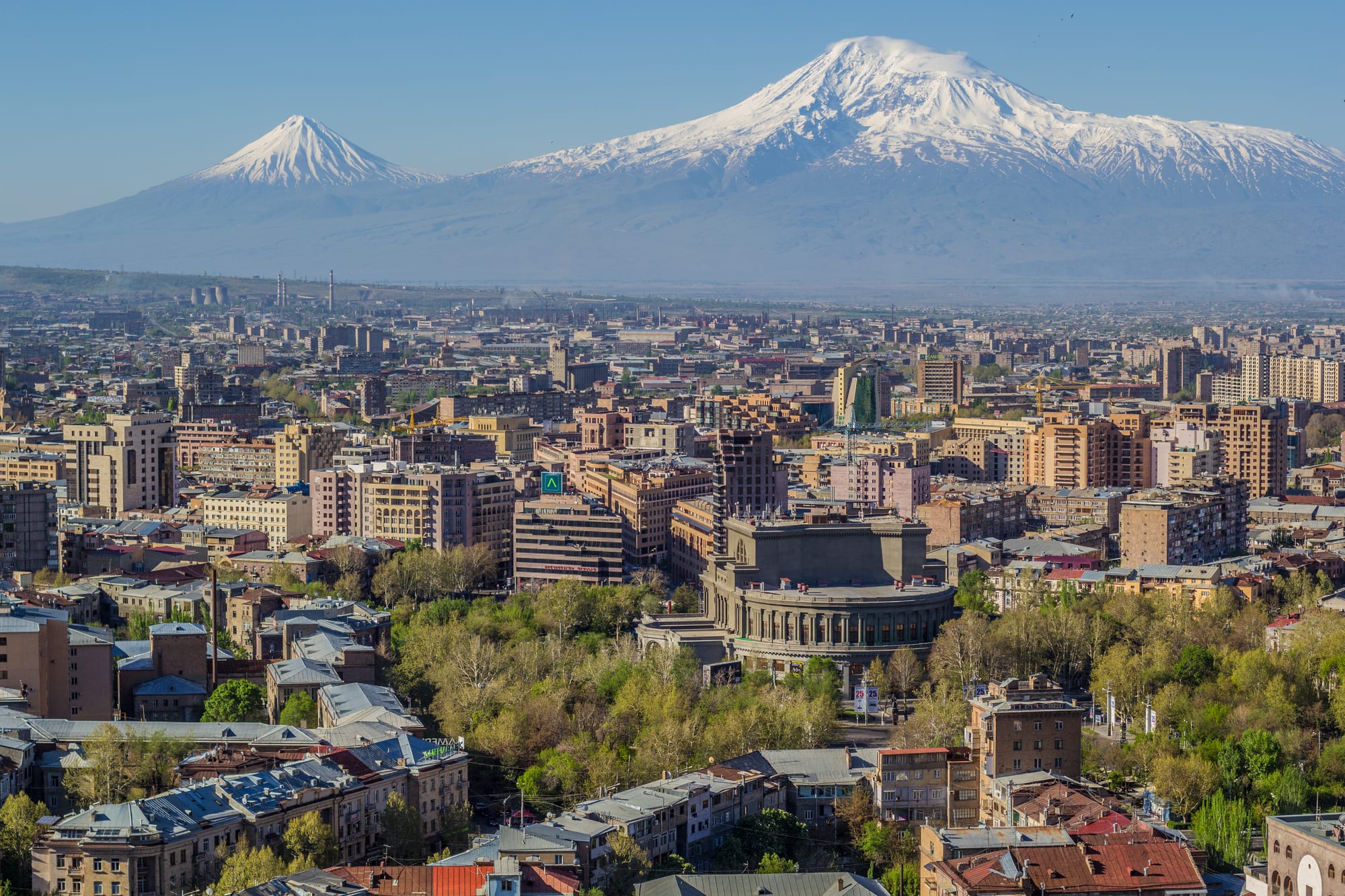
A low city of pale stone buildings and trees below the twin snow-covered peaks of a large volcano on a clear spring day

Armenia

Yerevan

The Yerevan skyline below the snow-covered peaks of Mount Ararat, with the opera house in the centre. (Սէրուժ Ուրիշեան (Serouj Ourishian) / Wikimedia Commons · CC BY-SA 3.0)

Armenia's capital and the home of about a third of its people, spread over the Hrazdan gorge and the edge of the Ararat plain. Founded as the fortress of Erebuni in 782 BC and rebuilt in the 1920s to Alexander Tamanian's radial plan in pink volcanic tuff, it is a city of boulevards, cafés, museums and open-air markets, with Mount Ararat across the closed Turkish border on the skyline.

Neighbourhoods

  • Kentron
    • First-time visitors
    • Best for food
    • Close to public transport

    The central district inside and around Tamanian's Ring Boulevard, holding Republic Square, the opera house, the Cascade, the main museums and nearly all the hotels. Almost everything a short visit needs is within a half-hour walk, and the streets are lined with cafés and wine bars.

    Open in Maps
  • The Cascade and Saryan Street
    • Arts and culture
    • Nightlife
    • Viewpoints

    The northern edge of the centre, where a giant stairway of stone terraces climbs the hillside with sculpture on every level. The blocks below hold the opera house, the city's densest run of wine bars and restaurants, and the park where the art market sets up at weekends.

    Open in Maps
  • Kond
    • Historic district
    • Local life
    • Street art

    One of the few surviving quarters of old Yerevan, a hillside maze of narrow lanes and small houses just west of the centre, some ruined and some painted with murals. It is poor, informal and much argued over, and gives the clearest idea of what the town looked like before the 1920s plan.

    Open in Maps
  • Arabkir
    • Quiet and residential
    • Local life

    A residential district on higher ground north of the centre, named after a town in historic western Armenia and settled by its refugees. Wide Soviet-era avenues, apartment blocks, schools and neighbourhood bakeries, with the zoo and the botanical garden on its edge.

    Open in Maps
  • Erebuni
    • History
    • Quiet and residential

    The southern district built around the hill where the Urartian fortress of Erebuni was founded in 782 BC, with its excavated citadel and museum. Below it are housing blocks, industry and the railway approach to the city.

    Open in Maps
  • Nork and the Hrazdan gorge
    • Viewpoints
    • Parks

    The steep eastern slopes and the gorge that cuts through the city, with Victory Park and the Mother Armenia statue above and sports grounds, the brandy factories and a green ravine walk below.

    Open in Maps

Things to do

Landmarks and squares

  • Republic Squarelandmark

    The oval centre of Tamanian's plan, ringed by pink and cream tuff buildings with arcades, with a musical fountain in front of the History Museum.

    Open in Maps
  • Cascade Complexlandmark

    A monumental stone stairway of terraces, fountains and escalators climbing from the city centre to a hilltop, lined with modern sculpture.

    Open in Maps
  • Armenian Genocide Memoriallandmark

    The memorial at Tsitsernakaberd, a split stone stele and a circle of basalt slabs around an eternal flame, with an underground museum beside it.

    Open in Maps
  • Saint Gregory the Illuminator Cathedrallandmark

    The largest cathedral of the Armenian Apostolic Church, completed in 2001 for the 1,700th anniversary of Armenia's adoption of Christianity.

    Open in Maps
  • Blue Mosquelandmark

    An eighteenth-century Persian mosque with a tiled dome and a walled courtyard garden, the only active mosque in Armenia.

    Open in Maps
  • Mother Armeniaviewpoint

    A copper statue of a woman holding a sword, raised in Victory Park in 1967 on the pedestal of a former Stalin monument, with a wide view over the city.

    Open in Maps

Museums and galleries

  • Matenadaranmuseum

    The national repository of Armenian manuscripts at the head of Mashtots Avenue, holding thousands of medieval codices, with a gallery of illuminated books.

    Open in Maps
  • History Museum of Armeniamuseum

    The national collection on Republic Square, from Bronze Age metalwork and Urartian finds to the world's oldest known leather shoe.

    Open in Maps
  • Erebuni Fortressmuseum

    The excavated Urartian citadel of 782 BC on a hill in the south of the city, with wall paintings and cuneiform inscriptions and a museum at its foot.

    Open in Maps
  • Cafesjian Center for the Artsmuseum

    A collection of modern sculpture and glass displayed inside and on the terraces of the Cascade, built around the gift of the collector Gerard Cafesjian.

    Open in Maps
  • Sergei Parajanov Museummuseum

    The house museum of the film director, with his collages, assemblages and drawings, many made during his years in Soviet prison camps.

    Open in Maps
  • Yerevan Brandy Companyattraction

    The hillside works above the Hrazdan gorge where Ararat brandy has been made since 1887, with cellars of oak casks open to visitors.

    Open in Maps

Parks, markets and streets

  • Vernissagemarket

    An open-air market near Republic Square selling carpets, woodwork, silver, khachkar carvings, records and Soviet oddments.

    Open in Maps
  • GUM Marketmarket

    A covered food hall east of the centre piled with dried fruit, walnuts in grape must, spices, cheese and pickles, where sellers press samples on passers-by.

    Open in Maps
  • Northern Avenueattraction

    A pedestrian boulevard of shops and cafés driven through the old blocks in the 2000s to link Republic Square with the opera house.

    Open in Maps

Short trips from the city

  • Garni Templelandmark

    A colonnaded Hellenistic temple above a gorge about 30 kilometres east, rebuilt from its fallen stones after an earthquake destroyed it.

    Open in Maps
  • Geghardlandmark

    A monastery partly cut into the rock of a gorge beyond Garni, a UNESCO World Heritage Site known for the acoustics of its chambers.

    Open in Maps
  • Etchmiadzin Cathedrallandmark

    The seat of the Armenian Apostolic Church about 20 kilometres west, among the oldest cathedrals in the world and a UNESCO World Heritage Site.

    Open in Maps
  • Zvartnots Cathedrallandmark

    The ruins of a vast seventh-century round church on the road to Etchmiadzin, listed by UNESCO with the cathedral.

    Open in Maps
  • Khor Viraplandmark

    A monastery on the Ararat plain about 30 kilometres south, built over the pit where Gregory the Illuminator is said to have been imprisoned, directly below Mount Ararat.

    Open in Maps
  • Lake Sevanattraction

    A large alpine lake north-east of the city, with the Sevanavank monastery on a promontory and beaches used through the summer.

    Open in Maps

Seasonal events

  • VardavarJuly, fourteen weeks after Easter

    A church feast with pre-Christian roots on which people drench each other with water in the streets, and nobody is exempt.

  • Golden Apricot International Film FestivalJuly

    The country's main film festival, with screenings across the city and an award named after the fruit most identified with Armenia.

  • Independence Day21 September

    Parades, concerts and fireworks around Republic Square marking independence from the Soviet Union in 1991.

Eat and drink

Long-standing places and food districts in Yerevan. Hours, ratings and directions come from your maps app, always current.

Markets and food halls

  • GUM Marketmarket

    The main covered market for dried apricots, sujukh strings of walnuts in grape must, herbs, cheese, honey and pickled vegetables.

    Open in Maps
  • Vernissagemarket

    The open-air craft market, with food and coffee stalls along its edges and the covered fruit market a short walk away.

    Open in Maps

Eating and drinking districts

  • Saryan Streetneighborhood

    A short street near the opera house that has become the centre of Armenia's wine revival, with small bars pouring wines from Vayots Dzor and Areni.

    Open in Maps
  • Northern Avenue and Abovyan Streetneighborhood

    The central pedestrian axis and the old street beside it, lined with cafés, bakeries and restaurants serving Armenian and Middle Eastern food.

    Open in Maps
  • Cascade caféscafe

    Outdoor tables in the sculpture park below the stairway, busy from late morning until after midnight through the warm months.

    Open in Maps

Experience Yerevan

History

Yerevan dates its founding to 782 BC, when the Urartian king Argishti I built the fortress of Erebuni on a hill above the Ararat plain and recorded the fact on a cuneiform stone that survives. The plain around it was settled continuously afterwards, but the town spent most of its history as a provincial place fought over by larger powers — Persian, Arab, Byzantine, Seljuk, Ottoman and Safavid — and repeatedly wrecked by earthquakes. Under Persian rule it was the seat of a khanate centred on a fortress above the Hrazdan, and its population was mixed Armenian and Muslim.

Russian forces took the city in 1827 and the region was ceded to the Russian Empire the following year. Yerevan remained small, a dusty district town of some 30,000 people, until it was made the capital of the short-lived independent republic in 1918 and then of Soviet Armenia. That, and the arrival of survivors of the 1915 genocide, transformed it. From 1924 the architect Alexander Tamanian rebuilt the town to a radial-concentric plan, sweeping away much of the old quarters and using the local volcanic tuff in pink, cream and black that gives the city its colour.

Soviet industry and in-migration pushed the population past a million by the 1980s. The 1988 earthquake in the north, the Karabakh conflict and the collapse of the Soviet Union brought years of blockade, cold and power cuts in the early 1990s. Since then the centre has been rebuilt and partly replaced, protests changed the government in 2018, and the city has absorbed successive waves of arrivals, including most recently people who left Nagorno-Karabakh in 2023.

Culture & Customs

Yerevan carries the weight of being the only large city of a nation whose diaspora outnumbers it. Institutions here are national by definition: the Matenadaran's manuscripts, the opera and its two halls, the History Museum, the conservatory, the film festival named after the apricot. Visitors from Los Angeles, Beirut, Paris and Moscow are a constant presence, and the varieties of Armenian spoken in the cafés are a subject of gentle comment.

The duduk, an apricot-wood reed pipe with a low mournful tone, is the national instrument and can be heard in concert halls and on the street. Composers from Komitas, who collected village songs and whose name is on the conservatory, to Aram Khachaturian are civic figures with statues and institutions attached. Chess is taught in schools and followed like a sport. The Armenian Apostolic Church orders the calendar, and even among the unobservant, church feasts such as Vardavar, when the whole city throws water, are kept without embarrassment.

Daily manners are formal at first and warm afterwards. Meals are long, toasts are structured and made by one person at a time, and refusing food outright is read as a rebuke. The genocide of 1915 and the loss of Nagorno-Karabakh are discussed openly among Armenians but are not casual conversation for a visitor. Evenings are spent outdoors from April to October, on café terraces, at the fountains of Republic Square and on the Cascade steps.

Daily Life

About 1.1 million people live in Yerevan, roughly a third of Armenia's population, and the share has grown as villages empty. Most live in Soviet-built apartment districts ringing the centre — Arabkir, Malatia-Sebastia, Nor Nork, Erebuni — while the tuff-fronted blocks of Kentron have become the expensive quarter, full of short-let flats, offices and restaurants, with new towers rising between them and old buildings lost to development.

The economy has shifted decisively towards services. Information technology is the growth sector, helped by large numbers of Russians who moved to the city from 2022, along with tourism, construction, education and the brandy, wine and food industries. Wages are low relative to prices in the centre, many households receive money from relatives abroad, and the arrival of more than a hundred thousand people from Nagorno-Karabakh in 2023 added pressure on housing and schools.

The rhythm of the day starts early for work and finishes late for pleasure: shops open into the evening, and families walk the boulevards after dark in summer to escape flats that hold the heat. Marshrutka minibuses and taxis fill the streets, traffic and parking dominate local politics, and winter air pollution and the green space lost to building are the other recurring complaints. Lake Sevan and the gorges within an hour's drive absorb the city at weekends.

Food

Yerevan eats the Armenian table at its fullest. Lavash, the thin bread baked against the wall of a clay tonir and listed by UNESCO, comes with everything and is used to wrap and to scoop. Khorovats, skewers of pork, lamb or vegetables grilled over vine cuttings, is the centrepiece of celebration and of any weekend gathering, served with grilled tomatoes, aubergine and peppers. Dolma means vine or cabbage leaves rolled around rice and minced meat, and the summer version stuffs tomatoes, peppers and aubergines instead.

Around these sit the herbs that Armenians eat by the handful, salty string cheese, thick matsun yoghurt, and soups: spas made from matsun and wheat, and khash, cow's feet simmered overnight and eaten early on winter mornings with garlic and dried lavash. Ghapama, a pumpkin baked with rice and dried fruit, appears at feasts. Lebanese and Syrian Armenians who settled here brought shawarma, lahmajoun and manti, now everyday food, and the city has a growing number of restaurants reworking village dishes.

Fruit is the pride of the place: apricots above all, then pomegranates, grapes, peaches and mulberries, sold fresh in summer and dried the rest of the year at the covered markets. Armenian brandy, aged in oak at the works above the gorge and usually called cognac locally, is the classic gift, while Areni wine from the south has revived enough to fill a street of bars near the opera house.

Planning tools

Budget

Yerevan is inexpensive by European standards, though it is the most expensive place in Armenia. Restaurant meals, coffee, taxis and the metro cost little; the main variables are hotel prices, which rise sharply in summer and around diaspora visits, and hired cars with drivers for trips to the monasteries and Lake Sevan.

Daily Budget Midrange
USD 60–110 (small hotel, restaurant meals, a hired car with driver for a day out)
Daily Budget Shoestring
USD 30–45 (hostel or guesthouse, market food and canteens, metro and shared minibuses)

A car and driver for a day of monasteries is affordable when split between two or three people, and costs less than a packaged tour.

Best Time to Visit

May to June and September to October are the most comfortable, with warm days, open terraces and, in autumn, the grape and pomegranate harvest. July and August are dry and very hot on the Ararat plain, when the city empties towards Lake Sevan at weekends. Winter is cold and often snowy, with low prices and a full concert season.

Suggested Number of Days

Two or three days are enough for the central district on foot. Five or six allow for the country around the capital, which is where much of the interest lies; each trip out of the city takes the better part of a day.

First Visit
2–3 days
With Surroundings
5–6 days

Transportation

The metro, opened in 1981, has a single line of ten stations running under the centre from the north-west to the south, cheap and simple but limited. Buses and minibuses cover the rest of the city, and taxis booked through apps are inexpensive and the way most visitors move around after dark. Long-distance minibuses and buses to the provinces and to Georgia leave from the Kilikia station and other terminals.

Traffic is assertive and parking blocks pavements, so cross at marked crossings and expect drivers to turn across them.

Airport & Station Connections

Zvartnots International Airport is about 15 kilometres west of the centre, roughly 20 to 30 minutes by taxi, and is the country's main gateway. The land borders with Turkey and Azerbaijan are closed, so overland arrivals come from Georgia or Iran, by minibus, shared taxi or the slow overnight train from Tbilisi. Citizens of the EU, the United States, the United Kingdom, Canada, Australia and many other countries enter visa-free for a stay of several months, and other nationalities can obtain an e-visa or, for some passports, a visa on arrival.

Walkability

The centre is one of the most walkable in the region: Republic Square, the opera house, the Cascade, the Matenadaran and the main museums sit within a compact grid of tree-lined avenues, and the Ring Boulevard of parks curves around it. The ground rises steadily towards the Cascade, pavements are uneven in places and summer heat is punishing in the afternoon, but distances are short and shade is plentiful.

Safety

Yerevan is a safe city with little violent crime and a strong habit of walking late at night. Petty theft is uncommon but possible in crowds and markets, and the main practical risks are traffic and the summer heat. Political demonstrations are held in the centre from time to time and are best avoided. The militarised borders with Azerbaijan are far from the capital, in the east and south of the country.

Avoid unmarked roads and hiking near the eastern and southern borders, and check the current situation before travelling to Syunik. Check current official travel advice before travelling.

Climate

A dry highland continental climate at about 1,000 metres, with a very large range between the seasons. Summers are long, hot and almost rainless; winters are cold with snow; spring and autumn are short and pleasant. Air quality is poorest on still winter days.

Summer
hot and dry, often 33–40°C in July and August, with cool evenings
Winter
cold, around -5 to 3°C from December to February, with snow and grey days

Local Customs

Hospitality is taken seriously: guests are fed generously and toasts are made in order by a designated toastmaster. Churches ask for modest dress and quiet, women often cover their heads, and candles are lit at the entrance. Armenian and Russian are widely spoken, with English common among younger people in the centre. The genocide memorial is a place of mourning rather than a sight, and is visited quietly.

Tipping of around 10 per cent is usual in restaurants where no service charge is added; ask before photographing people, and avoid political arguments about Nagorno-Karabakh or Turkey with strangers.

Common Payment Methods

The currency is the Armenian dram, which is hard to obtain outside the country, so money is usually changed on arrival at one of the many exchange offices. Cards are accepted in hotels, restaurants and shops across the centre, but cash is needed for markets, minibuses, small bakeries and anywhere outside the capital. Cash machines are plentiful.