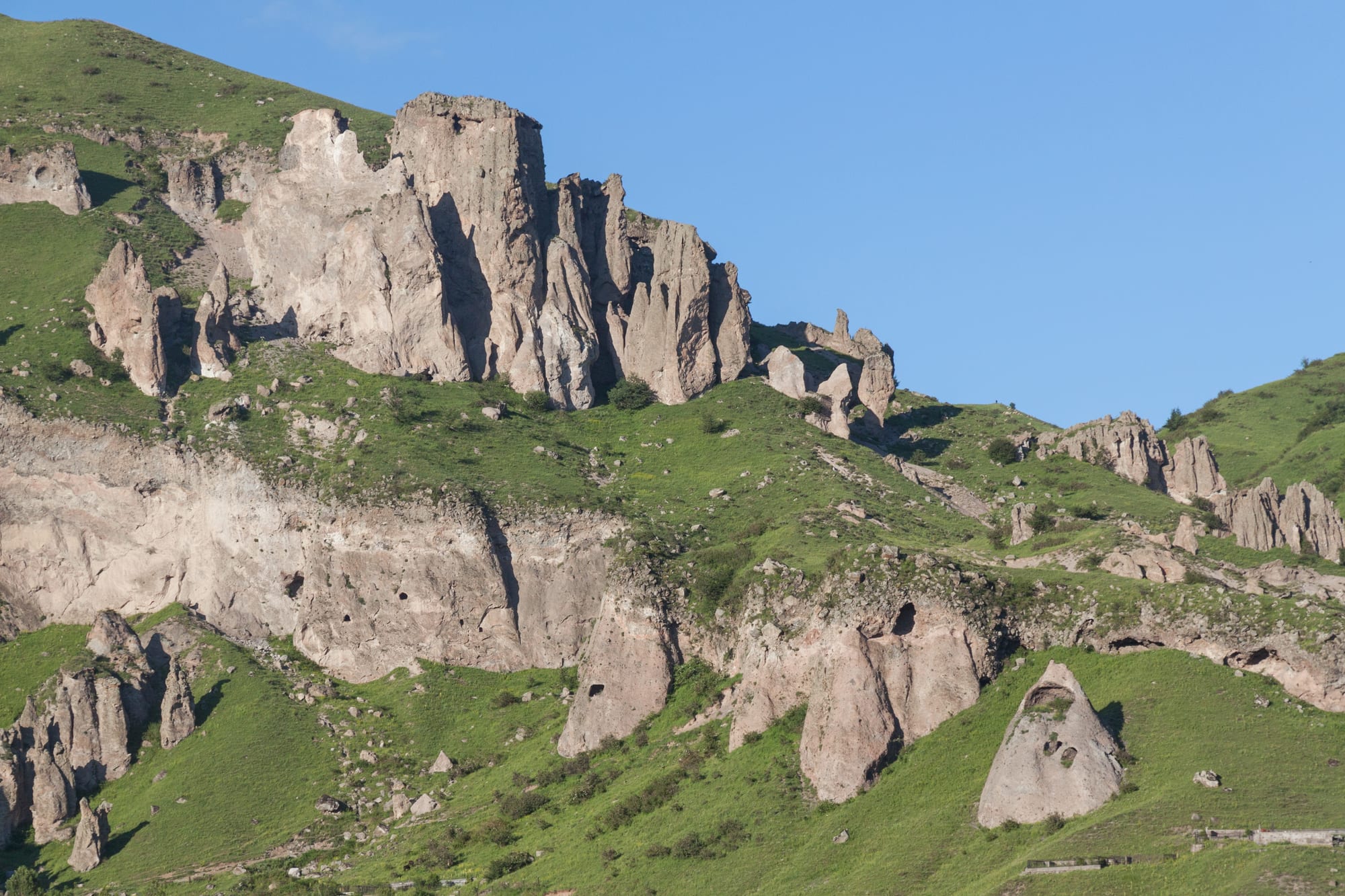
Grassy hillside above a town broken by tall pale rock pinnacles and cliffs pierced with dark cave openings under a deep blue sky

Armenia

Goris

The eroded rock pinnacles and cave dwellings of Old Goris on the slopes above the modern town. (Marcin Konsek / Wikimedia Commons · CC BY-SA 4.0)

A small town in the southern province of Syunik, laid out on a grid of stone houses in a bowl of eroded rock pinnacles above the Goris river. The hillsides around it are honeycombed with the cave dwellings of the older settlement, and the town is the usual base for Tatev monastery, reached by a long cable car across the Vorotan gorge.

Neighbourhoods

  • The planned town centre
    • First-time visitors
    • Historic district
    • Close to public transport

    The nineteenth-century grid of straight streets and stone houses with tiled roofs, walled yards and fruit trees, built when the Russian administration replanned the settlement. The main square, the church, the shops, the bus stop and most guesthouses are inside a few blocks.

    Open in Maps
  • Old Goris and the eastern slopes
    • Walks
    • Viewpoints
    • History

    The hillside above the eastern edge of town, where the older settlement of caves and rock-cut rooms stands among pinnacles of eroded tuff. Paths climb from the last streets to the viewpoints, and the whole town and its valley open up below.

    Open in Maps
  • The valley and the Kapan road
    • Quiet and residential
    • Local life

    The lower ground along the river and the highway south, with newer housing, workshops, the market gardens of the valley floor and the roadside businesses that serve traffic heading towards Kapan and the Iranian border.

    Open in Maps

Things to do

In and around the town

  • Old Goris cave dwellingsattraction

    The rock-cut houses, stores and pinnacles of the earlier settlement on the slopes east of the modern grid, reached on foot from the top of the town.

    Open in Maps
  • Axel Bakunts House-Museummuseum

    The home of the writer born in Goris in 1899, whose stories described this landscape, kept as a museum in a nineteenth-century town house.

    Open in Maps
  • Goris town gridneighborhood

    The planned streets of dark stone houses, carved gateways and walled gardens, laid out from 1870 to a plan by a German architect.

    Open in Maps

Short trips from the town

  • Tatev Monasterylandmark

    A ninth-century monastery on a promontory above the Vorotan gorge, once a university and one of the great medieval centres of Armenian learning.

    Open in Maps
  • Wings of Tatevattraction

    A cable car of 5.7 kilometres crossing the gorge from Halidzor to the monastery in about twelve minutes, the longest reversible aerial tramway built in a single section.

    Open in Maps
  • Khndzoreskattraction

    An abandoned cave village in a gorge about 8 kilometres east, its rock-cut houses lived in until the 1950s, when the present village was built above.

    Open in Maps
  • Zorats Karerlandmark

    A prehistoric site of standing stones, many pierced with holes, on a plateau west of the town near Sisian.

    Open in Maps
  • Shaki Waterfallattraction

    An eighteen-metre waterfall on the Vorotan west of the town, fed from a river that is also used for hydroelectric power.

    Open in Maps
  • Halidzorattraction

    The village at the cable-car station on the Goris side of the gorge, with a fortified complex above the gorge where Davit Bek defeated an Ottoman force in 1727, and views towards Tatev.

    Open in Maps

Seasonal events

  • VardavarJuly, fourteen weeks after Easter

    The national water festival, when people in the streets and squares drench one another without warning.

  • Harvest seasonSeptember and October

    The fruit harvest fills yards and roadsides with mulberries, grapes, walnuts and plums, much of it preserved or distilled at home.

Eat and drink

Long-standing places and food districts in Goris. Hours, ratings and directions come from your maps app, always current.

Where to eat

  • Guesthouse tablesrestaurant

    Most eating in Goris is done in family guesthouses, which serve home cooking — soups, dolma, grilled meat, garden vegetables and preserves — to their guests.

    Open in Maps
  • Town centre restaurants and cafésneighborhood

    A handful of places around the main square and along the highway grill khorovats and serve Armenian staples to travellers on the road south.

    Open in Maps
  • Goris marketmarket

    A small market for fruit, herbs, cheese, honey and home-made preserves from the villages of the Vorotan valley.

    Open in Maps

Experience Goris

History

The Goris basin has been inhabited for a very long time: the soft volcanic rock of the surrounding slopes was hollowed out for houses, byres and storerooms, and the settlement known as Old Goris or Kores lived in and among those caves for centuries. Medieval Syunik was a princely domain with a strong church presence, and Tatev, on its promontory above the Vorotan gorge to the west, was both a monastery and a university whose scholars shaped Armenian philosophy and manuscript painting in the fourteenth and fifteenth centuries.

The modern town is a deliberate creation. After the region passed to the Russian Empire in the first half of the nineteenth century, the administration founded a new town in 1870 and built it out from 1876 to a German architect's plan on the valley floor below the caves, on a rectangular grid with wide streets, plots for gardens and houses built of local stone with tiled roofs. Families moved down from the rock dwellings over the following decades, and Goris became the administrative and market centre of the district, with schools, a printing tradition and a reputation for producing writers, among them Axel Bakunts.

The twentieth century made it a Soviet district town with light industry and a carpet works. After 1991 it sat on the main road linking Armenia with Nagorno-Karabakh and grew in importance as a border and transit town. Following the 2020 war and the departure of the Armenian population of Nagorno-Karabakh in 2023, Goris was the main destination for the more than 100,000 people who crossed into Armenia in a week that September, and many have settled in Syunik. The town remains the main centre between Yerevan and the far south.

Culture & Customs

Goris has an outsized literary reputation for a town of its size. Axel Bakunts, born here in 1899, wrote the stories that fixed this landscape in Armenian literature, and his house is kept as a museum; other writers and academics came from the same streets, and the town is proud of having been a place of schools and printing rather than of trade alone. The stone architecture is the other point of pride, and restoration of the old houses, gates and roofs is a live local concern.

Syunik keeps its own dialect, strongly marked and often good-humouredly imitated elsewhere in Armenia, along with village traditions of beekeeping, distilling fruit vodka and making preserves that fill every household's autumn. Church life centres on the town's nineteenth-century church, and the great monasteries of the province — Tatev above all — are visited for feast days and family occasions as well as by travellers.

The town's position has shaped its temperament. It is a border district that has lived with conflict for three decades, and since 2023 it has absorbed families from Nagorno-Karabakh who arrived with very little. Visitors are received warmly, often with an invitation to eat, but the recent past is heavy, and it is better to let residents choose whether to speak of it. Modest dress in churches, a greeting in the street and asking before taking photographs are the usual courtesies.

Daily Life

About 17,000 people live in Goris, the second largest town of Syunik, though still small enough that the centre empties by mid-evening. Most people live in the grid of stone houses and in the newer blocks and streets along the river and the highway, with gardens, fruit trees and vines behind the walls — a town of household production as much as of wages.

Work comes from administration, since Goris is a district centre with schools, a hospital, a state university and public offices; from trade along the southern highway, including traffic to and from Iran; from tourism built on the cable car, the gorges and the guesthouses; and from farming in the Vorotan valley, where fruit, potatoes and livestock dominate. Mining elsewhere in Syunik and seasonal work in Russia support many families, and remittances matter.

The town's daily rhythm is slow and seasonal, turning on school hours, the market and the harvest. Its recurring concerns are those of a border district: the security situation along roads to the east, the condition of the highway north, depopulation and the search for work for young people, and, since 2023, housing, schooling and jobs for the displaced families who have settled here. Weekends and holidays bring relatives back from Yerevan and abroad.

Food

Goris eats the food of a mountain province where most households still grow and preserve a large part of what they consume. Khorovats, meat grilled over wood or vine cuttings, is the dish for guests and celebrations; soups, boiled meat and dolma of stuffed vine leaves or vegetables are everyday cooking, and greens picked on the slopes in spring are made into pies and stews. Lavash is baked in clay ovens and kept dried through the winter, and matsun yoghurt, string cheese and curd appear at every meal.

Fruit is the region's signature. The valleys grow mulberries, walnuts, grapes, plums, cornelian cherries, apples and quinces, and the autumn is spent boiling jams, drying fruit, pressing juice and distilling home-made vodka, particularly from mulberries — a strong clear spirit offered to visitors and used as a medicine. Honey from hives in the gorges is sold along the roads with the jams and dried herbs.

Everyday food in town is simple: bakeries, a few grills, and guesthouse kitchens that serve whatever the garden has produced. Sweet things mean gata, dried fruit and walnuts rolled in grape must, and tea from mountain herbs rather than elaborate pastry. Armenian brandy and the wines of nearby Vayots Dzor complete a table that is generous out of all proportion to the size of the town.

Planning tools

Budget

Goris is inexpensive. Guesthouse rooms with breakfast cost little, meals are cheap and mostly eaten where people stay, and the significant costs are the cable-car fare at Tatev and the taxi or hired car needed to reach the monasteries, the cave village and the sites out towards Sisian.

Daily Budget Midrange
USD 55–100 (guesthouse or small hotel, restaurant meals, a taxi or hired car for the day and the cable car)
Daily Budget Shoestring
USD 20–35 (guesthouse room, home cooking, shared minibuses and walking)

Bring cash from Yerevan or Kapan; cards are accepted in few places here and machines are limited to the centre.

Best Time to Visit

May to October is the season, with warm days, green gorges and the cable car and paths in full use; September and October add the harvest and autumn colour in the valleys. Winter is cold and snowy, the mountain roads can close, and the town is very quiet, though the rock landscape under snow is striking.

Suggested Number of Days

A night is enough to see the town itself. Two or three allow for the gorges, the monastery across the valley and the cave villages nearby, which is why most travellers stop here rather than passing straight through.

First Visit
1 day
With Surroundings
2–3 days

Transportation

The town is small enough to cross on foot. Minibuses and shared taxis run to Yerevan, Sisian and Kapan from the centre, and services to Iran pass through on the highway. Taxis wait on the main square and are the normal way to reach Khndzoresk, Halidzor and the Tatev cable car, usually hired for a half day with waiting time.

Agree a price and a waiting time with a driver before leaving, and allow for slow going on the winding gorge roads.

Airport & Station Connections

Goris is about 240 kilometres from Yerevan on the main southern highway, roughly four to five hours by minibus or car through several mountain passes. The road continues south through Kapan to the Iranian border, and the town is the last large stop before it. There is no airport or railway. Citizens of the EU, the United States, the United Kingdom, Canada, Australia and many other countries enter Armenia visa-free for a stay of several months, with an e-visa or a visa on arrival available to others.

Walkability

The grid of the town is flat, quiet and easily walked end to end in half an hour, with the church, the square, the museum and the guesthouses all close together. The slopes to the cave dwellings are a steep but short climb on rough paths, and everything beyond the town needs a vehicle, as the roads out have no pavement and little traffic.

Safety

Goris is a quiet town with very little crime, and the ordinary risks are outdoor ones: unmarked paths on the rock slopes, loose ground in the gorges, few railings at viewpoints and mountain weather that changes quickly. The town lies in Syunik, the province that runs along the militarised border with Azerbaijan, where the situation can change, so local advice on roads near the border should be taken seriously.

Avoid unmarked roads and hiking near the eastern and southern borders, and check the current situation before travelling to Syunik. Check current official travel advice before travelling.

Climate

A mountain climate at about 1,400 metres, drier and sunnier than the north of the country but with sharp seasonal extremes. Summers are warm by day and cool at night; winters bring snow and hard frost, and passes on the road to Yerevan can be difficult.

Summer
warm, usually about 22–30°C by day in July and August, with cool nights
Winter
cold, around -8 to 2°C from December to February, with snow and icy passes

Local Customs

This is a small, conservative town where guests are treated formally and generously; a guesthouse host will expect to feed visitors and to pour toasts. Churches ask for modest dress and quiet. Armenian and Russian are the working languages and English is limited outside the guesthouses. Syunik has taken in many people displaced from Nagorno-Karabakh since 2023, and the subject is best left to local people to raise.

Ask before photographing people, houses or livestock, take care not to damage the cave dwellings, and tip modestly in restaurants where no service charge is added.

Common Payment Methods

The currency is the Armenian dram. Cash is the norm: guesthouses, taxis, the market and most small shops do not take cards, though the cable car and a few larger businesses do. Cash machines exist in the centre but should not be relied on for large sums.