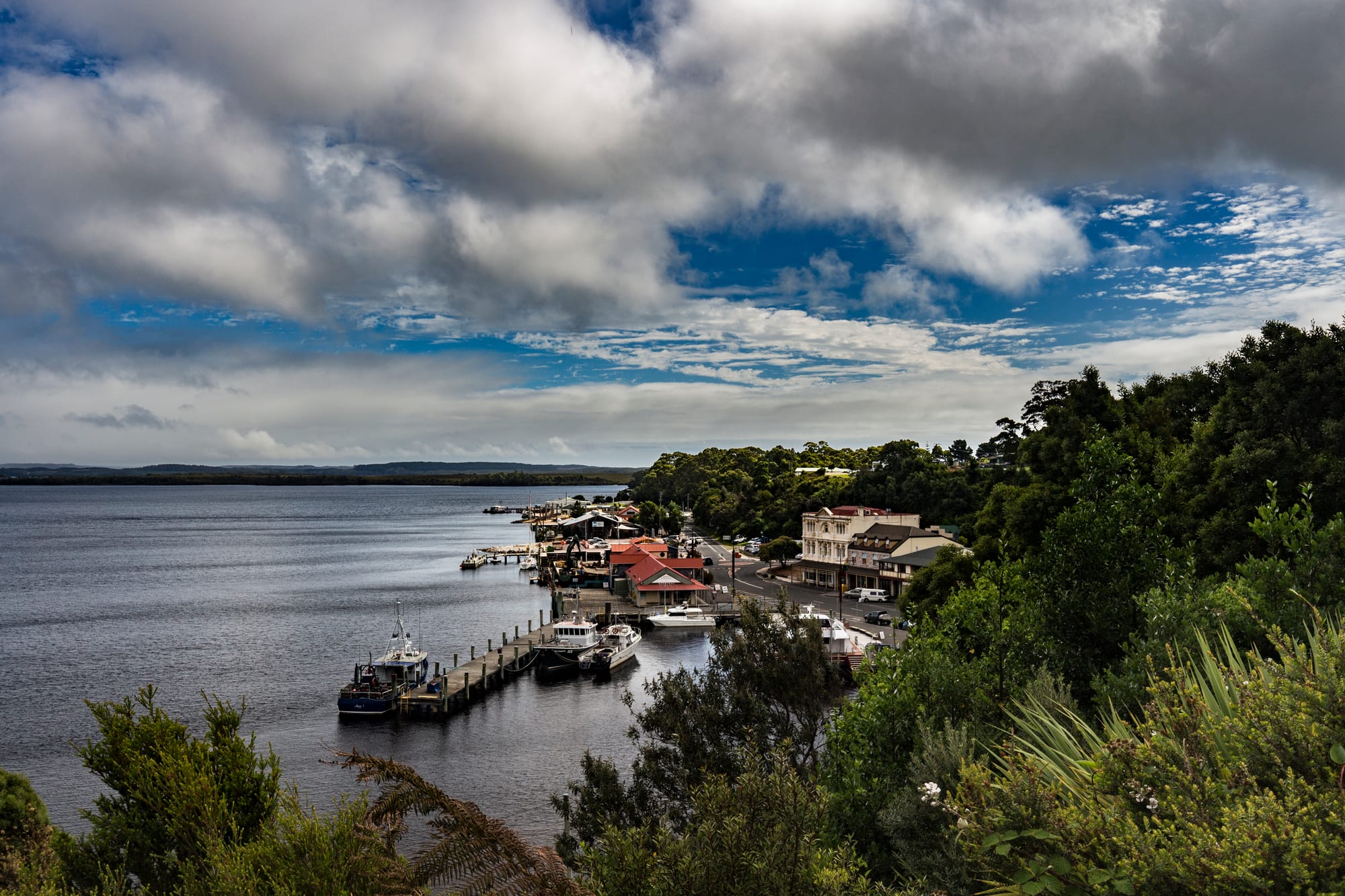
A small waterfront town of weatherboard buildings along the shore of a wide harbour, seen from a wooded rise

Tasmania, Australia

Strahan

The town of Strahan on the shore of Macquarie Harbour. (Steven Penton / Wikimedia Commons · CC BY 2.0)

A small port on Macquarie Harbour, the main town on Tasmania's rainforest west coast. It was built in the 1890s to ship copper from the mines at Queenstown and timber cut from the rivers behind it, and after the mining trade declined it turned to visitors, who come for cruises down the Gordon River, the restored mountain railway and the convict ruins on Sarah Island.

Neighbourhoods

  • The Esplanade and the wharf
    • First-time visitors
    • Close to the water
    • Cruises and tours

    The centre of town, a curve of 19th and early 20th-century weatherboard and brick buildings facing the harbour. The cruise boats, the visitor centre, pubs, cafés and most of the hotels stand within a few hundred metres, and fishing boats tie up at the jetties in front.

    Open in Maps
  • Regatta Point
    • Railway
    • Quiet and residential
    • Views

    A headland a couple of kilometres east of the centre where the wilderness railway has its station and where the old rail shipping works stood. Houses look back across the water to the town, and a foreshore path links the two.

    Open in Maps
  • West Strahan and the beach
    • Families
    • Beaches
    • Camping

    The shallow, sheltered harbour beach at the western end of the town, with the caravan park, holiday units and quiet streets behind it. The water here is tannin-stained and calm, in contrast to the ocean surf a few kilometres away.

    Open in Maps
  • Ocean Beach Road and Macquarie Heads
    • Remote camping
    • Fishing
    • Wild coast

    The road running west and south out of town past farmland to the dunes, the surf of Ocean Beach and eventually the campground and fishing spots at the harbour entrance. There are no services along it, only the coast and the wind.

    Open in Maps

Things to do

On the water

  • Gordon River cruiseattraction

    The main reason most people come: a catamaran trip across Macquarie Harbour and up the dark, still Gordon River into the Tasmanian Wilderness World Heritage Area, with a rainforest boardwalk on the way.

    Open in Maps
  • Sarah Islandlandmark

    The ruined convict settlement in Macquarie Harbour, used from 1822 to 1833 as one of the harshest penal stations in the Australian colonies, visited on the river cruises.

    Open in Maps
  • Hells Gatesviewpoint

    The narrow, shallow entrance to Macquarie Harbour, notorious among sailors; convict ships foundered in the channel on the way to the penal station, and cruise boats pass through it today.

    Open in Maps
  • Macquarie Harbourattraction

    A harbour several times the size of Sydney's, fed by the Gordon and King rivers, used for salmon and trout farming and open to kayaks, yachts and fishing boats.

    Open in Maps

Town and railway

  • West Coast Wilderness Railwayattraction

    A restored rack-and-pinion railway from Regatta Point towards Queenstown, following the original mining line of the 1890s through rainforest and over the King River.

    Open in Maps
  • Strahan wharf and visitor centreattraction

    The working waterfront and the town's interpretation centre, which covers the convict station, the piners who cut Huon pine and the Franklin River campaign.

    Open in Maps

Coast and dunes

  • Ocean Beachbeach

    A very long, exposed surf beach running north from Macquarie Heads a few kilometres west of the town, with dunes, wind-blown sand and no land between it and South America.

    Open in Maps
  • Henty Dunesattraction

    High sand dunes beside the road north of Strahan, at the mouth of the Henty River, walkable from the car park.

    Open in Maps

Short trips from the town

  • Queenstownattraction

    The mining town about 40 kilometres east, reached over a winding pass, known for its bare, eroded hills, its mining history and a gravel football ground.

    Open in Maps
  • Zeehanattraction

    A former silver-mining town to the north, known as the Silver City while the boom lasted, with a heritage museum among its old buildings.

    Open in Maps
  • Franklin-Gordon Wild Rivers National Parkpark

    The World Heritage park inland from the harbour, crossed by the Lyell Highway, where the campaign to stop a dam on the Franklin River was fought in the early 1980s.

    Open in Maps
  • Montezuma Fallstrail

    One of Tasmania's highest waterfalls, reached by a rainforest walk along a former tramway from Williamsford near Rosebery.

    Open in Maps

Seasonal events

  • The Ship That Never WasMost of the year

    A comedy about the convicts who seized a ship built at Sarah Island and sailed it to Chile, staged at the Strahan amphitheatre since 1993 and the longest-running play in Australia.

  • Summer holiday seasonDecember to February

    The busiest weeks, when cruise boats and the railway run at capacity, accommodation fills and the town's few restaurants are at their liveliest.

  • Mutton bird seasonSpring and summer

    Short-tailed shearwaters, the birds Tasmanians call mutton birds, nest in burrows in the coastal dunes and come in from the sea at dusk in large numbers.

Eat and drink

Long-standing places and food districts in Strahan. Hours, ratings and directions come from your maps app, always current.

Strahan classics

  • The Esplanade pubs and dining roomsneighborhood

    The waterfront holds the town's hotels, a bakery, cafés and a handful of restaurants, most of them serving harbour salmon and ocean fish; the choice is small and kitchens close early, especially outside summer.

    Open in Maps
  • Fish and chips on the waterfrontrestaurant

    Takeaway seafood eaten on the jetties or the grass beside the harbour is the standard Strahan meal, usually locally farmed salmon or ocean fish with chips.

    Open in Maps

Provisions

  • Strahan general store and supermarketmarket

    A small supermarket and bottle shop covering basics for self-caterers and campers; Queenstown and Zeehan have slightly larger shops, and prices everywhere on the west coast are higher than in the north.

    Open in Maps
  • Salmon and trout from the harbourmarket

    Macquarie Harbour is one of Tasmania's main aquaculture areas, and farmed Atlantic salmon and ocean trout appear on nearly every menu in town, alongside wild-caught fish from the boats.

    Open in Maps

Experience Strahan

History

Aboriginal people of Tasmania's west coast lived around Macquarie Harbour for thousands of years, travelling the shore and the rivers and leaving middens in the dunes; the colonial frontier of the early 19th century destroyed their communities here as elsewhere on the island. The harbour's recorded European history begins in 1815, when it was charted and named, and in 1822 the British opened a penal station on Sarah Island, deep inside the harbour. Convicts felled Huon pine and built ships in conditions notorious even by the standards of Van Diemen's Land, hemmed in by rainforest and by the narrow entrance the prisoners called Hells Gates. The station closed in 1833.

The town itself came with metal. Copper was found at Mount Lyell behind Queenstown, and from the late 1890s the mining company needed a deepwater outlet: Strahan, named after a colonial governor, grew into the port through which copper, silver from Zeehan and Huon pine from the rivers were shipped, served by the Abt rack railway that climbed over the mountains from Queenstown to Regatta Point. For a time it was a busy port, with regular shipping of passengers and cargo as well as ore.

The railway closed in 1963 and the ore went out by road; the population fell and the town emptied. Strahan returned to national attention in 1982 and 1983 as the base for the campaign against a hydroelectric dam on the Franklin River, a dispute that split the local community and ended in the High Court. The wilderness that the campaign protected became the town's new economy: Gordon River cruises, a rebuilt tourist railway from 2002, and the harbour's salmon farms.

Culture & Customs

Strahan's identity is that of a working west coast town rather than a resort, even though nearly everyone in it now works with visitors. The old trades — mining, fishing, cutting Huon pine — are still the source of local pride, and Huon pine timber, slow-grown and fragrant, is turned and carved in workshops around the town. The pubs on the Esplanade are where locals and travellers mix, and conversation runs to weather, boats and what the harbour is doing.

Theatre of a very particular kind is part of the place: a comedy about the convicts who seized a brig from the Sarah Island shipyard and sailed it to South America has been performed in the town since 1993 and is the longest-running play in Australia. The interpretation of the convict settlement, the piners and the Franklin campaign is unusually thorough for a town this size, because the visitor economy is built on that history.

Environmental politics still shapes local feeling. The Franklin blockade brought national attention and lasting bitterness between conservationists and timber and hydro workers; more recent arguments concern salmon farming in Macquarie Harbour, its effect on the endangered Maugean skate, and the future of mining nearby. Tasmanian Aboriginal heritage on the west coast, including cave sites in the river valleys inland, is increasingly part of how the region presents itself.

Daily Life

About 630 people live in Strahan, and the wider west coast municipality counts a few thousand across Queenstown, Zeehan, Rosebery and the smaller settlements. The population has fallen for most of a century as mining employment shrank, and the age profile is older than the state average, although tourism brings young seasonal staff each summer.

Work means cruise boats, the railway, hotels, cafés and tour operations, along with the salmon industry in the harbour, commercial fishing, and mining and forestry jobs reached by driving inland. Many households depend on a season that runs hard from December to March and slows sharply after Easter. Shopping beyond basics, secondary schooling and most medical care involve a drive to Queenstown, Burnie or further, and the isolation is real: the nearest large supermarket is hours away.

The rhythm of the day follows the boats and the trains — an early departure across the harbour, a quiet middle of the day, the town busy again in the late afternoon. Weather dominates conversation and plans, since a westerly gale can cancel a cruise or close the beach road. Local concerns are the long-term population decline, the reliability of the roads, housing taken up by holiday letting, and the balance between the industries that built the coast and the wilderness that now pays much of its wages.

Food

Seafood is the strength of the local table. Atlantic salmon and ocean trout are farmed in Macquarie Harbour and appear smoked, grilled and in pies and chowders across the town, while boats bring in ocean fish, and southern rock lobster — called crayfish in Tasmania — is the local luxury when in season. Fish and chips eaten beside the water is the standard evening meal for visitors and residents alike.

Beyond fish, the food is west coast pub and bakery cooking: steaks and roasts, chips and gravy, and the Tasmanian scallop pie, a pastry filled with scallops in a mild curried sauce, sold in bakeries here as across the state. Rainforest products give a few local flavours, among them leatherwood honey, made by bees working the leatherwood trees of the western forests and sold in jars around the town, and native pepperberry and other bush ingredients used by some kitchens.

Drinks follow Tasmania's reputation: cool-climate wine from the north and south-east of the island, craft beer and cider, and single malt whisky from the state's distilleries, all of which travel here rather than being made locally. Self-catering is common, because the number of restaurants is small and hours are short, and most visitors stock up in Queenstown or before they leave the north of the state.

Planning tools

Budget

Strahan is not expensive to sleep in by Tasmanian standards, but the things people come for are: the Gordon River cruise and the wilderness railway are both substantial tickets, and a hire car is needed to get here at all. Fuel, food and drink cost more than in the north of the state because everything is trucked in. Walking, the beaches, the dunes and the town's own history cost nothing.

Daily Budget Midrange
USD 180–320 (hotel or cottage, restaurant meals, a hire car, and a river cruise or railway ticket)
Daily Budget Shoestring
USD 80–130 (caravan park or hostel bed, self-catering, a shared hire car and fuel)

Book the river cruise and the railway ahead in summer, and fill the fuel tank before the long drive in, as stations on the west coast are few and close early.

Best Time to Visit

December to March brings the mildest, driest weather, the longest days and the fullest schedule of cruises and trains. Rain is possible in any month and often falls even in high summer. Autumn is quieter and the rainforest is at its greenest; winter is cold, wet and dark, with reduced services, although the harbour under cloud has a stark appeal.

Suggested Number of Days

Two days is the usual stay, given that the main boat trip and the railway each take the better part of a day. Three or four make sense for anyone also driving the mining towns inland or walking in the rainforest. The long drive in and out argues for at least two nights rather than one.

First Visit
2 days
With Surroundings
3–4 days

Transportation

A car is effectively the only way to reach and use the area; there is no local public transport and a limited coach service. The town itself is compact enough to leave the car parked, and the railway station at Regatta Point is a short drive or a walk along the foreshore. Boat cruises, seaplane and helicopter flights over the harbour and the Gordon, and four-wheel-drive and quad tours on the dunes all leave from the waterfront.

West coast roads are narrow, winding and often wet; drive slowly, allow far longer than the distances suggest, and avoid driving at dusk when wildlife is on the road.

Airport & Station Connections

Strahan is reached by road across the mountains, most often on the Lyell Highway from Hobart — roughly 300 kilometres and four to five hours, through Derwent Bridge and Queenstown — or from Devonport and Launceston in the north, a similar drive via Burnie or Rosebery. There is a small airport used by light aircraft and scenic flights, but almost everyone arrives in a hire car or on the Devonport ferry with their own vehicle.

Walkability

The village centre is easy on foot: the wharf, pubs, shops and most accommodation lie along a few hundred metres of the Esplanade, and a foreshore path continues towards Regatta Point and to the start of the Hogarth Falls walk. West Strahan beach is a walk of about a kilometre and a half from the centre. Ocean Beach, the dunes and the harbour heads are too far to walk and need a car.

Safety

The town is quiet and crime is rare. The hazards are natural: cold, rough surf and strong rips at Ocean Beach, which is not patrolled; sudden changes of weather and very high rainfall; slippery rainforest tracks; and long, winding roads with wildlife and log trucks. Mobile coverage thins quickly outside the town, and medical services are basic, with hospitals in Queenstown and much further afield.

Ocean Beach is best treated as unsafe for swimming, waterproofs and warm layers are worth carrying all year, and walkers should leave word of their intended route before heading into the bush. Check current official travel advice before travelling.

Climate

Cool, wet and maritime, on the coast that takes the full force of the Southern Ocean westerlies. Rain falls on most days of the year and annual totals are among the highest in Tasmania, though showers often pass quickly. Seasons are reversed from the northern hemisphere: summer runs December to February, winter June to August, and the temperature range across the year is narrow.

Summer
mild rather than hot, generally about 11–21°C, windy, with showers and occasional warm days
Winter
cool and very wet, roughly 5–13°C by day, with gales off the ocean and snow on the mountains inland

Local Customs

This is a small working town, informal and direct, where boat crews, fishers and hospitality staff make up much of the population. Tipping is not expected in Australia. Kitchens and shops keep short hours, and out of season much of the town shuts by early evening, so meals are eaten early. The west coast has a long history of mining, logging and the Franklin River dispute, and opinions about forestry, salmon farming and wilderness protection are strongly held on all sides.

Ask before photographing people at work on the wharf, respect private property and mine sites, take rubbish out of the bush, and remember that alcohol is sold only to over-18s and drink-driving limits are strictly enforced.

Common Payment Methods

The currency is the Australian dollar. Cards and contactless payment work at hotels, tour desks, the supermarket and most cafés, but banking is minimal on the west coast and connections can drop out, so carrying some cash is sensible, particularly for campgrounds and small purchases.