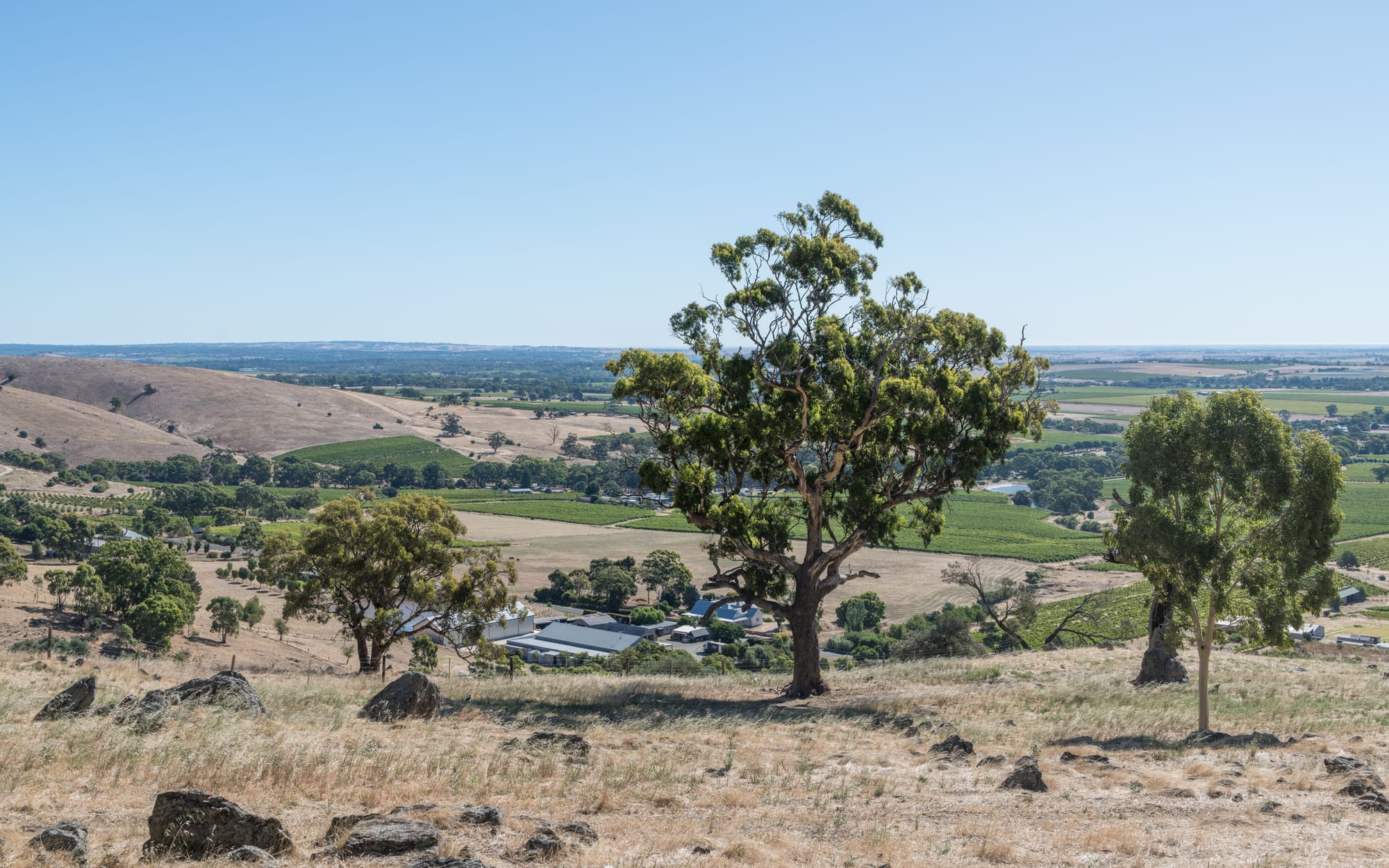
Rows of green vineyards and dry paddocks across a wide valley, seen past gum trees on a grassy hilltop

South Australia, Australia

Tanunda

The Barossa Valley near Tanunda, seen from Mengler Hill. (DXR / Wikimedia Commons · CC BY-SA 4.0)

Tanunda is the main town of the Barossa Valley, about 65 kilometres north-east of Adelaide, founded by German Lutheran settlers in the 1840s. Murray Street's bakeries, butchers and pubs stand among Lutheran churches and the graves of winemaking families, and dozens of cellar doors, many working old shiraz vines, lie within a short drive.

Neighbourhoods

  • Murray Street and the town centre
    • First-time visitors
    • Best for food
    • Close to shops

    The Barossa Valley Way runs through Tanunda as Murray Street, a wide main street of bakeries, butchers, pubs, galleries and wine shops under verandahs. Most of the town's accommodation, several Lutheran churches are within a few minutes' walk of it.

    Open in Maps
  • Langmeil
    • Historic district
    • Quiet and residential

    The northern end of town, named after the village German settlers founded here in 1843, on flat ground beside the North Para River. A bluestone church and its old cemetery, a winery working vines planted in the nineteenth century and a river footbridge make a short walk from the centre.

    Open in Maps
  • Bethany
    • Historic district
    • Quiet and residential

    The first German village in the Barossa, laid out in 1842 about two kilometres south-east of Tanunda against the hills. Its single street of cottages, its church and its small cemetery still show the Hufendorf plan, with long ribbons of farmland running back from each house.

    Open in Maps
  • Rowland Flat and Lyndoch
    • Cellar doors
    • Closest to Adelaide

    The southern entrance to the valley, on the road from Adelaide. Jacob's Creek crosses the highway at Rowland Flat, where the Bavarian settler Johann Gramp planted some of the Barossa's first vines in 1847, and Lyndoch beyond it has its own hotels, bakery and cellar doors.

    Open in Maps
  • Marananga and Seppeltsfield
    • Cellar doors
    • Scenic drives

    Rolling country a short drive west of Tanunda, on the western side of the valley. The bluestone cellars of the Seppeltsfield winery and several small cellar doors stand among the vineyards, with Lutheran churches on the ridges above.

    Open in Maps

Things to do

Wine and cellar doors

  • Seppeltsfieldattraction

    A bluestone winery begun by the Seppelt family in the 1850s that has kept a barrel of fortified tawny from every vintage since 1878.

    Open in Maps
  • Chateau Tanundaattraction

    A large winery of 1890 on the edge of town, built from bluestone quarried at nearby Bethany and now a cellar door.

    Open in Maps
  • Yalumbaattraction

    At Angaston, a family-owned winery founded in 1849, when the Smith family planted its first vineyards on land at the edge of the town.

    Open in Maps
  • Peter Lehmann Winesattraction

    A winery on the edge of Tanunda, set up in 1979 to buy fruit from Barossa growers who had lost their market.

    Open in Maps

Villages and country around the town

  • Kaiserstuhl Conservation Parkpark

    Native bushland and walking tracks in the hills about twelve kilometres south-east of Tanunda, with the Heysen Trail running along the park's western side.

    Open in Maps
  • Lyndochattraction

    One of the oldest towns in the valley, at its southern end, with a small main street and cellar doors on the surrounding slopes.

    Open in Maps
  • Nuriootpaattraction

    The valley's commercial centre and the seat of the Barossa Council, with the region's supermarkets, a large park along the North Para River and several major wineries.

    Open in Maps

Short trips from the town

  • Angastonattraction

    A stone-built town on the eastern hills, settled by English and Cornish rather than German migrants, with antique shops, a butcher known for smallgoods and the Saturday farmers market.

    Open in Maps
  • Barossa Reservoirattraction

    A concrete dam completed in 1902 south-west of the valley, known as the Whispering Wall because a whisper at one end of its curved wall carries to the other.

    Open in Maps
  • Kapundaattraction

    A copper-mining town north of the valley, where an 1840s find helped the young colony's finances; a tall statue of a Cornish miner, Map Kernow, stands at its edge.

    Open in Maps
  • Hahndorfattraction

    The other German village of South Australia, in the Adelaide Hills south of the valley, founded in 1839 and lined with craft shops, bakeries and pubs.

    Open in Maps

Seasonal events

  • Barossa Vintage FestivalLate March to early April, in odd-numbered years

    A week of winery events, long lunches and a parade through the valley's towns, first held in 1947 after the harvest.

  • VintageFebruary to April

    Not a festival but the busiest weeks of the year, when harvesters work through the night, trucks queue at the wineries and seasonal workers fill the town.

  • Wildflowers in the rangesAugust to October

    Orchids and pea flowers come out in the stringybark reserves on the hills either side of the valley, when the vines are still bare.

Eat and drink

Long-standing places and food districts in Tanunda. Hours, ratings and directions come from your maps app, always current.

Barossa classics

  • Tanunda's bakeriescafe

    Long-standing bakeries on and near Murray Street, known for their bread, pies and German-style cakes.

    Open in Maps
  • Tanunda's butchers and smallgoods makersneighborhood

    Shops on and around Murray Street selling mettwurst, lachsschinken, pickled pork and the pink luncheon meat South Australians call fritz.

    Open in Maps
  • Maggie Beer's Farm Shoprestaurant

    The farm shop and eatery of the cook who built her reputation nearby on Barossa pheasant, quince and verjuice.

    Open in Maps

Cellar doors

  • Cellar doors around Tanundaneighborhood

    Dozens of tasting rooms within a short drive, from stone sheds on single vineyards to large visitor centres, pouring shiraz, grenache, mataro and riesling.

    Open in Maps

Experience Tanunda

History

The valley is the country of the Peramangk people, with Ngadjuri lands to the north. In 1837 Colonel William Light, South Australia's first Surveyor-General, named the Barossa Range after Barrosa in Spain, where he had fought as a young officer; a clerical error fixed the spelling as Barossa. The first German-speaking Lutherans reached the colony from Prussia in 1838, having left home over restrictions on their form of worship, with their passage backed by the colonist George Fife Angas. Bethany, laid out in 1842 just south-east of the present town, was their first village in the valley; Langmeil followed in 1843, and the surveyed township of Tanunda grew up beside it. The name is generally explained as an Aboriginal word for a waterhole.

The settlers divided their land into Hufendorf strips, a narrow house block on the road with a long field running back from it, a pattern still legible around Bethany. Vines arrived quickly: Johann Gramp planted beside Jacob's Creek in 1847, and by the end of the century the valley was shipping fortified wine to Britain. Lutheran congregations argued and divided, which is why several churches stand within a few streets of each other.

The First World War brought suspicion of German Australians, the closing of German-language schooling and the renaming of German place names: Langmeil became Bilyara and Bethanien became Bethany, though Tanunda's Aboriginal name survived. From the 1960s the valley turned from fortified wine to table wine and then to tourism, and its century-old shiraz vines became its best-known asset.

Culture & Customs

Tanunda is the most visibly German of the Barossa towns. Lutheran churches stand within walking distance of one another, a legacy of nineteenth-century doctrinal splits, and their cemeteries record the same family names that appear on cellar-door labels: Gramp, Seppelt and Lehmann. Brass bands and Liedertafel singing societies came with the settlers, and the town band, formed in the nineteenth century, still plays at civic occasions and at the vintage parade.

The Barossa Vintage Festival, first held in 1947 and now run in odd-numbered years, is the valley's great gathering: winery events, long lunches, a parade and harvest customs brought from Germany. Wine shapes the year in quieter ways too, with pruning through the cold months, the round-the-clock crush of autumn, and a convention by which the person driving does the spitting.

German words have stayed in local speech and on menus: kuchen for a fruit or custard tart, streuselkuchen under its crumble, mettwurst, and the South Australian fritz. Australian rules football and netball fill winter Saturdays, and the valley's clubs draw supporters from the surrounding farms. Visitors are expected to be unhurried and to talk to whoever is pouring, and many cellar doors are staffed by people whose families have grown the fruit for generations. Aboriginal connection to the valley is acknowledged more openly than it once was, in place names and at public occasions.

Daily Life

About 4,700 people live in Tanunda, and roughly 25,000 in the Barossa Council area as a whole, which also takes in the larger commercial centre of Nuriootpa and the smaller Angaston. The town has grown steadily as the valley has become a weekend destination and as Adelaide's northern edge has crept closer.

Wine runs through the local economy from end to end: growing, contract crushing, bottling, cooperage, labelling and cellar-door hospitality, along with grain and sheep on the drier ground, smallgoods making, and a tourism trade that fills the streets from Friday to Sunday. Many residents commute to Gawler or to Adelaide's northern suburbs, and hospitals, schools and aged-care homes in the valley towns are among the biggest employers.

The working year follows the vines. Pruning runs through winter, canopy work fills spring, and from February to April vintage takes over, with night harvesting, queues of trucks and an influx of seasonal labour. Housing costs have risen as city buyers and holiday letting compete for the valley's cottages, and keeping young people in the district is a recurring worry. Water is the long-term problem: the Barossa is dry, irrigation water has to be brought in from outside the valley, and hotter summers and earlier harvests are changing how the vineyards are managed.

Food

Barossa cooking is German farm food adapted to a hot, dry country. Butchers make mettwurst, a coarse smoked sausage eaten cold in slices, along with lachsschinken, a smoked pork loin, and the pink luncheon meat South Australians call fritz. Bakeries sell kuchen, a yeast-dough tart filled with fruit or set custard, streuselkuchen under a crumble, bienenstich, pretzels and pies. Preserving is a habit here: dill cucumbers, quince paste, plum jam and pickled pork.

Wine is the point of the place. Shiraz from vines well over a century old is the Barossa's signature, dark and full-bodied; grenache and mataro, the grape known elsewhere as mourvedre, go into blends; semillon is the traditional white; and the cooler Eden Valley on the eastern hills is riesling country. Seppeltsfield, west of the town, keeps a barrel of fortified tawny from every year since 1878. Tasting is informal and conversational, and a nominated driver is the usual arrangement.

Modern Barossa cooking owes much to Maggie Beer, whose restaurant near Nuriootpa built a reputation in the 1980s and 1990s on local pheasant, quince and verjuice, the unfermented juice of unripe grapes. Weekend produce markets in the valley towns gather growers, bakers and smallgoods makers, and olives, almonds and stone fruit all come from the surrounding hills.

Planning tools

Budget

Tanunda is cheaper than a capital city for food but not for beds: the valley's hotels, cottages and bed-and-breakfasts charge most at weekends, through vintage and during the Barossa Vintage Festival, and they fill early. Tasting fees, tours and a hire car are the other main costs. Midweek stays and caravan parks bring the total down sharply.

Daily Budget Midrange
USD 170–290 (mid-range hotel or cottage, restaurant meals, cellar-door tastings, a hire car)
Daily Budget Shoestring
USD 70–120 (caravan-park cabin or hostel bed, bakery lunches and self-catering, a shared car)

Book accommodation well ahead for weekends and festival dates, and remember that a driver who is not drinking makes the difference between a hire car and a paid tour.

Best Time to Visit

Autumn, from March to May, is the classic season: vintage is under way, the vines turn colour and the days are warm rather than hot. Spring, from September to November, is green and cool with wildflowers in the ranges. Summer can be very hot and cellar doors are busy; winter is quiet, damp and cheap, with open fires and pruning in the vineyards.

Suggested Number of Days

One full day covers the town and a handful of cellar doors. Two or three more allow the wider valley, the Eden Valley hills and the Adelaide Hills on the way back. Without a car, or with a tasting pace kept slow, allow an extra day.

First Visit
1–2 days
With Surroundings
3–4 days

Transportation

Almost everyone drives. The Barossa Valley Way links Lyndoch, Tanunda, Nuriootpa and Angaston, all within about twenty kilometres of each other, and the cellar doors are scattered along side roads between them. A regional bus service connects the valley with Adelaide and Gawler, and local minibus tours, small-group wine tours and taxis cover the tasting circuit. A sealed cycling path runs between the valley towns, and the back roads are popular with cyclists early in the day.

The drink-driving limit in South Australia is 0.05, and police patrol the valley roads; use a driver, a tour or a bicycle for a day of tasting, and watch for kangaroos at dawn and dusk.

Airport & Station Connections

Tanunda is roughly 65 kilometres north-east of Adelaide, about an hour by car on the Northern Expressway and the Sturt Highway, or a little longer through the Adelaide Hills. Adelaide Airport is the nearest airport, and most visitors pick up a hire car there. Coaches and regional buses run from Adelaide, and many people come on a day tour from the city.

Walkability

The town centre is flat and easy on foot, and Murray Street's shops, hotels and churches sit within a few hundred metres of each other. Beyond the built-up streets the distances open out: the nearest cellar doors are a walk of one or two kilometres, the rest need wheels. Footpaths thin out on the edges of town and country roads have no shoulder, so walking between villages is not practical.

Safety

Tanunda is a quiet country town with little crime that touches visitors. The real risks are on the roads and in the weather: kangaroos at dusk, narrow shoulders on the vineyard back roads, drivers who have been tasting, summer heat, and bushfire danger across the dry hills from about December to March.

Check fire danger ratings and warnings in summer, carry water on walks in the ranges, and avoid driving country roads after dark. Check current official travel advice before travelling.

Climate

A Mediterranean climate of hot, dry summers and cool, damp winters, a little cooler than Adelaide because the valley sits inland and higher. In the southern hemisphere summer falls in December to February and winter in June to August. Most of the rain comes in the winter half of the year.

Summer
hot and dry — days usually in the high 20s to low 30s °C, with spells above 40°C and cool nights
Winter
cool and showery — days around 13–15°C, with cold nights and frost in the vineyards

Local Customs

Manners are informal: first names, a handshake, and conversation at the tasting bench with whoever is pouring. Tipping is not expected in Australia, though rounding up or leaving ten per cent after a good meal is appreciated. Spitting or tipping out wine at a cellar door is normal and nobody minds. Several Lutheran congregations still hold services, and quiet and modest dress are expected in the churches and cemeteries.

The legal drinking age is 18 and identification is asked for; ask before photographing people, and stay on public roads and tracks rather than walking into working vineyards.

Common Payment Methods

The currency is the Australian dollar. Cards and contactless payment, including phones, are accepted almost everywhere, and a card surcharge is common. A small amount of cash is useful at market stalls and the smallest cellar doors. There are banks and cash machines in Tanunda and Nuriootpa, and fewer elsewhere in the valley.