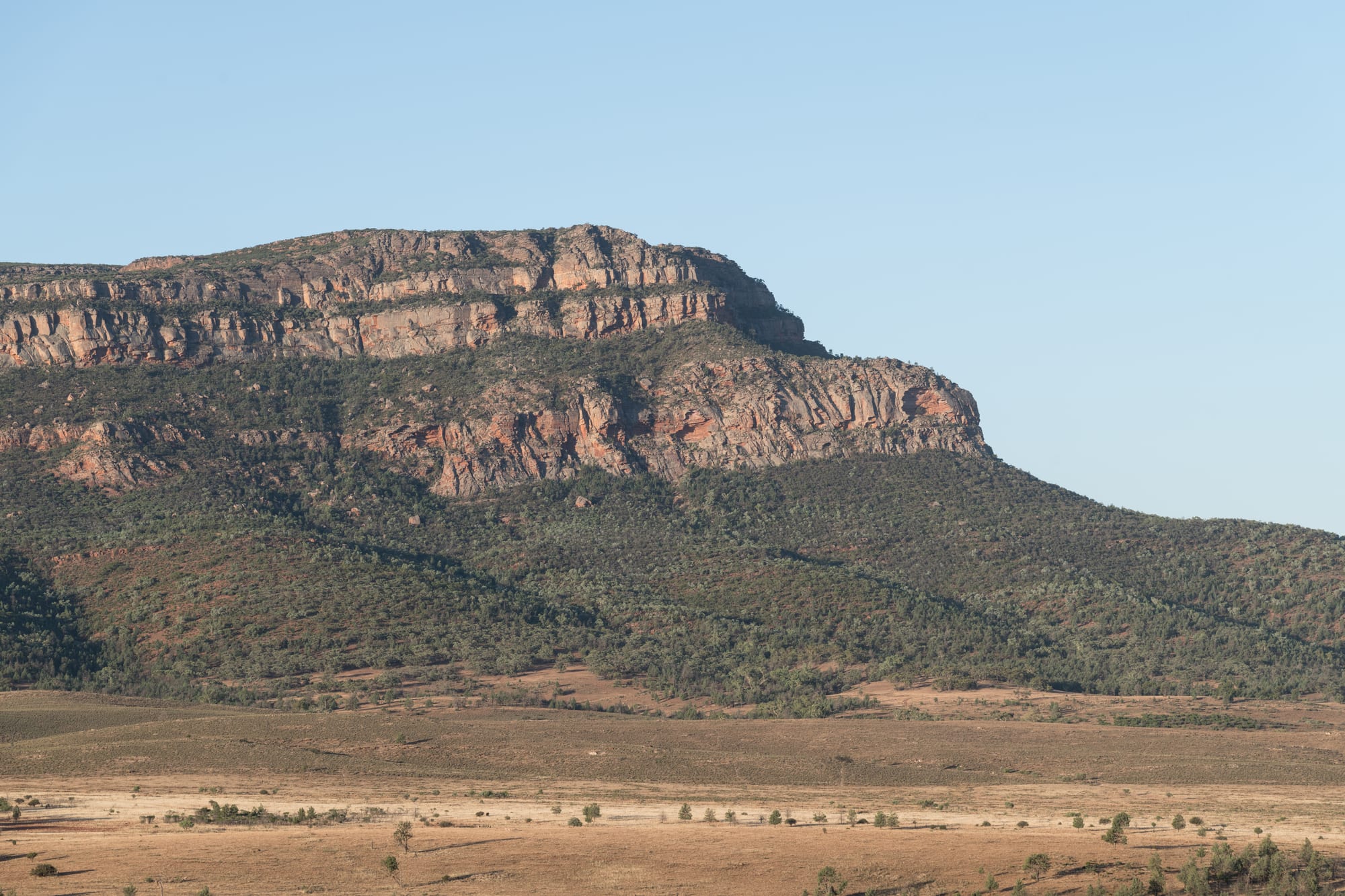
A layered red and grey rock escarpment above scrub-covered slopes and a dry, grassy plain under a clear blue sky

Australia

South Australia

Rawnsley Bluff on the southern rim of Wilpena Pound (Ikara) in the Flinders Ranges. (DXR / Wikimedia Commons · CC BY-SA 4.0)

A largely arid state running from the gulfs and wine valleys around Adelaide north through the Flinders Ranges to the opal fields and deserts of the outback — founded in 1836 as a planned colony of free settlers, known for its German-settled Barossa, its festivals and most of the country's wine.

Explore South Australia

History

The Adelaide Plains are Kaurna country; the Ngarrindjeri live along the Coorong and the lower Murray, the Adnyamathanha in the Flinders Ranges, and the Anangu of the Pitjantjatjara and Yankunytjatjara lands in the far north-west. The Adnyamathanha name for Wilpena Pound, Ikara, is now part of the national park's official name.

South Australia was founded in 1836 as a planned colony of free settlers, based on Edward Gibbon Wakefield's theory of systematic colonisation; it never received convicts. Colonel William Light laid out Adelaide on a grid surrounded by park lands. The founding documents acknowledged Aboriginal rights to land, but in practice Kaurna and other peoples were dispossessed, and conflict on the frontier and along the overland route from New South Wales was violent. From 1838 German Lutherans fleeing religious restrictions in Prussia settled Hahndorf and the Barossa, and copper finds at Kapunda and Burra helped save the young colony's economy.

South Australia was a political pioneer: in 1894 its parliament voted to give women the vote and, as the first place in the world, the right to stand for parliament. In the 1950s Britain tested nuclear weapons at Emu Field and Maralinga, contaminating the lands of Anangu people. In 1981 the Pitjantjatjara Land Rights Act returned a vast area of the north-west to Anangu ownership, and in 2023 South Australia legislated its own First Nations Voice to Parliament, the first state to do so.

Culture & Customs

Adelaide has long been called the "City of Churches", and its reputation is of a quiet, orderly, somewhat conservative city — one that has also produced social reforms, from women's suffrage to Don Dunstan's premiership of the 1970s. It is proud of never having been a convict colony.

Festivals are the state's calling card. February and March, known locally as "Mad March", bring the Adelaide Fringe — one of the largest arts festivals in the world — the Adelaide Festival, WOMADelaide and the Adelaide 500 motor race. The Tour Down Under cycling race runs in January. Australian rules football dominates, and the "Showdown" between the Adelaide Crows and Port Adelaide is the state's biggest derby.

German heritage remains visible in the Barossa and the Adelaide Hills, in Lutheran churches, brass bands, place names and food. The state has its own vocabulary: fritz for the processed meat called devon elsewhere, and Stobie poles, the steel-and-concrete power poles invented in Adelaide. Aboriginal art centres in the APY Lands produce paintings sought by galleries across the country.

Daily Life

South Australia has about 1.9 million people, and around three-quarters of them live in Greater Adelaide. The rest of the state is thinly populated: Mount Gambier in the south-east is the largest regional city, with about 27,000 people, followed by the industrial towns of Whyalla, Port Augusta and Port Pirie on Spencer Gulf and the fishing port of Port Lincoln.

The economy rests on wine — the state makes around half of Australia's wine — along with grain, seafood, and mining, including the huge copper and uranium deposit at Olympic Dam. Car manufacturing ended when Holden's Elizabeth plant closed in 2017, and defence shipbuilding at Osborne has become a large employer. South Australia gets most of its electricity from wind and solar power.

Water is a constant issue in a dry state that depends on the lower Murray River, and the health of the Coorong and the Murray mouth is watched closely. Adelaide's relatively low cost of living has drawn residents from the eastern capitals, but rising housing costs and keeping young people from moving interstate remain concerns.

Food

South Australia is the heart of Australian wine. The Barossa Valley is famed for rich shiraz from vines well over a century old, McLaren Vale for shiraz and grenache, the Clare Valley for dry riesling, Coonawarra's red terra rossa soil for cabernet sauvignon, and the Adelaide Hills for cool-climate whites and pinot noir. Penfolds Grange, Australia's most famous red wine, was first made in the 1950s by Penfolds, which began at Magill on Adelaide's edge.

The Barossa's German settlers left mettwurst, a smoked sausage, bienenstich, a cream-filled "bee sting" cake, and other Lutheran baking. Adelaide's own street foods include the pie floater, a meat pie served upside down in pea soup, and the frog cake, a small iced sponge shaped like a frog's head. Farmers Union Iced Coffee, a sweet flavoured milk, commands fierce loyalty, and Coopers of Adelaide is the largest Australian-owned brewery.

Seafood is a highlight: King George whiting, the mainstay of the state's fishery; Coffin Bay oysters; Spencer Gulf prawns; and southern bluefin tuna ranched off Port Lincoln. Kangaroo Island produces honey from Ligurian bees, and the Adelaide Central Market gathers dozens of produce stalls under one roof.

Attractions & Natural Wonders

Adelaide's North Terrace holds the Art Gallery of South Australia, the South Australian Museum and the State Library; nearby are the Botanic Garden, the Central Market and Adelaide Oval. A tram runs to the beach at Glenelg. The Adelaide Hills offer the German village of Hahndorf and views from Mount Lofty, while McLaren Vale and Victor Harbor lie on the Fleurieu Peninsula to the south.

The Barossa Valley, north-east of the city, has Tanunda and Angaston, the palm-lined avenues of Seppeltsfield and the Mengler Hill lookout; the Clare Valley's Riesling Trail is a cycle path through vineyards. Kangaroo Island, reached by ferry from Cape Jervis, has Flinders Chase National Park, with the Remarkable Rocks and Admirals Arch, and the sea lions of Seal Bay. In the south-east, the Coorong's lagoons, the Blue Lake at Mount Gambier and the fossil-rich Naracoorte Caves, a World Heritage Site, lie close to Coonawarra.

The Flinders Ranges begin a few hours north: Ikara-Flinders Ranges National Park has Wilpena Pound, Brachina Gorge and Aboriginal rock art, and Arkaroola lies further north. Coober Pedy has opal mines, underground churches and dugout homes, and the flat-topped hills of the Breakaways nearby. The Eyre Peninsula has Port Lincoln, Coffin Bay National Park and the sea lions of Baird Bay, and at its western edge the Nullarbor meets the sea at the Bunda Cliffs, where whales are watched from the Head of Bight.

Cities in South Australia

Planning basics

Budget

Adelaide is one of the cheaper mainland capitals for accommodation and eating out, though prices climb in February and March, when the Fringe, the Adelaide Festival and WOMADelaide overlap. Kangaroo Island is expensive once the car ferry, accommodation and tours are added, and outback travel carries the costs of fuel, long distances and limited choice.

Daily Budget Midrange
USD 160–280 (mid-range hotel, restaurant meals, cellar-door tastings, a hire car)
Daily Budget Shoestring
USD 70–110 (hostel dorm, self-catering, Adelaide buses, trams and trains)

Book accommodation early for the Fringe season, and choose a designated driver or a tour for a day of wine tasting.

Safety

South Australia is safe for visitors. The hazards are heat and isolation in the outback, fatigue and wildlife on long roads, bushfires — Kangaroo Island was badly burned in 2019–20 — and cold, shark-inhabited water on the ocean coasts. Around Coober Pedy, old mine shafts are unmarked and dangerous.

Carry plenty of water in the outback, stay on marked paths around the opal fields, and check fire danger ratings in summer. Check current official travel advice before travelling.

Climate

Adelaide and the southern coast have a Mediterranean climate, with hot, dry summers and mild, wet winters. North of the Flinders Ranges the state becomes desert, where summer days are extremely hot and winter nights near freezing.

Summer
Adelaide 16–29°C with frequent heatwaves above 40°C; the outback often 35–45°C
Winter
Adelaide cool and showery at about 8–16°C; the outback mild by day and cold at night

Transportation

Adelaide has suburban trains, buses and trams, including the line to Glenelg. The Barossa, the Adelaide Hills and McLaren Vale are within about an hour's drive. Car ferries cross from Cape Jervis to Kangaroo Island, and flights link Adelaide with Kangaroo Island, Port Lincoln and Coober Pedy. Coober Pedy is roughly 850 kilometres north on the Stuart Highway, and the Ghan and Indian Pacific trains both stop in Adelaide.

Drive outback highways in daylight, refuel at every chance, and allow a full day to reach Coober Pedy by road.

Best Time to Visit

Spring (September to November) and autumn (March to May) suit most of the state, and are the only comfortable seasons for the Flinders Ranges and Coober Pedy. February and March bring Adelaide's festivals and the start of the vintage in the wine valleys, and southern right whales are seen at the Head of Bight and Victor Harbor from about June to August.