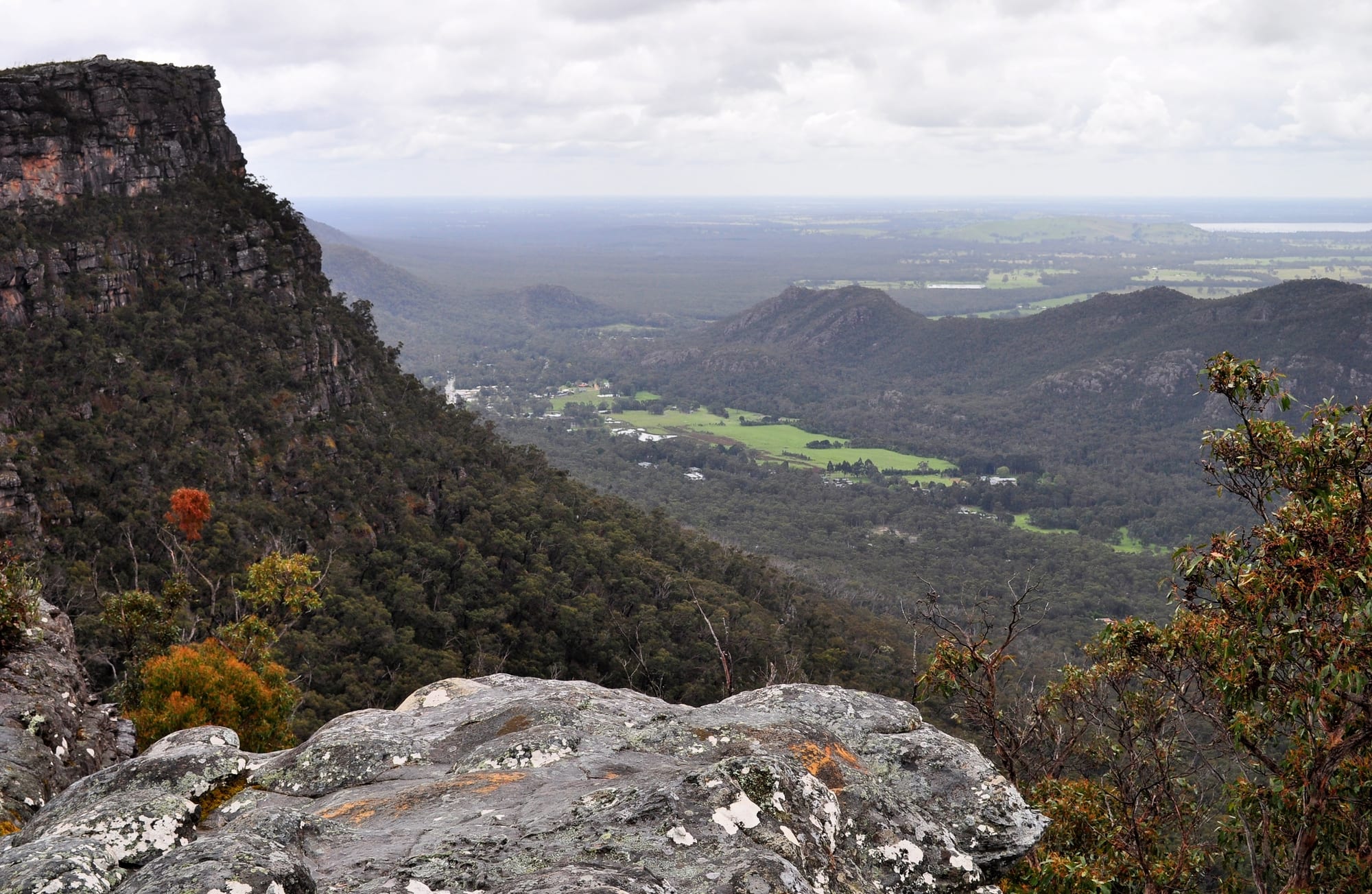
A forested sandstone escarpment above a green valley with the town of Halls Gap and farmland beyond

Australia

Melbourne & Victoria

Halls Gap and the valley below, seen from Lakeview Lookout in the Grampians National Park. (WikiWookie / Wikimedia Commons · CC BY-SA 4.0)

The small, densely settled state in Australia's south-east corner, stretching from the Murray River to the cold Southern Ocean coast — shaped by the gold rushes of the 1850s, dominated by the sport-, coffee- and arts-loving city of Melbourne, and reaching out to the Great Ocean Road, the Grampians and the alpine high country.

Explore Melbourne & Victoria

History

Victoria is the country of dozens of Aboriginal nations, among them the peoples of the Kulin alliance around Port Phillip Bay, including the Wurundjeri and the Boon Wurrung, and the Gunditjmara of the south-west. At Budj Bim, near Portland, the Gunditjmara built channels and weirs to trap and farm eels, a system dated to more than 6,000 years ago and inscribed as a UNESCO World Heritage Site in 2019.

Pastoralists from Van Diemen's Land arrived in the 1830s. In 1835 John Batman claimed to have bought land from Wurundjeri elders in a so-called treaty that the colonial government declared void, and Melbourne was founded on the Yarra River that year. Squatters spread across the grasslands within a decade; frontier conflict, including the Eumeralla Wars with the Gunditjmara, and disease cut the Aboriginal population drastically, and survivors were pushed onto missions such as Coranderrk.

The Port Phillip District separated from New South Wales as the colony of Victoria in 1851, the year gold was found at Ballarat and Bendigo. The rush made Melbourne one of the richest cities in the world; at Ballarat in 1854 miners rebelled against licence fees at the Eureka Stockade, a founding moment in Australian democratic mythology. The bushranger Ned Kelly was hanged in Melbourne in 1880. After federation in 1901 the national parliament sat in Melbourne until Canberra was ready in 1927. Post-war migration from Greece, Italy and later Vietnam reshaped the city, and in 2019 Victoria elected the First Peoples' Assembly to negotiate a treaty with the state; the Statewide Treaty, the first treaty between an Australian government and First Peoples, was signed in 2025.

Culture & Customs

Melbourne sees itself as Australia's capital of culture and sport, and its rivalry with Sydney is conducted with some relish. Australian rules football was codified here in 1859, and the AFL season — with the Grand Final at the Melbourne Cricket Ground in late September — dominates winter conversation, with families loyal to clubs for generations.

The sporting calendar sets the rhythm of the year: the Australian Open tennis in January, the Formula One Grand Prix at Albert Park, the Boxing Day cricket Test at the MCG, and the Melbourne Cup, run on the first Tuesday of November and a public holiday in the city. The Melbourne International Comedy Festival and the Moomba festival are fixtures too.

Café culture is taken seriously, with specialty roasters and brunch as a weekend ritual. Melbourne is where Australia's Greek community is most deeply established, and Italian, Vietnamese, Chinese, Indian and East African communities have their own neighbourhoods. The laneway street art and live-music scene are points of civic pride. Regional Victoria has its own traditions, from the gold-rush heritage of Ballarat and Bendigo — whose Chinese community stages its dragon parade at Easter — to agricultural shows and country football leagues.

Daily Life

Victoria has about 7 million people, and some 5 million of them live in Greater Melbourne, which has grown so fast that it is projected to overtake Sydney as the largest city in the country. Geelong, Ballarat and Bendigo are the largest regional cities, each growing as commuters and families look for cheaper housing.

The economy is dominated by services: finance, health, education — international students are a major presence at Melbourne's universities — and tourism. Car manufacturing ended in 2017, but food processing, construction and logistics remain large. Dairy farming fills Gippsland and the Western District, grain and sheep the Wimmera and Mallee, and irrigated fruit and grapes the Murray around Mildura. The Latrobe Valley's brown-coal power stations are being phased out, a sensitive issue for local jobs.

Melbourne endured some of the longest cumulative COVID-19 lockdowns in the world in 2020 and 2021. Current debates centre on housing costs, the pace of suburban growth, a large state debt and the treaty process with Aboriginal Victorians.

Food

Melbourne's food reflects its migrant waves. Lygon Street in Carlton was the heart of Italian Melbourne and helped bring espresso to Australia; Victoria Street in Richmond and Footscray are known for Vietnamese pho; Oakleigh and the old Greek precincts for souvlaki and loukoumades, fried honey doughnuts; and Box Hill for Chinese cooking. The dim sim, a large steamed or deep-fried dumpling, is a Melbourne creation sold at football grounds and fish-and-chip shops, and the chicken parma is a pub staple.

The Queen Victoria Market, trading since 1878, is the city's great food market. Beyond Melbourne, Gippsland and the Western District supply milk, cheese and beef, and the Goulburn Valley grows fruit.

Wine regions sit within easy reach of the city. The Yarra Valley is known for chardonnay, pinot noir and sparkling wine; the Mornington Peninsula for cool-climate pinot noir; Heathcote for shiraz; and the King Valley, settled in part by Italian families, is a newer wine area. Rutherglen in the north-east is famous for fortified muscat and topaque, rich dessert wines aged for decades.

Attractions & Natural Wonders

Melbourne's central city holds the laneways and arcades around Degraves Street, Federation Square, the National Gallery of Victoria, the Royal Exhibition Building — a World Heritage Site — the Royal Botanic Gardens and the Melbourne Cricket Ground. St Kilda's pier and seaside promenade, and the colourful bathing boxes at Brighton, lie on the bay. East of the city, the Dandenong Ranges have tall mountain-ash forest and the Puffing Billy steam railway, and the Yarra Valley's wineries surround Healesville, with its sanctuary for native animals.

The Great Ocean Road begins near Torquay and Bells Beach, famous for surfing, and runs past Lorne, Apollo Bay and the rainforest of the Great Otway National Park to the limestone stacks of the Twelve Apostles and Loch Ard Gorge, then on to Port Fairy. Budj Bim lies inland in the far south-west. South-east of Melbourne, Phillip Island's Penguin Parade draws visitors at dusk, and Wilsons Promontory offers Squeaky Beach, Mount Oberon and the camping ground at Tidal River.

Inland, the Grampians around Halls Gap have the Pinnacle lookout, MacKenzie Falls and Aboriginal rock-art shelters. The goldfields are best seen at Sovereign Hill, an open-air museum in Ballarat, and in Bendigo's grand Victorian streets. The High Country around Bright, Mount Buller and Falls Creek offers skiing in winter and walking and cycling in summer.

Cities in Melbourne & Victoria

Planning basics

Budget

Melbourne is slightly cheaper than Sydney but still expensive, with hotel prices climbing sharply during the Australian Open, the Grand Prix, the AFL Grand Final and Melbourne Cup week. Regional cities such as Ballarat, Bendigo and Geelong are cheaper, while the Great Ocean Road and Phillip Island fill up and raise prices in the summer holidays.

Daily Budget Midrange
USD 170–300 (mid-range hotel, restaurant meals, winery tastings, a hire car for the coast)
Daily Budget Shoestring
USD 80–120 (hostel dorm, self-catering, trams and V/Line trains, free galleries)

Trams in the central city's Free Tram Zone cost nothing; book Great Ocean Road accommodation early for the December–January holidays.

Safety

Victoria is safe for visitors. The main hazards are bushfires — the Black Saturday fires of February 2009 killed 173 people — dangerous rips and cold water on the exposed ocean coast, sudden weather changes in the Grampians and Alps, and tiredness on long scenic drives.

Check fire danger ratings and the VicEmergency service in summer, swim only at patrolled beaches, and take breaks on the Great Ocean Road. Check current official travel advice before travelling.

Climate

Temperate and famously changeable in Melbourne and along the coast, where cold southerly changes can end a hot day within an hour. The north-west around Mildura is hot and dry, and the alpine high country around Mount Buller and Falls Creek has winter snow.

Summer
Melbourne typically 14–26°C, with hot northerly days above 40°C; cooler and windier on the coast
Winter
cool and grey, about 6–14°C in Melbourne; frosts inland and snow in the Alps from June to September

Transportation

Melbourne has the largest urban tram network in the world, plus suburban trains and buses. V/Line regional trains and coaches reach Geelong, Ballarat, Bendigo, Warrnambool and the Gippsland towns, but the Great Ocean Road, Wilsons Promontory and the Grampians are best explored by car. Phillip Island is about two hours' drive from the city, and the Spirit of Tasmania ferry to Devonport sails from Geelong.

Allow two or three days for the Great Ocean Road rather than a single return drive, and watch for kangaroos on country roads at dusk.

Best Time to Visit

March to May brings settled weather, autumn colour in the hills and the grape harvest in the Yarra Valley; December to February is best for beaches and the Great Ocean Road but brings crowds and bushfire risk. Spring from September to November suits the Grampians' wildflowers and the racing season, and winter is ski season in the Alps.