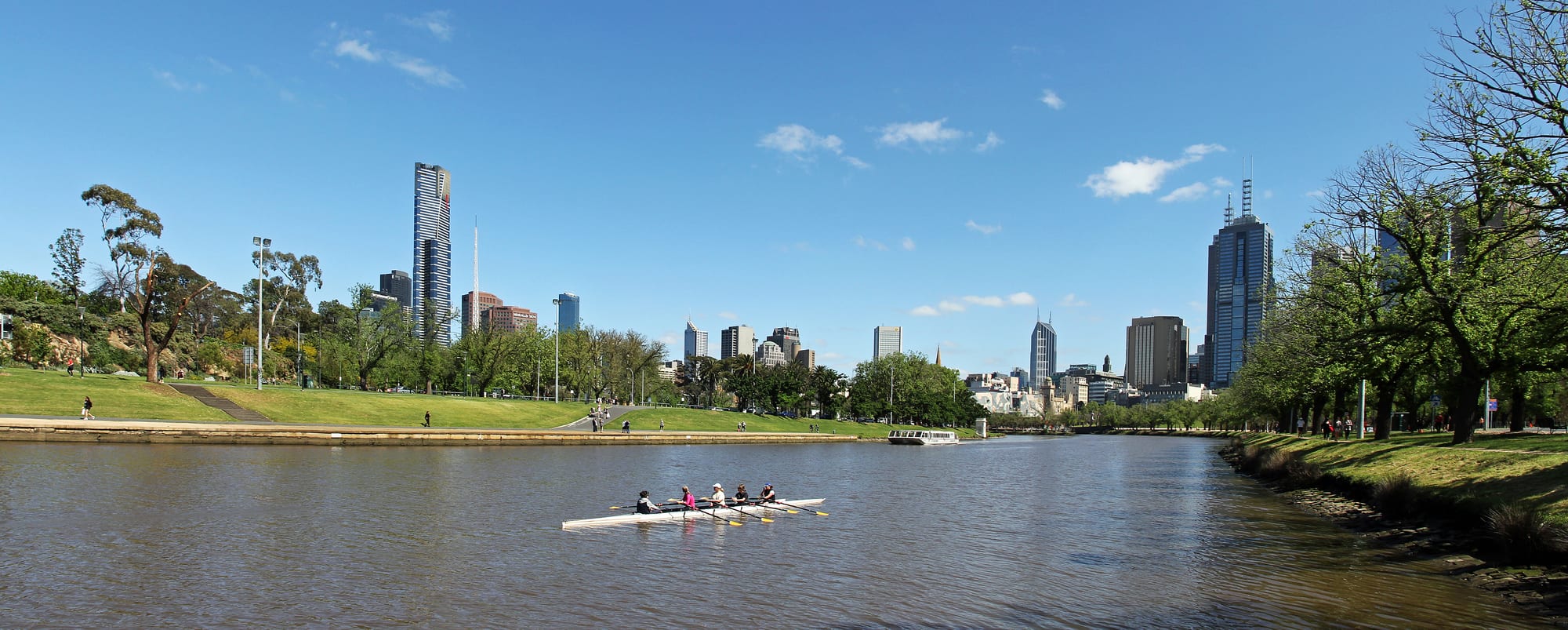
Rowers on the Yarra River beside parkland, with Melbourne's city towers behind the trees under a clear sky

Melbourne & Victoria, Australia

Melbourne

The Yarra River and the city skyline seen from Alexandra Gardens in Melbourne. (Donaldytong / Wikimedia Commons · CC BY-SA 3.0)

The capital of Victoria, at the head of Port Phillip Bay on the Yarra River, and home to about five million people. Laid out as a grid in 1837 and made rich by the gold rushes, it is known for its laneways and arcades, its coffee and live music, its migrant neighbourhoods and a sporting calendar that runs through the year.

Neighbourhoods

  • The city centre
    • First-time visitors
    • Close to public transport
    • Arts and culture

    The original grid between the Yarra and Victoria Street, with wide main streets and narrow lanes and arcades threaded between them. Most of the big museums, theatres, department stores, Chinatown and the railway stations are here, and trams inside the grid are free.

    Open in Maps
  • Southbank
    • Arts and culture
    • Waterfront
    • Views

    The south bank of the Yarra opposite the centre, rebuilt from industrial land into towers, hotels and a riverside promenade. The arts precinct along St Kilda Road holds the concert hall, the theatres and the state gallery, and the tallest residential towers stand behind them.

    Open in Maps
  • Carlton
    • Best for food
    • Historic district
    • Museums

    Immediately north of the grid, built in the Victorian boom and later the centre of Italian Melbourne. Lygon Street's restaurants and cafés run through it, the university sits on its western edge, and the Exhibition Building and the museum stand in Carlton Gardens.

    Open in Maps
  • Fitzroy
    • Nightlife
    • Bars
    • Street art

    Melbourne's first suburb, a grid of terraces and warehouses about two kilometres from the centre. Brunswick and Gertrude streets carry small bars, live-music pubs, galleries, record shops and bookshops, and the street art on the side lanes changes constantly.

    Open in Maps
  • Richmond
    • Best for food
    • Local life
    • Close to public transport

    An inner-eastern suburb of workers' cottages and converted factories. Victoria Street is the city's best-known Vietnamese strip, Bridge Road is a shopping street, and the football ground and tennis courts are a short walk across the park.

    Open in Maps
  • St Kilda
    • Beaches
    • Nightlife
    • Families

    The bayside suburb about six kilometres south of the centre, reached by tram along a seafront esplanade. It has the beach and pier, the old amusement park, cake shops on Acland Street and a long history as both a resort and a raffish inner suburb.

    Open in Maps
  • Footscray
    • Best for food
    • Local life
    • Close to public transport

    Across the Maribyrnong River west of the centre, an industrial suburb reshaped by successive waves of migration. Its market and main streets hold Vietnamese, Ethiopian, Somali, Sudanese and Indian shops and kitchens, and it is one train stop from the city.

    Open in Maps

Things to do

Famous landmarks

  • Flinders Street railway stationlandmark

    The domed Edwardian building of 1910, on a station first opened in 1854 and the busiest on the city network, whose row of indicator clocks under the main entrance is the traditional meeting place.

    Open in Maps
  • Federation Squarelandmark

    The angular civic square of 2002 across the road from Flinders Street station, built over the railway lines and holding galleries, screens and event spaces.

    Open in Maps
  • Royal Exhibition Buildinglandmark

    A great domed hall of 1880 in Carlton Gardens, built for an international exhibition and the site of the first Australian parliament in 1901; it was the first building in the country inscribed as a World Heritage Site.

    Open in Maps
  • Shrine of Remembrancelandmark

    The state war memorial dedicated in 1934 on a rise south of the river, built so that on Remembrance Day a ray of sunlight lights the word Love on the stone of remembrance, with galleries of military history beneath.

    Open in Maps
  • Eureka Towerviewpoint

    A 297-metre residential tower at Southbank with an enclosed observation deck near the top, giving views over the grid, the bay and the ranges.

    Open in Maps

Museums and galleries

  • National Gallery of Victoriamuseum

    Founded in 1861, with a European and Asian collection on St Kilda Road, a Leonard French stained-glass ceiling that is one of the world's largest pieces of suspended stained glass, and Australian art at its Federation Square building.

    Open in Maps
  • Melbourne Museummuseum

    The state natural history and social history museum in Carlton Gardens, with Victorian wildlife, dinosaur fossils, the racehorse Phar Lap and the Bunjilaka Aboriginal cultural centre.

    Open in Maps
  • State Library Victoriamuseum

    The state library of 1856 on Swanston Street, whose octagonal La Trobe Reading Room sits under a domed roof of glass, with free exhibitions on the city and Ned Kelly's armour.

    Open in Maps
  • Old Melbourne Gaolmuseum

    The bluestone prison of the 1840s where 133 people were hanged, among them Ned Kelly in 1880, now a museum of cells, death masks and colonial punishment.

    Open in Maps
  • Australian Centre for the Moving Imagemuseum

    A museum of film, television and digital culture at Federation Square, with a permanent exhibition on the Australian moving image and regular screenings.

    Open in Maps

Parks and gardens

  • Royal Botanic Gardens Victoriapark

    Thirty-eight hectares of lawns, lakes and plant collections beside the Yarra, begun in 1846, with the Tan running track around its edge.

    Open in Maps
  • Fitzroy Gardenspark

    Formal gardens of elms and avenues just east of the grid, containing a conservatory, a model Tudor village and the relocated cottage of Captain Cook's parents.

    Open in Maps
  • Melbourne Zooattraction

    Opened in 1862 in Royal Park north of the centre, with bioclimatic zones holding gorillas, orangutans and tigers and an Australian bush section of kangaroos, koalas and native birds.

    Open in Maps

Markets, laneways and arcades

  • Queen Victoria Marketmarket

    Seven hectares of sheds and halls officially opened in 1878 at the northern edge of the grid, the largest open-air market in the southern hemisphere, with fruit, meat, fish, delicatessens and a Wednesday night market for part of the year.

    Open in Maps
  • Hosier Laneattraction

    The best-known of the city's street-art lanes, a bluestone alley off Flinders Street whose walls and doors are painted over repeatedly.

    Open in Maps
  • Royal Arcadelandmark

    The oldest surviving arcade in Australia, opened in 1870 between Bourke Street Mall and Little Collins Street, with a chequered floor and the figures of Gog and Magog striking the hour.

    Open in Maps

Sport and the bay

  • Melbourne Cricket Groundattraction

    The country's largest stadium, holding about 100,000 people, home of Australian rules football and the Boxing Day cricket Test and the main arena of the 1956 Olympic Games, with a sports museum inside.

    Open in Maps
  • Melbourne Parkattraction

    The tennis complex beside the river where the Australian Open is played each January, with courts open to the public outside the tournament.

    Open in Maps
  • Luna Parkattraction

    A seaside amusement park at St Kilda that opened in 1912, entered through a huge laughing face, with a wooden scenic railway still driven by a brakeman.

    Open in Maps

Short trips from the city

  • Dandenong Rangesattraction

    Forested hills of tall mountain ash and tree ferns about an hour east, with gardens, villages and walking tracks among the fern gullies.

    Open in Maps
  • Puffing Billy Railwayattraction

    A narrow-gauge steam railway of 1900 that runs through the Dandenongs from Belgrave, with passengers traditionally sitting on the carriage window sills.

    Open in Maps
  • Yarra Valleyattraction

    The wine valley north-east of the city, known for cool-climate chardonnay, pinot noir and sparkling wine and for a wildlife sanctuary at Healesville.

    Open in Maps

Seasonal events

  • Australian OpenJanuary

    The first tennis grand slam of the year, played at Melbourne Park over two weeks, with the city's bars and parks given over to it.

  • MoombaMarch

    Australia's largest free community festival, four days over the Labour Day long weekend, with a parade, carnival rides, fireworks and water sports on the Yarra.

  • Melbourne International Comedy FestivalMarch and April

    Several weeks of stand-up and cabaret in the Town Hall and dozens of small venues, one of the largest comedy festivals in the world.

  • AFL Grand Finallate September

    The deciding match of the Australian rules football season, played at the Melbourne Cricket Ground before about 100,000 people, preceded by a public holiday and a parade.

  • Melbourne Cupearly November

    A horse race at Flemington run on the first Tuesday of November, a public holiday in the city and the centre of a week of racing and parties.

  • Boxing Day TestDecember

    The cricket Test match that begins on 26 December at the Melbourne Cricket Ground, filling the city between Christmas and New Year.

Eat and drink

Long-standing places and food districts in Melbourne. Hours, ratings and directions come from your maps app, always current.

Melbourne classics

  • Queen Victoria Marketmarket

    The city's main market, where the deli hall sells cheese, olives, smallgoods and borek and the produce sheds fill with growers several mornings a week.

    Open in Maps
  • Pellegrini's Espresso Barcafe

    A narrow Bourke Street bar that opened in 1954 and helped bring Italian espresso to Melbourne, serving coffee at the counter and plates of pasta at a long back table.

    Open in Maps
  • Young and Jacksonrestaurant

    A corner pub facing Flinders Street station, trading since the 1860s, known for the painting Chloe that has hung upstairs since 1909.

    Open in Maps

Food streets and districts

  • Chinatownneighborhood

    Little Bourke Street and its lanes, settled by Chinese miners from the 1850s and the longest continuous Chinese settlement outside Asia, with dumpling houses, Cantonese kitchens and late-night supper places.

    Open in Maps
  • Lygon Street, Carltonneighborhood

    The street where Italian Melbourne took shape after the war, still lined with pizzerias, pasticcerie and gelaterie among newer restaurants and student cafés.

    Open in Maps
  • Victoria Street, Richmondneighborhood

    A long strip of Vietnamese pho and banh mi shops, grocers and bakeries built up by refugees who arrived from the late 1970s.

    Open in Maps
  • Footscray Marketmarket

    A covered market in the western suburbs with African and Asian grocers, butchers and fishmongers, surrounded by Vietnamese kitchens and Ethiopian coffee houses.

    Open in Maps

Cafés and laneway bars

  • Degraves Streetcafe

    A lane of pavement tables, awnings and coffee machines between Flinders Street and Flinders Lane, the most concentrated version of the city's café habit.

    Open in Maps

Experience Melbourne

History

The land at the head of Port Phillip Bay is the country of the Kulin nations, among them the Wurundjeri of the Yarra and the Boon Wurrung of the bay shores, who gathered at the river's falls where fresh water met salt. In 1835 parties of settlers from Van Diemen's Land, led separately by John Batman and John Pascoe Fawkner, camped on the same stretch of river and founded a settlement that was named Melbourne in 1837 after the serving British prime minister. That year the surveyor Robert Hoddle set out the grid of wide streets and narrow lanes that still defines the centre.

Gold, found in Victoria in 1851, transformed the place within a decade. Diggers arrived from Britain, Ireland, Europe, China and America, the population multiplied, and the wealth built the boom city of the 1880s that visitors called Marvellous Melbourne, with banks, arcades, theatres, a cable tram network and the Exhibition Building. A speculative land bubble burst in 1891 and the 1890s depression was severe, but the city held its place, and the first federal parliament met in the Exhibition Building in 1901, with Melbourne serving as the seat of national government until 1927.

The 20th century brought the 1956 Olympic Games, the first held in the southern hemisphere, and a very large post-war migration from Italy, Greece, Malta, Turkey, Lebanon and later Vietnam, China and India that reshaped every inner suburb. Manufacturing that had carried the city faded from the 1980s, replaced by services, education and health; the old docks became the Docklands district, and the laneways filled with cafés and bars. Melbourne lived through some of the world's longest cumulative pandemic lockdowns in 2020 and 2021, and has grown quickly again since.

Culture & Customs

Melbourne treats culture as a competitive sport and sport as a form of culture. Coffee is the clearest marker: espresso arrived with Italian and Greek migrants in the 1950s, and the city now runs on small roasters, specific orders and a habit of long café breakfasts. Small bars hidden in basements, upstairs rooms and laneways are a local speciality, the result of licensing changes in the 1990s, and live music in pubs has produced generations of Australian bands.

Australian rules football dominates from March to September. Most residents follow a club inherited from family, suburban rivalries survive in a national competition, and the grand final at the Melbourne Cricket Ground comes with its own public holiday. The Australian Open, the Formula One race at Albert Park, the Boxing Day cricket Test and the spring racing carnival fill the rest of the calendar, and the city empties into its parks and stadiums for all of them.

The arts run just as deep. Melbourne was named a UNESCO City of Literature in 2008, and bookshops, small presses, writers' festivals and the state library support the claim. Street art is officially tolerated in designated lanes, and the festivals of comedy, film, fringe theatre and winter arts are among the largest in the country. Greek, Italian, Vietnamese, Chinese, Indian and East African communities each have their own precincts, newspapers and festivals, and the Wurundjeri and Boon Wurrung are acknowledged as traditional owners at public gatherings.

Daily Life

About five million people live in Greater Melbourne, spread across one of the largest urban footprints in the world, from the bayside suburbs through the inner terraces to growth corridors on the northern and western edges where new estates are still being laid out. It is one of the fastest-growing cities in Australia, a growth driven largely by overseas migration, and about two in five residents were born outside the country.

The economy runs on services — finance, health, education, professional and public sector work — with the universities and a very large international student population as major employers and earners. Car making ended in 2017, but food processing, construction, logistics and the port remain substantial. The average commute is by car in the outer suburbs and by train or tram closer in, and major rail and road projects have been under construction across the city for years.

Daily rhythm is café breakfast, a working day in the grid or a suburban office park, and evenings that spread out to local high streets rather than one centre. Weekends belong to sport, markets and the bay. The pressing issues are housing costs and rents, which have pushed younger residents further out; the pace of suburban expansion and the infrastructure to serve it; homelessness visible in the centre; and the state's debt after years of building and the pandemic.

Food

Coffee comes first, and it is worth knowing the vocabulary — a flat white, a long black, a magic in some cafés — because the order is taken seriously. Breakfast and brunch are the meals the city has made its own, and small roasteries supply cafés from the grid to the outer suburbs. Laneways such as Degraves Street are lined with tables from morning, and bakeries queue out the door at weekends.

The migrant map is the food map. Little Bourke Street's Chinatown, settled from the gold rushes, runs to dumpling houses and late-night Cantonese and Sichuan kitchens; Lonsdale Street keeps the Greek precinct with souvlaki and honey pastries; Lygon Street in Carlton is Italian; Victoria Street in Richmond is Vietnamese; Sydney Road in Brunswick is Lebanese and Turkish; Footscray is Vietnamese and East African; and Box Hill, Springvale and Clayton in the south-east hold some of the best Chinese, Cambodian and Sri Lankan cooking in the country. Queen Victoria Market and the Prahran and South Melbourne markets supply much of it.

Local staples are humbler than the restaurant scene suggests — the dim sim, a large steamed or fried dumpling sold at football grounds, the potato cake from the fish shop, and the pub chicken parma. Drinking has broadened from beer and Yarra Valley wine to craft brewing in the inner north and a taste for natural wine in the small bars, while the city's dessert habit runs to cannoli in Carlton and cakes on Acland Street in St Kilda.

Planning tools

Budget

Melbourne is expensive by world standards but cheaper than Sydney, and costs swing with the sporting calendar — hotel rates rise sharply for the Australian Open, the Grand Prix, the football grand final and Cup week. Eating well can be done cheaply in the migrant food streets and markets, the major galleries and the library cost nothing to enter, and trams inside the central grid are free.

Daily Budget Midrange
USD 180–310 (mid-range hotel in or near the grid, restaurant meals, a match or gallery ticket, occasional taxis)
Daily Budget Shoestring
USD 80–130 (hostel dorm, market and food-court meals, a Myki fare, free galleries and gardens)

Book accommodation months ahead for January and the spring racing season, and use the Free Tram Zone for trips inside the grid rather than buying short fares.

Best Time to Visit

March to May is the most settled time of year, warm without heat and crowded with festivals, and September to November brings blossom, football finals and the racing carnival. Summer is hot, dry and busy, with the tennis in January and beach weather on the bay. Winter is cool and grey but cheap, and the theatres, galleries and football fill it.

Suggested Number of Days

Three or four days give a fair sense of the centre, the inner suburbs and the bay. Five to seven allow the hills, the wine country and the coast as well. Anyone coming for a particular event or match should add the days around it, since the city fills up and slows down.

First Visit
3–4 days
With Surroundings
5–7 days

Transportation

Trams are the backbone in the centre and inner suburbs, with a free zone covering the grid, Docklands and the sports precinct. Suburban trains run underground through the city loop to every direction, buses fill the gaps, and V/Line trains reach the regional cities. Fares outside the free zone need a Myki smartcard, sold at stations, shops and machines and topped up before travel. Traffic in the centre is slow and parking expensive, so a car is worth hiring only for trips out of town.

Look both ways for trams before stepping off a kerb, and note that drivers in parts of the grid must make right turns from the left lane, the local hook turn, where signs direct it.

Airport & Station Connections

Melbourne Airport at Tullamarine, about 23 kilometres north-west of the centre, handles domestic and international flights, with an express bus, taxis and ride-hailing into the city in roughly 30 to 45 minutes depending on traffic. Avalon Airport, further south-west towards Geelong, takes some low-cost flights. Long-distance trains arrive at Southern Cross station from Sydney and Adelaide, and the ferry to Tasmania sails from Geelong.

Walkability

One of the easiest large Australian cities to walk. The grid is flat, rectangular and about 1.6 kilometres by 800 metres, its lanes and arcades make short cuts between main streets, and paths follow the Yarra in both directions. The inner suburbs are laid out on a walkable scale and linked by trams when distances stretch. Footpaths are wide, crossings frequent, and the main hazards are tram tracks and cyclists.

Safety

Melbourne is a safe city for visitors, with crime concentrated away from the places they go. Ordinary care applies late at night around the bar strips at the western end of the grid and at suburban stations, and pickpocketing happens in crowds at markets and events. Summer brings extreme heat days, high ultraviolet levels and, on occasion, smoke from bushfires in the state's forests.

Carry water and avoid the middle of the day in a heatwave, take care crossing tram tracks on foot or by bicycle, and swim only at patrolled bay beaches, which have little surf but sudden drop-offs. Check current official travel advice before travelling.

Climate

A temperate oceanic climate famous for changing quickly, since cold fronts cross Port Phillip Bay and can drop the temperature by fifteen degrees within an hour. Rain is spread through the year and rarely heavy, spring is the windiest season, and snow falls only in the ranges far outside the city. Seasons are reversed from the northern hemisphere, so summer runs from December to February and winter from June to August.

Summer
warm and dry — typically 14–26°C, with several days above 35°C and occasional northerly blasts over 40°C ended by a cool change
Winter
cool and grey — roughly 6–14°C, with frequent showers, few frosts in the city and long spells of cloud

Local Customs

Tipping is not expected, though rounding up or leaving ten per cent for good service in a restaurant is becoming more common; card payments often carry a small surcharge and a weekend one. Coffee is ordered by name — flat white, long black, latte — and made on an espresso machine. Football allegiance is a serious matter between March and September. Dress is informal and dark, and layers are practical because of the weather. Melbourne stands on the country of the Wurundjeri and Boon Wurrung peoples of the Kulin nations, acknowledged at the start of public events.

The legal drinking age is 18 and identification is often requested; smoking is banned in most outdoor dining areas, and jaywalking is an offence that is occasionally fined in the city centre.

Common Payment Methods

The currency is the Australian dollar. Cards and contactless payment are accepted nearly everywhere, and many cafés, bars and small venues no longer take cash at all. Public transport is the exception, needing a Myki card. ATMs are easy to find, and a small amount of cash is still useful at market stalls.