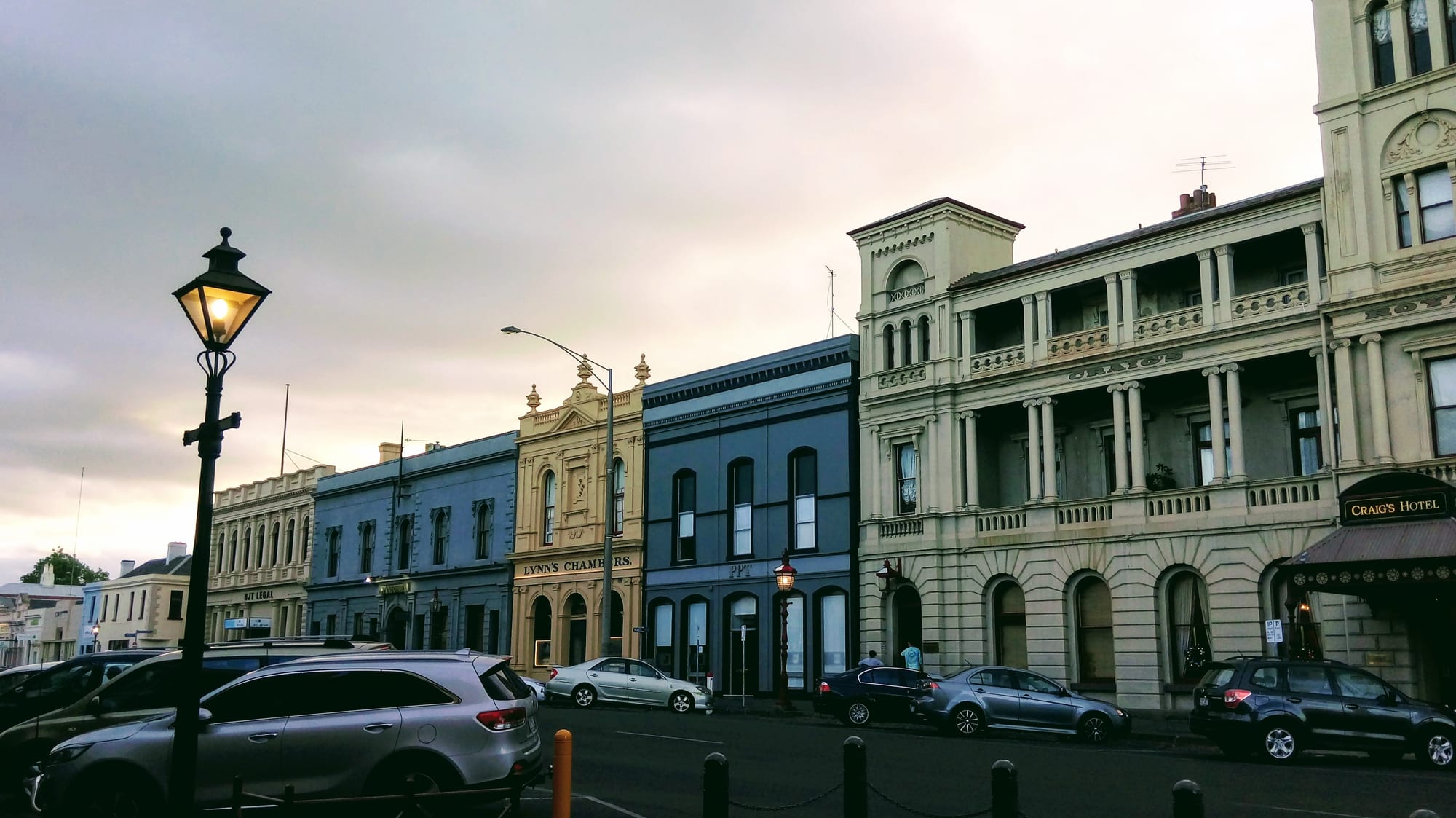
A row of two-storey Victorian buildings with iron verandahs and a tall street lamp on Lydiard Street, Ballarat

Melbourne & Victoria, Australia

Ballarat

Victorian-era buildings along Lydiard Street in central Ballarat, with Craig's Royal Hotel on the right. (DenisFrolow / Wikimedia Commons · CC BY-SA 4.0)

The largest inland city in Victoria, about 105 kilometres west of Melbourne on the country of the Wadawurrung. Gold found in 1851 turned a pastoral run into one of the richest diggings on earth and the site of the Eureka rebellion, and the wealth built the wide boulevards, theatres, gardens and stone banks that still define it.

Neighbourhoods

  • Ballarat Central
    • First-time visitors
    • Architecture
    • Close to public transport

    The gold-rush core, laid out around the boulevard of Sturt Street and the theatre and banking quarter of Lydiard Street, with the town hall, the art gallery, the railway station and most of the city's hotels, restaurants and bars inside a few blocks.

    Open in Maps
  • Lake Wendouree and the gardens
    • Quiet and residential
    • Parks
    • Running and cycling

    A residential district of large 19th-century houses around the shallow lake west of the centre, with the botanical gardens, boatsheds, rowing clubs and a six-kilometre path around the water. Heritage trams run along the gardens' edge.

    Open in Maps
  • Ballarat East and Bakery Hill
    • Historic district
    • Local life

    The old diggings side of the city, where the alluvial gold was found and the miners' meetings were held. Narrow streets of small cottages, corner hotels and churches run down towards the Yarrowee creek, and the Bridge Mall shops sit at the bottom of Sturt Street.

    Open in Maps
  • Golden Point and the Eureka quarter
    • Museums
    • Families

    South-east of the centre, on the slopes above the first diggings, this is where the open-air gold-mining museum and the Eureka Stockade site stand within a couple of kilometres of each other, among quiet streets of weatherboard houses.

    Open in Maps
  • Soldiers Hill
    • Quiet and residential
    • Historic homes

    A hillside of Victorian and Edwardian cottages just north of the centre, named for the soldiers' quarters of the gold-rush years, now one of the city's most sought-after older neighbourhoods and an easy walk into town.

    Open in Maps
  • Buninyong
    • Quiet and residential
    • Day trips

    A village about 12 kilometres south-east that predates Ballarat itself, one of the principal inland settlements of Victoria before the gold rush, with a main street of 19th-century shops and the site west of town where Thomas Hiscock found gold in 1851.

    Open in Maps

Things to do

Gold-rush Ballarat

  • Sovereign Hillmuseum

    A large open-air museum on a former mining site, recreating 1850s Ballarat with a main street of shops, working trades, underground mine tours and gold panning in the creek.

    Open in Maps
  • Eureka Stockade site and Eureka Centreattraction

    The parkland where miners built their stockade in 1854, with a memorial, an interpretive centre and the original Eureka Flag, on long-term loan from the art gallery.

    Open in Maps
  • Art Gallery of Ballaratmuseum

    Founded in 1884 and the oldest regional art gallery in Australia, with a strong Australian collection; the Eureka Flag, in the collection since 1895, is now on long-term loan to the Eureka Centre.

    Open in Maps
  • Her Majesty's Theatrelandmark

    Opened on Lydiard Street in 1875 as the Academy of Music and renamed in 1898, Australia's oldest continually operating theatre and still the city's main stage.

    Open in Maps
  • Ballarat Town Halllandmark

    The clock-towered civic building of the 1870s that anchors Sturt Street, a measure of how much money the goldfields produced.

    Open in Maps

The lake, gardens and wildlife

  • Lake Wendoureepark

    A shallow lake on the western side of the city, used for rowing and canoeing at the 1956 Melbourne Olympics, ringed by a popular walking and cycling path.

    Open in Maps
  • Ballarat Botanical Gardenspark

    Formal gardens beside the lake, laid out in 1857, with cool-climate trees, a conservatory that fills with begonias each autumn and an avenue of bronze busts of every Australian prime minister.

    Open in Maps
  • Ballarat Tramway Museummuseum

    Restored trams from the city's closed network, running on a short line through the botanical gardens along the lake shore.

    Open in Maps
  • Ballarat Wildlife Parkattraction

    A bushland park east of the centre where kangaroos graze loose among the paths, alongside koalas, wombats and reptiles.

    Open in Maps

Streets and buildings

  • Sturt Streetlandmark

    An unusually wide boulevard with a chain of central gardens, statues and memorials down the middle, lined with banks, hotels and churches from the boom decades.

    Open in Maps
  • Lydiard Streetlandmark

    The city's most intact Victorian streetscape, running north from Sturt Street past the theatre, the old mining exchange, galleries and iron-verandahed hotels.

    Open in Maps
  • Ballarat railway stationtransit hub

    A station opened in April 1862 as Ballarat West, its heritage buildings still the arrival point for trains from Melbourne.

    Open in Maps
  • Old Ballarat Cemeterylandmark

    Burial ground of the gold-rush years, holding Eureka Rebellion memorials to the miners and to the soldiers who died at the stockade.

    Open in Maps

Short trips from the city

  • Creswickneighborhood

    A small goldfields town about 18 kilometres north, with a forestry school, a mining museum and the birthplace of the Lindsay family of artists.

    Open in Maps
  • Clunesneighborhood

    One of the first places in Victoria where gold was found, a little town of intact 1870s streets that has become known for a book festival.

    Open in Maps
  • Daylesfordneighborhood

    A spa town in the hills to the north-east, in mineral-springs country, with bathhouses, a lake, guesthouses and a long-standing food reputation.

    Open in Maps
  • Bendigoneighborhood

    The other great goldfields city, about 120 kilometres north, with grand public buildings, a Chinese museum and deep-mine tours.

    Open in Maps

Seasonal events

  • Ballarat Begonia FestivalMarch

    Held since 1953 and built around the conservatory's begonia display in the botanical gardens, with floral plantings through the centre and a parade down Sturt Street.

  • Royal South Street EisteddfodSpring

    Australia's oldest and longest-running eisteddfod, begun in 1891 and held for weeks in Her Majesty's Theatre and other city venues, with thousands of young competitors.

  • Eureka anniversaryEarly December

    Commemorations at the stockade site and the cemetery mark the rebellion of 3 December 1854, when colonial forces stormed the miners' stockade at dawn.

Eat and drink

Long-standing places and food districts in Ballarat. Hours, ratings and directions come from your maps app, always current.

Ballarat classics

  • Craig's Royal Hotelrestaurant

    A gold-rush hotel on Lydiard Street, built and extended between 1862 and 1890, with a dining room and bars behind its iron verandah.

    Open in Maps
  • The Bridge Mallneighborhood

    The pedestrian mall at the eastern end of the main street, lined with bakeries, cafés, pie shops and cheap places to eat, busiest at lunchtime on weekdays.

    Open in Maps

Food districts and markets

  • Sturt and Armstrong streetsneighborhood

    The centre's restaurants, wine bars and coffee roasters are concentrated along and just off the boulevard, in shopfronts and old banking chambers; Melbourne's coffee culture is well established here.

    Open in Maps
  • Ballarat's farmers' marketsmarket

    Weekend markets in the city sell Central Highlands potatoes and vegetables, cheese, bread, meat and cool-climate wine from the surrounding district.

    Open in Maps

Experience Ballarat

History

The land around Ballarat is Wadawurrung country, and the name is thought to come from a Wadawurrung expression understood as a resting place. Squatters took up runs here from the late 1830s, grazing sheep on the volcanic plains and grassland around the swamp that became Lake Wendouree, and the district was quiet pastoral country until August 1851, when gold was found at Poverty Point. Within months tens of thousands of people were living in tents on the diggings, and Ballarat became one of the richest alluvial goldfields ever worked; the Welcome Nugget, the second largest ever found, was dug up at Bakery Hill in 1858.

Government licence fees, corrupt officials and the absence of a vote produced a rebellion. Miners burned their licences at Bakery Hill, built a stockade at Eureka and swore an oath under the Southern Cross flag; troops and police stormed it at dawn on 3 December 1854, in fighting with an official total of 27 deaths, most of them miners. The trials that followed ended in acquittals, the licence was replaced with a miner's right, and the events are read in Australia as a founding moment of its democracy.

Deep quartz mining then turned a camp into a city. Companies sank shafts, fortunes built Sturt Street's banks, churches, theatres and gardens, and Ballarat was proclaimed a city in 1870. Gold declined from the 1890s, and manufacturing, the railway workshops, food processing and education took over. The city's Victorian centre survived largely intact, and since the 1990s it has grown quickly as people have moved out from Melbourne.

Culture & Customs

Ballarat carries its history deliberately. The Eureka flag is a civic emblem, flown at public buildings and carried at union marches, and the rebellion is taught, commemorated each December and argued over by historians. Heritage is a live local concern, with the intactness of the streetscapes defended vigorously against unsympathetic development.

For a city of its size the performing arts are unusually strong. Her Majesty's Theatre has been in use since 1875, and the Royal South Street competitions, in their second century, fill the city's stages with young singers, dancers, musicians and speakers through the spring. The Art Gallery of Ballarat, the oldest regional gallery in the country, anchors a visual arts scene of studios and small galleries, and a substantial writers' and photographers' community has grown up alongside it.

Sport and the seasons set the social calendar: rowing and dragon boats on Lake Wendouree, Australian rules football through the winter, and harness and thoroughbred racing. Irish and Cornish names from the goldfields remain common, and the Chinese miners who came in the 1850s are remembered in cemetery monuments and museum displays. Winter is met with open fires, footy and long lunches rather than avoidance.

Daily Life

About 112,000 people live in Ballarat, which makes it the largest inland city in Victoria and one of the fastest-growing in regional Australia. New estates spread west around Lucas and Alfredton, while the older suburbs — Soldiers Hill, Ballarat East, Golden Point — hold cottages and villas from the mining decades. Many households now include someone who commutes to Melbourne by train, and the Ballarat line carries heavy commuter traffic.

Health, education and public administration are the largest employers, with the base hospital, Federation University and government offices in and near the centre. Food processing and light manufacturing continue on the edges of the city, and tourism is significant, built on the gold story. Gold mining itself has returned and stopped again more than once; the district also runs cattle, sheep, potatoes and cool-climate wine.

Day to day, the city feels calmer and cheaper than Melbourne while offering most of the same services. The recurring debates are familiar ones for a growing regional centre: house prices and rents rising faster than local wages, pressure on the hospital and schools, the balance between new housing and heritage protection, and how to keep the centre busy as shopping moves to the malls at the edge. Winter cold and homelessness are a sharp seasonal concern, and the city has also been a focus of national reckoning with institutional child abuse, a painful part of recent local history.

Food

Ballarat eats well for a country city. The centre has a dense run of cafés, wine bars, bakeries and restaurants in old shopfronts and banking chambers along Sturt and Armstrong streets, with coffee taken as seriously as it is in Melbourne, and the surviving gold-rush hotels serve dining-room meals behind iron verandahs. Pie shops and bakeries are a genuine local institution, and the Bridge Mall is where the city buys lunch.

The surrounding Central Highlands are productive cool-climate farming country: potatoes above all, along with brassicas, berries, beef, lamb and free-range eggs, and the volcanic soils and cold nights also suit chardonnay, pinot noir and sparkling wine made in small quantities nearby. Weekend markets bring that produce into the city, and mineral water from the springs around Daylesford and Hepburn, about 45 minutes north-east, is sold everywhere.

Migration has layered the menu. Chinese cooking has been part of the goldfields since the 1850s, Italian and Greek families arrived after the Second World War, and Indian, Vietnamese and African restaurants have opened more recently. Beer has a long local history going back to goldfields breweries, continued now by small independent brewers and distillers. At the open-air museum, boiled sweets are still made in a period lolly shop, and the raspberry drops leave the city in a great many glove boxes.

Planning tools

Budget

Ballarat is considerably cheaper than Melbourne for rooms and meals. Accommodation ranges from pub rooms and motels to restored Victorian hotels and guesthouses, with prices rising for the Begonia Festival weekend and other big event weekends. Museum and attraction entry is the other main cost; the gardens, lake and streetscapes are free.

Daily Budget Midrange
USD 160–280 (hotel or restored guesthouse, restaurant meals, museum entry, some car use or taxis)
Daily Budget Shoestring
USD 70–120 (hostel or pub room, self-catering and bakery lunches, trains and local buses)

Trains from Melbourne are cheap and frequent enough to make Ballarat a low-cost base for the goldfields; a combined ticket to the open-air museum covers more than one day, which is worth it for families.

Best Time to Visit

October to April is the comfortable half of the year, with warm days, gardens in flower and events most months. March, when the begonias are on show, and the autumn colour of April and May are the highlights. Winter is cold, grey and foggy — genuinely colder than Melbourne — which suits the museums, galleries, theatres and open fires in old hotels.

Suggested Number of Days

Two days covers the centre, the gardens and the main museums without rushing. Three or four allow the other goldfields towns and the spa country north of the city. Families tend to need longer than couples, and wet winter weather pushes visits indoors and slows them down.

First Visit
2 days
With Surroundings
3–4 days

Transportation

V/Line trains run between Melbourne and Ballarat through the day, taking about an hour and a half, and continue west towards Ararat, so the city works well without a car. Local buses radiate from the centre and the railway station to the suburbs, the lake, the university and the main attractions. The centre is walkable; a car is useful mainly for the surrounding goldfields towns.

Street parking in the centre is metered but plentiful compared with Melbourne, and heritage trams run in the botanical gardens on weekends and holidays rather than as transport.

Airport & Station Connections

Ballarat is about 105 kilometres west of Melbourne on the Western Freeway, roughly an hour and a half by car, and frequent V/Line trains from Southern Cross station take about the same. Melbourne Airport is about an hour and a quarter away by road, with coach services, and Avalon Airport is a similar distance. The Western Highway continues north-west towards Adelaide.

Walkability

The centre is easy on foot and rewarding for it, since the Victorian streetscapes are the attraction: Sturt Street and Lydiard Street can be walked end to end in half an hour, with wide footpaths and the central gardens to cross. The lake, the wildlife park and the open-air museum are two to three kilometres out, on bus routes, and the ground rises and falls more than a map suggests.

Safety

Ballarat is a safe regional city. The usual precautions apply around pubs and clubs in the centre late on Friday and Saturday nights, and theft from parked cars happens at trailheads and car parks. Winter brings thick morning fog and icy patches on the roads, and kangaroos come onto the highways around the city at dawn and dusk.

Leave nothing visible in a parked car, take care crossing Sturt Street's wide central gardens at night, and allow extra time on foggy winter mornings. Check current official travel advice before travelling.

Climate

Cool temperate and noticeably colder than Melbourne, since the city sits between about 400 and 630 metres above sea level on the Great Dividing Range. Rain falls through the year with a winter maximum, mornings are frosty and foggy in the cold months, and hot summer days end abruptly when a cool change arrives.

Summer
warm days and cool nights — December to February, the southern summer, is typically 11–25°C, with heatwave days above 35°C and high fire danger in the surrounding bush
Winter
cold and damp — June to August days reach about 10–11°C with frosty nights near 3°C, frequent fog, and occasional snow flurries that rarely settle

Local Customs

The city is on Wadawurrung country, acknowledged at public events and in signage. Eureka is more than history here: the Southern Cross flag flown by the miners is a civic emblem and a union symbol, and the rebellion is treated as a founding moment of Australian democracy. Ballarat is a football and rowing town, dress is practical rather than smart, and locals say the name with the stress on the first syllable.

Tipping is not expected, though it is welcomed for good service; the legal drinking age is 18 and identification is often asked for; dress for cold evenings even in summer, and treat the goldfields cemeteries and the Chinese memorials as places of respect.

Common Payment Methods

The currency is the Australian dollar. Cards and contactless payment are accepted everywhere, including buses and market stalls, usually with a displayed surcharge on cards, and cash machines are easy to find in the centre. A little cash is still useful at community markets, school fetes and honesty boxes on farm gates outside the city.