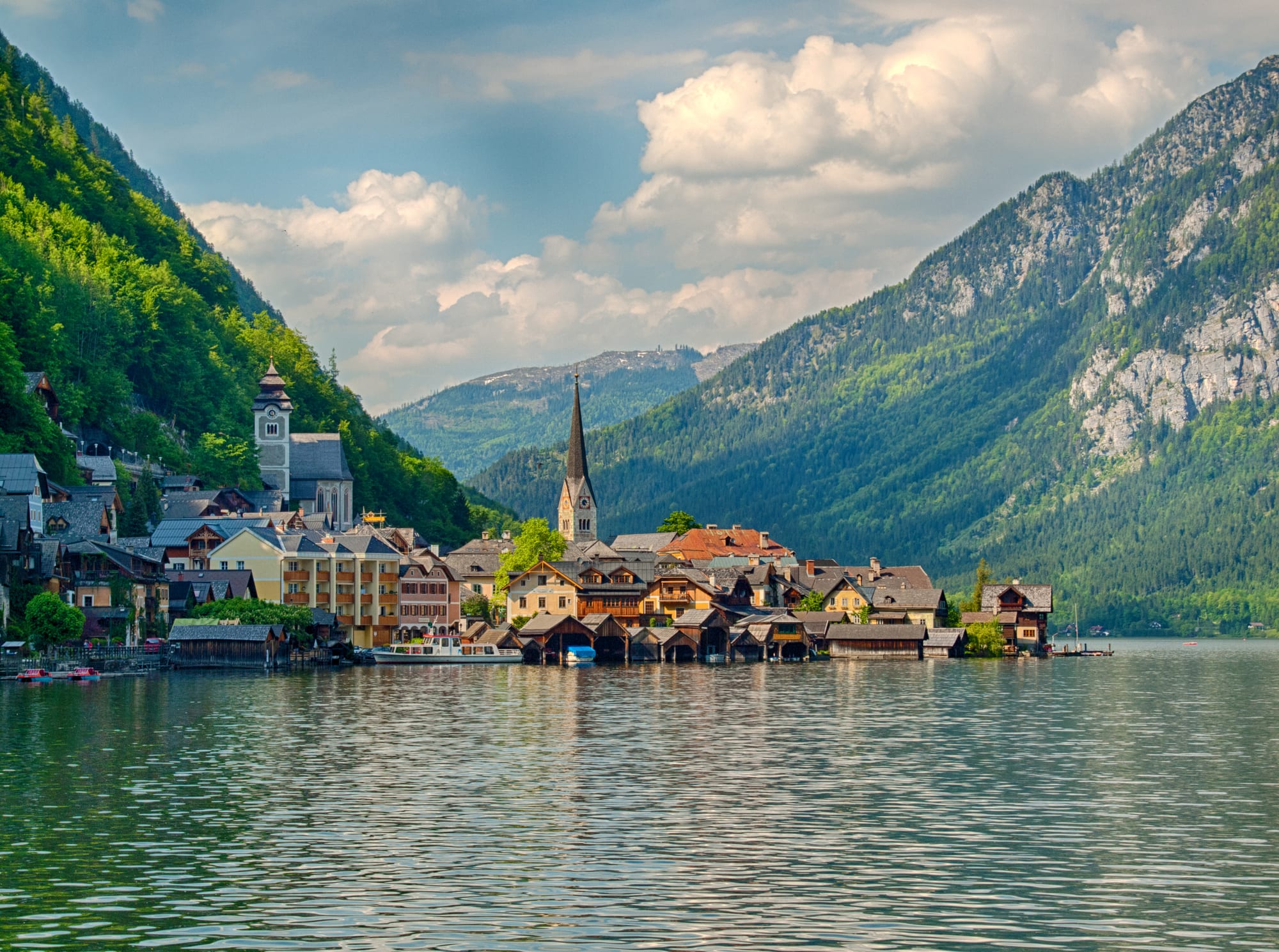
Hallstatt's church spire, boathouses and steep-roofed houses on the lake shore below forested mountains

Salzburg & Upper Austria, Austria

Hallstatt

Hallstatt seen from the Hallstätter See, with the Protestant church spire at the water's edge. (Kevin Poh / Wikimedia Commons · CC BY 2.0)

A salt-mining village of a few hundred people on a narrow strip between the Hallstätter See and the Dachstein massif in the Salzkammergut. Its prehistoric mine and cemetery gave their name to the Hallstatt culture of Iron Age Europe; since UNESCO listing in 1997 and viral fame online it has become a well-known example of overtourism.

Neighbourhoods

  • Markt, the old centre
    • First-time visitors
    • Historic district

    The old village is essentially one street running parallel to the shore and a few lanes around the Marktplatz, packed between the cliff and the lake. The two churches, the museum and the funicular to the salt mine are here, and the centre is closed to private cars.

    Open in Maps
  • Lahn
    • Quieter stay
    • Lakeside walks

    The southern part of the village at the mouth of the Echerntal, at the foot of the Dachstein, where more than half of Hallstatt's residents live. Bus stops, car parks and a lakeside playground and bathing area lie at this end, with paths into the valley behind.

    Open in Maps
  • The Salzberg
    • History
    • Views

    The high valley above the roofs, reached by funicular, where the salt mine, the prehistoric cemetery and the Skywalk viewing platform 360 metres above the village are found.

    Open in Maps
  • Obertraun
    • Outdoor activities
    • Base for the Dachstein

    The neighbouring village at the south-east end of the lake, a holiday base for skiing in winter and mountain biking, swimming and kayaking in summer, with the cable car to the Dachstein caves and plateau.

    Open in Maps

Things to do

Salt and history

  • Hallstatt salt mineattraction

    The world's oldest working salt mine, with 21 levels in the mountain above the village, visited on guided tours that include a long miners' slide; a funicular climbs from the village.

    Open in Maps
  • Hallstatt Museummuseum

    An outstanding collection of finds from the salt mines and Iron Age cemeteries that made Hallstatt the type site of the Hallstatt culture, housed since 2002 in the former parsonage.

    Open in Maps
  • Charnel house of St. Michael's Chapellandmark

    More than 1,200 skulls, about 600 of them painted with names, dates and symbols — a custom born of the village's lack of burial space.

    Open in Maps
  • Catholic parish churchlandmark

    The late Gothic church of the Assumption, completed in 1505, set on a rock above the roofs of the village.

    Open in Maps

Lake and viewpoints

  • Hallstätter Seepark

    The lake beside the village, up to 125 metres deep, crossed by boats to the railway station on the east shore and popular with divers.

    Open in Maps
  • Hallstatt Skywalkviewpoint

    The 'World Heritage View' platform 360 metres above the village, looking over the roofs, the lake and the Dachstein mountains.

    Open in Maps

Short trips from the village

  • 5 Fingersviewpoint

    A free viewing platform on the Krippenstein, its five finger-like walkways built out over a drop of about 400 metres, a short walk from the Dachstein cable car.

    Open in Maps
  • Dachstein ice cavesattraction

    Caves in the Dachstein across the lake, with ice waterfalls, frozen ponds and lakes inside the limestone, reached by cable car from Obertraun.

    Open in Maps
  • Hoher Dachsteinviewpoint

    The 2,995-metre mountain at the meeting point of three states, the highest in Upper Austria and Styria, with glaciers on its northern side.

    Open in Maps
  • Gosauseenpark

    Three lakes near Gosau beneath the glaciers and peaks of the Dachstein mountains.

    Open in Maps
  • Bad Ischlattraction

    The spa town on the Traun at the centre of the Salzkammergut, the main rail and bus hub for Hallstatt.

    Open in Maps

Seasonal events

  • Corpus Christi lake processionCorpus Christi, May or June

    A procession on boats across the Hallstätter See, held every year on the feast of Corpus Christi since 1623.

  • Winter quiet seasonNovember to March, outside Christmas

    Fewer shops and restaurants open, but the village is far less crowded and the lake and roofs are often under snow.

Eat and drink

Long-standing places and food districts in Hallstatt. Hours, ratings and directions come from your maps app, always current.

Hallstatt classics

  • Grilled lake fishrestaurant

    Locally caught freshwater fish from the lake, the village's speciality, served at several restaurants along the shore and the Marktplatz.

    Open in Maps
  • Café Derblcafe

    A café on the Marktplatz serving Austrian dishes and pastries alongside pizza, pasta and grilled local fish.

    Open in Maps
  • Bäckerei Konditorei Maislingercafe

    A small bakery and café on Seestrasse overlooking the lake, with breads, cakes and pastries.

    Open in Maps

Experience Hallstatt

History

Salt made Hallstatt. In the Bronze Age salt production was already an organised, everyday industry here, and between the 8th and 5th centuries BC the miners and their community grew rich enough to fill a large cemetery with fine grave goods. In 1846 the mine official Johann Georg Ramsauer discovered that cemetery near the Salzberg mines and excavated it over the following decades; some 1,300 burials are now known. The finds were so distinctive that Hallstatt gave its name to the Hallstatt culture of Late Bronze Age and Early Iron Age Europe. The salt preserved textiles, wood, leather, shoes, tools and miners' backpacks in the workings, but major activity at the site seems to have ended around 500 BC for reasons that remain unclear.

Mining continued in later centuries. A brine pipeline north to the saltworks at Ebensee has run since 1607, and visitors are told it is the world's oldest pipeline, built from 13,000 hollowed-out trees. In September 1750 a great fire destroyed the salt works, the court buildings and many private houses. Until the late 19th century Hallstatt could be reached only by boat or narrow trails, and some houses were linked only by boat or by a path through attics; the first road was blasted along the west shore in 1890.

Tourism began in the 19th century and grew sharply after the Hallstatt-Dachstein/Salzkammergut Cultural Landscape was listed by UNESCO in 1997. In 2025 excavations for a new funicular station uncovered a 2nd-century Roman cameo of Medusa.

Culture & Customs

The charnel house is Hallstatt's most unusual tradition. The churchyard has so little space that graves were long reopened after a decade or so and the bones moved into the ossuary in St. Michael's Chapel; more than 1,200 skulls are kept there, about 600 of them painted with names, dates and decorations. The practice ended in the 1970s, after the Catholic Church approved cremation.

Religion is visible in the village's skyline. At the 2001 census about two-thirds of residents were Catholic and a quarter Protestant, and the two churches stand close together: the late Gothic Catholic church of 1505 high on its rock, and the much younger Protestant church lower down near the water, whose tall spire, locals say, brings it just as close to heaven. Around 1600 the Counter-Reformation provoked unrest here, when miners mocked a Catholic salt official in a mock procession to Ischl. Every year since 1623 the feast of Corpus Christi has been marked with a procession on boats across the lake.

Modern fame has changed the village's culture. It became popular with East Asian visitors after a South Korean television drama, Spring Waltz, featured it in 2006, and online images calling it the most Instagrammable town in the world spread widely. A full-scale replica of the village was built in Huizhou, China, which is now its twin town. Rumours in 2013 that it inspired Arendelle in Frozen increased day visits further, though the filmmakers said their research was done in Norway and Canada.

Daily Life

Hallstatt had 741 inhabitants at the start of 2026, most of them living in Lahn, the southern part of the village, rather than in the old centre. Alexander Scheutz has been mayor since 2009. Tourism is the main source of income, and salt is still mined above the village.

Overtourism dominates local debate. In 2020 estimates put the number of visitors at 10,000 to nearly 30,000 a day, most of them arriving by coach for a short photo stop. By 2017 churches were employing door staff to protect services. From autumn 2020 coaches had to book time slots, with arrivals limited to 54 a day and groups required to stay at least two and a half hours. In 2023 fences built to stop selfie-takers were removed after a backlash online, and in August protesters blocked the road tunnel used by coaches; the mayor then announced further cuts to coach numbers.

Life follows the seasons: crowded summers, when the narrow shore street is barely passable at midday, and quiet winters, when many shops and restaurants close outside the Christmas holidays and the village belongs largely to its residents again.

Food

Hallstatt's food is simple Austrian village fare. For a place with so many visitors the choice is fairly limited: restaurants serve typical Austrian dishes along with pizza, and kiosks sell snacks to the day visitors. The local speciality is freshwater fish caught in the lake, often grilled and served at the restaurants along the shore and on the Marktplatz.

Coffee and cake are part of every visit. Bakeries and cafés in the village sell bread, cakes and pastries, and typical Austrian desserts appear on many menus. Many restaurants have English menus.

Salt is the village's oldest product. The mine above the roofs is still worked, and since 1607 its brine has travelled by pipeline to the saltworks at Ebensee on the Traunsee, which also processes brine from Altaussee and Bad Ischl. The beer on tap in the village is Stiegl, brewed in Salzburg, and the grocery shop in Lahn stocks a selection of local beers and wines. The cafés around the Marktplatz are the place to sit once the coaches have left.

Planning tools

Budget

Hallstatt's few rooms are expensive and booked months ahead, so many visitors stay in Obertraun, Bad Goisern or Bad Ischl. Parking near the village costs more the longer it is used, and the salt mine and funicular are among the dearer tickets in the region. Food is mostly simple Austrian fare, pizza and snacks.

Daily Budget Midrange
USD 180–320 (lakeside guesthouse, restaurant dinners with lake fish, the salt mine and funicular, a Dachstein cable car)
Daily Budget Shoestring
USD 90–140 (room in a neighbouring village, bakery and snack-kiosk meals, regional trains, buses and the ferry)

Stay overnight, or arrive early in the morning, to see the village before the day visitors arrive.

Best Time to Visit

May, June and September balance good weather and lighter crowds. July and August are the busiest and wettest months. The salt mine, cable cars and ice caves operate mainly from spring to autumn, while winter, outside the Christmas holidays, is the quietest time, with fewer shops and restaurants open and snow on the roofs.

Suggested Number of Days

Many people come for only a few hours on a coach tour, but a full day, or a night in or near the village, allows time for the salt mine and the museum in calm. Two to four days cover the Dachstein, the other lakes and walks in the surrounding mountains.

First Visit
1 day
With Surroundings
2–4 days

Transportation

The village centre is for pedestrians and buses only, and a walk from one end to the other takes about half an hour. Bus 542 runs from Bad Ischl station and 543 from Obertraun station, stopping at Lahn and Demelgasse. Private cars must use the car parks outside the centre, and boats cross and tour the lake.

Come by train and ferry rather than by car; in hard winters the lake can freeze and the ferry stop, so check at the station.

Airport & Station Connections

Salzburg Airport, about 75 kilometres away, is the nearest. By train, passengers change from the Salzburg–Vienna main line at Attnang-Puchheim onto the Salzkammergut line and get off at Hallstatt station, a halt on the east shore, where a ferry crosses to the village in about ten minutes. Buses run from Salzburg to Bad Ischl, connecting to bus or train. The road enters the village through a tunnel.

Walkability

The village is small and walkable, but squeezed onto a steep slope: lanes climb by steps between the houses, and the shore street is narrow and, at midday in summer, crowded. The lake path south to Lahn is level, and hiking trails lead into the mountains behind.

Safety

Austria is very safe, with low levels of violent crime. In Hallstatt the practical concerns are dense crowds on the narrow shore street and the mountains behind it, where the alpine weather changes fast. The lake is deep and cold, and in June 2013 the flooded Mühlbach stream poured through the village centre while the rising lake entered some houses.

Get a good hiking map before setting out, carry a warm layer into the mine and caves, and respect private houses and gardens when taking photographs. Check current official travel advice before travelling.

Climate

A humid continental climate with plentiful precipitation all year, highest in June to August. Spring is a short transition in March and April, and by mid-November night-time lows are around freezing.

Summer
warm and rainy, with days of about 22–28°C in nearby Salzburg and frequent showers
Winter
chilly to cold and snowy — nearby Salzburg and Linz see about -4 to 3°C — and in hard winters the lake can freeze

Local Customs

Hallstatt is a working village where most houses are private homes, and residents have protested against overtourism. At the 2001 census about two-thirds of residents were Catholic and a quarter Protestant, and churches have had to protect their services from sightseers.

Keep out of private gardens and boathouses, and stay out of churches during services.

Common Payment Methods

The currency is the euro. Cards are widely accepted, but small cafés, bakeries and kiosks may prefer cash, and it is useful to carry small notes and coins.