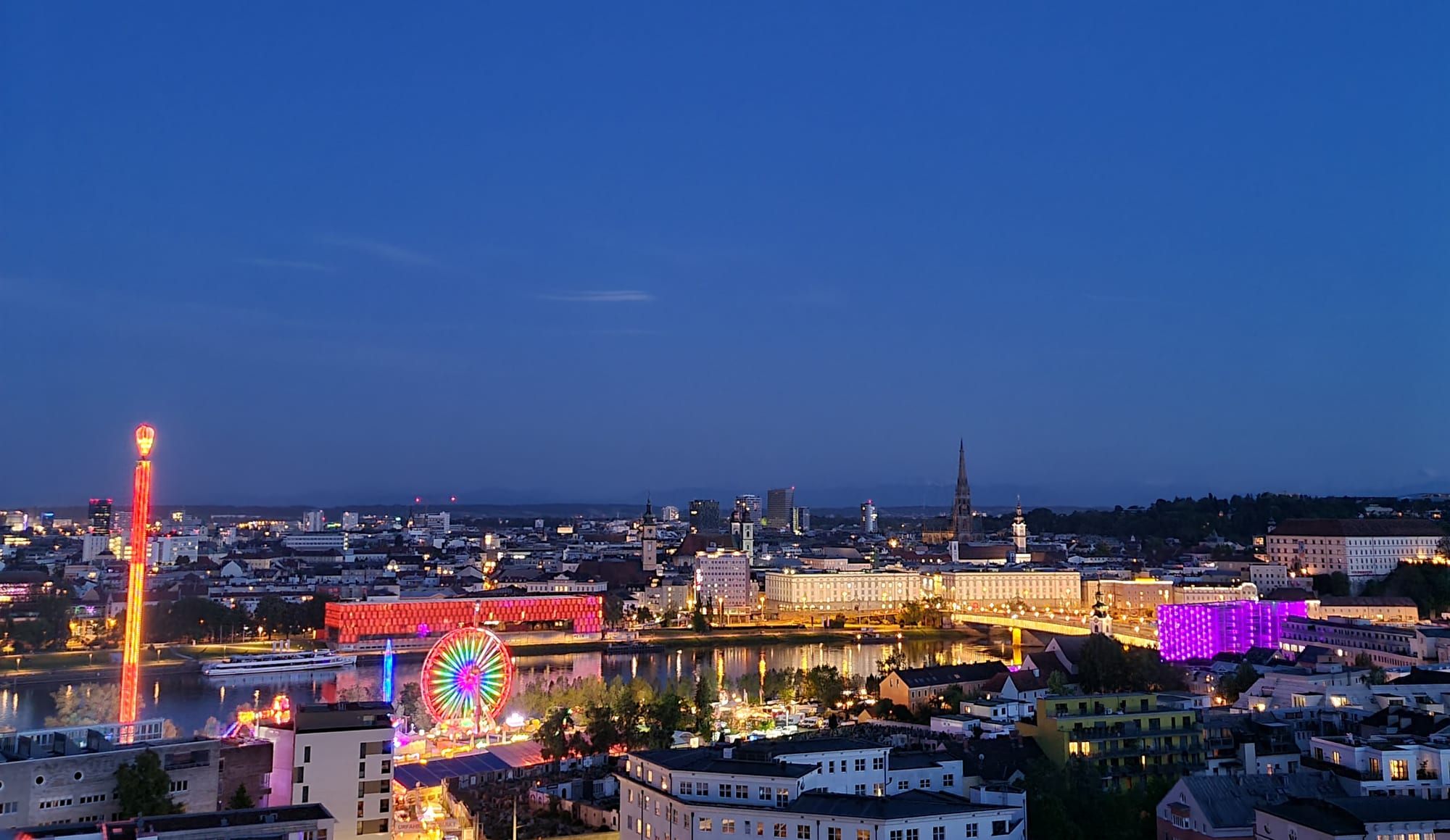
Linz at dusk across the Danube, with a lit Ferris wheel, glowing museum façades and a cathedral spire on the skyline

Salzburg & Upper Austria, Austria

Linz

Linz in the evening, with the Danube, the Lentos and Ars Electronica Center lit up and the New Cathedral's spire behind. (Lemur1000 / Wikimedia Commons · CC0)

The capital of Upper Austria and the country's third-largest city, on the Danube about 30 kilometres south of the Czech border. A Roman fort and medieval trading town, it became a centre of steel and chemicals in the 20th century, and since the 1970s has recast itself as a city of media art, festivals and universities while remaining one of Austria's main economic centres.

Neighbourhoods

  • The Altstadt
    • First-time visitors
    • Historic district
    • Nightlife

    The old town on the south bank between the main square, the castle hill and the Danube, with the Trinity Column, the Old Cathedral, narrow lanes of bars and restaurants and the Pöstlingberg tram stop. It is lively on weekend evenings but quiet on Sunday nights.

    Open in Maps
  • Landstrasse and the city centre
    • Shopping
    • Close to public transport

    The main shopping street runs south from the old town towards the main station, the busiest shopping street in Austria outside Vienna, with trams along its length. The New Cathedral, the Musiktheater by the Volksgarten and many offices lie on either side.

    Open in Maps
  • The Danube bank and the Kulturmeile
    • Arts and culture
    • Parks
    • Cycling

    The riverside park between the Lentos and the Brucknerhaus, known as the 'culture mile', with sculptures in the Donaupark and the Danube Cycle Path running past. The former tobacco factory, the Tabakfabrik, now a creative quarter, is a short way east.

    Open in Maps
  • Urfahr
    • Museums
    • Students
    • Local life

    The north bank, across the Nibelungen Bridge from the main square, with the Ars Electronica Center on the river, the fairground of the twice-yearly Urfahraner Markt and, further out, the Johannes Kepler University campus. It was once the heart of the city's small Jewish community.

    Open in Maps
  • Pöstlingberg
    • Views
    • Families

    The hill at the northern edge of the city, crowned by a pilgrimage basilica and reached by the steep Pöstlingberg tram from the main square. The zoo sits halfway up, and the views stretch over the city to the Alps.

    Open in Maps

Things to do

Famous landmarks

  • New Cathedrallandmark

    The neo-Gothic Cathedral of the Immaculate Conception, the largest church building in Austria.

    Open in Maps
  • Old Cathedrallandmark

    The Baroque Jesuit church of 1669–83, the diocese's cathedral from 1785 to 1909, where Anton Bruckner was organist from 1855 to 1868.

    Open in Maps
  • Linz Castlemuseum

    The castle on the hill above the old town and the Danube, now the Schlossmuseum, part of the Upper Austrian provincial museums.

    Open in Maps
  • Hauptplatz and the Trinity Columnlandmark

    The large main square at the bridgehead of the Danube, with its Baroque Trinity Column completed in 1723 and trams running through.

    Open in Maps

Museums and new media

  • Ars Electronica Centermuseum

    The 'Museum of the Future' on the north bank, base of the Ars Electronica institute for art, technology and society, founded in 1979, and its research lab.

    Open in Maps
  • Lentos Art Museummuseum

    The city's museum of 20th- and 21st-century art, opened in 2003 in a 130-metre glass box on the Danube that is lit up at night.

    Open in Maps

Music and the stage

  • Brucknerhausattraction

    The concert and congress hall on the Danube by Heikki and Kaija Siren, opened in 1974 and home to the Brucknerfest and the Klangwolke.

    Open in Maps
  • Musiktheaterattraction

    The opera house by the Volksgarten designed by Terry Pawson and opened in 2013, staging opera, operetta, ballet and musicals for the Linz State Theatre.

    Open in Maps

Hills, parks and the river

  • Pöstlingbergbahntransit hub

    The mountain tramway of 1898 from the main square to the top of the Pöstlingberg, one of the steepest adhesion railways in the world.

    Open in Maps
  • Pöstlingberg basilicaviewpoint

    The pilgrimage basilica on the hilltop, a city landmark visible from far around, with views over Linz towards the Alps.

    Open in Maps
  • Donauparkpark

    The riverside park between the Lentos and the Brucknerhaus, with sculptures by Herbert Bayer, Max Bill and others, and the stage for the Klangwolke.

    Open in Maps
  • Danube Cycle Pathtrail

    The long-distance cycle route between Passau and Vienna, which runs through the city along the redesigned riverbank.

    Open in Maps

Short trips from the city

  • St. Florian Monasterylandmark

    The largest monastery in Upper Austria, an Augustinian house and one of the finest Baroque buildings in the country, where Bruckner is buried beneath the organ.

    Open in Maps
  • Mauthausen Memorialmuseum

    The former main camp of the Nazi Mauthausen complex, about 20 kilometres east of Linz, now a museum and memorial; it was liberated by the US Army on 5 May 1945.

    Open in Maps
  • Steyrattraction

    Upper Austria's third-largest city, with a long history as a manufacturing centre that gave its name to the Steyr-Daimler-Puch group.

    Open in Maps

Seasonal events

  • Urfahraner Marktspring and autumn

    A fair held twice a year on the north bank, with rides and stalls, described as Austria's oldest public festival.

  • Linz FestMay

    An annual festival with the Brucknerhaus on the Danube as its venue.

  • PflasterspektakelJuly

    Three days of street performance — music, juggling, acrobatics, clowns, fire dancing and samba — in and around Landstrasse and the main square, held since 1987.

  • Ars Electronica Festivalearly September

    The annual festival of media art, with exhibitions, concerts, performances and talks across the city, drawing tens of thousands of visitors.

  • Linzer Klangwolkeearly September

    An open-air 'cloud of sound' in the Donaupark, held since 1979, with commissioned music staged with lasers, projections, fireworks and ships; it opens the Brucknerfest.

  • Christmas marketsAdvent

    Christmas markets on the Hauptplatz and in the Volksgarten.

Eat and drink

Long-standing places and food districts in Linz. Hours, ratings and directions come from your maps app, always current.

Linz classics

  • Linzer Torte at the pastry shopscafe

    The city's namesake cake, a crumbly nut pastry with a fruit-preserve filling under a lattice, sold at pastry shops such as Jindrak on Herrenstrasse.

    Open in Maps
  • Leberkäse and Bosnarestaurant

    Linz's snack food: rolls of Leberkäse from specialist counters in the old town, and the Bosna, a grilled sausage roll with curry sauce and onions that some sources say was created here.

    Open in Maps

Food districts and markets

  • Altstadt bars and restaurantsneighborhood

    The lanes off the main square, including the passageways between its houses, are lined with restaurants and bars.

    Open in Maps
  • Klosterhof on Landstrasserestaurant

    A restaurant serving traditional Austrian cuisine on the main shopping street, with a large beer garden.

    Open in Maps

Experience Linz

History

Linz began as Lentia, a Roman fort founded in the first century at a bend in the Danube — the name comes from a Celtic root meaning "bendable" — and the first Roman fort in Noricum. The present name is recorded in 799; Linz was a fortified town by 1236 and received city rights in 1324. Johannes Kepler taught mathematics here for several years, and the city's university now bears his name. The wool manufactory founded in 1672 became the largest in the Austrian lands, and in 1832 a horse-drawn railway from Linz to České Budějovice became the first railway line on the European mainland. Anton Bruckner was organist at the Old Cathedral from 1855 to 1868.

Adolf Hitler moved to Linz as a child and regarded it as his home town for the rest of his life; Adolf Eichmann also grew up here. Under Nazi rule the city became a giant industrial complex: Hermann Göring oversaw the construction of the steelworks, built with slave labour, and three subcamps of Mauthausen operated inside it. The synagogue was destroyed in November 1938, and the city's Jewish community was persecuted and murdered.

After the war Linz lay in the American zone and grew into one of Austria's main economic centres, reaching a record population of 204,889 in 1971. Since 1979 the founding of Ars Electronica and the Klangwolke has given the steel town a second identity, and in 2009 Linz was a European Capital of Culture. Since 1988 many streets have been named after victims of Nazism and resistance fighters.

Culture & Customs

Linz's cultural reinvention began in 1979, when the International Brucknerfest, the new Ars Electronica festival and the first Klangwolke were brought together. Ars Electronica, with its museum, research lab and annual festival, has made the city a world centre of new media art, and Linz is a designated City of Media Arts; the Valie Export Center in the Tabakfabrik holds the legacy and archives of the artist. The Lentos art museum of 2003 faces the Ars Electronica Center across the Danube.

Music follows from Bruckner, who worked here and is buried at nearby St. Florian. The Brucknerhaus, opened in 1974 with Herbert von Karajan conducting the Vienna Philharmonic, holds about 200 performances a year, and the Musiktheater, opened in 2013, is one of the most modern opera houses in Europe. Each September the Klangwolke turns the riverside into a stage of music, lasers and fireworks, while July's Pflasterspektakel fills the streets with performers.

Football is followed closely. LASK, the oldest club in the region and in 1965 the first team outside Vienna to win the Austrian championship, won its second title in 2026. The twice-yearly Urfahraner Markt, Austria's oldest public festival, and the Christmas markets on the main square and in the Volksgarten mark the calendar. The city's handling of its Nazi past, from renamed streets to memorials, is part of its public life.

Daily Life

Linz had 214,064 inhabitants at the start of 2025, and about 820,000 people live in its metropolitan region. It is the only large Austrian city with nearly twice as many jobs as residents to fill them — about 157,000 — so commuters pour in each day, and traffic congestion is a constant issue. The Westring motorway is being built in stages, with the new Donautal Bridge opened in November 2024 and completion planned for 2031.

Industry still matters. voestalpine, founded as the Reichswerke Hermann Göring, is a large steel and technology group known for the basic oxygen steelmaking process, and the Danube port handles ores and scrap for the works. Services, research and higher education have grown alongside: the Johannes Kepler University has about 27,000 students, and the city ranks third in Austria for congresses.

Linz lost residents to the suburbs between 1991 and 2001 and began growing again from 2012, passing 200,000 at the end of 2015. The city has thirteen shopping malls, three of them in the centre, and eleven farmers' markets. Serbian and Romanian immigrants have founded their own churches.

Food

The Linzer Torte is the city's gift to the world's pastry trays: a very short, crumbly pastry of flour, butter, egg yolks, lemon, cinnamon and ground nuts, usually hazelnuts, filled with redcurrant, raspberry or apricot preserves and covered with a lattice of thin dough. It is a holiday treat in Austria and neighbouring countries, often eaten at Christmas, and Linzer Augen, sandwich biscuits with a round window showing the jam, are a biscuit version. Pastry shops in the centre, such as Jindrak on Herrenstrasse, sell the torte.

Beyond the cake, typical dishes in Linz include Knödel, dumplings, and strudel in many varieties. Snack food has a strong local following: Leberkäse in a bread roll is sold at specialist counters and supermarkets, and the Bosna, a grilled bratwurst in white bread with onions and curry-spiced mustard or ketchup, is claimed by some sources to have been invented in Linz rather than Salzburg.

Snack stands in the centre serve fried sausages with sauerkraut, Leberkäse, kebabs, Chinese food and pizza. Local beers and Most, a still cider and the region's traditional drink, are the usual accompaniments, and the city's eleven farmers' markets sell fresh produce.

Planning tools

Budget

Linz charges ordinary Austrian prices and is good value next to Salzburg or Vienna. Rooms fill up and rise in price during big congresses and the Ars Electronica Festival in September. Much of the culture mile, the riverside park and the festivals' open-air events cost nothing.

Daily Budget Midrange
USD 160–280 (mid-range hotel, restaurant dinners, museum tickets, a concert or opera)
Daily Budget Shoestring
USD 80–125 (hostel or budget hotel, Leberkäse and market lunches, trams)

A day ticket covers trams, buses and the Pöstlingberg tram, which makes it the easiest way to see the city.

Best Time to Visit

May to September. May has the Linz Fest, July the Pflasterspektakel street festival, and early September the Ars Electronica Festival and the Klangwolke, the busiest week of the year. Spring and autumn bring the Urfahraner Markt, and Advent the Christmas markets. Winters are quite cold.

Suggested Number of Days

Two days are enough for a first look at the city centre, the riverbank and the hills. Three or four allow time for the abbeys and memorials nearby or for cycling along the Danube, and festival visitors in September often stay longer.

First Visit
2 days
With Surroundings
3–4 days

Transportation

Linz Linien run the trams, including the Pöstlingberg tram, trolleybuses and city buses, with trams running underground to the main station. The Upper Austria S-Bahn links the city with the surrounding region. Cycling accounts for about a tenth of trips, though cycle lanes are patchy, and the Danube Cycle Path runs through the centre.

Commuter traffic into the city is heavy, and parking in the centre is limited; the trams and S-Bahn avoid both.

Airport & Station Connections

Linz Hauptbahnhof, at the southern edge of the city centre, is on the Western Railway, with frequent fast trains to Vienna and Salzburg, and is linked to the tram network underground. Linz Airport, at Hörsching about 14 kilometres south-west of the centre, has a few scheduled routes and many charters; bus 601 reaches the centre in about 20 minutes. River cruise ships also call at the city.

Walkability

The old town, the main square, the riverbank and Landstrasse are flat and easy to walk, and the Nibelungen Bridge brings Urfahr's museums within a short stroll. The castle and the Pöstlingberg involve a climb, though the tram takes the work out of the latter. Busy roads cut through some districts beyond the centre.

Safety

Austria is very safe, with low levels of violent crime. Linz is a calm city; the main hazards are traffic on its busy roads and bridges and the Danube, which has flooded in the past.

Carry a waterproof and a warm layer on any mountain outing, start early to be down before the afternoon storms, and heed closed-path signs in winter and spring. Keep to marked lanes when walking along the cycle path, and follow local warnings when the river is high. Check current official travel advice before travelling.

Climate

An oceanic climate with warm summers and quite cold winters; the Danube valley is drier than the mountains to the south.

Summer
warm, with days of about 22–28°C in Linz and occasional thunderstorms
Winter
cold, around -4 to 3°C, with some snow

Local Customs

Linz is a working city proud of its reinvention from steel town to media art capital. Austrian courtesies such as titles still matter, Catholic tradition is strong, and shops close by early evening and on Sundays, when the old town also goes quiet at night.

Many places in the old town close on Sunday evenings; plan meals accordingly. The city has confronted its Nazi past openly, and memorial sites call for respectful behaviour.

Common Payment Methods

The currency is the euro. Cards and contactless are widely accepted, but market stalls, bakeries and small snack counters often prefer cash.