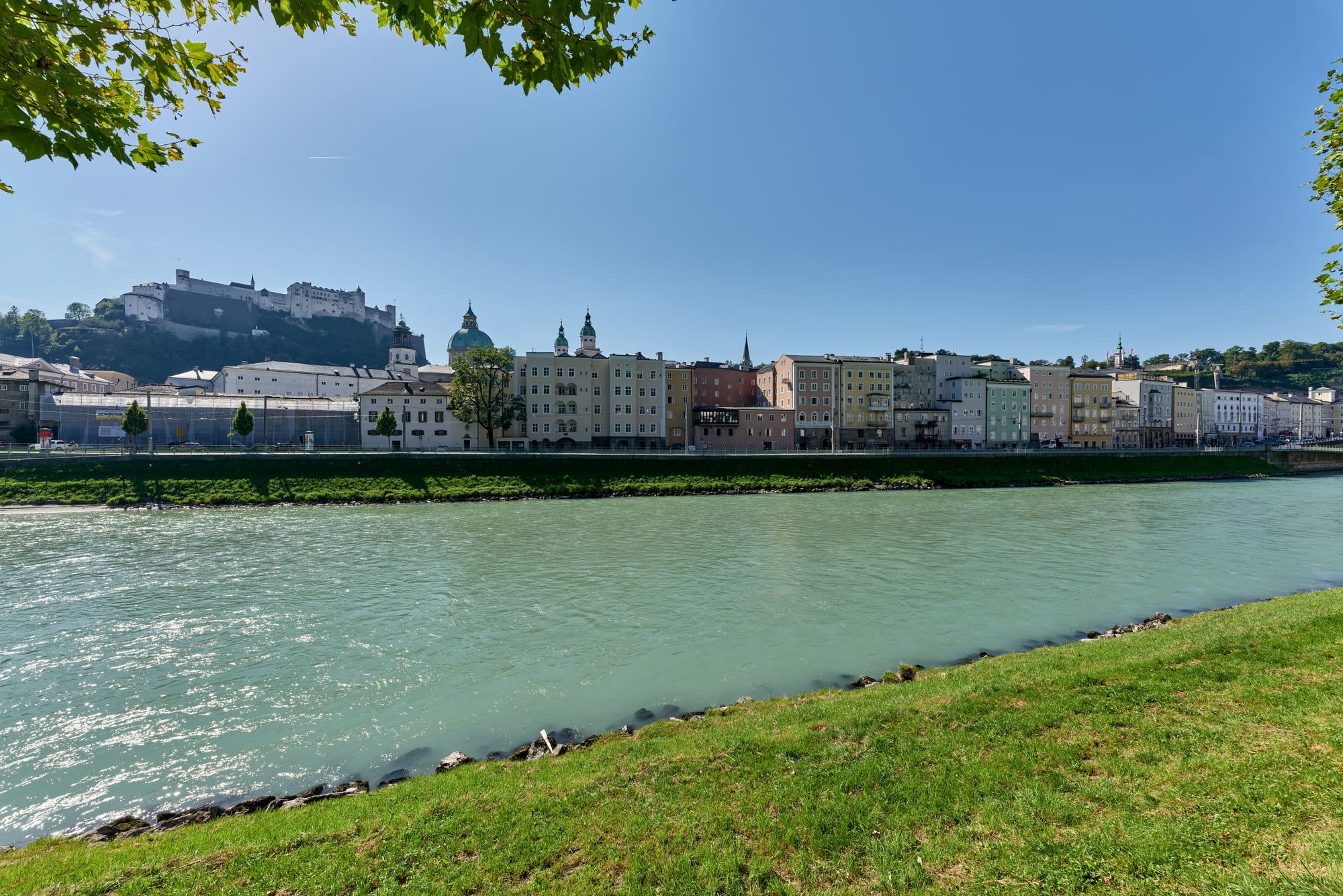
The green Salzach river below a row of pastel townhouses, church domes and the Hohensalzburg fortress on its hill

Salzburg & Upper Austria, Austria

Salzburg

The Salzach and Salzburg's old town, seen from the Giselakai, with Hohensalzburg Fortress above. (Leonhard Lenz / Wikimedia Commons · CC0)

Austria's fourth-largest city, on the Salzach River at the foot of the Alps beside the German border. Built on salt and ruled for centuries by prince-archbishops, it was rebuilt in Baroque style in the 17th century and gave the world Mozart. Today its UNESCO-listed old town, fortress and summer festival draw visitors who at peak times far outnumber residents.

Neighbourhoods

  • The Altstadt
    • First-time visitors
    • Historic district
    • Music and theatre

    The old city on the left bank, squeezed between the Salzach and the Mönchsberg cliff below the fortress. Its squares around the cathedral and Residenz, the narrow Getreidegasse with its wrought-iron guild signs, St. Peter's Abbey and the festival halls make up the heart of the World Heritage Site, and in summer it is extremely crowded.

    Open in Maps
  • The right bank and the Kapuzinerberg
    • Close to public transport
    • Shopping
    • Walks

    Across the river the old town continues around Linzergasse and Steingasse, below the wooded Kapuzinerberg hill, whose steep paths are reached from Linzergasse. Mirabell Palace and its gardens are here, and the main railway station lies about a quarter of an hour's walk to the north.

    Open in Maps
  • Mülln
    • Beer gardens
    • Local life

    A small old suburb of about 1,000 people at the northern foot of the Mönchsberg. Monastery beer has been brewed here since 1621, and its beer hall and garden are among the city's favourite gathering places.

    Open in Maps
  • Nonntal
    • Quiet and residential
    • Students

    The quarter south-east of the fortress below Nonnberg Abbey, the oldest continuously existing nunnery in the German-speaking world. The university's Unipark Nonntal campus, opened in 2011, brings students to its streets.

    Open in Maps
  • Hellbrunn and the southern districts
    • Parks
    • Families

    Green, residential southern Salzburg, with Hellbrunn Palace and its gardens, the zoo in the palace park on the boundary with Anif, and the lake of Leopoldskron. The road south leads on towards the Untersberg.

    Open in Maps

Things to do

Famous landmarks

  • Hohensalzburg Fortresslandmark

    The prince-archbishops' fortress on the Festungsberg, begun in 1077 and 250 metres long, one of the largest medieval castles in Europe; a funicular has carried visitors up since 1892.

    Open in Maps
  • Salzburg Cathedrallandmark

    The 17th-century Baroque cathedral dedicated to St. Rupert and St. Vergilius, a model for many churches in southern Germany and Austria; a bomb crashed through its dome in 1944, and restoration was complete by 1959.

    Open in Maps
  • Getreidegasselandmark

    The narrow, busy shopping street of tall townhouses and wrought-iron guild signs, where Mozart was born at No. 9.

    Open in Maps
  • St. Peter's Abbeylandmark

    A Benedictine monastery founded in 696, the oldest in the German-speaking area with a continuous history, known for its cemetery below the Mönchsberg cliff.

    Open in Maps
  • Nonnberg Abbeylandmark

    The Benedictine nunnery founded by St. Rupert around 712–715 on the terrace east of the fortress.

    Open in Maps
  • Mirabell Palace and gardenslandmark

    A palace of 1606 on the right bank with formal gardens and a marble hall, part of the World Heritage Site.

    Open in Maps

Museums

  • Mozart's birthplacemuseum

    The third-floor flat where Mozart was born on 27 January 1756, a museum since 1880 holding his childhood violin and portraits, documents and early editions.

    Open in Maps
  • Mozart's residencemuseum

    The Tanzmeisterhaus on the right bank, where Mozart lived with his family from 1773 until he moved to Vienna in 1781.

    Open in Maps
  • Salzburg Museummuseum

    The museum of the art and cultural history of the city and region, housed since 2005 in the Neue Residenz — its main site there is closed for renovation and expansion.

    Open in Maps
  • Museum der Moderne Salzburgmuseum

    Modern art in two buildings — the Rupertinum in the old town, opened in 1983, and a museum on top of the Mönchsberg, opened in 2004.

    Open in Maps
  • Hangar-7museum

    Red Bull's glass hangar beside the airport, showing historic aircraft, helicopters and Formula One cars in rotating exhibitions.

    Open in Maps

Music and the stage

  • Großes Festspielhausattraction

    The large festival hall by Clemens Holzmeister, opened in 1960 for the Salzburg Festival.

    Open in Maps
  • Felsenreitschuleattraction

    An open-air theatre built in the quarry that supplied stone for the cathedral, used as a festival stage.

    Open in Maps
  • Salzburg Marionette Theatreattraction

    One of the oldest continuing marionette theatres in the world, founded in 1913, performing operas and ballets with marionettes.

    Open in Maps

Parks, hills and viewpoints

  • Mönchsbergviewpoint

    The 508-metre hill on the west side of the old town, named after the monks of St. Peter's, with paths along its wooded top and views over the domes.

    Open in Maps
  • Kapuzinerbergviewpoint

    The 640-metre hill on the right bank, part of the World Heritage Site, with views over the old town.

    Open in Maps
  • Hellbrunn Palacepark

    Markus Sittikus's summer day residence of 1613–19 in the southern countryside of the city, with large gardens and trick fountains.

    Open in Maps
  • Gaisbergviewpoint

    The 1,287-metre mountain east of the city, a recreation area with views over Salzburg and across to the Berchtesgaden Alps.

    Open in Maps

Short trips from the city

  • Untersbergviewpoint

    The table-top massif on the German border, reached by cable car, whose lopsided peak opens and closes the film The Sound of Music.

    Open in Maps
  • Hallein Salt Mineattraction

    The Dürrnberg salt mine above Hallein, worked for over 2,600 years and now a mining museum known for its long wooden slides between levels.

    Open in Maps
  • Silent Night Chapellandmark

    The memorial chapel in Oberndorf on the site of the church where the carol was first performed on 24 December 1818.

    Open in Maps
  • Kehlsteinhauslandmark

    The Eagle's Nest, completed in 1938 for the Nazi Party on a rocky promontory above Berchtesgaden in Germany, now a seasonal restaurant with wide views.

    Open in Maps

Seasonal events

  • Mozart Weeklate January

    A festival of a little over a week around Mozart's birthday on 27 January, created in 1956 and run by the International Mozarteum Foundation.

  • Salzburg Easter FestivalHoly Week, March or April

    Opera and orchestral concerts founded by Herbert von Karajan in 1967; the Berlin Philharmonic returned as resident orchestra in 2026.

  • Salzburg Festivalfive weeks from late July

    One of the world's leading festivals of music and drama, founded in 1920, centred on Mozart's operas and the annual performance of Hofmannsthal's Jedermann.

  • RupertikirtagSeptember

    The fair in honour of St. Rupert on the squares beside the cathedral, held since the 14th century, with vintage rides, stalls, craft demonstrations and a beer tent.

  • Christmas marketAdvent

    The Christkindlmarkt on the cathedral squares, with seasonal food, decorations and crafts.

Eat and drink

Long-standing places and food districts in Salzburg. Hours, ratings and directions come from your maps app, always current.

Salzburg classics

  • Augustiner Bräu Müllnrestaurant

    The beer hall and garden of the monastery brewery at the foot of the Mönchsberg, where beer has been brewed since 1621.

    Open in Maps
  • Café Konditorei Fürstcafe

    The confectioner whose founder, Paul Fürst, created the Mozartkugel in 1890; his descendants still make them by hand and sell them in their own shops in the city.

    Open in Maps
  • Stiegl breweryrestaurant

    The brewery founded in the city in 1492, with a large beer museum on the outskirts and a pub at the end of the tour.

    Open in Maps

Street food and food streets

  • Bosna standsrestaurant

    Stands and small shops selling the Bosna, a grilled roll of bratwurst, onions and curry-spiced sauce said to have been invented in Salzburg in 1949.

    Open in Maps
  • Linzergasseneighborhood

    The right-bank old-town street with traditional inns and brewery taverns among its shops.

    Open in Maps

Experience Salzburg

History

In the La Tène period the site was a centre of the Celtic Taurisci, and after the Roman conquest of 15 BC the town of Iuvavum grew up on the ground of today's old town, becoming a municipium in 45 AD. Around 696 Bishop Rupert received the ruins from Duke Theodo II of Bavaria and founded St. Peter's Abbey; Salzburg became a bishopric in 739 and an archbishopric in 798. Its name comes from the salt barges on the Salzach, and salt, trade and gold mining paid for its rise. Archbishop Gebhard began Hohensalzburg in 1077.

The archbishops ruled as princes of the Holy Roman Empire, independent of Bavaria from the late 14th century. In 1525 rebellious peasants besieged the archbishop in his fortress for three months. From the late 16th century Wolf Dietrich von Raitenau, Markus Sittikus and Paris Lodron rebuilt the centre with Italian architects. In 1731 Archbishop Firmian expelled the Protestants; over 20,000 were driven out in the persecutions, most of them resettling in East Prussia. Mozart served the court until his break with Archbishop Colloredo in 1781. The archbishopric was secularised in 1803, passed between Austria and Bavaria, and became Austrian for good in 1816.

The Anschluss of 1938 brought arrests, deportations and the destruction of the synagogue; a camp for Roma operated in Maxglan, and there were five subcamps of Dachau in the city. Allied bombing destroyed 46 per cent of its buildings, and a bomb crashed through the cathedral dome, but most of the Baroque centre survived. American troops arrived on 5 May 1945. The old town became a World Heritage Site in 1996.

Culture & Customs

Music defines the city. Mozart was born in the Getreidegasse in 1756 and worked for the archbishops until 1781, and his name is everywhere, from the Mozarteum university to the chocolates. On the 250th anniversary of his birth in 2006, all 35 of the city's churches rang their bells together. The Salzburg Festival, founded in 1920, fills the summer with opera, concerts and theatre, and Hofmannsthal's Jedermann is played every year; the Easter Festival founded by the Salzburg-born conductor Herbert von Karajan, a Whitsun festival and Mozart Week in January extend the season. The Marionette Theatre, founded in 1913, performs opera with puppets.

The city is also bound up with two famous songs. Joseph Mohr, a Salzburg-born priest, wrote the words of Silent Night, first sung in nearby Oberndorf on Christmas Eve 1818. And the Trapp family, who lived in Salzburg until they fled the Nazis, inspired The Sound of Music, filmed in and around the city in the 1960s; tour companies still visit its locations. Writers connected with the city include the poet Georg Trakl, born here, Stefan Zweig, who lived here for about 15 years until 1934, and Thomas Bernhard, who grew up here.

Catholic tradition shapes the calendar, from the September fair for St. Rupert, held since the 14th century, to the Advent market around the cathedral. In sport, FC Red Bull Salzburg, which plays at a stadium in suburban Wals-Siezenheim, has dominated Austrian football for more than a decade.

Daily Life

Salzburg had 157,994 inhabitants in 2026. It passed 100,000 around 1950, after absorbing neighbouring municipalities in 1935 and taking in many post-war refugees, and reached 150,000 in 2016. Large German, Bosnian, Serbian and Romanian communities live here, and the urban area spills across the border into Bavaria, where transport lines continue to Freilassing, Ainring and Piding.

Tourism is the most visible industry: at peak times visitors greatly outnumber residents, and the old town's shops and cafés depend on them. Salzburg is also a university city, with the University of Salzburg — around 18,000 students — the Paracelsus Medical University and the Mozarteum, and the city has Austria's second-largest airport. GDP per head is above the Austrian average.

Most residents live outside the historic core, in districts such as Lehen, Maxglan and Gnigl, and travel by trolleybus or bicycle. Life follows the seasons — summer evenings in beer gardens and on the riverbanks, winter weekends skiing in the mountains to the south — and housing costs in a city with limited room to grow are a frequent subject of debate.

Food

Salzburg's best-known dish is a dessert. Salzburger Nockerl are fluffy dumplings resembling a soufflé, traditionally served as a dessert in the city. The Mozartkugel — pistachio, marzipan and nougat covered in dark chocolate — was created in 1890 by the confectioner Paul Fürst, whose descendants still make the original by hand, while many other makers produce versions industrially.

The street food is the Bosna, said to have been invented in Salzburg in 1949: a bratwurst with onions and a blend of mustard or tomato ketchup with curry powder, in white bread grilled briefly before serving. It is now eaten across western Austria and southern Bavaria. Sausage stands and small snack shops sell it around the old town.

Beer is the everyday drink. Stiegl, founded in the city in 1492, is the most common beer brand in Austria and brews light lager, wheat beer and other styles, with a beer museum on the city's edge. Augustiner Bräu in Mülln has brewed beer at the foot of the Mönchsberg since 1621, and its beer hall and garden are an institution. At the Christmas market the stalls sell hot potatoes, doughnuts and sweets alongside mulled drinks.

Planning tools

Budget

Salzburg is one of Austria's dearest cities, and rooms cost most during the Festival from late July to the end of August and again in Advent. Many sights are close together and walking is free; a city card covering public transport and many sights, including the fortress funicular and the Untersberg cable car, suits a busy visit. Lakeside towns and neighbouring Bavaria are cheaper bases when the city is full.

Daily Budget Midrange
USD 190–330 (mid-range hotel, restaurant dinners, museum and fortress tickets, a concert)
Daily Budget Shoestring
USD 90–140 (hostel bed, Bosna and bakery lunches, beer-hall dinners, trolleybuses)

Book rooms and Festival tickets well ahead for July and August.

Best Time to Visit

May, June and September suit walking and the hills best. July and August bring the Festival, the highest prices and the heaviest crowds, and summer is also the wettest season. Late January has Mozart Week, September the St. Rupert's fair, and Advent the Christmas market. In winter the ski areas to the south are within reach.

Suggested Number of Days

Two or three days cover the old town, the hills and the main museums. A Festival programme, the mountains to the south, the Salzkammergut lakes or a crossing into Bavaria each add a day or more, and the city makes a practical base for all of them.

First Visit
2–3 days
With Surroundings
4–6 days

Transportation

The old town is best on foot. More than 20 trolleybus and bus lines run across the city, many of them electric trolleybuses, and four S-Bahn lines reach the suburbs and, across the border, Freilassing. The city has over 100 kilometres of bike paths, and cycling is often the fastest way around. Regional buses serve the lakes and valleys beyond.

Check the time of the last bus for late evenings after concerts; a city card includes public transport.

Airport & Station Connections

Salzburg Airport, Austria's second largest, lies about 3 kilometres west-south-west of the centre, linked by trolleybus; it has scheduled flights from many European cities and winter charters for skiers. Salzburg Hauptbahnhof has frequent trains to Vienna, Munich, Innsbruck and Zurich, and is about a quarter of an hour's walk from the old town. Munich is about 150 kilometres to the west.

Walkability

The old towns on both banks are compact and largely pedestrian, linked by footbridges across the Salzach. Lanes are cobbled, and the walks up the Mönchsberg, Kapuzinerberg and to the fortress are steep, though lifts and the funicular avoid some of the climbing. Hellbrunn and the southern districts are more easily reached by bus or bicycle.

Safety

Austria is very safe, with low levels of violent crime. Salzburg's main concerns are the very dense crowds in the old town at peak times and the mountains around it, where weather changes quickly.

Keep valuables secure in festival and Christmas-market crowds, and carry a waterproof and warm layer on any mountain outing. Check current official travel advice before travelling.

Climate

A borderline warm-summer continental climate at the northern rim of the Alps, with rain all year and most of it in summer — the local drizzle has its own name, Schnürlregen. Föhn winds bring rapid thaws in winter and spring.

Summer
mild to warm, with a July daily mean of about 20°C and frequent showers and storms
Winter
cold, with a January daily mean of about 0°C; snow is common but less frequent than it was

Local Customs

Salzburg is a strongly Catholic city of 35 churches, and services and cemeteries expect quiet and respect. Courtesies such as titles still matter in Austria. Shops close by early evening and stay shut on Sundays.

Keep voices down in churches and in St. Peter's cemetery, and avoid sightseeing inside churches during services.

Common Payment Methods

The currency is the euro. Cards and contactless payment are accepted in most places, but small cafés, bakeries, market stalls and some sausage stands prefer cash, so small notes and coins are useful.