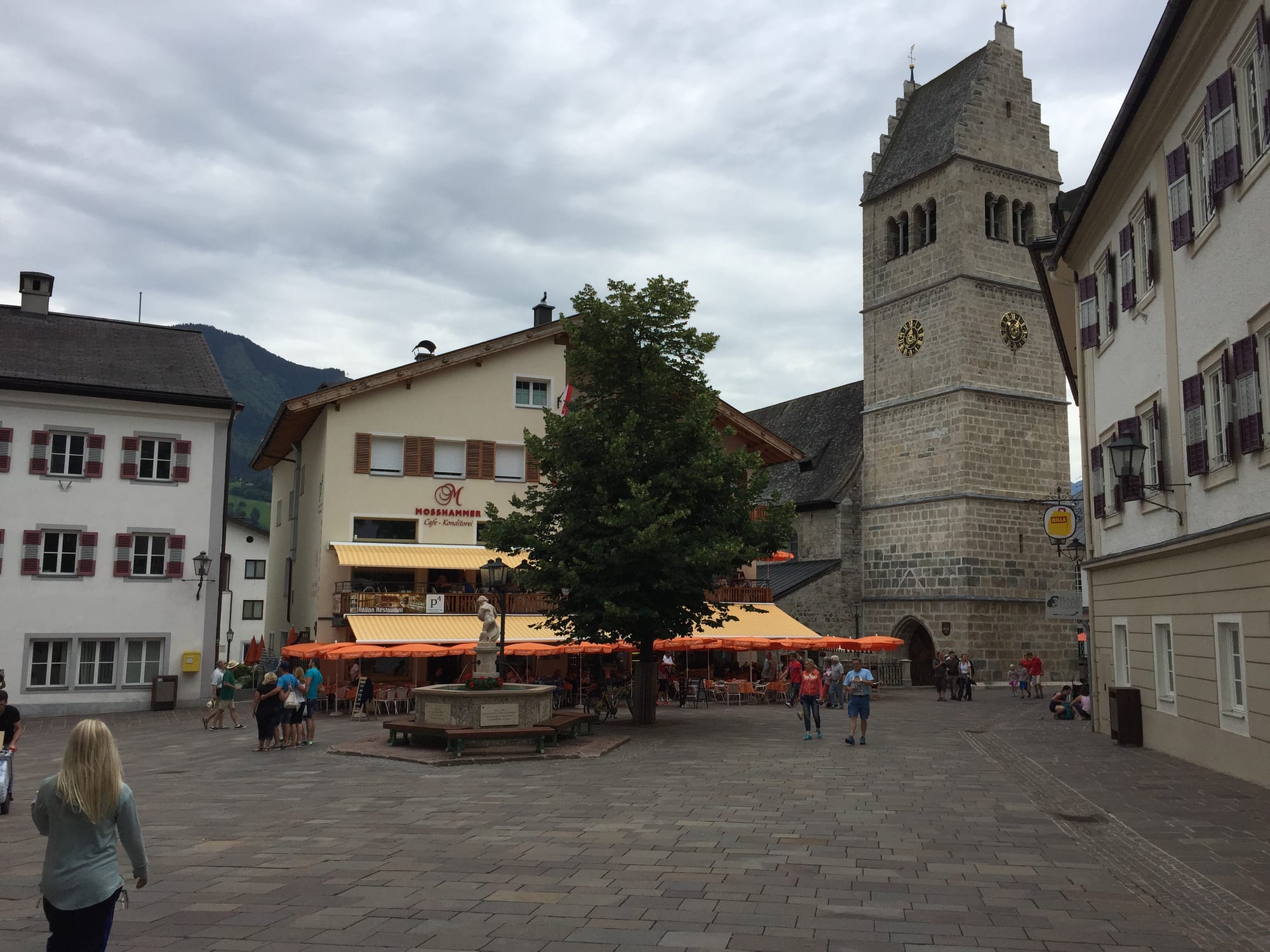
A paved town square with a fountain, café umbrellas and white houses beside a tall stone church tower

Salzburg & Upper Austria, Austria

Zell am See

The Stadtplatz in the centre of Zell am See, with the tower of St. Hippolytus Church. (Piotr Michalak / Wikimedia Commons · CC BY-SA 4.0)

A lake and ski town in the Pinzgau, on the alluvial fan of the Schmittenbach on the western shore of Lake Zell, below the Schmittenhöhe, about 30 kilometres north of the Grossglockner. Founded by monks around 740 and opened up by the railway in 1875, it grew from an aristocrats' summer retreat into one of Austria's leading year-round resorts, closely linked with the Porsche family.

Neighbourhoods

  • The town centre
    • First-time visitors
    • Close to public transport
    • Lakeside

    The old town on its peninsula on the western shore of the lake, with the Romanesque church of St. Hippolytus, Rosenberg Castle, the Vogtturm and a pedestrian zone created in the 1960s and 1970s. The railway station and the Postplatz bus station are here, and the lakeside promenade runs along its edge.

    Open in Maps
  • Schmitten
    • Skiing
    • Hiking

    The slopes above the town proper, where many of the cable cars start for the Schmittenhöhe. In winter skiers stay here for quick access to the lifts; in summer the same lifts carry walkers up the mountain.

    Open in Maps
  • Thumersbach
    • Quiet and residential
    • Lakeside
    • Views

    An affluent district and lakeside resort on the eastern shore, linked to the centre by ferries across the lake. It looks back across the water to the town and the Schmittenhöhe, and includes the summer resort of Prielau in the north.

    Open in Maps
  • Schüttdorf
    • Local life
    • Budget stays

    The part of town directly south of the centre, at the shallower southern end of the lake, on the road towards Kaprun and the Salzach valley.

    Open in Maps
  • Bruckberg
    • Quiet and residential

    A residential area of the town, including the Zellermoos locality.

    Open in Maps

Things to do

The town

  • St. Hippolytus Churchlandmark

    The mostly Romanesque three-naved church holding the oldest known building remains in the Pinzgau, with a carved gallery of 1514 on marble columns and a 36-metre tower that dominates the skyline.

    Open in Maps
  • Vogtturmmuseum

    With the church, the oldest building in the town, now the town museum with exhibitions on five floors.

    Open in Maps
  • Rosenberg Castlelandmark

    A castle in the town centre with four corner towers and a round central tower, seat of the mayor and town council since 1970.

    Open in Maps
  • Elisabethparkpark

    The lakeside park in the centre, saved from being built on by Mayor Josef Wisgrill amid the conflicts over the railway's double-track extension.

    Open in Maps

Lake and mountain

  • Lake Zellpark

    A clear lake about 4 kilometres long, used for swimming, diving and electric boats in summer, with ferries to Thumersbach; in winter it freezes over and is used for winter sports.

    Open in Maps
  • Schmittenhöheviewpoint

    The town's own 1,965-metre mountain, reached by cable car since 1927, and the town's main ski area.

    Open in Maps

Short trips from the town

  • Kaprunattraction

    The neighbouring resort that shares the Zell am See-Kaprun ski area, with year-round access to the Kitzsteinhorn.

    Open in Maps
  • Kitzsteinhornviewpoint

    A 3,203-metre peak of the Glockner Group whose glaciers hold a ski area open most of the year, included in the local ski pass.

    Open in Maps
  • Grossglockner High Alpine Roadviewpoint

    Austria's highest surfaced pass road, a toll route built for its scenery, climbing from Bruck past the Fuscher Törl to the Hochtor at 2,504 metres.

    Open in Maps
  • Hohe Tauern National Parkpark

    By far the largest of Austria's national parks and the largest nature reserve in the Alps, with glaciers, glacial valleys, tundra and forests.

    Open in Maps
  • Saalbach-Hinterglemmattraction

    A ski municipality in the next valley north-west, part of a network of 270 kilometres of slopes.

    Open in Maps
  • Krimml Waterfallsviewpoint

    The highest waterfalls in Austria, falling 380 metres in total on the Krimmler Ache in the Hohe Tauern National Park.

    Open in Maps

Seasonal events

  • International Porsche Dayssummer

    A gathering hosted each summer by the Porsche family together with the town.

  • Greger Porsche Ice Racewinter

    A motor race on ice held in winter since 1952, hosted by the Porsche family and the town.

  • Trasslaufwinter

    An alpine ski race on the Trass, the steepest piste in the area, held since 1951.

Eat and drink

Long-standing places and food districts in Zell am See. Hours, ratings and directions come from your maps app, always current.

Zell am See classics

  • Cafés of the Stadtplatzcafe

    Café terraces and pastry shops on the square around the town fountain and church tower in the pedestrian centre.

    Open in Maps
  • Restaurants of the old townneighborhood

    Traditional Austrian inns and restaurants in the lanes of the pedestrian zone.

    Open in Maps
  • Mountain huts on the Schmittenhöherestaurant

    Restaurants and huts on the town's mountain, serving skiers in winter and walkers in summer with views over the lake.

    Open in Maps

Experience Zell am See

History

The valley around Lake Zell has been inhabited at least since Roman times. Around 740, on the orders of Bishop John I of Salzburg, monks founded a settlement here; a deed of 743 calls it Cella in Bisonzio — Cella for a monastic cell, Bisonzio for the Pinzgau. Zell received market rights in 1357. The area saw heavy fighting in the German Peasants' War of 1526, and two centuries later many Protestant inhabitants were expelled on the orders of Archbishop Firmian. French troops occupied the town in the Napoleonic Wars, and in 1816 it passed to Austria for good. In 1850 its mayor won the district seat away from Saalfelden.

The opening of the Salzburg–Tyrol railway on 30 July 1875 began the summer tourist season. Empress Elisabeth climbed the Schmittenhöhe in 1885 and Franz Joseph visited in 1893; the cable car up the mountain followed in 1927, and Zell became a town in 1928. The First World War took 62 of its 270 conscripts. Under Nazi rule the town saw deportations, forced labour and Aryanisation; in 1939 Ferdinand Porsche bought the Schüttgut estate, and near the end of the war evacuated military headquarters were set up in the area. American troops arrived in 1945.

After the war came rebuilding, new lifts and lake shipping, interrupted in June 1966 by a catastrophic storm, when the Schmittenbach burst its banks. The pedestrian zone and the restoration of Rosenberg Castle date from the 1960s and 1970s, and the Schmitten Tunnel, opened in 1996, took traffic out of the centre.

Culture & Customs

Zell's culture is that of a resort with deep roots. Since the 19th century it has drawn aristocrats — Empress Elisabeth, Franz Joseph and the von Trapp family among them — and today it is known as a meeting place of the international jet set. The Porsche family, whose estate is in the town, have shaped that image: they have run the local airport since 2001, completed a congress centre named after Ferry Porsche in 2007, and with the town host the International Porsche Days each summer and the Greger Porsche Ice Race, held since 1952, in winter.

Skiing is part of local identity. The town has hosted the Austrian Alpine Ski Championships, the Academic World Winter Games of 1937 and Alpine World Cup races, and the Trasslauf has been run on its steepest slope since 1951. The Zeller Seefest, a municipal folk festival held since 1875, celebrates the lake, and since 2012 an Ironman 70.3 triathlon has been held with neighbouring Kaprun.

The town's guests have become more international. Alongside Vienna, Zell am See is one of the most popular Austrian destinations for Arab visitors, and families from Kuwait and the United Arab Emirates stay for weeks to escape the summer heat at home.

Daily Life

Zell am See had 10,217 inhabitants at the start of 2026. It is the administrative capital of its district and an important transport hub for the region, with the Tauernklinikum hospital in Thumersbach, rebuilt in the 1970s and modernised between 2010 and 2021. Andreas Wimmreuter of the Social Democrats has been mayor since 2019.

Tourism dominates the economy. Between November 2022 and October 2023 the town recorded 2.79 million overnight stays, almost as many in summer as in winter, and with Kaprun it forms one of Austria's most important tourist regions.

Daily life follows the two seasons. In winter the ski buses run from Postplatz and the lake freezes; in summer residents swim, sail electric boats and walk the mountains. The challenges of a low-lying ski area in a warming climate, where snow cover on the Schmittenhöhe can suffer in mild spells, are a recurring concern, as was flood protection, addressed by the largest flood defence project in Salzburg state, begun in 2017.

Food

Zell am See eats like the rest of alpine Austria. Its restaurants serve Austrian cooking, which is known internationally for meat dishes such as the Wiener schnitzel, traditionally made of veal, and for pastries such as Kaiserschmarrn, a lightly sweetened, fluffy shredded pancake, and apple strudel. Dumplings appear in many dishes, from Semmelknödel served with goulash to Germknödel, a yeast dumpling filled with plum jam, and sauerkraut accompanies smoked and roast pork.

Coffee and cake are an institution in the pastry shops and cafés around the Stadtplatz. Austrian cakes and pastries are a well-known feature of the national cuisine: apple strudel, Topfenstrudel filled with sweetened curd cheese, and Sachertorte, a chocolate cake with apricot jam, eaten with a Melange — half Mokka, half heated milk — or a kleiner Brauner, Mokka with milk. One hotel in the centre keeps a wine cellar said to be 600 years old. Austrian wine is mostly dry and white, often from Grüner Veltliner, and about 30 per cent is red, from Blaufränkisch, Pinot noir and Zweigelt.

Mountain restaurants on the Schmittenhöhe and the Kitzsteinhorn feed skiers in winter and walkers in summer, and in summer the cafés and restaurants along the lakeside promenade fill with guests from many countries.

Planning tools

Budget

Zell am See is a prosperous resort, and prices peak at Christmas, in February and in high summer, when long-staying guests from the Gulf fill the lakefront. Parking in the centre is scarce and charged by day. A ski pass covers the whole Zell am See-Kaprun area, including the glacier, and gives free use of the local Postbuses.

Daily Budget Midrange
USD 190–340 (mid-range hotel or Gasthof, restaurant dinners, a cable car or day's ski pass, a lake boat)
Daily Budget Shoestring
USD 90–140 (private room or apartment, supermarket and bakery food, Postbuses and the train)

Come by train: the station is in the centre, and a ski pass makes the buses to Kaprun and the lifts free.

Best Time to Visit

December to March for skiing, though the low-lying Schmittenhöhe can suffer in warm spells and the Kitzsteinhorn glacier is the reliable option. June to September for swimming in the lake, walking and the Grossglockner road. The resort now records almost as many overnight stays in summer as in winter.

Suggested Number of Days

Two or three days cover the town, the lake and the town mountain. Most visitors stay a week, for skiing or for walking and drives in the Hohe Tauern, and the length of a winter stay is usually set by the ski pass.

First Visit
2–3 days
With Surroundings
5–7 days

Transportation

The centre is walkable. Postbuses leave from Postplatz for the Schmittenhöhe lifts, Kaprun and the Kitzsteinhorn, and are free with a lift pass. Ferries cross the lake to Thumersbach. A car is useful for the Grossglockner road and the side valleys, but parking in town is limited and paid during the day.

Use the free ski bus rather than driving to the lifts; car parks at the cable cars may not be used overnight.

Airport & Station Connections

Zell am See station, in the town centre, is on the main line from Salzburg, about 80 kilometres away and roughly 90 minutes by the hourly train, and has connections to Innsbruck via St. Johann in Tirol and Wörgl. Salzburg Airport is the usual airport, with a few direct buses a day. The town also has its own small airfield, in use since 1934.

Walkability

The town centre and lakeside promenade are compact and largely pedestrian, and the station is in the middle of town. The lifts at the edge of the centre are within walking distance of much of the old town, and paths circle parts of the lake; Thumersbach is easiest by ferry.

Safety

Austria is very safe, with low levels of violent crime. In Zell am See the risks are those of the mountains — fast-changing weather, afternoon thunderstorms, and avalanches off-piste — and of the lake, whose water stays chilly. A severe storm struck the town in 1966, and large flood defences have been built since 2017.

Check avalanche and weather bulletins, stay on marked pistes and trails unless experienced, and leave word of the planned route before heading into the mountains. Check current official travel advice before travelling.

Climate

An alpine valley climate with cold winters and plenty of precipitation, which often falls as snow in winter. Rain can be expected all year.

Summer
warm and showery, with days of about 22–28°C in Salzburg to the north and afternoon thunderstorms in the mountains
Winter
cold, around -4 to 3°C in the nearest cities, with snow in the valley

Local Customs

Zell am See mixes alpine Austrian life with an international clientele; families from Kuwait and the United Arab Emirates spend up to six weeks here in summer. Catholic tradition and courtesies such as the use of titles still matter, and shops close by early evening and on Sundays.

Respect private property and grazing land on mountain walks, and leave gates as they were found.

Common Payment Methods

The currency is the euro. Cards and contactless are accepted in most places, but small cafés, bakeries and mountain huts often prefer or require cash.