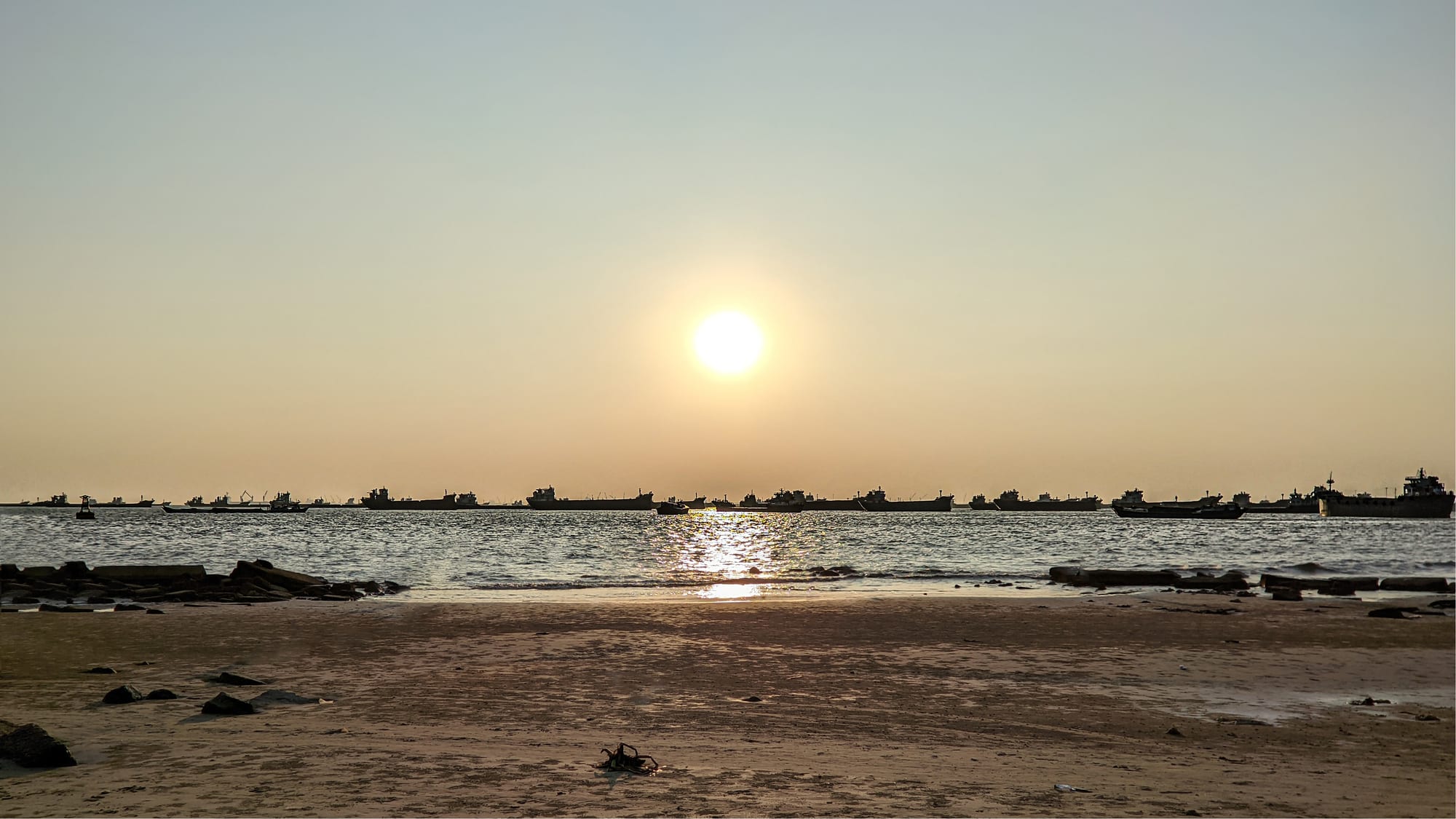
The sun low over the Bay of Bengal at Patenga, with a line of anchored cargo ships on the horizon and wet sand and stones in the foreground

Chittagong, Sylhet & the East, Bangladesh

Chittagong

Ships at anchor off Patenga beach at the mouth of the Karnaphuli, on the southern edge of Chittagong. (Nafiur14 / Wikimedia Commons · CC BY 4.0)

Bangladesh's second city and its main seaport, set where the Karnaphuli river meets the Bay of Bengal on a line of low green hills. A trading port for more than a thousand years, known to the Portuguese as Porto Grande, it now handles most of the country's seaborne trade and serves as the gateway to the Chittagong Hill Tracts and the coast road south.

Neighbourhoods

  • Agrabad
    • First-time visitors
    • Business district
    • Close to public transport

    The commercial centre laid out in the 1960s between the old city and the port, with banks, shipping and freight offices, several of the larger hotels and a wide main road. It is convenient rather than pretty, and busy from early morning.

    Open in Maps
  • Kotwali and Anderkilla
    • Historic district
    • Markets
    • Local life

    The oldest part of the city, on and around the low hill where the Mughal fort once stood. Anderkilla's Shahi Jame Mosque, the court building on its ridge, and the crowded wholesale lanes of Riazuddin Bazar and Khatunganj are all here.

    Open in Maps
  • Chawkbazar
    • Best for food
    • Students
    • Shopping

    A dense market and student quarter below Chittagong College, full of clothing shops, bookshops, tea stalls and cheap kitchens. The streets are narrow and the traffic constant, but this is where much of the city eats out.

    Open in Maps
  • GEC Circle and Nasirabad
    • Best for food
    • Modern hotels
    • Shopping

    The modern centre of gravity, a roundabout surrounded by shopping centres, restaurants, coffee shops and hotels, with the quieter residential streets of Nasirabad and Panchlaish behind it.

    Open in Maps
  • Khulshi
    • Quiet and residential
    • Views

    A hillside district of embassies, consulates, private universities and large houses north of the centre, with trees, slopes and views over the city. It is the calmest of the central neighbourhoods.

    Open in Maps
  • Patenga and Halishahar
    • Beaches
    • Sunsets
    • Families

    The strip along the coast south of the port, where the Karnaphuli meets the sea. Patenga's beach, the Marine Drive road and the naval and airport areas draw large crowds of city families in the late afternoon.

    Open in Maps

Things to do

Mosques and shrines

  • Andarkilla Shahi Jame Mosquelandmark

    A Mughal mosque built in 1667 on the Ander-Qila hill, under the governorship of Shaista Khan and at the direction of his son Buzurg Umed Khan, as a monument of the conquest of the city.

    Open in Maps
  • Chandanpura Mosquelandmark

    A much-photographed mosque on Sirajuddaula Road near Chawkbazar, also known as Masjid-e-Siraj ud-Daulah, its many small domes and minarets painted in strong colours.

    Open in Maps

Museums, memorials and sport

  • Ethnological Museummuseum

    The country's main museum of its ethnic groups, with displays on the peoples of the Chittagong Hill Tracts and other communities.

    Open in Maps
  • Zia Memorial Museummuseum

    The old circuit house of 1913, where President Ziaur Rahman was assassinated in 1981, now a museum devoted to him.

    Open in Maps
  • Chittagong War Cemeterylandmark

    A walled Commonwealth cemetery of the Second World War, holding graves of servicemen from the Burma campaign in quiet terraced gardens.

    Open in Maps
  • Bir Shreshtho Flight Lieutenant Matiur Rahman Cricket Stadiumattraction

    The city's international cricket ground, a Test venue since 2006 and known for years as the Zahur Ahmed Chowdhury Stadium until it was renamed in 2025.

    Open in Maps

Hills, lakes and the sea

  • Patenga Beachbeach

    A stretch of dark sand and stone breakwaters at the river mouth, lined with food stalls and busy at sunset, with cargo ships waiting offshore.

    Open in Maps
  • Foy's Lakepark

    A lake made in the 1920s by damming a stream for the railway, set among wooded hills north of the centre, with boats and an amusement park.

    Open in Maps
  • Karnaphuli Riverattraction

    The river that made the city, running down from the hills past the wharves and ferry ghats to the sea, crossed by bridges and busy with lighters and country boats.

    Open in Maps
  • Batali Hillviewpoint

    The highest hill within the city, near Tiger Pass, climbed for a wide view over the rooftops towards the port and the sea, with an eternal flame commemorating the war dead of 1971.

    Open in Maps

Short trips from the city

  • Chandranath Templelandmark

    A Hindu temple on a steep hill above Sitakunda, north of the city, reached by a long stairway and an important pilgrimage site.

    Open in Maps
  • Chittagong ship-breaking yardsattraction

    The beaches north of the city at Sitakunda where ocean-going ships are dismantled by hand; the yards themselves are closed to casual visitors, but the coast road passes them.

    Open in Maps
  • Kaptai Lakeattraction

    The large reservoir created by the Kaptai dam in the hills east of the city, crossed by boats between villages and Buddhist temples.

    Open in Maps
  • Rangamatiattraction

    The lakeside town at the centre of the Chittagong Hill Tracts, reached by a winding road; foreigners need permits for the hill districts and some areas are closed.

    Open in Maps

Seasonal events

  • Jabbarer Boli KhelaApril

    A wrestling contest held at Laldighi in the old city since the early 20th century, with a large street fair around it.

  • Pohela Boishakhmid-April

    The Bengali new year, marked with morning processions, fairs and music across the city.

  • Eid al-Fitr and Eid al-Adhadates move through the year with the Islamic calendar

    The two main Muslim festivals, when mass prayers fill the eidgahs and mosques and much of the port city stops for several days.

  • Durga Pujaautumn, September or October

    The principal Hindu festival, celebrated at pavilions across the city and in the temples of the old quarter.

  • Buddha PurnimaApril or May

    The Buddha's birth, enlightenment and death, observed by the city's Barua Buddhist community at its temples and monasteries.

Eat and drink

Long-standing places and food districts in Chittagong. Hours, ratings and directions come from your maps app, always current.

Chittagong classics

  • Mezbani beef houses of the old cityneighborhood

    Kitchens around the old quarter serving mezbani gosht, the fiery beef stew cooked for communal feasts, usually with plain rice.

    Open in Maps
  • Kala bhuna kitchensneighborhood

    Small restaurants across the centre known for kala bhuna, beef fried slowly with spices until it turns almost black, a dish that belongs to this city.

    Open in Maps

Food districts and markets

  • Chawkbazar street foodneighborhood

    Student-priced kitchens, tea stalls and fried snacks around the college, at their busiest in the evening and during Ramadan.

    Open in Maps
  • GEC Circle restaurantsneighborhood

    The modern eating district, with Bengali dining halls, kebab and biryani houses, Chinese and Thai restaurants and coffee shops.

    Open in Maps
  • Fishery Ghatmarket

    The wholesale fish landing on the Karnaphuli, where the night's catch is auctioned from dawn, along with racks of shutki, dried fish.

    Open in Maps
  • Khatunganjmarket

    One of the country's largest wholesale commodity markets, dealing in rice, pulses, sugar, spices and cooking oil in a warren of old warehouses.

    Open in Maps

Experience Chittagong

History

Chittagong has been a harbour for well over a thousand years, mentioned by Arab geographers and used by traders sailing between Bengal, Arakan and the ports of the Indian Ocean. Control shifted repeatedly between the sultans of Bengal and the Arakanese kingdom to the south. The Portuguese arrived in the 16th century and called it Porto Grande, the great port of Bengal; Portuguese and Arakanese raiders preyed on the delta until the Mughal governor Shaista Khan took the city in 1666 and renamed it Islamabad. The East India Company acquired it in the later 18th century and the modern port, railway and jute and tea trades grew from there.

The city has a place in the independence story out of proportion to its size. In April 1930 Surya Sen and a group of young revolutionaries seized the British armoury here in a raid that became famous across India. During the Second World War the city was a supply base for the Burma front, and the Commonwealth war cemetery holds the dead of that campaign. In late March 1971 the declaration of Bangladesh's independence was broadcast from the Kalurghat radio station on the edge of the city, and the port and its hills saw heavy fighting in the months that followed.

Since independence the port has driven everything. An export processing zone opened in 1983, drawing garment factories, and steel, cement and shipbreaking followed along the coast. The cyclone of April 1991 killed well over a hundred thousand people in the coastal districts and damaged the port badly. The city's official English name was changed to Chattogram in 2018, though Chittagong remains in common use.

Culture & Customs

Chattogram thinks of itself as a place apart, and its speech proves the point: Chittagonian differs so far from standard Bengali that many linguists count it a separate language, and outsiders rarely follow a conversation. The city is commercial, devout and proud, with a strong tradition of Sufi shrines and of merchant families whose names appear on mosques, schools and hospitals.

Its best-known institution is the mezban, a communal feast at which beef cooked in enormous pots is served to hundreds or thousands of guests, seated in rows and fed in shifts, to mark a death anniversary, a birth or a public occasion. Hospitality is measured by it. The other great local event is the Jabbarer Boli Khela, a wrestling tournament held at Laldighi on the twelfth day of the Bengali year and popularised in the early 20th century by the merchant Abdul Jabbar, whose surrounding fair fills the old city with stalls selling handicrafts, furniture and plants.

Chittagong also has one of the country's largest Buddhist communities, the Barua, whose monasteries and Vesak processions are part of the city's calendar, alongside Hindu temples and a small Christian presence. The Hill Tracts peoples are present in the city as students, traders and residents, and the Ethnological Museum is the national collection devoted to them. Cricket is followed closely, football has a strong local following, and the sea and the port shape the way people speak about their city.

Daily Life

About three million people live within the city corporation, and more in the built-up area spreading north towards Sitakunda and east along the Karnaphuli. The port is the reason for all of it: container terminals, freight yards, customs houses and shipping agents employ tens of thousands, and the export processing zones, garment factories, steel mills, cement works and oil refineries around them employ many more. Money from the Gulf and from the shipping trade shows in the newer apartment blocks of Khulshi and Nasirabad.

Most people live in dense, low-rise neighbourhoods behind the main roads, and many workers commute in from Hathazari, Sitakunda and the outer upazilas by bus and auto-rickshaw. Rents near the port are high for what they offer, and informal settlements have spread up the sides of the city's hills, where landslides after heavy rain are a recurring and sometimes deadly problem. Waterlogging is the other constant complaint: rain and high tides together put parts of Agrabad and the low ground under water.

The working day starts early, with markets and the fish landing at dawn and offices by nine. Evenings fill the restaurants around GEC Circle and the beach road at Patenga, where families come out for the sunset and fried snacks. Hill cutting, air quality and the pace of port expansion are steady subjects of local argument.

Food

Chittagong's cooking is the spiciest and most meat-heavy in Bangladesh. Mezbani gosht is the city's emblem: beef, including bone and fat, simmered for hours with a heavy hand of chilli, cumin and other spices and served with plain white rice at communal feasts. Kala bhuna, beef fried slowly with onion, ginger and spices until it darkens almost to black, is the everyday version of the same enthusiasm, and both have spread from here to restaurants nationwide.

The sea and the river supply the rest. Fishery Ghat on the Karnaphuli lands prawns, crab, rupchanda and the fish of the season, and racks of shutki, dried fish, are prepared along the coast and cooked as a pungent bhorta with chilli, onion and garlic, or in curry. Loitta shutki, dried Bombay duck, is a particular favourite. Hilsa from the Meghna comes to market fried or in mustard sauce.

Beyond the beef and fish, the city eats rice three times a day, with dal, mashed vegetables and small fish. Chittagong is also known for a strong local tradition of sweets and milk-based puddings, and for the tea grown further inland and drunk everywhere at stalls. Ramadan brings evening street markets selling haleem, fritters and chholabuta, and the Patenga road fills at all seasons with stalls grilling fish, crab and corn.

Planning tools

Budget

Chittagong is a working port city rather than a tourist centre, and prices reflect business travel: hotels in Agrabad and around GEC Circle cost more than their equivalents elsewhere in Bangladesh, while street food, markets and local transport are very cheap. Trips into the Hill Tracts add a car, a guide and permit arrangements.

Daily Budget Midrange
USD 50–100 (business hotel, restaurant meals, car with driver for the coast or the hills)
Daily Budget Shoestring
USD 20–35 (simple hotel, local food, buses and auto-rickshaws)

Hotel rates are aimed at business visitors and can often be negotiated at quiet times; arrange Hill Tracts travel through a local operator who handles permits.

Best Time to Visit

November to February is dry, warm and clear, the best time for the coast, the hills and the beach at Patenga. March to May is hot and increasingly humid, with pre-monsoon storms, and the monsoon from June to September brings heavy rain and waterlogged streets. The coast is exposed to cyclones, most often in April and May and again in October and November.

Suggested Number of Days

Two days are enough for the city's mosques, museums, hills and beach. Four to six allow the Hill Tracts or the coast road south as well, both of which involve slow roads and, for the hill districts, permits arranged in advance.

First Visit
2 days
With Surroundings
4–6 days

Transportation

Cycle rickshaws, auto-rickshaws and crowded local buses cover the city, and ride-hailing apps work here. Traffic is heavy and slow, particularly on the port roads and around Agrabad, though flyovers and the elevated expressway towards Patenga have eased some routes. Cars with drivers are the usual choice for the coast, Sitakunda or the hills.

Agree rickshaw and auto-rickshaw fares before setting off, and allow far more time than the distance suggests when crossing the city in the morning or early evening.

Airport & Station Connections

Shah Amanat International Airport sits beside the sea in the Patenga area, about 20 kilometres from GEC Circle, with frequent flights from Dhaka taking under an hour and services to the Gulf and other regional hubs. Trains from Dhaka take roughly six hours, and the Dhaka–Chattogram highway, about 250 kilometres, carries a constant stream of buses and freight lorries. Trains and buses continue south to Cox's Bazar.

Walkability

Individual quarters are walkable — the old town around Anderkilla, the markets of Chawkbazar, the beach promenade at Patenga — but the city as a whole is not. Distances are long, the ground is hilly, pavements are often occupied by stalls or parked vehicles, and crossing the main roads takes patience. Most people move between districts by rickshaw or car.

Safety

Chittagong is generally safe for visitors, with petty theft in crowded markets and on buses the main crime risk. Traffic is the real danger, and the port roads carry heavy lorries day and night. Political demonstrations and strikes can block roads at short notice. Monsoon rain causes serious waterlogging, and the coast is exposed to cyclones during the storm seasons.

Foreigners need permits for the Chittagong Hill Tracts, some areas are closed, and travel there is best arranged through a local operator; swim with care on the open coast, where currents are strong. Check current official travel advice before travelling.

Climate

A tropical monsoon climate, humid all year and moderated a little by the sea. Most of the rain falls between June and September, and the city is one of the wetter parts of the country; the winter months are dry and comfortable, and cyclones can strike the coast in spring and autumn.

Summer
hot, humid and very wet, about 26–32°C, with heavy monsoon rain from June to September
Winter
dry and mild, about 15–28°C, with sunny days and cool evenings

Local Customs

The city is devout and fairly conservative, though used to foreign visitors through the port. Modest dress is expected, shoes are removed at mosques, temples and homes, and non-Muslims should ask before entering a shrine. The right hand is used for eating and giving. Alcohol is not generally available outside a few hotels. Invitations to a meal, above all to a mezban, are a serious mark of hospitality.

Ask before photographing people, and do not photograph the port, naval areas or the ship-breaking yards, where security is strict.

Common Payment Methods

The currency is the Bangladeshi taka. Cash runs daily life, and ATMs are easy to find in Agrabad, GEC Circle and Khulshi, though not every machine takes foreign cards. Hotels, shopping centres and larger restaurants accept cards; markets, rickshaws and small kitchens do not. Mobile payment services are widely used by residents.