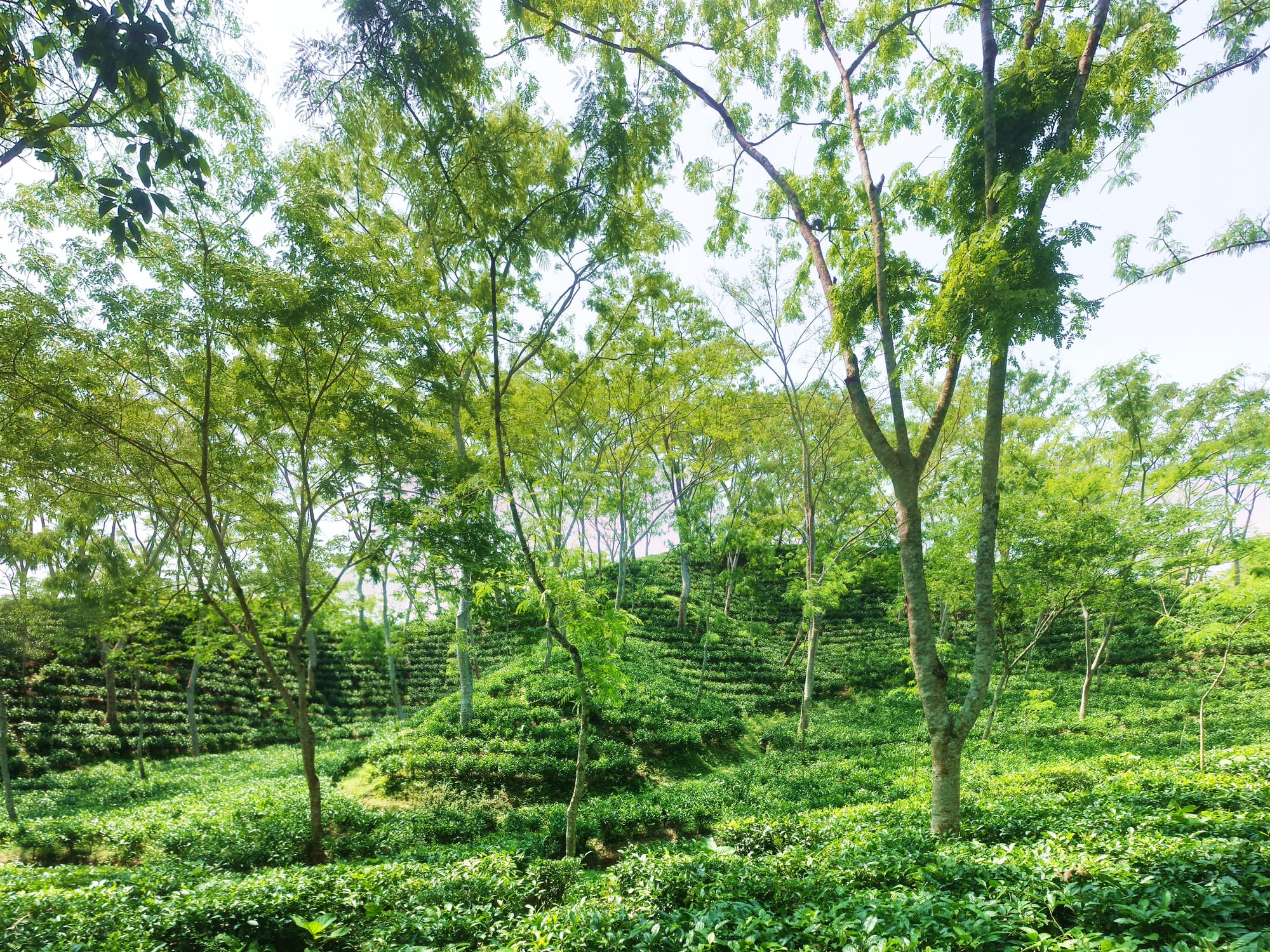
Terraced rows of low green tea bushes climbing a hillside beneath tall feathery shade trees

Chittagong, Sylhet & the East, Bangladesh

Sreemangal

Tea bushes and shade trees on a hillside estate at Sreemangal. (Mar11 / Wikimedia Commons · CC BY-SA 4.0)

A small town in Moulvibazar district, in the hills of Sylhet division, surrounded by the largest concentration of tea estates in Bangladesh. Planting began here in the 19th century, and the town grew as the trade's market and railway stop. It is now the country's main base for tea country, the forest of Lawachara and the wetlands of Hail Haor.

Neighbourhoods

  • Town centre and the bazar
    • First-time visitors
    • Best for food
    • Close to public transport

    A few busy streets around the railway station, the bus stand and the main market, with tea shops, grocers and simple hotels. Almost everything in the town is within ten minutes' walk, and shared jeeps and auto-rickshaws leave from here for the estates and the forest.

    Open in Maps
  • Radhanagar and the resort road
    • Quiet and residential
    • Tea gardens
    • Families

    The road north-east of the town towards Bhanugach, where most of the tea-country guesthouses, eco-resorts and cottages stand among gardens and rubber plantations. It is quiet, green and dark at night, with restaurants attached to the hotels.

    Open in Maps
  • The tea estate villages
    • Local life
    • Walks

    Labour lines and villages spread through the estates around the town, where the tea workers' communities live, many descended from labourers brought from central India in the 19th century. Roads run between the bushes and the shade trees, and walking or cycling among them is the main pleasure of a stay.

    Open in Maps
  • Khasia punjis
    • Local life
    • Hill walks

    Small Khasi settlements on the wooded hills near Lawachara, where families grow betel leaf up the trunks of forest trees. Visits are made with a local guide and by agreement with the village headman.

    Open in Maps

Things to do

Forests and wildlife

  • Lawachara National Parkpark

    A patch of semi-evergreen hill forest about eight kilometres from the town, declared a national park in 1996 and crossed by walking trails, best known for holding the largest surviving population of hoolock gibbons in Bangladesh, heard more often than seen.

    Open in Maps
  • Satchari National Parkpark

    A smaller forest in Chunarughat, in Habiganj district west of the town, declared a national park in 2005, with short trails, hoolock gibbons and a Tipra village inside it.

    Open in Maps

Tea country and water

  • Bangladesh Tea Research Instituteattraction

    The national tea research institute, an autonomous body under the Bangladesh Tea Board, with experimental gardens on the edge of the town.

    Open in Maps

Short trips from the town

  • Madhabkundaattraction

    One of the highest waterfalls in the country, dropping over a rock face at Barlekha in the east of Moulvibazar district.

    Open in Maps
  • Hakaluki Haorattraction

    One of the largest wetlands in the country, east of the town, which floods into a shallow inland sea in the monsoon and draws great numbers of migratory birds in winter.

    Open in Maps
  • Moulvibazarneighborhood

    The district town north-east of Sreemangal, a market centre for the tea estates with a bazar, mosques and bus links across the division.

    Open in Maps
  • Rema-Kalenga Wildlife Sanctuarypark

    A tract of hill forest at Chunarughat in Habiganj, next to the Tripura border, protected since 1982 and among the better preserved natural forests in the country, with a wider range of wildlife than the parks nearer the town.

    Open in Maps

Seasonal events

  • Pohela Boishakhmid-April

    The Bengali new year, marked in the town with fairs, music and processions.

  • Eid al-Fitr and Eid al-Adhadates move through the year with the Islamic calendar

    The two main Muslim festivals, when the town's hotels fill with domestic visitors and the bazar closes for several days.

  • Durga Pujaautumn, September or October

    The main Hindu festival, celebrated in the town and in the estate villages, where the tea workers' communities are largely Hindu.

  • Manipuri Raas LeelaNovember, at the full moon

    The Manipuri community of Kamalganj, east of the town, keeps the Raas Leela dance-drama of the life of Krishna, performed at the full moon of the Bengali month of Kartik.

Eat and drink

Long-standing places and food districts in Sreemangal. Hours, ratings and directions come from your maps app, always current.

Tea and tea cabins

  • Tea cabins on the station roadcafe

    Small stalls serving the seven-layer tea the town is famous for, in which teas of different density are poured so that they settle in separate bands in the glass, along with plain strong milk tea.

    Open in Maps
  • Tea estate factory shopscafe

    Shops in the town selling loose leaf from the surrounding gardens, from everyday dust grades to orthodox leaf, usually with a glass of tea to taste.

    Open in Maps

Town kitchens and markets

  • Sreemangal bazarmarket

    The daily market for fish from the haor, pineapple, lemons, betel leaf and vegetables grown on the hills, busiest in the early morning.

    Open in Maps
  • Station road restaurantsneighborhood

    Plain rice-and-curry kitchens around the station and bus stand, serving river fish, beef cooked with satkora and seasonal vegetable bhortas.

    Open in Maps

Experience Sreemangal

History

Sreemangal exists because of tea. Commercial planting began in the Sylhet region in the 1850s, and the low hills of Moulvibazar, with their rain, drainage and shade trees, proved ideal; within a generation estates covered much of the district. The planters, mostly British companies, could not recruit enough local labour, and brought workers from central and eastern India — Chhota Nagpur, Odisha, Chhattisgarh and the Madras Presidency — in the 19th and early 20th centuries. Their descendants still make up the estate communities, speaking their own languages alongside Bengali.

The railway from Chittagong and Dhaka to Sylhet, built in the colonial period, gave the tea its route to the ports and made the small market town at Sreemangal into the trade's local centre, with brokers, warehouses and a station that still sits at the middle of the town. Government research into tea cultivation was established nearby, and the town became the recognised capital of Bangladeshi tea.

Labour history runs through the same ground. In 1921 thousands of tea workers walked out of gardens in the Sylhet region and set off for their home districts, an exodus remembered as one of the earliest organised labour movements in the region. Low wages, housing and land rights on the estates have remained contested ever since, and a wage strike across the tea sector in 2022 brought the gardens to a standstill. Since the late 20th century the town has gained a second livelihood in tourism, with resorts along the Bhanugach road and a steady flow of Bangladeshi visitors.

Culture & Customs

Few places in Bangladesh hold so many communities in so small an area. The estate villages are home to people whose ancestors came from central and southern India, keeping festivals, songs and languages that belong nowhere else in the country. Khasi families, related to the Khasi of Meghalaya across the border, live in punjis on the forested hills and grow betel leaf on the trees; they are matrilineal, with property passing through the youngest daughter. The Manipuri of Kamalganj, further east, are known for their weaving and for a classical dance tradition performed at the November full moon.

Religion is mixed. Muslim villages surround the town, the estate communities are largely Hindu, and the Khasi are mostly Christian, with churches among the gardens. Temples, mosques and chapels can stand within a few kilometres of each other, and each community's festivals are watched by the others.

Tea itself is a social institution rather than a drink. It is taken sweet and milky at stalls that double as village meeting places, and Sreemangal's tea cabins draw visitors from across Bangladesh for the layered tea invented here. Visitors are treated with warmth and considerable curiosity, and conversation turns quickly to where they are from and how the tea compares with home.

Daily Life

The upazila has more than 360,000 residents, of whom only a fraction live in the town itself; the rest are in villages and estate labour lines spread through the hills. Tea dominates employment, with plucking done largely by women who carry loads to weighing sheds and factories. Pay in the gardens is low and housing is provided by the estates, an arrangement that keeps families tied to them across generations and is the subject of long-running disputes.

The land does other work too. Rubber and lemon plantations, pineapple and jackfruit, betel leaf from the Khasi hills, and rice and fish from Hail Haor all reach the bazar, and fish from the haor is trucked to Dhaka. Tourism supports hotels, guides, jeep drivers and shops in and around the town, and remittances from the Gulf and Britain support many households, as across Sylhet division.

The day follows the gardens. Workers go out at first light and the weighing is done in the afternoon; the bazar is busiest early, and the town winds down soon after dark, when the estate roads are unlit and quiet. Water is the recurring worry — floods in the haor after heavy rain in the Meghalaya hills, and dry spells that hurt the tea crop — along with the slow conversion of forest and wetland to other uses.

Food

Sreemangal's fame rests on tea. The seven-layer tea, made by pouring teas of different strength and sweetness so that they settle in visible bands, was devised in the town and is now sold at several cabins; ordinary tea here is strong, sweet and milky, drunk in small glasses many times a day. The gardens around the town supply leaf to shops selling everything from fine orthodox grades to the dust used in roadside stalls.

The everyday cooking is Sylheti. Beef or fish is cooked with satkora, a thick citrus whose rind gives a sour, perfumed edge; shutki, dried fish, is pounded into bhorta with chilli and onion; and shidol, a fermented fish preserve, gives a strong note to vegetable dishes. Small fish from Hail Haor, prawns and river fish appear on most menus, and rice is eaten at every meal.

The hills add their own produce. Pineapple and lemons from the plantations are sold at the roadside, jackfruit comes in early summer, and Khasi betel leaf is chewed with areca nut across the district. Winter brings pitha, rice cakes made with date-palm molasses, and the estate communities cook dishes carried from central India by their ancestors, including pork, which is rare elsewhere in the country.

Planning tools

Budget

Sreemangal is cheap outside its resorts. Simple hotels in the town and meals in the bazar cost very little, while the eco-resorts and estate bungalows along the Bhanugach road charge several times as much and fill at winter weekends and the Eid holidays. A hired car or a day's jeep for the forests and the haor is usually the largest single cost.

Daily Budget Midrange
USD 45–95 (tea-country resort or estate cottage, restaurant meals, car with driver and a park guide)
Daily Budget Shoestring
USD 15–30 (simple hotel in town, local food, rickshaws and shared jeeps)

Book resort rooms well ahead for winter weekends and Eid, and hire a guide at the forest office, which is both the rule and the best way to see anything.

Best Time to Visit

October to March is the most comfortable season: dry, mild days, clear views across the gardens and the best months for birds on Hail Haor and Baikka Beel. Plucking runs from about April into the autumn, when the gardens are at their greenest and busiest. June to September brings very heavy rain, leeches on the forest trails and occasional flooding.

Suggested Number of Days

Two days cover the tea gardens and one forest. Three or four allow the wetlands, a second park and the villages, and suit anyone who wants to walk rather than drive. Rain in the monsoon months slows everything down.

First Visit
2 days
With Surroundings
3–4 days

Transportation

The town itself is walked or cycled. Auto-rickshaws and shared jeeps run out along the main roads to the estates, Lawachara and Kamalganj, and cars with drivers can be hired for the day through hotels. Bicycles are available in the town and are the pleasantest way to move between gardens. Roads into the forests and around the haor are rough in the rains.

Agree a price for a full day when hiring a jeep or car, since sights are scattered over a wide area and public transport thins out in the afternoon.

Airport & Station Connections

Trains on the Dhaka–Sylhet line stop at Sreemangal, taking roughly six hours from Dhaka and under two from Sylhet, and the station is in the centre of town. Buses from Dhaka cover about 200 kilometres of highway in five to seven hours. The nearest airport is Osmani International at Sylhet, about 75 kilometres to the north-east.

Walkability

The town is small enough to cross on foot in fifteen minutes, and the estate roads just beyond it are quiet, level and good for walking or cycling. Lawachara and the other parks have marked trails that are muddy and slippery after rain. There are few pavements on the main highway through town, where lorries and buses pass steadily.

Safety

Sreemangal is a calm place with little crime, and foreign visitors are few enough to attract friendly curiosity. The practical risks are on the trails and the roads: leeches and slippery ground in the forest during the rains, snakes, and fast highway traffic. Tea estates are private property, and the haor can flood quickly after heavy rain upstream.

Take a guide from the forest office for Lawachara and Satchari, ask before walking through estate villages or Khasia punjis, and carry insect repellent in the wet months. Check current official travel advice before travelling.

Climate

A humid subtropical climate, wetter than most of Bangladesh because the hills catch the monsoon coming off the Bay of Bengal. Rain falls heavily from June to September, the winter is dry, mild and often misty in the mornings, and the spring months are warm with thunderstorms.

Summer
warm, humid and very wet, about 25–33°C, with heavy rain from June to September
Winter
dry and mild, about 12–27°C, with cool nights in the gardens and morning mist

Local Customs

This is a conservative rural district with a mixed population of Muslims, Hindus, Christians and several Indigenous communities. Modest dress is expected, shoes come off at temples, mosques and in homes, and the right hand is used for eating and giving. Alcohol is not generally sold. Tea workers' villages are homes, not attractions, and should be entered only with an invitation or a local guide.

Ask before photographing people at work in the gardens or in the Khasia and Manipuri villages, and accept tea when it is offered; refusing is taken as a slight.

Common Payment Methods

The currency is the Bangladeshi taka. Cash is needed for almost everything, including guides, jeeps and most small hotels. There are ATMs in the town centre, but they are few and not all take foreign cards, so it is worth arriving with enough cash from Sylhet or Dhaka. Resorts and a handful of larger hotels take cards.