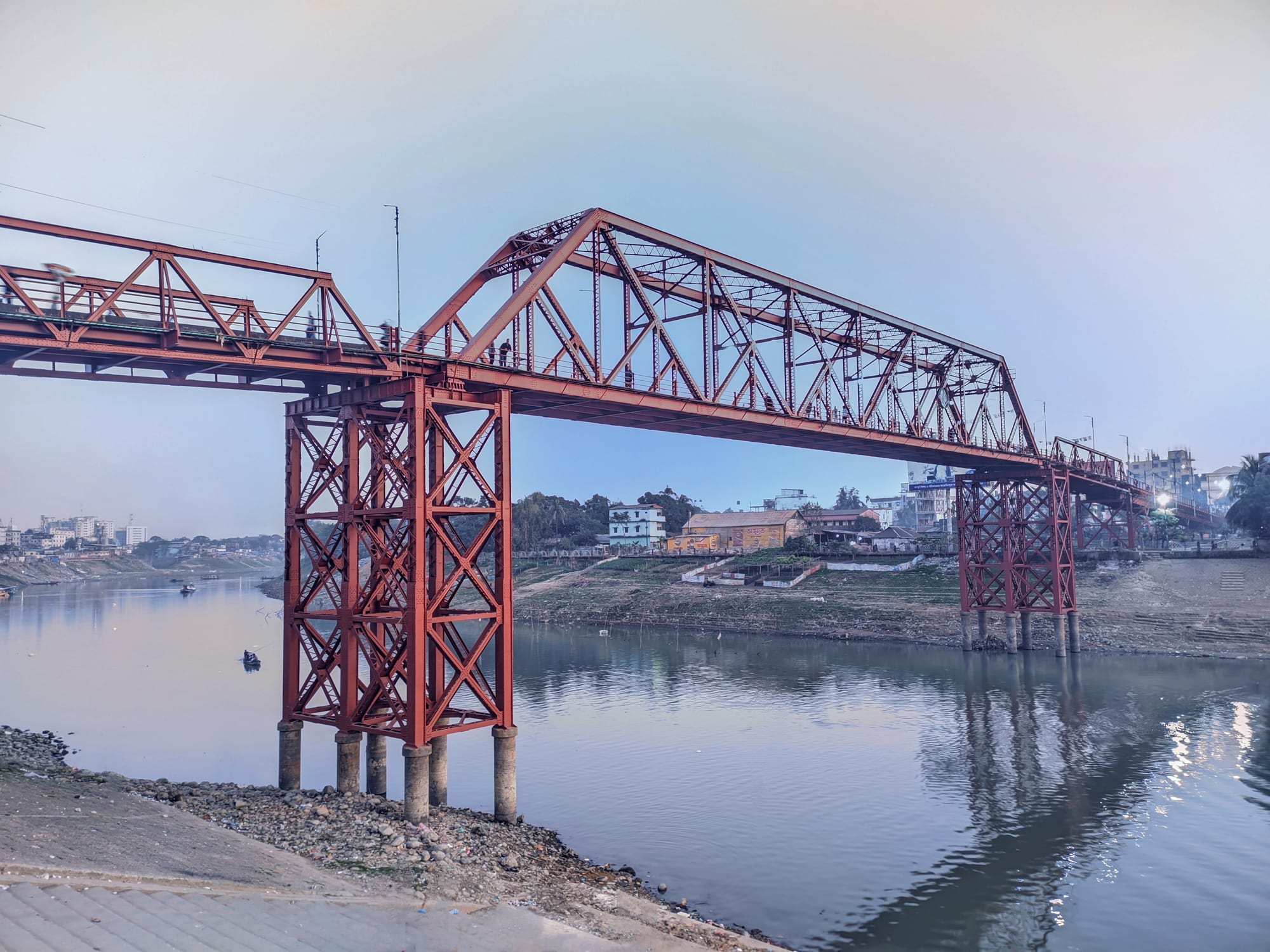
A red steel truss bridge on tall braced piers crossing a calm river at dusk, with the low buildings of a city on the far bank

Chittagong, Sylhet & the East, Bangladesh

Sylhet

Keane Bridge crossing the Surma river in the centre of Sylhet. (Tarunno / Wikimedia Commons · CC BY-SA 4.0)

The main city of north-eastern Bangladesh, spread along the Surma river below the Meghalaya hills of India. It grew around the shrine of the Sufi saint Shah Jalal, became the centre of the country's tea country after planting began in the 19th century, and is now visibly prosperous on money sent home by a large Sylheti diaspora in Britain and the Gulf.

Neighbourhoods

  • Zindabazar
    • First-time visitors
    • Best for food
    • Shopping

    The commercial heart of the modern city, a dense run of shopping centres, clothing shops, banks and large restaurants north of the river. Most of the city's mid-range hotels are here or within a short rickshaw ride, and the streets stay busy late into the evening.

    Open in Maps
  • Bandar Bazar and the Surma riverside
    • Markets
    • Historic district
    • Close to public transport

    The old trading quarter beside the river, where wholesale shops, food stalls and the approaches to Keane Bridge crowd together. Ali Amjad's Clock stands on the riverbank nearby, and boats and sand barges work the Surma below.

    Open in Maps
  • Dargah Mahalla
    • Pilgrimage
    • Local life

    The lanes around the shrine of Shah Jalal on a low hill north of the centre, filled with pilgrims, sweet shops, bookstalls and sellers of caps, rosaries and perfume oils. The atmosphere is devotional rather than commercial, and busiest on Thursday evenings and Fridays.

    Open in Maps
  • Ambarkhana
    • Local life
    • Transport links

    A busy junction north of the shrine where the roads to the airport, Jaflong and Tamabil meet. It is a working residential and market area, useful for buses and shared auto-rickshaws heading out of the city.

    Open in Maps
  • Shahjalal Upashahar
    • Quiet and residential
    • Modern hotels

    A planned residential district south of the river, laid out in numbered blocks with wide streets, new apartment buildings and houses built with money earned abroad. It is calmer than the centre and has a growing number of cafés and restaurants.

    Open in Maps

Things to do

Shrines and landmarks

  • Shrine of Shah Jalallandmark

    The tomb complex of the 14th-century Sufi saint whose followers spread Islam through north-eastern Bengal, still the religious centre of the region and visited by pilgrims from across the country.

    Open in Maps
  • Shahi Eidgahlandmark

    A large terraced open-air prayer ground built on a hillside in the 17th century, under the Mughal governor Farhad Khan, and reached by steps; it is still used for the mass Eid prayers.

    Open in Maps
  • Keane Bridgelandmark

    The steel bridge of 1936 over the Surma, named after Sir Michael Keane, then governor of Assam, treated as the emblem of the city and now given over to pedestrians.

    Open in Maps
  • Ali Amjad's Clocklandmark

    The country's oldest clock tower, put up in 1872 beside the river near Keane Bridge by Nawab Ali Ahmad Khan of Prithimpassa and named after his son.

    Open in Maps

Museums and sport

  • Osmani Museummuseum

    The family home of M. A. G. Osmani, commander of the Bangladeshi forces in 1971, kept as a museum of his papers and possessions.

    Open in Maps
  • Sylhet International Cricket Stadiumattraction

    A ground on the northern edge of the city, ringed by green hills and known for its grass gallery, which has hosted internationals since 2014 and Test cricket since 2018.

    Open in Maps

Tea gardens and green space

  • Malnicherra Tea Estateattraction

    A tea garden on the city's northern edge, established in 1849 and described as the first and largest tea estate in the country.

    Open in Maps
  • Khadim Nagar National Parkpark

    An area of evergreen hill forest a short drive north-east of the city, declared a national park in 2006 and surrounded by tea estates.

    Open in Maps

Short trips from the city

  • Ratargul Swamp Forestattraction

    A freshwater swamp forest in Gowainghat, visited by small boat during the rains when water rises among the trunks.

    Open in Maps
  • Jaflongattraction

    A stretch of shallow, stony river on the Indian border below the Meghalaya hills, where stone is dredged from the riverbed by hand.

    Open in Maps
  • Tanguar Haorattraction

    A large wetland in Sunamganj district, north-west of the city, visited by great numbers of migratory birds in winter.

    Open in Maps
  • Lalakhalattraction

    A wide reach of the Sari river at Jaintiapur, near the Tamabil road, known for water that turns green and turquoise over its limestone bed.

    Open in Maps
  • Madhabkundaattraction

    One of the highest waterfalls in Bangladesh, dropping about 50 metres over a rock face in Barlekha, in the hills of Moulvibazar district to the south-east.

    Open in Maps

Seasonal events

  • Urs of Shah Jalalannually, on dates set by the Islamic calendar

    The commemoration of the saint's death fills the shrine quarter with pilgrims, drumming and communal cooking over several days.

  • Pohela Boishakhmid-April

    The Bengali new year, marked with processions, fairs, music and red-and-white dress.

  • Eid al-Fitr and Eid al-Adhadates move through the year with the Islamic calendar

    The two great Muslim festivals, when mass prayers fill the Shahi Eidgah and much of the city closes for family visits.

  • Durga Pujaautumn, September or October

    The main Hindu festival of Bengal, celebrated at temporary pavilions in several parts of the city.

Eat and drink

Long-standing places and food districts in Sylhet. Hours, ratings and directions come from your maps app, always current.

Food districts

  • Zindabazar restaurantsneighborhood

    The city's main concentration of restaurants, from large Bengali dining halls serving akhni and beef with satkora to grills, biryani houses and fast food aimed at students.

    Open in Maps
  • Bandar Bazarneighborhood

    The older market quarter near the river, with cheap rice-and-curry kitchens, sweet shops and stalls frying pitha and snacks in the late afternoon.

    Open in Maps
  • Dargah Gateneighborhood

    Tea stalls, sweet sellers and small kitchens serving pilgrims around the shrine of Shah Jalal; a place to try strong milky tea and Sylheti sweets.

    Open in Maps

Markets

  • Kalighat wholesale marketmarket

    A riverside wholesale district dealing in spices, tea, dried fish and produce brought in from the haors and hills.

    Open in Maps
  • Lalbazar fish marketmarket

    The city's best-known fish market, where river fish from the Surma and the wetlands are sold each morning.

    Open in Maps

Experience Sylhet

History

Sylhet appears in early records as Srihatta, a trading town on the Surma at the edge of the Bengal plain, where boats met the routes coming down from the hills. Its decisive moment came in 1303, when forces of the Bengal Sultanate took the town; the Sufi saint Shah Jalal, who arrived with them from the west, settled here with his followers, and the region's conversion to Islam is traced to that generation. The Moroccan traveller Ibn Battuta made a month-long detour through the hills to meet him in 1345. For centuries afterwards Sylhet was a frontier district of Bengal, governed at a distance and known chiefly for its shrine.

Under British rule the town was attached to Assam rather than to Bengal from 1874, a decision that shaped its trade, its schools and its politics. Commercial tea planting began in the district in the 1850s, and the hills around the town filled with estates worked by labourers brought from central India. The great Assam earthquake of 12 June 1897 flattened almost the whole town, which was rebuilt on a European plan. In 1947 a referendum placed most of Sylhet in East Pakistan rather than India.

Sylhetis had been going to sea on British ships since the 19th century, and from the 1950s that thread became mass migration to Britain, where families from the district came to dominate the Bangladeshi community. The money they sent home rebuilt the city in concrete. Sylhet became a divisional headquarters in 1995 and a city corporation in 2001, and has grown quickly since, with severe river flooding in 2022 among its hardest recent years.

Culture & Customs

Sylhet is spoken of within Bangladesh as a land of saints, and the shrines set its tone. Thursday evenings at the dargah of Shah Jalal draw crowds for devotional song and the lighting of lamps, and the same shrine culture supports a long tradition of mystic poetry and music: the songs of Hason Raja and Shah Abdul Karim, both from the Sunamganj wetlands nearby, and of Radha Raman, are sung throughout Bengal. Dhamail, a circle song and dance performed mainly by women at weddings, belongs to this corner of the country.

The Sylheti language marks the city out. Distinct enough from standard Bengali that many linguists treat it as a separate language, it was once written in its own script, Sylheti Nagri, and it is the mother tongue of most British Bangladeshis. Returning families, British-accented teenagers in the shopping centres of Zindabazar and houses built to designs imagined abroad are all part of the city's texture.

Manners are more formal and religion more visible than in Dhaka. Mosques are numerous, Friday prayers empty the streets for an hour, and Ramadan changes the rhythm of the whole city, with iftar stalls appearing along the main roads in the late afternoon. Hindu, Christian and Buddhist minorities have their own festivals and institutions, and the Manipuri communities of the wider division keep their own language, weaving and dance.

Daily Life

About half a million people live in the city corporation area, with many more in the surrounding upazilas that are steadily being absorbed into it. Wealth is unusually visible for a Bangladeshi city of this size: banks, money-transfer offices, shopping centres, private hospitals and hotels cluster in Zindabazar, funded largely by remittances from Britain and the Gulf, while apartment blocks spread across Upashahar and the roads out towards the airport.

The wider economy rests on tea from the estates of Sylhet and Moulvibazar, on natural gas from fields in the division, on stone and sand dredged from the border rivers around Jaflong, and on agriculture in the haors, the seasonal wetlands that flood each monsoon and are harvested in spring. Education is a large employer too, with Shahjalal University of Science and Technology, a medical college and an agricultural university drawing students from across the country.

The day starts early, with markets busy soon after dawn and offices working through the morning; the evening belongs to restaurants, tea stalls and the shopping streets, which stay open late. Traffic is the common complaint, along with the loss of hills and wetlands to building. Flooding is the recurring crisis: the Surma rises fast when rain falls on the Meghalaya hills, and low neighbourhoods near the river are the first to go under.

Food

Sylheti cooking has a sour, aromatic streak that sets it apart. The signature ingredient is satkora, also called hatkora, a citrus fruit whose thick rind is cooked with beef or fish to give a bitter-fragrant edge; beef with satkora is the dish Sylhetis abroad most often miss. Akhni, rice and meat cooked together with whole spices, is the standard dish of weddings and large gatherings, lighter than the biryanis of Dhaka. Shutki, dried fish, appears as a fiery paste or in curries, and fermented fish pastes are pounded with chilli and onion into bhorta.

The wetlands and rivers supply the table. Small river fish, prawns from the haors and seasonal greens are cooked simply with mustard oil and green chilli. Chunga pitha, sticky rice stuffed into a length of young bamboo and slowly smoked, is a winter speciality of the region, and date-palm molasses sweetens the rice cakes made in the cold months.

Tea is the other constant. It grows on the city's doorstep and is drunk strong, sweet and milky at stalls on every corner, with the layered seven-colour tea of the tea district to the south now sold in Sylhet as well. Around the shrine, sweet shops sell milk-based sweets and jilapi, while Zindabazar's restaurants serve everything from grilled meat and paratha to Chinese dishes and the British-Bangladeshi curry-house menu, brought home again by returning families.

Planning tools

Budget

Sylhet is inexpensive by international standards but a little dearer than most Bangladeshi cities, because remittance money supports a large restaurant and hotel trade. Simple hotels and local meals cost very little; the main variable costs are a car with driver for Jaflong, Ratargul or the tea gardens, and rooms in the newer hotels, which fill during Eid and the winter wedding season.

Daily Budget Midrange
USD 50–100 (good hotel, restaurant meals, car with driver for day trips out of the city)
Daily Budget Shoestring
USD 20–35 (guesthouse, local food, rickshaws and shared auto-rickshaws)

Book ahead around Eid, when visitors from abroad return in large numbers, and agree the price of a car and driver for the day before setting off.

Best Time to Visit

November to February is the driest and most comfortable time, with warm days, cool nights and clear views of the hills across the Indian border. The swamp forest at Ratargul and the wetlands are at their best in the rains, roughly July to October, when the water is high. Sylhet is one of the wettest parts of Bangladesh, and June and July can bring flooding.

Suggested Number of Days

Two days cover the city itself. Four or five allow the river and hill sights north of the city and the tea country to the south, which need a hired car and a slow road. Monsoon rain and flooding can make any of these journeys longer.

First Visit
2 days
With Surroundings
4–5 days

Transportation

Cycle rickshaws and green CNG auto-rickshaws handle almost all short journeys, with fares agreed before setting off. Buses and shared auto-rickshaws run out along the main roads to Jaflong, Tamabil and Moulvibazar, and hired cars with drivers are widely available and the usual way to reach the sights outside the city. Traffic in the centre is heavy through the day.

Agree the fare with a rickshaw or CNG driver before getting in, and hire a car for a full day rather than by the trip when visiting several places outside the city.

Airport & Station Connections

Osmani International Airport lies a few kilometres north of the centre and has frequent flights from Dhaka, taking under an hour, along with direct services to the Gulf and to the United Kingdom. Trains from Dhaka take roughly seven hours; buses on the highway take about the same and run through the night. The land border with India at Tamabil, for Shillong, lies north-east of the city beyond Jaflong.

Walkability

The central area between Zindabazar, Bandar Bazar and the river can be walked in half an hour or so, and the shrine of Shah Jalal is a short walk further north. Beyond that, pavements are broken or missing, traffic is constant and distances grow quickly, so most people use a rickshaw. The hilly ground means some streets rise and fall more than is usual in Bangladesh.

Safety

Sylhet is a calm city by the standards of large South Asian towns, and foreign visitors attract curiosity rather than trouble. The everyday risks are traffic, uneven pavements and open drains, petty theft in crowded markets, and heat and heavy rain. Political demonstrations and strikes can close roads at short notice, and the region floods quickly during the monsoon.

Keep away from demonstrations and large political gatherings, dress modestly and remove shoes at shrines, and avoid river and hill trips when heavy rain is forecast. Check current official travel advice before travelling.

Climate

A humid subtropical climate with very heavy rainfall, fed by moist air rising against the Meghalaya hills just across the border. The monsoon runs from about June to September and can be intense; winter is dry and mild, and the pre-monsoon months bring heat and thunderstorms.

Summer
hot and very wet, about 26–33°C, with heavy rain and high humidity from June to September
Winter
dry and mild, about 13–27°C, with cool mornings and occasional mist

Local Customs

Sylhet is religious and fairly conservative. Modest dress covering shoulders and knees is expected, and women often cover their heads at shrines; shoes come off before entering a shrine or mosque. Greetings are usually verbal rather than by handshake between men and women. Alcohol is not generally sold or drunk in public. Hospitality is strong, and invitations to tea or a meal are common and genuine.

Ask before photographing people, especially women and worshippers at the shrines; tipping is not expected but small change for helpers is appreciated, and eating is done with the right hand.

Common Payment Methods

The currency is the Bangladeshi taka. Cash is used for almost everything, and ATMs are plentiful in Zindabazar and around the main roads, though not all accept foreign cards. Larger hotels, some restaurants and shopping centres take cards; markets, rickshaws and small kitchens do not. Money-transfer offices are everywhere, a reflection of the city's links abroad.