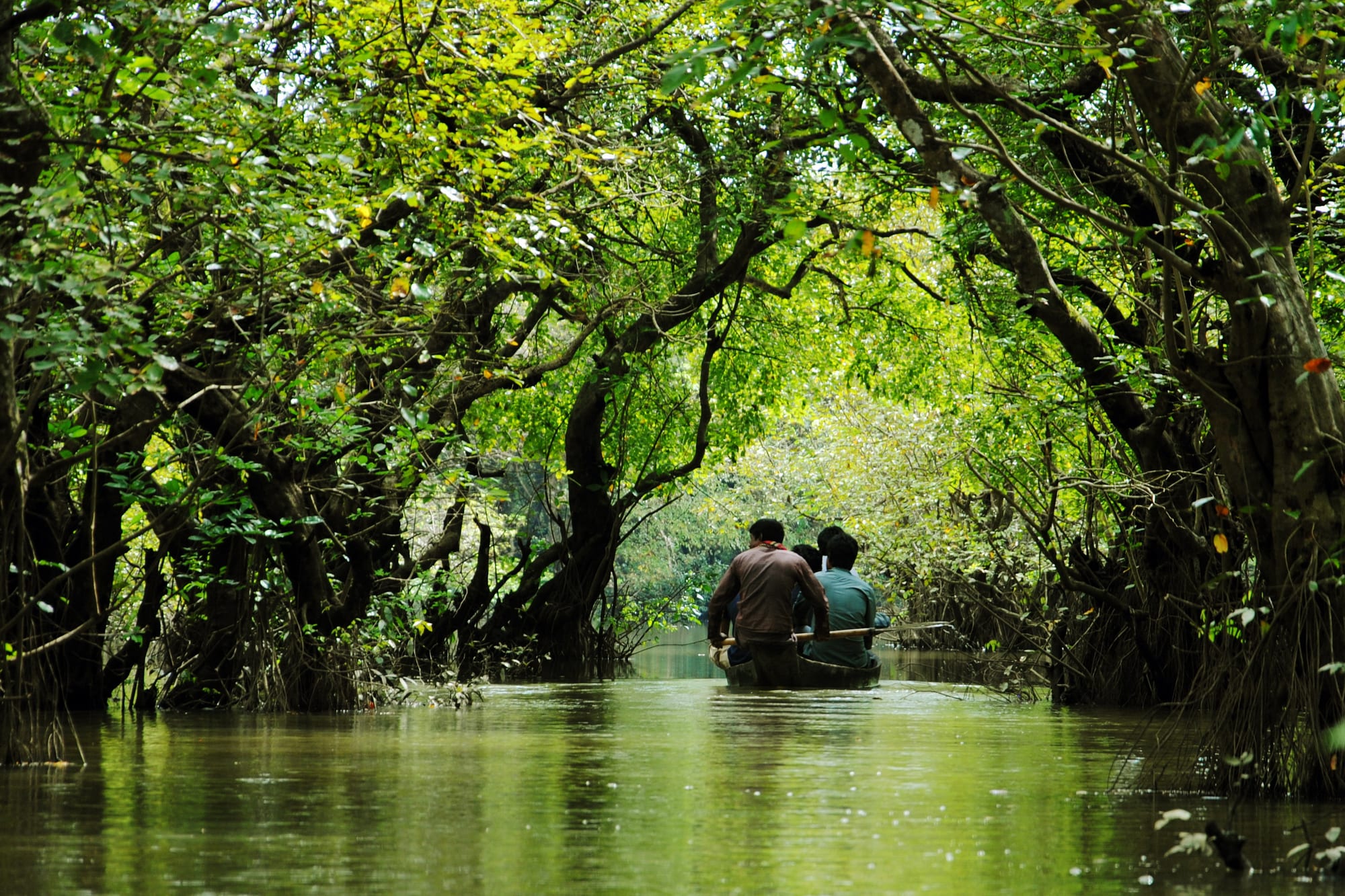
A wooden boat carrying three people glides along a green channel under the arching trees of a flooded forest

Bangladesh

Chittagong, Sylhet & the East

A boat on the water under the trees of Ratargul, the freshwater swamp forest in Gowainghat, Sylhet. (Sumon Mallick / Wikimedia Commons · CC BY-SA 4.0)

The eastern arm of Bangladesh, made up of the Chattogram and Sylhet divisions — the port city of Chattogram, the long beach at Cox's Bazar and St Martin's Island, the forested Chittagong Hill Tracts with their Indigenous peoples, and in the north-east the tea gardens, haors and Sufi shrines of Sylhet.

Explore Chittagong, Sylhet & the East

History

Chattogram has been a port for well over a thousand years, visited by Arab traders and fought over by Bengal and the Arakanese kingdom to the south. The Portuguese knew it as Porto Grande in the 16th century, and Portuguese and Arakanese raiders worked the coast until the Mughal governor Shaista Khan took the city in 1666. The port passed to the East India Company in the later 18th century. In 1930 the revolutionary Surya Sen led a raid on the British armoury here, and in the Second World War the city was a base for the Burma front; Commonwealth war cemeteries at Chattogram and Cumilla hold the dead. Further back, the Mainamati ruins near Cumilla mark Buddhist monasteries of the 8th to 12th centuries.

Sylhet's turning point came in 1303, when its conquest by Muslim forces was followed by the arrival of the Sufi saint Shah Jalal, whose shrine remains the region's spiritual centre. Commercial tea planting began in 1857. In 1947 a referendum placed most of Sylhet in East Pakistan.

The Hill Tracts followed a separate course, governed under special rules as a hill district. The Kaptai dam of the early 1960s flooded the valley around Rangamati and displaced about 100,000 people, most of them Chakma. After 1971 settlement by Bengalis and demands for autonomy led to an insurgency by the Shanti Bahini that ended with a peace accord in 1997. In March 1971 Chattogram was the site of the declaration of independence, and since 2017 Cox's Bazar district has sheltered the Rohingya fleeing Myanmar.

Culture & Customs

Each part of the east has its own speech. Chittagonian is so different from standard Bengali that many linguists treat it as a separate language, and Sylheti, once written in its own Sylheti Nagri script, is the mother tongue of most British Bangladeshis, whose families largely came from Sylhet and whose remittances built many of its houses.

Sylhet is known as a land of saints. Pilgrims crowd the shrines of Shah Jalal and Shah Paran, and the mystic songs of Hason Raja and Shah Abdul Karim, both from Sunamganj, are sung across Bengal. The Manipuri community of Moulvibazar keeps its own language and traditions, and the tea workers' communities have their own languages and festivals.

Chattogram is proud, commercial and devout, with a significant Buddhist Barua community. Its best-known tradition is the Jabbarer Boli Khela, a wrestling contest at Laldighi held every April since the early 20th century, and the mezban, a communal feast of beef served to hundreds of guests.

In the Hill Tracts the Chakma, Marma, Tripura, Mro, Bawm and other peoples are mostly Buddhist, Hindu or Christian, with their own languages and dress. Mid-April brings their new-year festivals, such as the Chakma Biju and the Marma Sangrai, with water games, sports and dances, and Buddhist temples such as the golden Buddha Dhatu Jadi near Bandarban are active places of worship.

Daily Life

Chattogram, with several million people in its metropolitan area, is the country's second city and main seaport, handling over 70 per cent of Bangladesh's foreign trade. Its economy runs on the port, export zones, steel and the shipbreaking yards of Sitakunda, where old vessels are dismantled on the beach by hand. Cumilla, Feni, Noakhali and Chandpur are busy district towns, and Chandpur, at the meeting of the Meghna and Padma, is famous for its hilsa catch.

Sylhet city is prosperous for its size, its high streets full of banks, shopping centres and money-transfer offices, much of the wealth coming from Britain and the Gulf. Tea estates around Srimangal and Habiganj run on the labour of plantation workers whose low pay and housing are long-standing issues. The haors of Sunamganj and Habiganj follow the same flood-and-harvest cycle as those further west, and flash floods in 2022 were among the worst in memory.

Cox's Bazar lives on domestic tourism, fishing and the huge aid operation for around a million Rohingya refugees in camps near Ukhia and Teknaf, which has strained local forests, water and jobs. In the Hill Tracts, land disputes between Indigenous communities and settlers remain the central issue.

Food

Chattogram's great dish is mezbani gosht, beef cooked in large pots for the mezban feasts, and kala bhuna, beef fried slowly until almost black, is another local speciality. The coast supplies shutki, dried fish, laid out on racks at Cox's Bazar and eaten in bhorta or curry, along with prawns, crab and the fish of the season. Chandpur's hilsa is eaten fried, in mustard sauce or smoked.

Sylhet cooks with the satkora, a sour citrus fruit whose rind is cooked with beef or fish to give a sharp, fragrant flavour. Sylhet also has akhni, a rice dish with meat cooked together, and a taste for strong local tea. Tea stalls serve the seven-colour tea, made of separate layers of different teas.

Cumilla is known across the country for its rasmalai, small milk-curd patties in thickened sweetened milk. In the Hill Tracts, food is built on rice, vegetables from hillside plots, and bamboo shoots, with chicken or fish cooked inside a length of green bamboo over a fire, and sidol, fermented fish or shrimp paste, used much as ngapi is across the border in Myanmar.

Attractions & Natural Wonders

The coast begins at Cox's Bazar beach, a very long, flat stretch of sand running south to Teknaf beside the Marine Drive, with Himchari's waterfall and hills and the coral stones of Inani beach along the way. Moheshkhali island has the hilltop Adinath temple. Off the southern tip lies St Martin's Island, the country's only coral island, where the government now limits visitor numbers and restricts visits to the winter months. North of Chattogram, the Sitakunda hills lead to the Chandranath temple, and the city itself has Patenga beach and Foy's Lake.

The Chittagong Hill Tracts cover three districts. Rangamati sits on Kaptai Lake, crossed by boat to Buddhist temples and Chakma villages; Bandarban has the waterfall of Nafakhum, Boga Lake and the Buddha Dhatu Jadi; Sajek Valley, reached through Khagrachari, looks out over ridges and clouds. Near Cumilla, the Mainamati ruins include the Salban Vihara.

In Sylhet division, Sylhet's tea gardens spread over the hills of Moulvibazar around Srimangal, next to the forest of Lawachara National Park and its gibbons, with the Madhabkunda waterfall further east. North of Sylhet city, the Ratargul swamp forest is explored by small boat in the rains, and Jaflong and Bichanakandi have stony rivers below the Meghalaya hills. Tanguar Haor in Sunamganj is a vast wetland visited by around 200 kinds of migratory birds in winter, and the shrine of Shah Jalal is Sylhet city's main sight.

Cities in Chittagong, Sylhet & the East

Planning basics

Budget

Costs are much like the national picture, but Cox's Bazar has its own range, from cheap guesthouses to large beach hotels whose prices jump in the winter season and on public holidays. Travel in the Hill Tracts adds permit arrangements, guides and hired jeeps, and trips to St Martin's Island involve a boat crossing and limited island accommodation.

Daily Budget Midrange
USD 55–110 (beach or tea-country resort, restaurant meals, car with driver or jeep hire)
Daily Budget Shoestring
USD 20–35 (guesthouse, local food, buses and trains)

Book Cox's Bazar and Srimangal accommodation ahead for winter weekends and the Eid holidays, when domestic tourists fill them.

Safety

Cities, tea country and the beaches are generally safe. The Chittagong Hill Tracts are different: foreigners need permits, some areas are closed, and armed groups have been active, notably in parts of Bandarban. The area around the Rohingya camps near Ukhia and Teknaf has crime and restrictions, and rip currents at Cox's Bazar drown swimmers every year.

Swim only where lifeguards are posted, carry permits in the Hill Tracts and follow local advice on closed areas. Check current official travel advice before travelling.

Climate

The east is wetter than central Bangladesh. The Sylhet region takes very heavy rainfall, fed by the Meghalaya hills to the north, and floods quickly in the monsoon. The coast from Chattogram to Teknaf is exposed to cyclones from the Bay of Bengal, and the Hill Tracts are a little cooler at height, with misty winter mornings.

Summer
hot and humid, about 28–34°C, with very heavy monsoon rain from June to September
Winter
dry and pleasant, about 13–27°C; cooler at night in the hills and tea country

Transportation

Domestic flights link Dhaka with Chattogram, Cox's Bazar and Sylhet, and trains run from Dhaka to all three, with the line to Cox's Bazar opened in 2023. Buses and hired cars cover the rest; the Hill Tracts are reached by winding roads from Chattogram, and Bandarban's remote areas need jeeps and boats. St Martin's Island is reached by boat from Teknaf or Cox's Bazar in the permitted season.

Take the train to Sylhet or Chattogram for a calmer journey than the highway, and arrange Hill Tracts travel through a local operator who handles permits.

Best Time to Visit

November to February for the beaches, St Martin's Island and the Hill Tracts, when seas are calm and trails dry. Ratargul and the Sylhet haors are at their best in the rains, from about July to October, when the water rises among the trees. The tea gardens are green through most of the year. Cyclone season in April–May and October–November can close the coast.