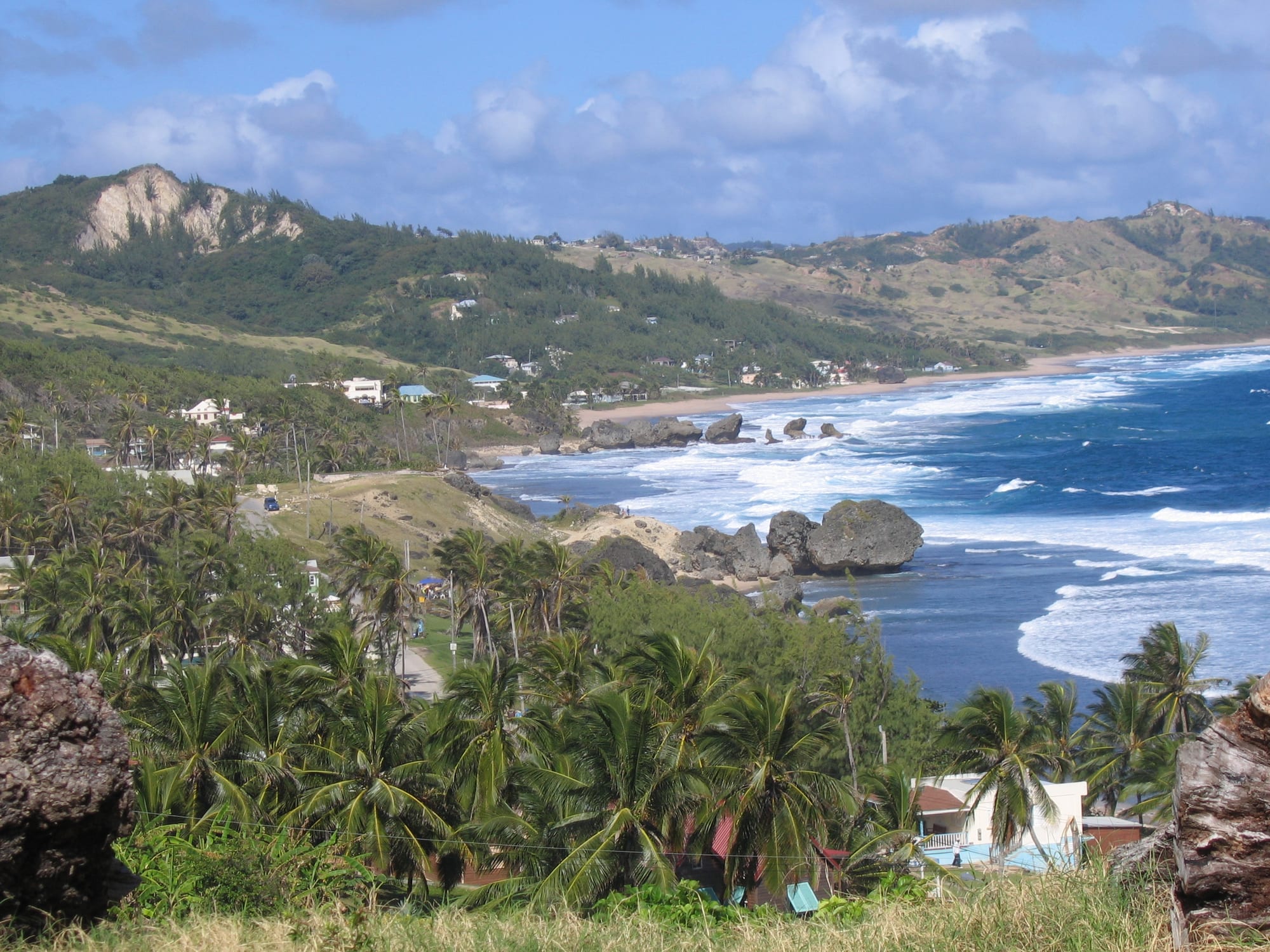
Palm-covered hillside above Bathsheba, with large boulders in white Atlantic surf and green hills along the coast

Barbados

Bathsheba

Bathsheba's boulder-strewn shore and the hills of the east coast of Barbados. (Postdlf / Wikimedia Commons · CC BY-SA 3.0)

The main fishing village of the parish of Saint Joseph, on the Atlantic coast of Barbados, where giant boulders stand in the surf below green hills. Known for the Soup Bowl surf break and for the hillside Andromeda Botanic Gardens, it is the quiet, scenic opposite of the island's hotel coasts — a place for views and waves rather than swimming.

Neighbourhoods

  • Bathsheba beach and the Soup Bowl
    • Surfing
    • Scenery
    • Beaches for walking

    The shore of the village, dotted with colossal boulders standing in the surf, including the large offshore rock some call Bathsheba Rock. The reef break known as the Soup Bowl lies just off the beach, and a few small bars and cafés look out over the waves.

    Open in Maps
  • The hills above the village
    • Gardens
    • Views
    • Quiet stays

    The green slopes behind the coast, where the Andromeda Botanic Gardens, the parish church on Horse Hill and scattered houses and guesthouses look down on the Atlantic. Inland, the rugged hill country is known as the Scotland District.

    Open in Maps

Things to do

The coast

  • Soup Bowlbeach

    The reef break off Bathsheba beach, where local and international surfing competitions are held every year.

    Open in Maps
  • Bathsheba beachbeach

    A beach of huge boulders and pounding surf, made for walking and photographs rather than swimming.

    Open in Maps

Gardens and churches

  • Andromeda Botanic Gardenspark

    An 8-acre hillside garden in the village, created from the 1950s by the self-taught horticulturalist Iris Bannochie and later given to the Barbados National Trust.

    Open in Maps
  • Saint Joseph Parish Churchlandmark

    The Anglican church on Horse Hill, first built as early as 1640 and rebuilt in 1839 after the hurricane of 1831; the 1839 building is now a ruin.

    Open in Maps

Short trips from the village

  • Flower Forestpark

    A 50-acre garden park of flowering plants and tropical trees on a former sugar plantation near Bloomsbury, in the hills of Saint Joseph.

    Open in Maps
  • Hunte's Gardenspark

    A botanical garden planted in a sinkhole-like gully on old plantation land, created by the horticulturist Anthony Hunte and opened to the public in 2007.

    Open in Maps
  • Gun Hill Signal Stationviewpoint

    A restored 1818–19 military signal station in Saint George, with a lookout tower, wide views and a well-known lion carved on the hillside below.

    Open in Maps
  • Codrington Collegelandmark

    One of the oldest Anglican theological colleges, in Saint John, south of Bathsheba, now affiliated with the University of the West Indies.

    Open in Maps

Eat and drink

Long-standing places and food districts in Bathsheba. Hours, ratings and directions come from your maps app, always current.

East coast food

  • Bathsheba's bars and cafésneighborhood

    A handful of small bars, rum shops and cafés in the village, several with views over the beach and the Atlantic.

    Open in Maps
  • Roadside Bajan eateriesneighborhood

    Informal lunch spots in the villages of the district, such as Lemon Arbour in Saint John, serve Bajan cooking such as pudding and souse and fried or barbecued fish, chicken and pork.

    Open in Maps

Experience Bathsheba

History

Bathsheba grew up as a fishing village on the Atlantic side of the parish of Saint Joseph. Its oldest landmark is the parish church on Horse Hill: Saint Joseph Anglican Church was first built as early as 1640, wrecked by the hurricane of 1831 and rebuilt in 1839; that building is now a ruin. A small chapel built nearby in 1837 was restored after a landslide and dedicated to Saint Aiden in 1904.

The hill country inland is known as the Scotland District. When the island's military signal stations were set up in 1818–19, the chain ran from Gun Hill north to the Cotton Tower, which stands near the village and is known for its views over the district, and on to the northern stations.

In the 20th century Bathsheba became known for its scenery and surf rather than for development. From the 1950s Iris Bannochie turned her family's land on the hillside into the Andromeda Botanic Gardens, later given to the Barbados National Trust, and the Soup Bowl reef break became known for its surf, drawing competitions every year.

Culture & Customs

Bathsheba's culture is that of the rural east coast: fishing, village churches, rum shops and a slower pace than the hotel coasts of the west and south. For visitors who stay, the east coast offers the feeling of a Caribbean retreat, a world away from the busy hotel strips of the south and west.

Surfing gives the village an international side. The Soup Bowl, a reef break just off the beach, hosts local and international competitions each year, bringing surfers from abroad to a village that is otherwise built around fishing.

Gardening is the other local passion. Iris Bannochie, a self-taught Barbadian horticulturalist, created the Andromeda Botanic Gardens on the hillside from the 1950s, and it is now a Partner Garden of the UK's Royal Horticultural Society. The wider parish has two more well-known gardens, the Flower Forest and Hunte's Gardens, and the outskirts of the village hold Joe's River Tropical Rainforest, about 85 acres of woodland with giant fig trees, mahogany and cabbage palms.

Daily Life

Bathsheba is the main fishing village of Saint Joseph, with some 5,000 inhabitants. Fishing remains part of local life, alongside small-scale tourism: a few guesthouses, bars and cafés that serve day visitors and surfers. The area is more often visited than stayed in.

The east coast is the least developed part of Barbados, and that shapes everyday life. There is little accommodation, few shops and slow public transport; buses run mainly to and from Bridgetown, and most people do their big shopping in town. The village's links to the rest of the island are an hourly bus to Bridgetown's Fairchild Street terminal and a less frequent route across the north of the island to Speightstown on the west coast.

The sea dominates the village's rhythm. The Atlantic breaks hard against the boulders, and the beach is generally too rough for swimming, so it is used for walking, fishing and surfing instead. Green monkeys, introduced from Africa in the colonial era, are often seen in the surrounding hills.

Food

The food of Bathsheba is everyday Bajan cooking. The national dish is cou-cou and flying fish — a smooth cornmeal-and-okra mash with flying fish, fried or steamed, and a spicy gravy. Barbados is known as "the land of the flying fish", and the fish is one of the country's national symbols. Fish cakes, macaroni pie, and rice and peas are staples, and cutters, sandwiches in a bread roll, are the quick lunch.

In the villages of the east coast, informal lunch spots serve pudding and souse — a spiced sweet-potato pudding served with pickled pork — along with fried or barbecued fish, chicken and pork. Bathsheba itself has a handful of small bars and cafés, several of which look out over the beach.

Rum shops are the social centre of village life, and drinks include rum punch, mauby, a bittersweet bark infusion, and sorrel. Bajan pepper sauce is on every table. For a bigger choice of restaurants, visitors head back to the west and south coasts.

Planning tools

Budget

The east coast has little accommodation and few places to eat, so most visitors come on a day trip from the south or west coast. Those who stay find small guesthouses and local food at lower prices than on the hotel coasts, but a hire car or taxis add to the cost.

Daily Budget Midrange
USD 200–350 (guesthouse or small hotel, car hire, garden entry fees, café meals)
Daily Budget Shoestring
USD 90–140 (guesthouse, buses, local lunches and rum shops)

The beach, the boulders and the views cost nothing; the gardens charge for entry.

Best Time to Visit

Mid-December to April has the driest weather, and the gardens are good all year. The surf is the main event for surfers, with competitions held every year. June to November is wetter and more humid, and the east coast faces the full force of the Atlantic in the hurricane season.

Suggested Number of Days

Most visitors come for a day from elsewhere on the island. Staying a night or two suits surfers and those who want quiet, and allows time for the gardens and viewpoints of the surrounding hills.

First Visit
1 day
With Surroundings
2–3 days

Transportation

This is the part of Barbados where a car is most useful. Buses are slow and run mainly to and from Bridgetown: one route runs hourly from Bridgetown's Fairchild Street terminal to Bathsheba, and another crosses the north of the island every couple of hours from Speightstown. Little runs across the district between villages.

Hill roads are narrow and winding; traffic drives on the left.

Airport & Station Connections

Bathsheba is on the east coast, on the opposite side of the island from Bridgetown. Most visitors arrive by hire car, taxi or organised tour; the direct bus from Bridgetown is the cheap option.

Walkability

The village and beach are small and easy to explore on foot, though the roads climbing to the gardens and Horse Hill are steep. The other gardens and viewpoints of the district need a car or taxi.

Safety

Barbados is one of the safer Caribbean destinations, with a stable society and low levels of violent crime affecting tourists, though gang- and gun-related crime has risen in specific residential areas of and around Bridgetown that visitors have no reason to enter. At Bathsheba the danger is the sea: the Atlantic coast has dangerous currents and surf, and swimming there is discouraged.

Take local advice before going into the water; waves and undertow can pull small children off the beach, so keep hold of them. Avoid isolated beaches and unlit areas after dark. Check current official travel advice before travelling.

Climate

Tropical and warm all year, steadied by the trade winds that blow straight onto this coast. The dry season runs roughly December to May; June to November is wetter and more humid and coincides with the Atlantic hurricane season.

Summer
June to November — across the island hotter than the dry season's 26–29°C and more humid, with short heavy downpours
Winter
December to May — across the island days are around 26–29°C, with low rainfall and a steady breeze

Local Customs

English is the official language, and Bajan creole is widely spoken. This is a quiet, close-knit fishing community: a 'good morning' or 'good afternoon' before a question is the polite way to start, and the rum shop is the local meeting place.

Beachwear is for the beach — cover up in shops and the church. Ask before photographing fishermen or residents.

Common Payment Methods

The currency is the Barbadian dollar, pegged to the US dollar at roughly two to one, and US dollars are widely accepted, often with change given in local money. Cards are accepted in many larger places, but cash in small local notes is needed for buses, rum shops and small places, and it is wise to bring enough from town.