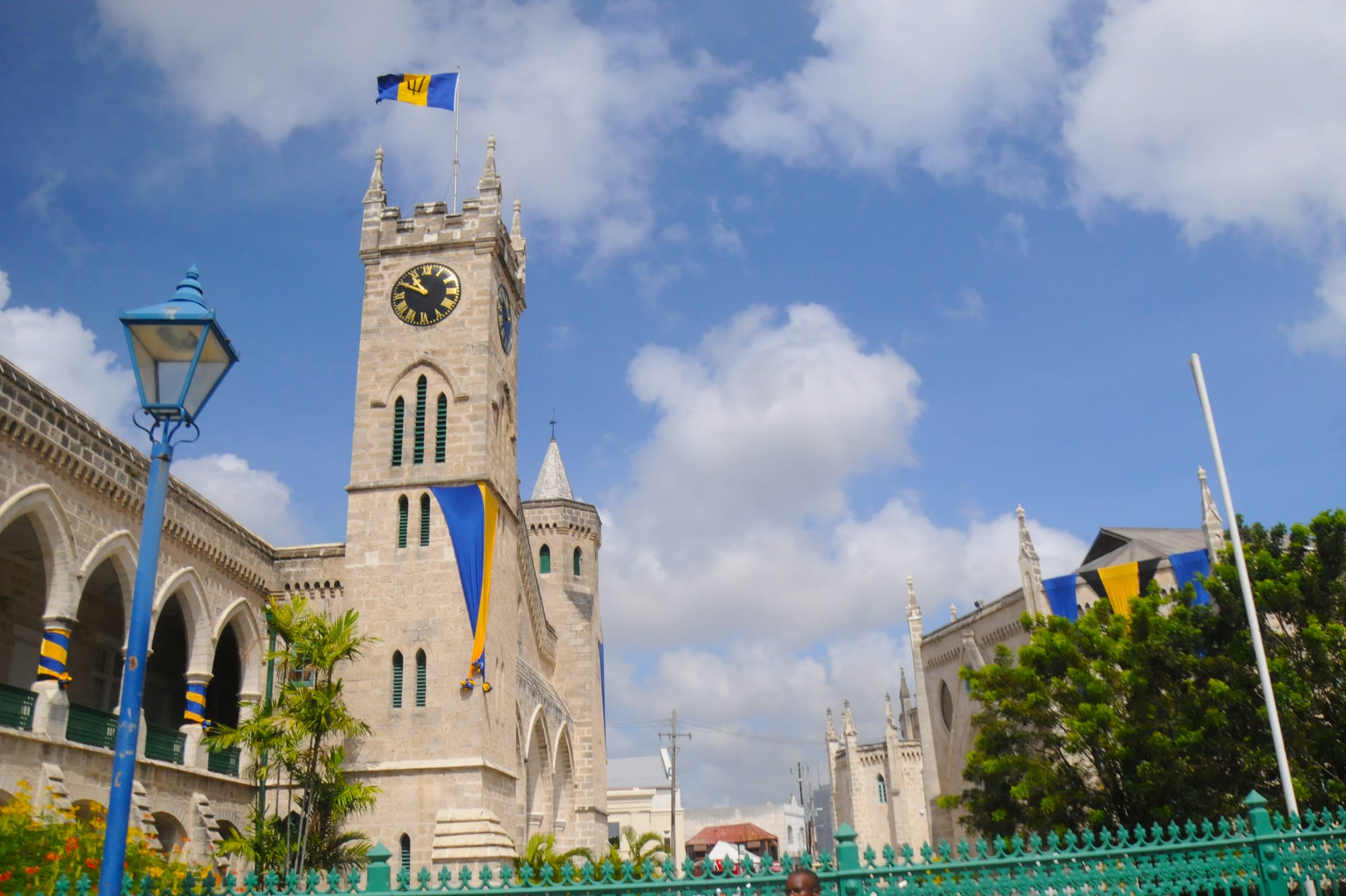
The coral-stone clock tower of the Parliament Buildings in Bridgetown, hung with blue and gold Barbados flags

Barbados

Bridgetown

The neo-Gothic Parliament Buildings beside National Heroes Square in central Bridgetown. (David Broad / Wikimedia Commons · CC BY 3.0)

The capital and largest city of Barbados, on Carlisle Bay on the island's south-west coast. Founded by English settlers in 1628 around a swampy river mouth, it grew into the island's main port. Its old centre and the military Garrison to the south are a UNESCO World Heritage Site, and today it is the island's business, government and cruise-ship hub.

Neighbourhoods

  • The Careenage and Broad Street
    • First-time visitors
    • Historic district
    • Shopping

    The old heart of the city, where the narrow inlet of the Careenage meets National Heroes Square and the Parliament Buildings. Broad Street, the main shopping street, and the pedestrianised Swan Street run north of the water, and the south bank of the Careenage has restaurants and bars in former warehouses.

    Open in Maps
  • The Garrison
    • Historic district
    • Museums
    • Horse racing

    The former British military base about 3 km south of the centre, built around the Garrison Savannah parade ground, now a racecourse. Old barracks and other military buildings, the Barbados Museum and George Washington House stand around the green.

    Open in Maps
  • Bay Street and Carlisle Bay
    • Beaches
    • Best for food
    • Close to the centre

    The road that runs south from the centre along the curve of Carlisle Bay, lined with small restaurants, bars and beach access. The calm bay is a marine park popular for snorkelling and diving, with boat trips leaving from nearby.

    Open in Maps
  • Fontabelle and the Deep Water Harbour
    • Cruise passengers
    • Boat trips

    The district west of the centre around the Princess Alice Highway and the Deep Water Harbour, where cruise ships dock. It is within walking distance of the centre, and the small-boat harbour north of the cruise terminal is where many sailing and snorkelling trips begin.

    Open in Maps

Things to do

Famous landmarks

  • Parliament Buildingslandmark

    Two neo-Gothic coral-stone buildings of 1870–74 on the north bank of the Careenage, home since 1874 to the island's Parliament, among the oldest in the Commonwealth.

    Open in Maps
  • National Heroes Squarelandmark

    The central square on Upper Broad Street, formerly Trafalgar Square, on the north bank of the Careenage beside the Parliament Buildings.

    Open in Maps
  • Chamberlain Bridgelandmark

    The bridge over the Careenage beside the Independence Arch, opened as a swing bridge in 1872 and rebuilt in 2005–06 as a lifting bridge; it is now for pedestrians.

    Open in Maps
  • Cathedral Church of Saint Michael and All Angelslandmark

    The Anglican cathedral two blocks east of National Heroes Square, the tallest Anglican church on the island; Sir Grantley Adams is buried in its churchyard.

    Open in Maps
  • Nidhe Israel Synagoguelandmark

    One of the oldest synagogues in the Western Hemisphere, founded by Jewish settlers in the 17th century, with an excavated mikveh, or ritual bath, beside it.

    Open in Maps

The Garrison and museums

  • Garrison Savannahattraction

    The old parade ground of the British garrison, now a grass racecourse where horses have raced since the days of the army.

    Open in Maps
  • Barbados Museummuseum

    The island's main museum, founded in 1933 in the old military prison of the Garrison, with more than 500,000 artefacts on the island's history and natural history.

    Open in Maps
  • George Washington Housemuseum

    The house where the 19-year-old George Washington stayed with his half-brother Lawrence in 1751, his only journey outside what became the United States, now a museum.

    Open in Maps

The bay, parks and cricket

  • Carlisle Baybeach

    The sheltered bay in front of the city, a marine park where divers find anchors and cannonballs on the sea floor.

    Open in Maps
  • Needham's Point Lighthouselandmark

    One of the island's four surviving historic lighthouses, on the point at the southern end of Carlisle Bay.

    Open in Maps
  • Queen's Parkpark

    A park in the north-east of the city on the grounds of the former home of the commander of British troops in the West Indies.

    Open in Maps
  • Kensington Ovalattraction

    The island's main cricket ground, which staged its first Test match in 1930 and was rebuilt for the 2007 Cricket World Cup, whose final it hosted.

    Open in Maps

Short trips from the city

  • Harrison's Caveattraction

    A limestone cave in the centre of the island, first mentioned in 1795, toured on a tram past underground streams and formations.

    Open in Maps

Seasonal events

  • Crop OverJune to the first Monday in August

    The harvest festival with roots on the sugar plantations, whose modern festival was first launched in 1970, ending with the Grand Kadooment costume parade, which draws huge crowds along the Spring Garden Highway west of the city.

  • Barbados Gold Cuplate February or early March

    The most important horse race of the Barbadian year, run on the grass track of the Garrison Savannah since 1982.

Eat and drink

Long-standing places and food districts in Bridgetown. Hours, ratings and directions come from your maps app, always current.

Food districts and markets

  • Cheapside Marketmarket

    The city's market area at the western end of the centre, near the bus terminals, good for a walk among stalls of local produce.

    Open in Maps
  • The Careenage waterfrontneighborhood

    Restaurants and bars in the old warehouses along the inlet, especially on the pedestrianised south bank.

    Open in Maps
  • Bay Streetneighborhood

    The road along Carlisle Bay, with a string of small local restaurants, fish stands, cafés and bars.

    Open in Maps

Experience Bridgetown

History

English settlement of what is now Bridgetown began on 5 July 1628, when Charles Wolverstone landed with 64 settlers on land claimed by the Earl of Carlisle; an earlier English settlement lay further up the coast at St James Town. The settlers found a simple bridge across the swamp at the river mouth, thought to have been built by Indigenous people, and called the place Indian Bridge. The swamp was drained, and after a new bridge was built over the Careenage in 1654 the town became the Town of Saint Michael and later Bridgetown, named after Sir Tobias Bridge. Its narrow, winding streets still follow the pattern of an English market town.

The port grew rich on sugar and the slave trade: an estimated 387,000 enslaved Africans were shipped to Barbados between 1627 and 1807. In 1751 the young George Washington stayed here, the only journey he ever made outside what became the United States. In 1824 the island became the seat of an Anglican diocese, St Michael's Parish Church was raised to a cathedral in 1825, and royal letters patent of 1842 named Bridgetown a city; and from 1800 to 1885 it was the seat of government for Britain's Windward Islands colonies.

A city council set up under the Local Government Act of 1958 was dissolved in 1967, and the city has had no municipal government since. The Deep Water Harbour was completed in 1961, and in 2011 "Historic Bridgetown and its Garrison" was inscribed as a UNESCO World Heritage Site. When Barbados became a parliamentary republic on 30 November 2021, Dame Sandra Mason became its first president.

Culture & Customs

Bridgetown is where the island's public life is staged. The Parliament Buildings house one of the oldest parliaments in the Commonwealth, the Anglican cathedral was first consecrated in 1665, and the Nidhe Israel Synagogue recalls the Jewish community that arrived in the 17th century. The 2011 UNESCO listing covers the historic city and its Garrison, including the synagogue.

Cricket is followed with passion. Kensington Oval, in the west of the city, has staged Test cricket since 1930 and the final of the 2007 World Cup, and the city's list of famous sons includes Sir Garfield Sobers, Sir Frank Worrell, Sir Everton Weekes, Sir Clyde Walcott and Malcolm Marshall. Horse racing at the Garrison Savannah, held on the old parade ground since the days of the British army, is another long tradition.

Music is the other passion. The singer Rihanna grew up in the city, which has a Rihanna Drive Monument, and the singer Jackie Opel, credited with creating the local style called spouge, is also among its notable people. Every summer Crop Over ends on Grand Kadooment Day, the first Monday in August, with a costume parade that draws more than 85,000 spectators and participants along the Spring Garden Highway.

Daily Life

The greater Bridgetown area had roughly 110,000 people in 2014, spread across much of the parish of Saint Michael, and many more travel into town each day to work. The city has had no local council of its own since 1967, and many of the national government's ministries and departments are in the greater Bridgetown area.

The economy rests on government, banking and finance, trade through the port and tourism. Bridgetown is home to the Barbados Stock Exchange and branches of large international and Caribbean banks, and the Deep Water Harbour is the island's main port of entry for cargo and cruise ships, dredged in 2002 to take the largest ships. Cruise passengers fill Broad Street's duty-free shops on ship days.

Residential districts such as Belleville, Fontabelle, Pinelands, Strathclyde and Whitepark ring the centre, and the University of the West Indies has a campus in the northern suburb of Cave Hill. Well-known secondary schools such as Harrison College, Combermere and The St. Michael School are in the city. As the centre of the island's bus network, Bridgetown draws commuters from across Barbados each working day.

Food

Bridgetown eats like the rest of Barbados. The national dish is cou-cou and flying fish — a smooth cornmeal-and-okra mash served with flying fish, fried or steamed, and a spicy gravy. Fish cakes, macaroni pie, and rice and peas are everyday food, and "cutters", sandwiches in a bread roll, are the standard quick lunch.

Pudding and souse — a spiced sweet-potato pudding served with pickled pork — is a traditional meal. Bajan pepper sauce is on every table, and drinks include mauby, a bittersweet infusion of tree bark, and sorrel.

Rum is part of the city's life too. Mount Gay, whose oldest surviving deed dates from 1703, has its visitor centre on the Spring Garden Highway just north of the centre, and small rum shops serve as neighbourhood bars across the city. For eating out, the Careenage waterfront and Bay Street along Carlisle Bay have the widest choice, from fish stands to sit-down restaurants, and Cheapside Market sells local fruit and vegetables.

Planning tools

Budget

Barbados is one of the more expensive Caribbean islands, and Bridgetown itself has few places to stay, so most visitors base themselves on the south or west coast and come into town. Buses, market food and rum shops keep costs down; boat trips, diving and imported goods push them up.

Daily Budget Midrange
USD 200–400 (south-coast hotel, sit-down dinners, museum tickets, a catamaran or dive trip)
Daily Budget Shoestring
USD 90–140 (guesthouse, buses, market food and local lunch spots)

Many of the city's sights — the Careenage, the squares, the cathedrals and the Garrison green — cost nothing to see from outside.

Best Time to Visit

January to May is the drier season, with steady trade winds and the busy winter tourist months. Crop Over fills the city with music and parties from June to early August, and the wetter months from June through the autumn coincide with the Atlantic hurricane season and lower prices.

Suggested Number of Days

The city centre and the Garrison can be seen in a day or two. Most visitors use Bridgetown as part of a longer beach stay on the island, and the number of days depends mainly on how much time goes to the coasts, the sea and the interior.

First Visit
1–2 days
With Surroundings
4–7 days

Transportation

Bridgetown is the hub of the island's transport, and almost all bus routes begin or end here. Buses north to Holetown and Speightstown leave from the Princess Alice Bus Terminal west of the centre; buses east and south leave from the Fairchild Street Bus Terminal on the eastern edge of the centre. Privately run yellow buses and white minivans fill the gaps, and taxis are unmetered.

Traffic drives on the left. Agree a taxi fare before setting off, and carry small local notes for buses.

Airport & Station Connections

Grantley Adams International Airport, the island's only airport, is at Seawell in Christ Church, about 13 km from the city centre, and is reached by taxi, hire car or bus along the south coast. Cruise ships dock at the Deep Water Harbour, within walking distance of the centre.

Walkability

The old centre is compact and easy to walk, from the Careenage up Broad Street and Swan Street to the cathedral and Cheapside. The Garrison is about 3 km south and the harbour lies to the west; the heat, busy roads and narrow pavements make a bus or taxi the easier way to reach them.

Safety

Barbados is one of the safer Caribbean destinations, with a stable society and low levels of violent crime affecting tourists, though gang- and gun-related crime has risen in specific residential areas of and around Bridgetown that visitors have no reason to enter. The centre is busy and well used by day; it is much quieter after the shops close.

Keep valuables out of sight in the crowds around the bus terminals and markets, use taxis after dark, and be firm with persistent vendors near the cruise terminal and the Careenage. Check current official travel advice before travelling.

Climate

A tropical savanna climate, hot all year but cooled by the trade winds, with a shorter dry season and a longer wet season. The wet months are also the Atlantic hurricane season.

Summer
the wet season, roughly June to November — hot and humid, with brief heavy showers; the city's record high is 33.1°C
Winter
the dry season, roughly December to May — across the island days are around 26–29°C, with low rainfall and a steady breeze

Local Customs

English is the official language, and most Bajans also speak Bajan creole among themselves. Greetings matter: a 'good morning' or 'good afternoon' before a question is the polite way to start. Barbados is a churchgoing island, and Sunday is quiet in town.

Beachwear is for the beach — cover up in shops, offices and churches. Ask before photographing people, especially vendors and market traders.

Common Payment Methods

The currency is the Barbadian dollar, pegged to the US dollar at roughly two to one, and US dollars are widely accepted, often with change given in local money. Cards are accepted in hotels, restaurants and larger shops, and ATMs are easy to find in the centre; small local notes are needed for buses and vendors.