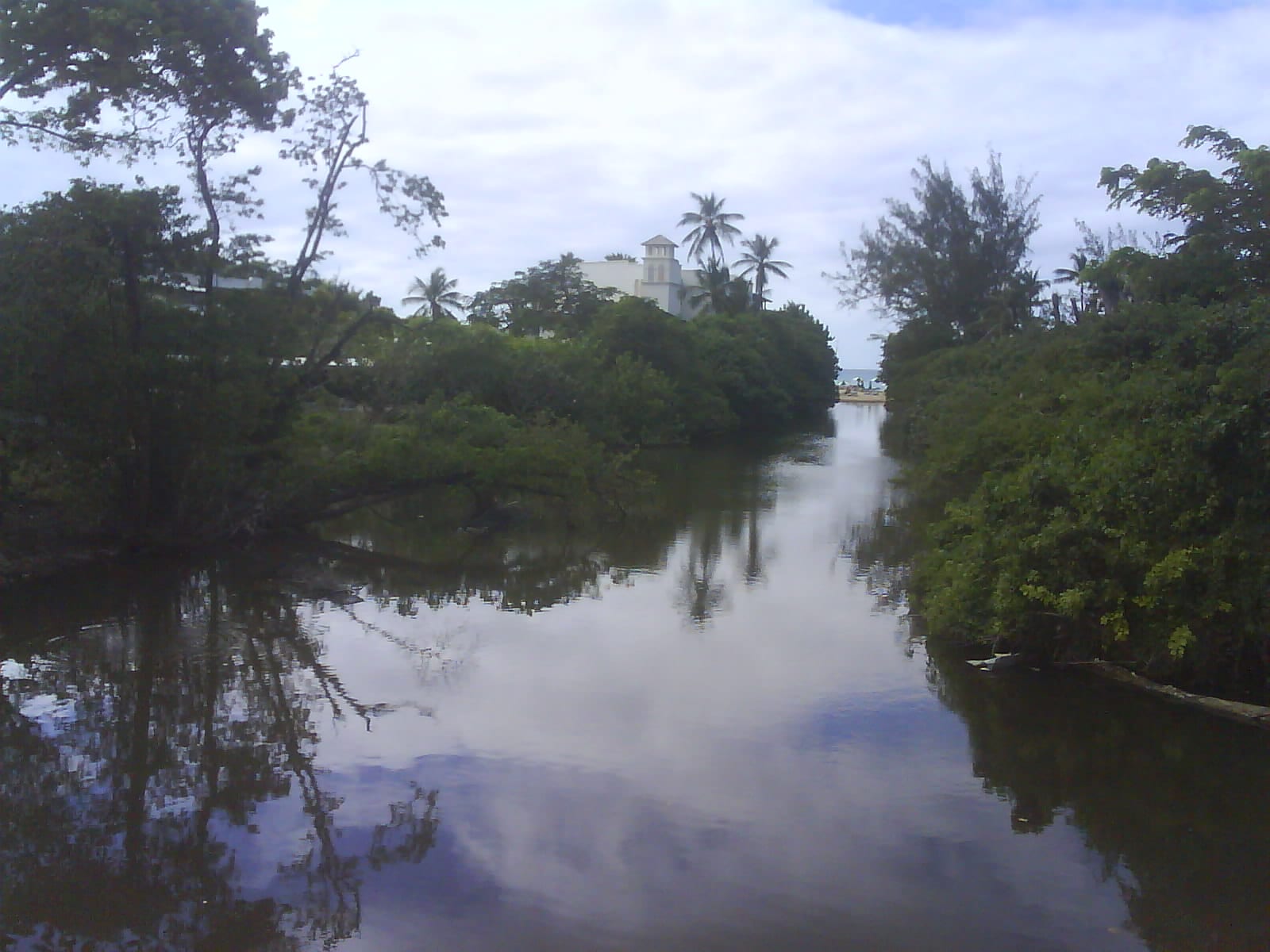
A still stream lined with dense green trees in Holetown, reflecting the sky and flowing towards the sea

Barbados

Holetown

The view from the bridge in Holetown along the stream towards the west coast. (CaribDigita / Wikimedia Commons · Public domain)

A small town in the parish of Saint James on the sheltered west coast of Barbados, where the first English settlers landed in 1627 and founded the island's first town. Today it is the main centre of the west coast's long strip of beaches, villas and hotels, with shops, restaurants and the island's oldest parish church site.

Neighbourhoods

  • Holetown centre
    • First-time visitors
    • Shopping
    • Best for food

    The short stretch of Highway 1 between the Limegrove shopping centre and Trents Road, with the landing monument, banks, shops, restaurants and bars. The parish church and Folkestone Park lie just to the north, and the beach is a few steps from the road.

    Open in Maps
  • Paynes Bay
    • Beaches
    • Quiet stays

    The bay to the south of Holetown, part of the stretch of shore sometimes called the 'Platinum Coast', with calm water and a sandy beach backed by villas and hotels. Small guesthouses and local eating places sit a few blocks inland.

    Open in Maps

Things to do

History in the town

  • St. James Parish Churchlandmark

    The parish church just north of the town centre, on one of the oldest pieces of consecrated land on the island; the first church here was built in 1628 and the present one dates from 1874.

    Open in Maps
  • Holetown Monumentlandmark

    A monument in the town commemorating the first English landing on the island — though its inscription gives the date wrongly as 1605.

    Open in Maps

Beaches

  • Paynes Baybeach

    A calm west-coast bay just south of the town, with clear water for swimming and snorkelling.

    Open in Maps

Short trips from the town

  • Speightstownneighborhood

    The island's second-largest town, further up the coast in Saint Peter, once known as 'Little Bristol' for its trade with that port, with an old centre of 18th- and 19th-century buildings.

    Open in Maps
  • Harrison's Caveattraction

    A limestone cave in the hills inland, toured by tram past its stalactites and stalagmites.

    Open in Maps

Seasonal events

  • Holetown FestivalFebruary

    A week of parades, dancing, street fairs and services at St James Parish Church, held since 1977 to mark the arrival of the first English settlers.

Eat and drink

Long-standing places and food districts in Holetown. Hours, ratings and directions come from your maps app, always current.

Holetown food

  • Holetown restaurants and barsneighborhood

    The town centre has the west coast's biggest cluster of places to eat and drink, from beachfront dining rooms to bars and small local spots.

    Open in Maps
  • Paynes Bay roti and local foodneighborhood

    On the coast road at Paynes Bay, a small shop serves roti and curries.

    Open in Maps

Experience Holetown

History

English sailors first claimed Barbados in 1625 after a ship led by John Powell was blown off course on its way from South America to England. On 17 February 1627 his brother, Captain Henry Powell, returned aboard the Olive Blossom with about fifty settlers and ten captive Africans, backed by the merchant Sir William Courteen, and landed here. The settlement was first called St James Town; its later name comes from the stream known as The Hole, which gave the settlers a safe landing place. A monument in the town marks the landing, though it gives the date wrongly as 1605.

Until 1629 this was the island's only town. The first plantations, the first fort, court and governor's house were founded here, and the island's oldest church, St James, was built in 1628. Ships traded with Bristol, London and Boston. When the Earl of Carlisle gained control of the island, his own settlement on Carlisle Bay to the south grew into Bridgetown, and the island's capital moved there.

Today hotels and villas line the shore on either side of the town, part of one long ribbon of building along the coast road. Since 1977 the town has celebrated the first landing every February with the Holetown Festival.

Culture & Customs

Holetown's identity rests on being the place where English Barbados began. The Holetown Festival, held each February since 1977, marks the arrival of the settlers with a week of parades, dances, street fairs and services at St James Parish Church, whose churchyard is known locally as one of the island's "God's acres", among the oldest consecrated ground in Barbados. The church's original bell, the oldest in Barbados, carries the inscription "God Bless King William 1696".

The town looks both ways: towards the parish life of Saint James, with its church and rum shops, and towards the holiday coast of hotels, villas and beach bars that lines the shore. McGill University's Bellairs Research Institute, a marine biology field station founded in 1954 with a bequest from the British naval commander Carlyon Bellairs, brings students from Canada and other countries for field courses in marine science, geography and development studies. Holetown has been twinned with the London borough of Haringey since 2009.

Daily Life

Holetown is small, and its official boundary covers only the stretch of Highway 1 from the Limegrove shopping centre to Trents Road. Life revolves around tourism: hotels, villas, restaurants, watersports, diving and the shops of the town centre provide much of the local work, alongside banks and services for the surrounding parish.

The coast north and south of the town is one long ribbon of building along the shore road, which carries buses, minibuses and heavy traffic at rush hour between Speightstown and Bridgetown. The busiest months are the dry winter season, when the holiday homes fill; in the wetter months from June the coast is quieter. Highway 2A, the Ronald Mapp Highway, carries much of the island's traffic inland, linking the west coast with the highways that bypass Bridgetown. Small guesthouses and bed-and-breakfasts a few blocks inland, around Fitts Village and Risk Road to the south, offer a more local side of the coast than the beachfront.

Food

Holetown eats the same Bajan food as the rest of the island, alongside the international and upmarket restaurants that serve the west coast's visitors. Cou-cou and flying fish is the national dish: a smooth cornmeal-and-okra mash with flying fish, fried or steamed, and a spicy gravy. Fish cakes, macaroni pie, and rice and peas are everyday food, and cutters — sandwiches in a bread roll — are the standard quick lunch.

Roti, a flatbread wrapped around a spiced filling such as chicken, beef or saltfish with potatoes, is sold at small shops such as one at Paynes Bay, and Bajan pepper sauce is on every table. Rum is everywhere, from beach bars to village rum shops, and local drinks include mauby, a bittersweet bark infusion, and sorrel. The town centre has a cluster of restaurants and bars along Highway 1, and Speightstown, further north, has a reasonably priced pub serving local food among its eating places.

Planning tools

Budget

The west coast is the most expensive part of Barbados, with the island's highest concentration of upmarket hotels and villas. Package deals can bring prices down, and small guesthouses a few blocks inland are much cheaper than beachfront rooms. Buses and minibuses along the coast road are the cheap way to get around.

Daily Budget Midrange
USD 250–450 (beach-area hotel, restaurant dinners, a catamaran or dive trip)
Daily Budget Shoestring
USD 100–150 (inland guesthouse, buses and minibuses, roti and local lunches)

Inland guesthouses and package deals are the main ways to keep costs down on this coast; buses and minibuses cost far less than taxis.

Best Time to Visit

Mid-December to April brings the driest weather and the busiest, most expensive season on the west coast; the Holetown Festival falls in February. Late April to June is a good-value shoulder, and the wetter months from June to November are quieter and cheaper.

Suggested Number of Days

Holetown is usually a base for a beach stay rather than a place to tour, so the length of a visit depends on how much time goes to the sea and how many trips are made to the rest of the island.

First Visit
3–5 days
With Surroundings
7–10 days

Transportation

The town lies on Highway 1, the coast road that runs north from Bridgetown to Speightstown. Government buses from Bridgetown's Princess Alice terminal and frequent privately run minibuses use this road, and taxis and hire cars are the usual way inland.

The coast road is narrow and busy at rush hour; traffic drives on the left.

Airport & Station Connections

Grantley Adams International Airport is on the south coast; transfers by taxi or hotel car to the west coast take up to about an hour, using the highways that bypass Bridgetown. Buses run up the coast from Bridgetown.

Walkability

The town centre is small and easy to cover on foot, and the beach is close to the main road. Beyond it the coast road is narrow and busy with poor pavements, so a minibus is the better way to travel along the shore.

Safety

Barbados is one of the safer Caribbean destinations, with a stable society and low levels of violent crime affecting tourists, though gang- and gun-related crime has risen in specific residential areas of and around Bridgetown that visitors have no reason to enter. The west coast's sea is usually calm.

Use hotel safes, do not leave valuables on the beach, and avoid isolated beaches and unlit areas after dark. Check current official travel advice before travelling.

Climate

Tropical and warm all year, steadied by the trade winds. The dry season runs roughly December to May; June to November is wetter and more humid and coincides with the Atlantic hurricane season.

Summer
June to November — across the island hotter than the dry season's 26–29°C and more humid, with short heavy downpours
Winter
December to May — across the island days are around 26–29°C, with low rainfall and a steady breeze

Local Customs

English is the official language, and Bajan creole is widely spoken. Greetings matter: a 'good morning' or 'good afternoon' before a request is polite. Barbados is a churchgoing island, and Sunday is quiet.

Beachwear is for the beach — cover up in shops, restaurants and the church. Be firm but polite with beach vendors.

Common Payment Methods

The currency is the Barbadian dollar, pegged to the US dollar at roughly two to one, and US dollars are widely accepted, often with change given in local money. Cards are accepted at hotels, restaurants and shops, and the town has banks with ATMs; carry small local notes for buses and vendors.