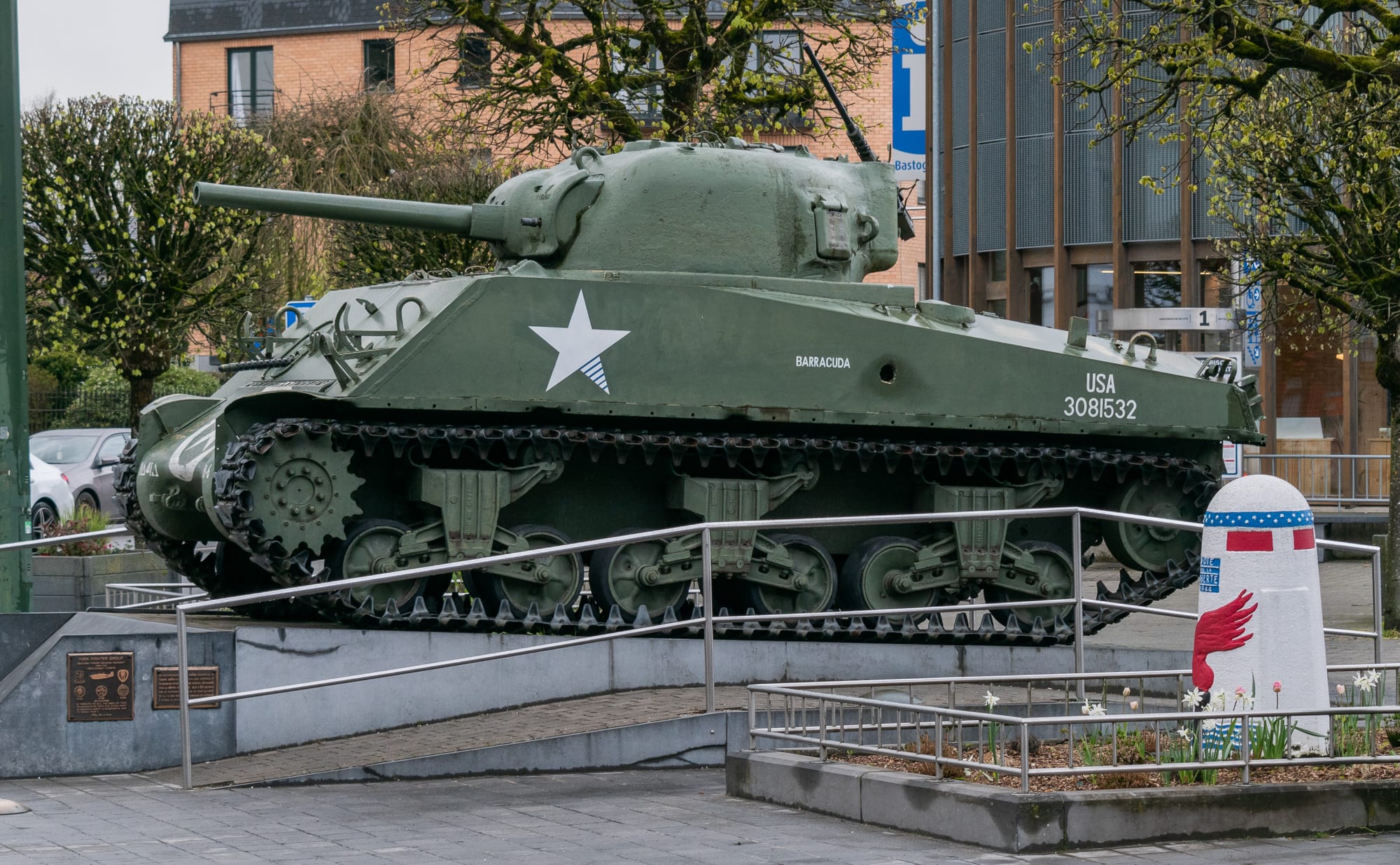
A green Sherman tank with a white star on a stone plinth on Place McAuliffe in Bastogne, beside a red-and-white Liberty Road marker

Wallonia, Belgium

Bastogne

The Sherman tank on Place McAuliffe in the centre of Bastogne. (Tournasol7 / Wikimedia Commons · CC BY 4.0)

A market town on a ridge in the Belgian Ardennes, 12 km from the Luxembourg border, long known for its cattle and grain fairs. In December 1944 American troops held out under siege here at the heart of the Battle of the Bulge, and today its museums, memorials and the Mardasson star make it a place of remembrance for visitors from both sides of the Atlantic.

Neighbourhoods

  • The town centre
    • First-time visitors
    • History
    • Shopping

    The compact centre around Place McAuliffe, with its Sherman tank and monuments. Cafés, shops, the church of Saint-Pierre, the medieval Porte de Trèves and the town's museums are all within walking distance.

    Open in Maps
  • Mardasson hill
    • War memorials
    • Museums

    The hill about 1.5 km from the centre where the star-shaped Mardasson Memorial and the Bastogne War Museum stand side by side.

    Open in Maps
  • The battlefield villages
    • Quiet and rural
    • Battlefield sites

    The municipality's farming villages — Foy, Noville, Recogne, Longvilly, Wardin and, since the 2024 merger, Bertogne — ring the town on the open Ardennes plateau, with the German war cemetery at Recogne and the ground where the siege was fought.

    Open in Maps

Things to do

Memorials and museums

  • Mardasson Memoriallandmark

    A monument in the shape of a five-pointed American star, erected in 1950 in memory of the American soldiers wounded or killed in the Battle of the Bulge.

    Open in Maps
  • Bastogne War Museummuseum

    A museum of the Battle of the Bulge opened in 2014 beside the Mardasson Memorial, with an interactive audio tour lasting at least two hours.

    Open in Maps
  • Bastogne Barracksmuseum

    The army barracks that served as the 101st Airborne's headquarters during the siege, now a museum run by the Belgian Army with restored tanks and vehicles and the basement office where McAuliffe answered 'Nuts!'.

    Open in Maps
  • 101st Airborne Museummuseum

    A museum on Avenue de la Gare with dioramas on the experience of soldiers and civilians during the siege.

    Open in Maps
  • Place McAuliffelandmark

    The main square, with a Sherman tank and a bust of General McAuliffe, at the end of the Liberty Road that marks the route of the liberating Allied forces.

    Open in Maps

The old town

  • Porte de Trèveslandmark

    A surviving gate of the defensive walls built after John the Blind granted the town its charter in 1332.

    Open in Maps
  • Church of Saint-Pierrelandmark

    A church with a Romanesque tower and baptismal fonts dating from the Middle Ages.

    Open in Maps

Short trips from the town

  • Recogne German war cemeterylandmark

    The cemetery north of the town where 6,807 German soldiers of the Second World War are buried.

    Open in Maps
  • Wiltzattraction

    A Luxembourgish town just across the border, an easy excursion from Bastogne.

    Open in Maps
  • Clervauxattraction

    A small town in the north of Luxembourg, the other usual excursion across the border.

    Open in Maps

Seasonal events

  • Liège–Bastogne–LiègeSpring

    One of the oldest one-day races in professional cycling, which turns at Bastogne, its halfway point, before heading back to Liège.

  • Foire aux noix and the siege commemorationsDecember

    The old Nuts Fair, once a hiring fair for servants, falls in the same season as McAuliffe's 'Nuts!' of 22 December 1944; today it mixes folklore and military history, and town representatives throw nuts to residents from the town hall balcony.

Eat and drink

Long-standing places and food districts in Bastogne. Hours, ratings and directions come from your maps app, always current.

Ardennes classics

  • Jambon d'Ardennerestaurant

    The cured, smoked ham of the province of Luxembourg, with protected geographical status, often served with pâtés made from game such as wild boar.

    Open in Maps
  • Ardennes gamerestaurant

    Game such as wild boar, for which the forested Ardennes are renowned, often in pâtés served with the local ham.

    Open in Maps

Cafés

  • Place McAuliffe cafésneighborhood

    The cafés and brasseries around the main square and the shopping street of the centre.

    Open in Maps

Experience Bastogne

History

The Treveri, a Gaulish tribe, lived in the region at the time of the Roman conquest, but the name Bastogne first appears in 634, when the local lord gave the area to St Maximin's Abbey near Trier; it later passed to Prüm Abbey, and an 887 document mentions the town and its market. By the 13th century Henry VII, Count of Luxembourg, was minting coins here, and in 1332 John the Blind granted the town its charter and surrounded it with walls, of which the Porte de Trèves survives. Its grain and cattle fairs were so well known that in the 16th century Bastogne was called the "Paris of the Ardennes".

The town passed with Luxembourg to Burgundy in 1451 and then to the Spanish crown. Its walls repelled the Dutch in 1602 but were dismantled by order of Louis XIV in 1688. Belgian independence brought prosperity, as Ardennes timber and cattle fairs found markets abroad and railways linked the town to its neighbours, until German occupation in the First World War.

Liberated on 10 September 1944, Bastogne was attacked again when the Battle of the Bulge began on 16 December. The 101st Airborne Division, with parts of the 10th Armored and 82nd Airborne Divisions, was encircled in the town. On 22 December, asked to surrender, Brigadier General Anthony McAuliffe answered "Nuts!". The skies cleared the next day for supply drops, and on 26 December Patton's Third Army broke the siege. Fighting in the area ended three weeks later. On 2 December 2024 Bastogne merged with Bertogne, becoming the largest municipality in Belgium by area.

Culture & Customs

Remembrance defines the town. Bastogne is the end point of the Liberty Road, the commemorative route that follows the path of the liberating Allied forces, and monuments to McAuliffe, Patton and others stand around the centre. The Mardasson Memorial, a five-pointed star erected in 1950, honours the Americans killed or wounded in the Battle of the Bulge, while the German dead lie at Recogne to the north. Monuments and markers of the Liberty Road keep that memory visible in the streets.

Older traditions survive alongside the war memory. The foire aux noix, the Nuts Fair, held every December, has nothing to do with McAuliffe's reply: it was a fair at which servants were hired, and those taken on again tied a red handkerchief with white spots around their necks to show they were no longer for hire and gave nuts to the young women. By chance, the general's "Nuts!" came on 22 December 1944, at the time of year when the fair was traditionally held. The key figure of local legend is the piche-cacaye.

Sport has deep roots here. Bastogne is the turning point of Liège–Bastogne–Liège, one of cycling's oldest one-day races, dating from the late 19th century. The Circuit des Ardennes, a 600-kilometre car race near Bastogne held from 1902, moved to Francorchamps around the First World War and lives on as the Belgian Grand Prix.

Daily Life

Since merging with Bertogne in December 2024, the municipality has had a population of just under 21,000, spread over about 264 square kilometres, the largest area of any Belgian municipality. It includes the old sections of Bastogne, Longvilly, Noville, Villers-la-Bonne-Eau and Wardin, each a cluster of villages, as well as Bertogne, Flamierge and Longchamps. It is now the second most populous municipality in the province of Luxembourg, after Arlon.

The town sits on the ridge between the Rhine and Meuse basins, and the 50th parallel runs through it. It has been a market town since its medieval fairs, with shops and cafés along the main street and around Place McAuliffe. Visitors come to its museums and memorials throughout the year.

Without a railway since the 1990s, Bastogne depends on the car; two bus stations, Bastogne Nord and Bastogne Sud, serve a shuttle to Libramont, and part of the old railway line is now a cycle path. Winters on the plateau bring regular snow and frost.

Food

Bastogne eats as the Ardennes do. Jambon d'Ardenne, a cured and smoked ham with protected geographical status, is one of the province's best-known products, often served with pâtés made from game such as wild boar; the forested Ardennes are renowned across Belgium for this kind of food. Game such as wild boar appears on local menus.

Belgian fries are as common here as anywhere in the country, bought from a friterie and traditionally served in a white cardboard cone wrapped in paper, with a spoonful of sauce on top, and carbonade flamande, beef stewed in Belgian beer, counts as one of the national dishes. The Trappist beers of Orval and Rochefort are brewed at abbeys elsewhere in Wallonia.

The forests turn colour in autumn. The spa town of Spa lies in an Ardennes valley south-east of Liège, and Jupiler lager comes from Jupille in Liège. The cafés and brasseries around Place McAuliffe and the main street serve the region's dishes.

Planning tools

Budget

Bastogne is cheaper than Brussels or Bruges, with prices typical of the Ardennes. Rooms are in short supply in December. A car is the main extra cost, since there is no railway; the memorials cost nothing, while the War Museum charges.

Daily Budget Midrange
USD 150–250 (mid-range hotel or gîte, restaurant dinners, museum tickets, a hire car for the Ardennes)
Daily Budget Shoestring
USD 75–110 (campsite, gîte or simple guesthouse, friterie and bakery meals, buses)

Book well ahead for December, and bring warm clothes: the town is high and winters are cold.

Best Time to Visit

May to September for walking and cycling on the plateau, and autumn for the forest colours. December is the month of the battle and the Nuts Fair; snow and frost are common then.

Suggested Number of Days

One day covers the town's museums and memorials. Two or three allow for the battlefield villages and woods, the Luxembourg border towns and the wider Ardennes; a car makes the difference.

First Visit
1 day
With Surroundings
2–3 days

Transportation

The centre is small and walkable, but the Mardasson hill and the battlefield villages are spread across the plateau, and a car is close to essential. TEC buses are sparse. Part of the old railway line has been turned into a cycle path.

Drive carefully on Ardennes roads in winter, when snow and frost are common.

Airport & Station Connections

Bastogne has had no passenger railway since the 1990s. The nearest station is at Libramont, on the main line from Namur to Luxembourg, from where TEC bus 6 runs to the town. Most visitors arrive by car; the Luxembourg border is 12 km away.

Walkability

The centre is easy on foot: Place McAuliffe, the shopping street, the church and the Porte de Trèves are close together, as are the town's museums. The Mardasson Memorial and War Museum, about 1.5 km out, are a fair walk or a short drive.

Safety

Belgium is generally safe, with low levels of violent crime against visitors. Bastogne is a quiet rural town; the hazards are those of the Ardennes — snowy and frosty winter roads and ticks in the woods.

Check for ticks after walks in the woods and allow extra time on winter roads. Check current official travel advice before travelling.

Climate

Oceanic like the rest of Belgium but with more continental influence, because the town stands at about 510 metres on an inland ridge. Winters are moderate for the latitude, with means just above freezing, but snow and frost are common.

Summer
Mild; Belgium as a whole averages 18°C in July, and the town's height adds a more continental influence
Winter
cold, with means just above 0°C; snow and frost are common

Local Customs

Bastogne is French-speaking. The memory of 1944 is everywhere, from the monuments to McAuliffe and Patton to the Liberty Road markers. Local legends centre on a figure called the piche-cacaye.

Service is included in Belgian bills and tipping is not expected; a small tip of a euro or two is a generous sign of appreciation. Behave quietly at the memorials and cemeteries.

Common Payment Methods

Belgium uses the euro. Card and phone payment are widely accepted; carry a little cash for small purchases.