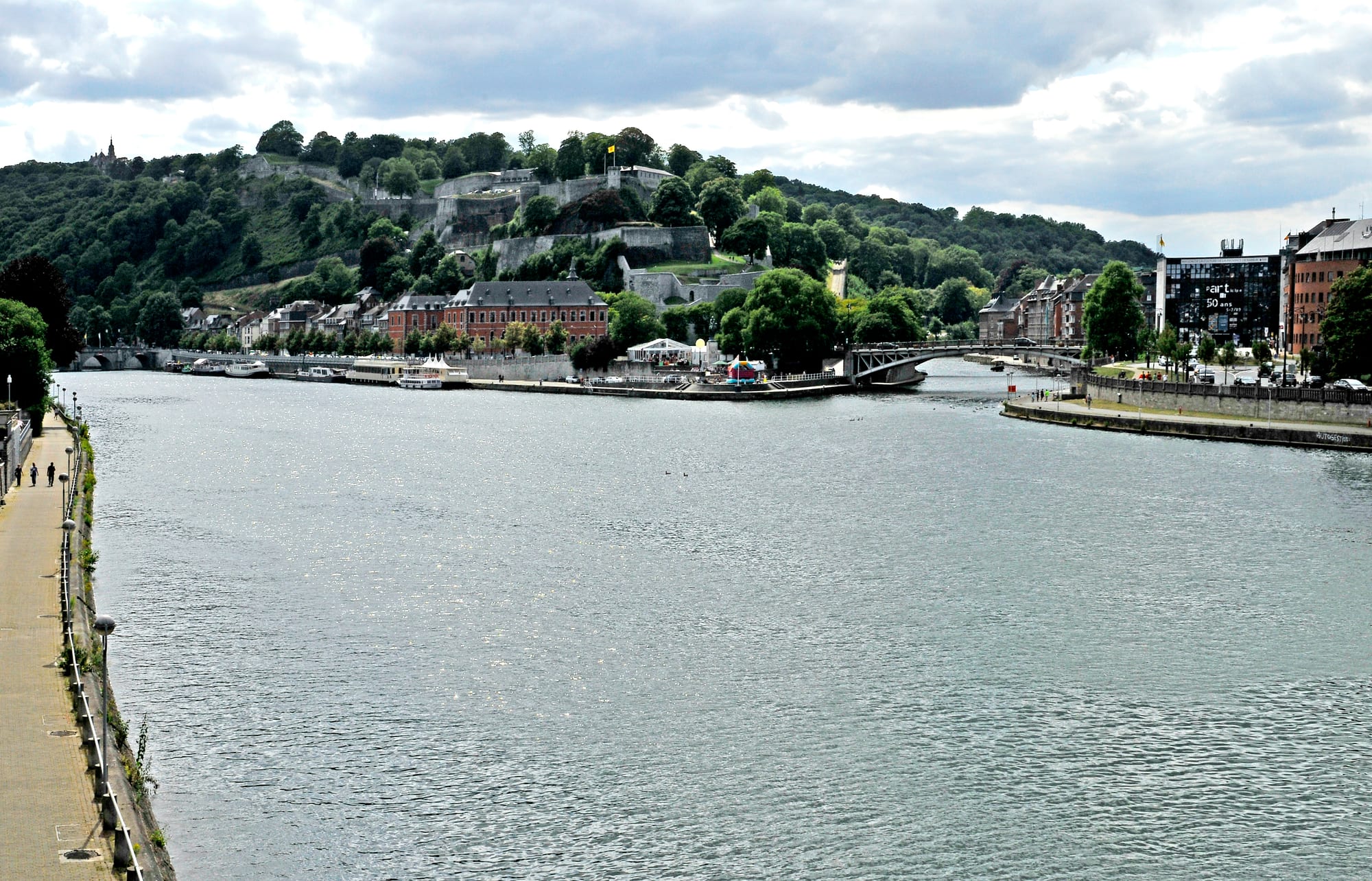
The broad Meuse at Namur where the Sambre joins it, with the citadel walls on a wooded hill above red-brick buildings

Wallonia, Belgium

Namur

The confluence of the Sambre and the Meuse at Namur, below the citadel. (LBM1948 / Wikimedia Commons · CC BY-SA 4.0)

The capital of Wallonia, at the point where the Sambre flows into the Meuse beneath a rocky spur crowned by a large citadel. Fought over for centuries as a fortress town, it is now a French-speaking city of government offices, a university and pedestrian streets, and a gateway to the Meuse valley and the Ardennes.

Neighbourhoods

  • The old town
    • First-time visitors
    • Historic district
    • Best for food

    The historic centre below the citadel, where many streets are reserved for pedestrians. The cathedral, the belfry, the Walloon parliament and the main shopping streets, Rue de Fer and Rue de l'Ange, are all here, with cafés and terraces on the squares.

    Open in Maps
  • The citadel
    • Views
    • Walks
    • History

    The fortified spur above the confluence, reached on foot or by the cable car from the old town. Its ramparts, an open-air theatre and an arboretum share the hilltop, and the views take in both rivers and the city.

    Open in Maps
  • Jambes
    • Quiet and residential
    • Riverside

    The district across the Meuse, once owned by the bishops of Liège and a separate town until 1977. It has its own railway station, a medieval keep, the old bridge over the Meuse and the seat of the Walloon government, and a Sunday flea market.

    Open in Maps
  • Wépion
    • Food
    • Riverside

    A riverside village of the municipality about 8 km south of the centre, on the slopes above the Meuse, known across Belgium for the strawberries grown there for more than 150 years.

    Open in Maps

Things to do

Famous landmarks

  • Citadel of Namurlandmark

    A fortress dating to 937, given its present layout by Menno van Coehoorn and Vauban in the late 17th century, with positions added in the 18th; disestablished as a military post in 1891 and now reached on foot, by cable car or by tourist train.

    Open in Maps
  • St Aubin's Cathedrallandmark

    Belgium's only cathedral in academic Late Baroque style, an 18th-century building and the only church in the Low Countries built as a cathedral after 1559.

    Open in Maps
  • Belfry of Namurlandmark

    A tower built in 1388 as part of the city wall and turned into a belfry in 1746, one of the UNESCO-listed belfries of Belgium and France.

    Open in Maps
  • Parliament of Wallonialandmark

    The regional parliament, which sits in the former Hospice Saint-Gilles in the old town.

    Open in Maps
  • Cable car to the citadelattraction

    An aerial cable car from Place Maurice Servais in the old town to the esplanade at the top of the citadel.

    Open in Maps

Museums

  • Musée des Arts Anciens du Namuroismuseum

    The museum on Rue de Fer that shows the masterpieces of Mosan goldsmith work by Hugo d'Oignies.

    Open in Maps
  • Félicien Rops Museummuseum

    A museum devoted to the Symbolist printmaker and illustrator Félicien Rops.

    Open in Maps

Across the river

  • Jambesneighborhood

    The south bank district, with the 13th-century Enhaive keep, the old Meuse bridge and the Élysette, seat of the Walloon government.

    Open in Maps
  • Wépionneighborhood

    Belgium's strawberry capital, on west-facing slopes above the Meuse, which also lends its name to a strawberry beer.

    Open in Maps

Short trips from the city

  • Floreffe Abbeylandmark

    A former Premonstratensian monastery on the Sambre about 11 km south-west of Namur, the second house of the order ever founded.

    Open in Maps
  • Annevoie Castlepark

    An 18th-century château known for its water gardens, the only ones of their kind in Belgium, fed by the River Rouillon.

    Open in Maps
  • Maredsous Abbeylandmark

    A Benedictine abbey founded in 1872, whose church is a minor basilica and whose dairy makes cheeses.

    Open in Maps
  • Dinantattraction

    The Meuse town about 30 km upstream, squeezed between the river and a cliff topped by its own citadel.

    Open in Maps

Seasonal events

  • Namur en MaiAscension weekend, May

    A street-arts festival of storytellers, jugglers and musicians in the pedestrian streets, with free and ticketed shows.

  • Verdur RockJune

    A free festival of contemporary music.

  • Fêtes de WallonieAround the third Sunday of September

    Five days of concerts, parades and folklore for Wallonia's regional holiday, including the stilt-walkers' fight for the Golden Stilt.

  • Festival International du Film FrancophoneSeptember

    A festival of French-language films from around the world, held since 1986.

Eat and drink

Long-standing places and food districts in Namur. Hours, ratings and directions come from your maps app, always current.

Namur classics

  • Wépion strawberriesmarket

    Strawberries grown on the sunny slopes of Wépion for more than 150 years, an established name in Belgian cooking, also turned into a strawberry beer.

    Open in Maps

Food districts and markets

  • Saturday marketmarket

    The Saturday-morning market in the centre, held alongside a flea market.

    Open in Maps
  • Old town cafésneighborhood

    Cafés, chocolate shops and restaurants with terraces on the pedestrian squares and streets of the centre.

    Open in Maps

Experience Namur

History

Namur began as a trading settlement in Celtic times, where routes across the Ardennes met at the confluence of the Sambre and the Meuse. The Romans followed Julius Caesar's defeat of the local Aduatuci, and in the early Middle Ages the Merovingians built a castle on the rocky spur above the rivers. In the 10th century Namur became a county in its own right; its counts could build only on the north bank of the Meuse, because the south bank, which grew into Jambes, belonged to the prince-bishops of Liège. Philip the Good of Burgundy bought the county in 1421.

The citadel made the town a prize. Strengthened in the 1640s under Spanish rule, it was captured by Louis XIV in 1692 and rebuilt by Vauban, then retaken by William III of Orange in 1695. Under the Barrier Treaty the Dutch garrisoned the fortress while the Austrians ruled the town, and the French besieged and annexed it again in the 1790s. After Belgian independence in 1830 Namur stayed a garrison town until the citadel was decommissioned in 1891 in favour of a ring of outlying forts.

Those forts did not save it in August 1914, when the Germans bombarded the town without warning and the supposedly impregnable defences fell in three days. Namur was in the front line again in 1940 and in the Battle of the Bulge in 1944. Paratroopers were based here until 1977. When Wallonia gained its own government, Namur was chosen as its seat and in 1986 was declared the regional capital, despite being smaller than Liège or Charleroi.

Culture & Customs

Namur's best-known tradition is jousting on stilts, practised since at least 1411. Two teams, the Mélans and the Avresses, dressed in medieval clothes, try to topple each other on one of the main squares, and the year's biggest bout, the fight for the Golden Stilt, takes place on the third Sunday in September during the Fêtes de Wallonie. Since 2021 the jousts have been on UNESCO's list of the Intangible Cultural Heritage of Humanity, and the belfry is a World Heritage Site too, so the city counts two UNESCO entries.

Walloon is cherished alongside French. The city hymn, Li Bia Bouquet, was composed in Walloon in 1851 by Nicolas Bosret, the blind organist of the church of Saint-Loup, and the house of Walloon and folklore on Rue Saint-Nicolas is the base of the stilt-walkers and other folk societies.

As a university and capital city, Namur has a full cultural calendar: the Festival International du Film Francophone each September since 1986, the Namur en Mai street-arts festival, the free Verdur music festival in June, the KIKK festival and, in October, a nature film festival. Sport means the cyclo-cross World Cup round on the citadel's slopes and the memory of the motocross Grand Prix, held around the citadel from 1950 to 2007 and once called the Monaco of motocross.

Daily Life

The municipality had 115,029 inhabitants on 1 January 2025, spread over 175 square kilometres that take in the old city and some two dozen former villages, including Jambes, Wépion, Malonne, Bouge and Saint-Servais. French is the language of daily life. Jambes, across the Meuse, has its own station and shopping, while the villages on the plateaus are quiet residential places.

Government is the backbone of the economy: the Walloon parliament, government and administration are all here, and the city is also the capital of the province of Namur. The University of Namur, founded in 1831, brings a large student population, and the UCLouvain Namur university hospital is the province's largest employer. The city also has a commercial and industrial side on the Sambre and Meuse valley, producing machinery, leather goods, metals and porcelain, and barges pass through the middle of town on the Meuse.

Daily rhythms follow the working week of a capital city. The station, the busiest in Wallonia, fills with commuters each morning; the shopping streets between the station, Rue de Fer and Rue de l'Ange are busy on Saturdays, when the market and a flea market take over the centre; and Sundays bring a flea market to Jambes. Location at the head of the Ardennes also makes the city a stop for visitors heading south.

Food

Namur's most prized local product grows a few kilometres upriver: Wépion strawberries, cultivated for more than 150 years on sun-exposed, west-facing slopes with their own micro-climate, are an established name in Belgian cooking, and the village also produces a strawberry beer.

The Meuse valley has a claim on one of Belgium's national foods. The Belgian journalist Jo Gérard claimed that a family manuscript of 1781 recounts potatoes being deep-fried in the Meuse valley before 1680, in place of fish when the rivers froze. Today they are bought from a friterie in a paper cone with the sauce on top. Walloon cooking around the city borrows from its neighbours: jambon d'Ardenne, smoked ham and game pâté from the forests to the south; boulets à la liégeoise, two big meatballs in a sweet-and-sour sauce called sauce lapin; and the Liège waffle.

Abbey products are a speciality of the surrounding countryside. Maredsous makes cheeses in its own dairy, though the beer bearing its name is now brewed in Flanders. The old town's chocolate shops and cafés serve thick hot chocolate and waffles.

Planning tools

Budget

Rooms are scarcer during the Fêtes de Wallonie and the film festival in September. The citadel grounds and the old town cost nothing to explore; the cable car and museums charge.

Daily Budget Midrange
USD 150–240 (mid-range hotel, restaurant dinners, museum and cable car tickets, a hire car for day trips)
Daily Budget Shoestring
USD 75–110 (youth hostel or simple hotel, friterie and bakery meals, buses and regional trains)

Use Namur as a base for the Meuse valley; collect a hire car here for the Ardennes.

Best Time to Visit

May to September, when the citadel and the riverbanks are at their best and the festival calendar runs from Namur en Mai at Ascension to the Fêtes de Wallonie in September. Autumn brings forest colour to the surrounding valleys. Winters are cold and grey.

Suggested Number of Days

One or two days cover the city and its hilltop. With the abbeys, gardens and towns of the Meuse valley added, three or four days make sense, and a car makes the outlying places easier to combine.

First Visit
1–2 days
With Surroundings
3–4 days

Transportation

The old town is compact and largely pedestrian. TEC, the Walloon bus company, runs the city buses; tickets come from kiosks or, for a little more, from the driver. A cable car climbs from the old town to the top of the citadel. Namur also has a second station, Jambes, across the Meuse, and the city can be reached by boat on both rivers.

Bus drivers may not speak much English, so having the destination written down helps.

Airport & Station Connections

Namur's station is the busiest in Wallonia, a junction of the main lines from Brussels to Luxembourg and from Lille to Liège; trains from Brussels take about an hour, and the line continues up the Meuse to Dinant. The nearest airport is Brussels South Charleroi, about 30 km away and specialised in low-cost flights; long-distance coaches also call at the city.

Walkability

Good in the centre: many streets of the historic core are reserved for pedestrians, and pavements run almost everywhere. The station, the shopping streets and the cathedral are close together. The citadel is a steep climb, which is why the cable car exists, and Wépion and the outer villages need a bus or car.

Safety

Belgium is generally safe, with low levels of violent crime against visitors. Namur is a calm administrative and university city; petty theft is the usual concern in busy places, and the citadel's steep paths and steps are the more common hazard.

Keep bags closed around the station and on busy festival nights, and wear sturdy shoes for the citadel paths. Check current official travel advice before travelling.

Climate

Mild and damp, like the rest of the Meuse valley. Temperatures in Namur typically range from 5°C to 20°C for most of the year, with cold snaps down to −15°C in winter and highs up to 35°C in summer.

Summer
warm, with highs that can reach 35°C in Namur
Winter
cold, with lows that can fall to −15°C in Namur

Local Customs

Namur is French-speaking, and some bus drivers speak little English, so a few words of French help. The city's folklore — stilt-jousting, the Walloon language, the city hymn Li Bia Bouquet — is a matter of local pride.

Restaurant service is included in Belgium, so tipping is not expected, though a small tip is a sign of appreciation.

Common Payment Methods

Belgium uses the euro. Card and phone payment are widely accepted; carry a little cash for small purchases and the Saturday market.