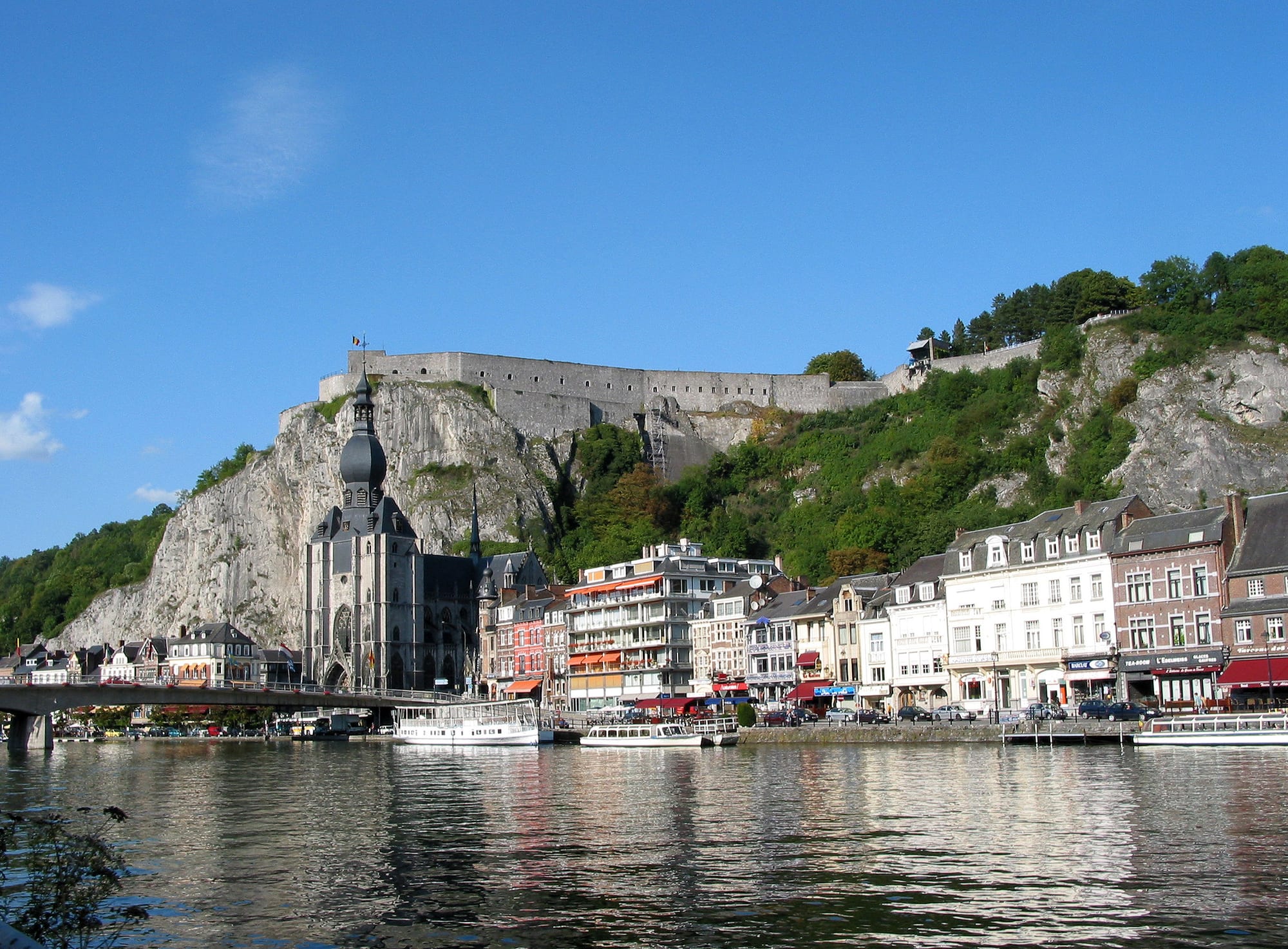
Dinant's riverfront on the Meuse, with the onion-domed collegiate church below a grey cliff and the citadel walls on top

Wallonia, Belgium

Dinant

The Meuse, the collegiate church of Notre-Dame and the citadel at Dinant. (Jean-Pol GRANDMONT / Wikimedia Commons · CC BY 3.0)

A long, narrow town on the Meuse in the Belgian Ardennes, squeezed between the river and a limestone cliff topped by a citadel, with the onion-domed collegiate church at its foot. Once a rich centre of medieval brassware, sacked in 1466 and devastated in 1914, it is now a small tourist town, the birthplace of Adolphe Sax and a base for the Lesse valley.

Neighbourhoods

  • The riverside town
    • First-time visitors
    • Historic district
    • Best for food

    The old town stretches in a long, thin strip along the right bank of the Meuse between the water and the cliff. The collegiate church, the foot of the citadel steps and cable car, riverside restaurants and the departure points for boat tours are all close together.

    Open in Maps
  • The left bank
    • Close to public transport

    Across the bridge from the collegiate church, the left bank has the railway station and quieter streets, with the classic view of the church and citadel back across the river.

    Open in Maps
  • Bouvignes-sur-Meuse
    • Quiet and residential
    • History

    Dinant's old rival a short way downriver, once a centre of brassware in its own right, now a village of the municipality below the ruins of Crèvecœur Castle.

    Open in Maps
  • Anseremme
    • Outdoors
    • Riverside

    The village just upstream where the Lesse flows into the Meuse, living from farming and tourism, on a river well known for kayaking.

    Open in Maps

Things to do

Famous landmarks

  • Collegiate Church of Our Ladylandmark

    The Gothic church at the foot of the cliff, rebuilt in the 13th century after a rockfall destroyed its Romanesque predecessor, crowned by a pear-shaped 16th-century bell tower.

    Open in Maps
  • Citadel of Dinantlandmark

    The fortress on the cliff above the church, on a site fortified since 1051; its present form dates from the years after 1815 and it is reached by 408 rock-cut steps or by cable car.

    Open in Maps
  • Rocher Bayardlandmark

    A split pinnacle of rock beside the Meuse, said in legend to have been cleft by the hoof of the horse Bayard; in fact Louis XIV's soldiers cut it to build a riverside road.

    Open in Maps

Museums

  • Maison de Monsieur Saxmuseum

    A small interpretation centre in the house on Rue Adolphe Sax commemorating the inventor of the saxophone and his instruments.

    Open in Maps
  • Leffe Abbey and Maison Leffeattraction

    The abbey of Notre-Dame de Leffe, inhabited since 1152, north of the citadel, and a museum about the beer that began here, though it is no longer brewed in Dinant.

    Open in Maps

Short trips from the town

  • Crèvecœur Castlelandmark

    The ruins of a castle on the heights above Bouvignes, owned by the Walloon Region and open freely all year, with views over the Meuse.

    Open in Maps
  • Castle of Freÿrlandmark

    A château with gardens in the style of Le Nôtre on the left bank of the Meuse between Dinant and Waulsort, one of Belgium's finest natural sites.

    Open in Maps
  • Montaigle Castlelandmark

    A ruined 14th-century castle on a rocky spur above the Molignée valley, destroyed by Henry II of France in 1554.

    Open in Maps
  • Caves of Han-sur-Lesseattraction

    One of Belgium's main tourist attractions, a cave system carved under a limestone hill by the Lesse, reached by an old tramway.

    Open in Maps
  • Annevoie Castlepark

    An 18th-century château downriver towards Namur, known for the only water gardens of their kind in Belgium.

    Open in Maps

Eat and drink

Long-standing places and food districts in Dinant. Hours, ratings and directions come from your maps app, always current.

Dinant classics

  • Couque de Dinantmarket

    Dinant's honey-sweetened biscuit, pressed in a carved wooden mould before baking and said to be the hardest in Europe; usually eaten with coffee or hot chocolate.

    Open in Maps
  • Flamiche dinantaiserestaurant

    The local version of a quiche, made with the cheese boulette de Romedenne.

    Open in Maps
  • Maison Leffeneighborhood

    A museum of the Leffe beer that began in the town's abbey, ending with a tasting.

    Open in Maps

Along the river

  • Riverside restaurantsrestaurant

    The restaurants along the river below the citadel, some with views over the Meuse.

    Open in Maps

Experience Dinant

History

The name Dinant comes from the Celtic Divo-Nanto, "sacred valley". The area was settled in Neolithic, Celtic and Roman times, and the town is first recorded in the 7th century, when Bishop Perpète moved his residence here. In the 11th century Emperor Henry IV gave the prince-bishops of Liège market and justice rights over Dinant, which became one of the principality's 23 "bonnes villes"; the first stone bridge over the Meuse dates from the end of that century. Wedged between cliff and river, the town grew in a long, thin strip along the bank.

Its wealth came from metal and stone. Medieval Dinant and its rival Bouvignes, across the river, cast silvery brass into candlesticks, aquamaniles and altar furniture for churches throughout the Meuse valley, so that such work is still called dinanderie; the cliffs supplied black marble and bluestone. An uprising during the Liège Wars ended in 1466, when Philip the Good, Duke of Burgundy, and his son Charles the Bold punished the town and sacked it. Wars between France and Spain brought more destruction, the French occupied it in 1675, and in 1795 it passed to France with the rest of the prince-bishopric. Leather tanning and playing cards replaced brass, and the couque appeared.

On 15 August 1914 French and German troops fought for the town; among the French wounded was a young Lieutenant Charles de Gaulle. On 23 August German troops summarily executed 674 inhabitants, the largest German massacre of 1914, and burned the collegiate church. In May 1940 Rommel's 7th Panzer Division crossed the Meuse here. Today the municipality includes Anseremme, Bouvignes, Furfooz and other villages.

Culture & Customs

Dinant's most famous son is Adolphe Sax, born here in 1814, who invented the saxophone. A small museum in his house on the street that bears his name tells his story, and saxophone-shaped statues stand around the town. The Belgian historian Henri Pirenne wrote his doctoral thesis on medieval Dinant, and its brass tradition gave its name to dinanderie.

Legend is never far away. The split pinnacle of the Rocher Bayard is said to have been cleft by the hoof of Bayard, the giant horse that carried the four sons of Aymon in their flight from Charlemagne through the Ardennes in the 12th-century chanson de geste Les Quatre Fils Aymon. In reality the soldiers of Louis XIV cut it to make way for a road beside the river.

Memory of the war runs deep. The town received the Croix de Guerre in 1919, and a national monument to Belgium's civilian victims of 1914 was unveiled on the Place d'Armes in 1936 and destroyed by German troops in 1940. The abbey of Leffe, inhabited since 1152, gave its name to one of Belgium's best-known beers, and the town has been twinned with Disneyland Paris since 2012.

Daily Life

Dinant had 13,412 inhabitants on 1 January 2026, spread across the town and the villages of the municipality, from Anseremme and Bouvignes on the river to Furfooz, Sorinnes and Thynes on the plateau. French is the everyday language. Farming matters in the surrounding area, and the limestone cliffs long supported quarrying.

Tourism shapes the riverside. Day visitors come from Brussels, Namur and Liège to see the church and citadel, take a boat on the Meuse or paddle on the Lesse, and the town's choice of beds is limited, so many visitors do not stay the night. Healthcare is a major employer: Dinant has two sites of the CHU UCLouvain Namur university hospital, the largest employer in the province.

The rhythm is that of a small valley town. Hourly trains run to Brussels, and the riverside road carries traffic along the narrow strip between cliff and water. Agriculture and tourism are the main sources of income in Anseremme, as in much of the surrounding area.

Food

The couque de Dinant is the town's emblem: a honey-sweetened biscuit pressed into a carved wooden mould before baking, said to be the hardest biscuit in Europe and usually eaten with coffee or hot chocolate. The biscuit first appeared when the town's brassware had fallen out of fashion. The flamiche dinantaise is the local version of a quiche, made with a cheese called boulette de Romedenne.

The Meuse valley also features in the story of fries. The Belgian journalist Jo Gérard claimed that a family manuscript of 1781 recounts potatoes being deep-fried in the valley before 1680, as a substitute for fried fish when the rivers froze. Fries are now sold in friteries, traditionally in a white cardboard cone wrapped in paper, with a spoonful of sauce on top.

Beer is part of the town's identity. Leffe, now a brand of abbey beers brewed in large quantities by AB InBev and no longer made in Dinant, takes its name from the town's abbey, and Maison Leffe tells its story and ends with a tasting. Around the town, the Ardennes supply jambon d'Ardenne, smoked ham and game pâté, and restaurants line the river.

Planning tools

Budget

Dinant is a small town with a limited choice of beds, so many visitors come for the day from Namur, Brussels or Liège. Prices are in line with the rest of Wallonia, cheaper than Brussels or Bruges, but rise at summer weekends when the kayak and boat trips are busiest.

Daily Budget Midrange
USD 150–240 (mid-range hotel or gîte, restaurant dinners, citadel and cave tickets, a kayak trip or hire car)
Daily Budget Shoestring
USD 75–110 (hostel or simple guesthouse, friterie and bakery meals, regional trains)

Visit midweek outside the school holidays for a quieter town and an easier choice of rooms.

Best Time to Visit

May to September for boat trips on the Meuse and kayaking on the Lesse. Autumn brings the forest colours of the valleys. Winter is quiet and some seasonal attractions close.

Suggested Number of Days

The town's sights are close together and few, so a day is enough for most visitors. Two or three days allow for the castles and caves of the surrounding valleys and time on the river, and a car makes the outlying places much easier.

First Visit
1 day
With Surroundings
2–3 days

Transportation

The town is small enough to cover on foot along the river. A cable car, running in the high season, climbs from beside the collegiate church to the citadel, and boat trips leave from the riverside. Buses beyond the town are sparse, so the castles and caves of the area are easiest by car.

The cable car runs only in the high season; at other times the citadel means climbing the 408 steps.

Airport & Station Connections

Dinant's station, on the left bank, has an hourly train to Brussels taking about 90 minutes, and a branch line follows the Meuse from Namur in about half an hour. The nearest airports are Brussels, Charleroi and Liège; from Brussels Airport the route is by train with a change at Brussels-Nord, while Charleroi and Liège airports need a bus to a railway station first.

Walkability

Very walkable. The main sights are all close together along the river, and the bridge links the station to the old town in a few minutes. The citadel is a stiff climb of 408 steps, which the cable car avoids, and the riverside road carries steady traffic.

Safety

Belgium is generally safe, with low levels of violent crime against visitors. Dinant is a quiet small town; the hazards are outdoor ones — rivers, slippery steps and the forest paths of the Ardennes.

Follow kayak operators' instructions on river conditions and check for ticks after woodland walks. Check current official travel advice before travelling.

Climate

Maritime temperate, as across Belgium, with rain possible in any season; summers are usually comfortably warm and winters cool.

Summer
Comfortably warm; Belgium averages 18°C in July, occasionally reaching 30°C
Winter
Cool; Belgium averages 3°C in January, with occasional hard frosts

Local Customs

Dinant is French-speaking. Adolphe Sax is the town's hero, and saxophone-shaped statues stand around the town. The 1914 massacre is remembered with memorials, and the collegiate church is a working place of worship.

Service is included in Belgian bills and tipping is not expected; a small tip of a euro or two is a generous sign of appreciation. Dress modestly and keep quiet during services in the collegiate church.

Common Payment Methods

Belgium uses the euro. Card and phone payment are widely accepted; carry a little cash for small purchases.