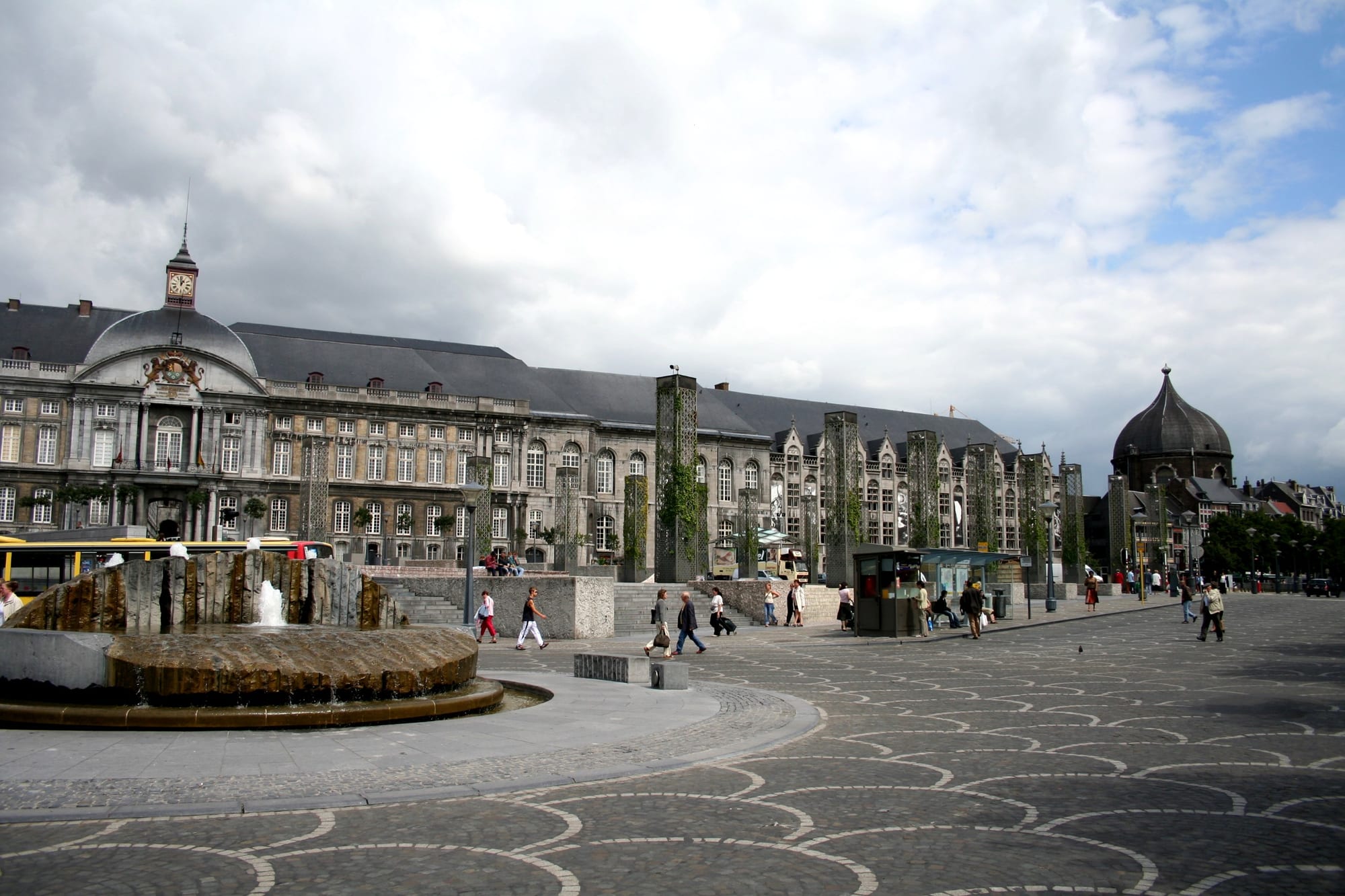
The long stone façade of the Prince-Bishops' Palace across the paved Place Saint-Lambert, with a fountain in the foreground

Wallonia, Belgium

Liège

The Prince-Bishops' Palace on the Place Saint-Lambert in Liège. (Jean-Pol GRANDMONT / Wikimedia Commons · CC BY 2.5)

A big French-speaking city on the Meuse in eastern Belgium, close to the Dutch and German borders. For eight centuries the capital of an independent prince-bishopric, then one of continental Europe's first great steel towns, it remains Wallonia's economic and cultural centre — a hilly, hard-working city known for its folk festivals, nightlife, Sunday market and Calatrava's railway station.

Neighbourhoods

  • The historic centre and Hors-Château
    • First-time visitors
    • Historic district
    • Museums

    The old heart around the Place Saint-Lambert and the Place du Marché, with the Prince-Bishops' Palace, the Perron and the city hall. North-east of it, the streets of Hors-Château and Féronstrée hold the Grand Curtius museum and the foot of the Montagne de Bueren stairway, and much of the centre lies in Belgium's oldest pedestrian zone.

    Open in Maps
  • Le Carré
    • Nightlife
    • Bars
    • Students

    A block of pedestrian streets behind the opera house packed with pubs and bars, many reputed to stay open until the last customer leaves. It is the centre of the city's nightlife, busy with students from the university.

    Open in Maps
  • Outremeuse
    • Local life
    • Folklore
    • Festivals

    The district across the Meuse from the centre, with narrow pedestrian streets and old courtyards. It has few grand buildings but a welcoming atmosphere, and on 15 August it hosts one of the city's biggest folk festivals, with the puppet hero Tchantchès as its emblem.

    Open in Maps
  • Guillemins
    • Close to public transport
    • Architecture

    The area around Santiago Calatrava's white railway station, south of the centre and linked to it by tram. Across the river, the Parc de la Boverie holds the city's fine-arts museum.

    Open in Maps
  • The citadel heights
    • Views
    • Walks

    The hill of Sainte-Walburge above the old town, reached by the 374 steps of the Montagne de Bueren. The citadel was mostly replaced by a hospital in the 1970s, but its southern walls, a memorial to Belgians executed there by German occupiers and wooded slopes remain, with views over the valley.

    Open in Maps

Things to do

Famous landmarks

  • Prince-Bishops' Palacelandmark

    The vast former residence of the prince-bishops on the Place Saint-Lambert, its oldest rooms from the 16th century; it now houses the courts and the provincial government.

    Open in Maps
  • Archéoforummuseum

    An archaeological display beneath the Place Saint-Lambert, where St Lambert's Cathedral stood until it was destroyed after the French Revolution.

    Open in Maps
  • Perron of Liègelandmark

    The column on the Place du Marché near the city hall, built from 1714, once the symbol of justice in the prince-bishopric and now the emblem of the city.

    Open in Maps
  • Liège-Guillemins railway stationtransit hub

    Santiago Calatrava's sweeping white station, opened in 2009, one of Belgium's four stops on the high-speed network.

    Open in Maps
  • Montagne de Buerenviewpoint

    A 374-step stairway built in 1881 from Hors-Château towards the citadel, named after Vincent de Bueren, who defended the city against Charles the Bold.

    Open in Maps
  • Citadel of Liègeviewpoint

    The heights 111 metres above the Meuse where the city's fortress stood from 1255, with surviving southern walls and a memorial to Belgians executed there in both world wars.

    Open in Maps

Churches

  • Liège Cathedrallandmark

    The former collegiate church of St Paul, raised to cathedral status in 1802 after St Lambert's was demolished, with a treasury and Saint Lambert's tomb.

    Open in Maps
  • St James's Churchlandmark

    A Gothic church completed in 1538, with a Renaissance portal of 1558, limewood sculptures by Jean Del Cour and 14th-century choir stalls.

    Open in Maps
  • Collegiate Church of St Bartholomewlandmark

    A Romanesque church of coal sandstone with a massive twin-towered westwork, home to the 12th-century Mosan brass baptismal font.

    Open in Maps

Museums

  • Grand Curtiusmuseum

    A red-brick and stone mansion of about 1600 on the Meuse, reopened in 2009 with the merged collections of archaeology, weapons, decorative arts and Mosan religious art.

    Open in Maps
  • La Boveriemuseum

    The city's fine-arts museum, opened in 2016 in the palace of fine arts built in the Parc de la Boverie for the international exhibition of 1905.

    Open in Maps
  • Museum of Walloon Lifemuseum

    A folk museum founded in 1913, covering the folklore and ethnography of Wallonia.

    Open in Maps

Markets and nights out

  • Marché de la Battemarket

    The long Sunday market along the left bank of the Meuse, where most locals go on Sundays, running from early morning until early afternoon.

    Open in Maps
  • Opéra Royal de Wallonieattraction

    The opera company of Wallonia, performing in the city-centre opera house beside Le Carré.

    Open in Maps

Short trips from the city

  • Blegny-Minemuseum

    A preserved coal mine and show mine near the city, one of the four Walloon mining sites listed by UNESCO in 2012.

    Open in Maps
  • Fort de Loncinlandmark

    One of the twelve forts built around Liège in the 1880s, destroyed in 1914 when a German shell hit its magazine; it is now a military cemetery.

    Open in Maps

Seasonal events

  • Liège–Bastogne–LiègeSpring

    The oldest of cycling's five 'monuments', run in late April from Liège south to Bastogne and back through the hilly Ardennes.

  • Le 15 Août in OutremeuseMid-August, around 15 August

    One of the city's biggest folk festivals, with a religious procession, flea market, dances, concerts and peket, ending on the 16th with the mock burial of Matî l'Ohê, a ceremonial ham bone.

  • Foire de LiègeFrom late October

    The oldest kermesse in Belgium, a funfair held every year from 28 October.

  • Saint Nicholas student festivalAround 6 December

    Days of student revelry, with university students in dirty lab coats collecting money in the streets.

  • Christmas VillageDecember

    One of the oldest and biggest Christmas markets in Belgium, drawing more than a million visitors.

Eat and drink

Long-standing places and food districts in Liège. Hours, ratings and directions come from your maps app, always current.

Liège classics

  • Boulets à la liégeoiserestaurant

    Two big meatballs in sauce lapin, a sweet-and-sour sauce of sirop de Liège with raisins, onions, prunes and cloves, served with fries.

    Open in Maps
  • Liège wafflecafe

    The dense waffle studded with pearl sugar that caramelises on the iron, often sold by street vendors.

    Open in Maps
  • Peketcafe

    The Walloon name for jenever, a spirit flavoured with juniper berries and the favourite drink of the 15 August festival.

    Open in Maps

Food districts and markets

  • Marché de la Battemarket

    The Sunday market along the Meuse, dating from 1561 and the oldest market in Belgium.

    Open in Maps
  • Le Carréneighborhood

    The pub-filled block behind the opera house, the heart of the city's late nights.

    Open in Maps
  • Place du Marchéneighborhood

    The square around the Perron and the city hall, lined with cafés and another centre of the city's nightlife.

    Open in Maps

Experience Liège

History

Liège is first recorded in 558 as Vicus Leudicus. Its rise began with a murder: Saint Lambert, credited with completing the conversion of the region around 705, was killed here, and his successor Hubert built a basilica for his relics that became the nucleus of the city. From 985 to 1794 Liège was the capital of a prince-bishopric, nominally within the Holy Roman Empire but largely independent. Its first prince-bishop, Notger, made it a great intellectual and religious centre. In 1345 the citizens defeated their prince-bishop in battle, and the city's 32 guilds took control of its government, the most democratic system the Low Countries had known. Rebellion against Burgundy ended in 1468, when Charles the Bold captured and largely destroyed the city.

The Liège Revolution of 1789 created a short-lived Republic of Liège; the French arrived in 1794 and destroyed St Lambert's Cathedral. After a spell under the Netherlands, Liège joined independent Belgium in 1830 and became one of continental Europe's first large-scale steel centres, as John Cockerill built up iron and steel from 1817. Its ring of twelve forts held up the German invasion of August 1914 for twelve days before heavy artillery destroyed them; the city was occupied again in 1940 and liberated in September 1944.

Postwar Liège was a stronghold of the labour movement. The general strike of 1950 led to King Leopold III's abdication, and in the winter strike of 1960–61 striking workers badly damaged the Guillemins station. Coal and then steel declined, bringing high unemployment; the city has shown signs of economic recovery in recent years, and Calatrava's station opened in 2009 and a tram line in April 2025.

Culture & Customs

The city calls itself la cité ardente, the fervent city, a name that first recalled its revolts against Burgundy and later its industrial energy. It is known for crowded folk festivals, above all the 15 August celebration in Outremeuse, which draws more than 300,000 people to its narrow streets for a religious procession, a flea market, dances, concerts and peket, served by some residents from their own doors. It ends on the 16th with the mock burial of Matî l'Ohê, a ceremonial ham bone. Its emblem is Tchantchès, a stubborn but resourceful Walloon boy from Charlemagne's time, remembered with a statue, a museum and puppets all over the city.

Liège is renowned for its nightlife. In Le Carré, behind the opera house, pubs are reputed to stay open until the last customer leaves, and the Place du Marché is another late-night centre. The city has the Opéra Royal de Wallonie, the Liège Royal Philharmonic, the Les Ardentes electro-rock festival and Jazz à Liège, and its Walloon dialect is said to be one of the most distinctive in Belgium. A large Italian community means Italian is heard in many places.

Sport matters too. Standard Liège, winner of several national championships, is the main football club, and the city hosts the start and finish of Liège–Bastogne–Liège, the oldest of cycling's monuments; it was the first city to host stages of all three Grand Tours.

Daily Life

In January 2026 the municipality had 198,102 inhabitants, and the wider urban area about 750,000, the third largest in Belgium after Brussels and Antwerp. The municipality takes in Angleur, Bressoux, Chênée, Grivegnée, Jupille-sur-Meuse and other sections. Its people are mainly French-speaking, and the city is home to large Algerian, Moroccan, Turkish, Vietnamese and Italian communities.

Liège is the most important economic city in Wallonia. Steel once dominated, and the Seraing works upriver were the largest industrial complex in the world, but the economy has diversified into aerospace and space technology, information technology, biotechnology, and the production of water, beer and chocolate. Arms making goes back to the Middle Ages, and FN Herstal is based here. The river port is the third largest in Europe, and Liège Airport is among Europe's biggest cargo airports. The University of Liège, founded in 1817, has about 20,000 students, and a science park near its campus holds spin-off companies.

The week has a familiar shape: commuters on the trains and the new tram, students filling Le Carré at night, and Sunday morning at the Batte market along the Meuse. The city is also known as a traditionally socialist place, and the effects of industrial decline, unemployment remain part of local life, and the city was among the places hit by floods in July 2021.

Food

Liège cooking is sweet-and-sour. Boulets à la liégeoise are two big meatballs served with fries in sauce lapin, made from sirop de Liège — a jelly-like spread made mainly from apples and pears cooked down slowly — cooked with raisins, onions, prunes and cloves. The same syrup is spread on bread with Herve, the strong-smelling washed-rind cheese from the Herve area of Liège province. Salade liégeoise mixes green beans, potatoes and bacon.

The Liège waffle, dense and studded with pearl sugar that caramelises on the iron, is often sold by street vendors. At the 15 August festival people eat cooked pears, boûkètes and sausages, and the local spirit is peket, the Walloon name for jenever, flavoured with juniper berries.

Local producers are household names. The lager Jupiler comes from Jupille on the edge of the city; Galler makes chocolate; and the water and soft-drink companies Spa and Chaudfontaine are among the region's best-known businesses. Cider and Herve cheese are typical things to buy. The Sunday Batte market along the quays is the place to find produce and snacks, and the restaurants and cafés of the Place du Marché and the pedestrian centre serve the city's classics.

Planning tools

Budget

Liège is cheaper than Brussels or Bruges for hotels and restaurants, like the rest of Wallonia. Rooms are scarcer around the 15 August festival, the Christmas Village and big cycling races. Many of the best things — the Batte market, the Montagne de Bueren, the churches and the folk festivals — cost nothing.

Daily Budget Midrange
USD 150–250 (mid-range hotel, restaurant dinners, museum tickets, day trips by train or hire car)
Daily Budget Shoestring
USD 75–115 (hostel or budget hotel, friterie and market food, trams and buses)

Go on a Sunday morning for the Batte market, when the trams take a different route through the centre.

Best Time to Visit

May to September for the best weather, with the 15 August festival in Outremeuse the high point of the year. Late October brings the Foire de Liège, and December the Christmas Village and the student Saint Nicholas celebrations. Spring brings Liège–Bastogne–Liège.

Suggested Number of Days

Two days cover the old centre, the museums and the views. Three or four allow for the mines, forts and Ardennes towns nearby, or for a festival; Liège is also an easy base for Maastricht and Aachen across the borders.

First Visit
2 days
With Surroundings
3–4 days

Transportation

A tram line opened on 28 April 2025, running along the Meuse from Sclessin to Coronmeuse via Guillemins station and the Place Saint-Lambert, with a branch to Bressoux. TEC buses cover the rest of the city and region. Tram tickets come from machines at the stops, not on board. Regional trains also link Guillemins with the city-centre stations of Liège-Saint-Lambert and Liège-Carré.

Buy a ticket at the stop before boarding the tram; on Sundays the line through the centre is rerouted to make room for the Batte market.

Airport & Station Connections

Liège-Guillemins, about 3 km south of the centre, is a stop for high-speed ICE and Eurostar trains to Cologne, Frankfurt and Paris; intercity trains take about 50 minutes from Brussels-Nord. Liège Airport, 9 km west at Grâce-Hollogne, is mainly a cargo airport and had no regular airline passenger flights in January 2026, so most visitors fly to Brussels, changing trains at Leuven or Brussels-Nord, or to Brussels South Charleroi.

Walkability

The centre is good on foot, with Belgium's oldest and Wallonia's biggest pedestrian zone, and the old town, Le Carré and Outremeuse are close to each other. The walk from Guillemins to the centre takes about half an hour, so most people take the tram or a train. The city is hilly: the climb to the citadel is steep.

Safety

Belgium is generally safe, with low levels of violent crime against visitors. Liège is generally safe by day and robbery is rare, but harassment of women walking alone late at night is a known problem, and Le Carré is busy until the early hours.

Take a taxi late at night if staying more than a short walk from the centre, keep bags closed in festival crowds, and look out for the trams when crossing. Check current official travel advice before travelling.

Climate

Maritime despite its inland position, moderated by mild winds from the sea, with summers tempered by maritime air; the city averages about 11°C over the year.

Summer
Moderated by maritime air; Belgium averages 18°C in July
Winter
Cool; Belgium averages 3°C in January

Local Customs

Liège is French-speaking, with a distinctive Walloon dialect and a large Italian community. People call it la cité ardente, the fervent city, and are proud of its rebellious, socialist and festive reputation; folk figures such as Tchantchès are treated with affection.

Service is included in Belgian bills and tipping is not expected; a small tip of a euro or two is a generous sign of appreciation.

Common Payment Methods

Belgium uses the euro. Card and phone payment are widely accepted; carry a little cash for the Batte market and small purchases.