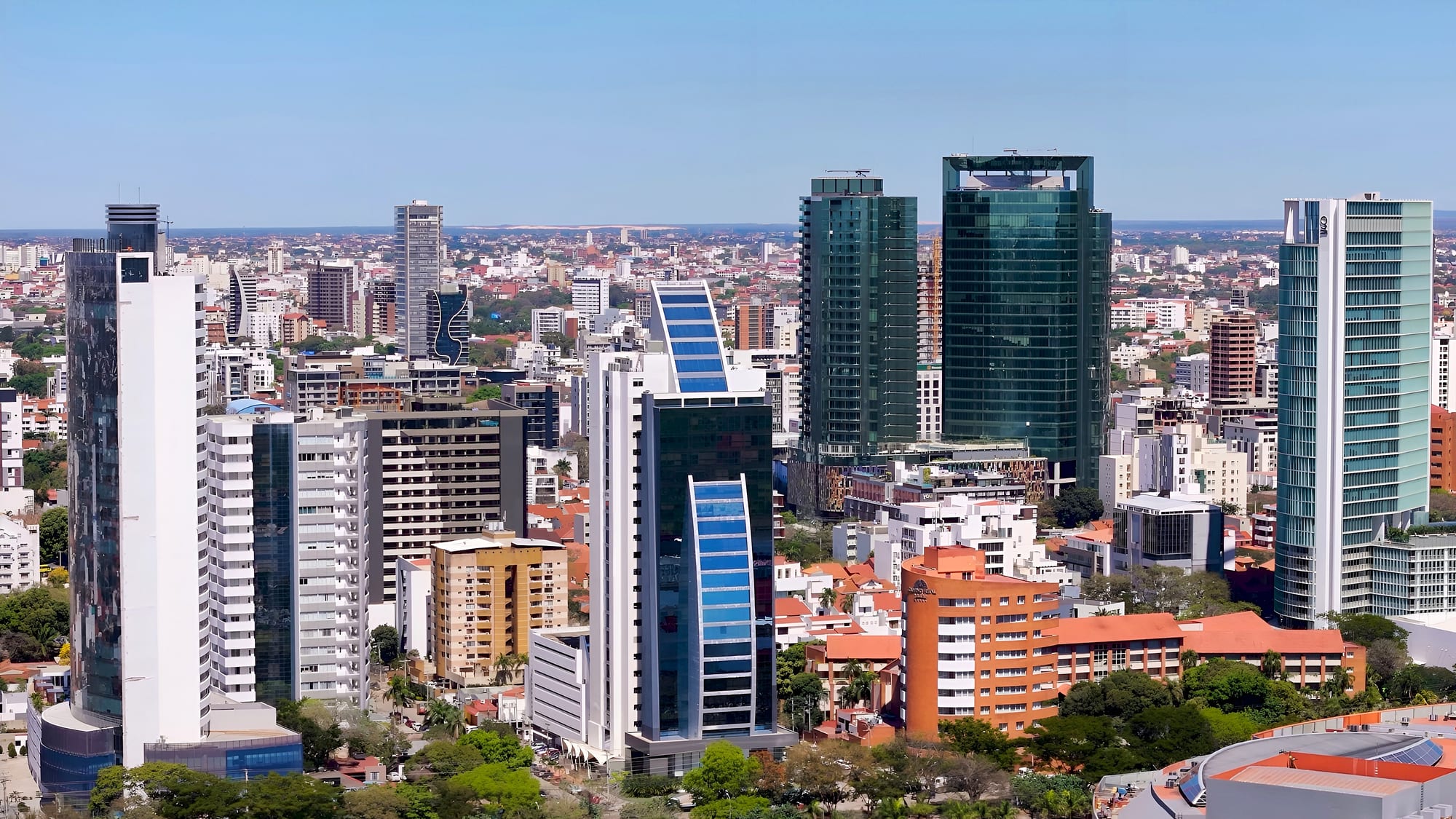
Glass and concrete high-rise towers rising above red-roofed low buildings and trees in Santa Cruz de la Sierra

Santa Cruz & the Lowlands, Bolivia

Santa Cruz de la Sierra

High-rise towers above the low-rise spread of Santa Cruz de la Sierra. (Parallelepiped09 / Wikimedia Commons · CC BY-SA 4.0)

Bolivia's largest city, on the Piraí River in the hot eastern lowlands. Founded by Spanish settlers from Asunción in 1561 and moved several times, it stayed a small frontier town for almost four centuries, then grew in a single generation into the country's business capital — a city of concentric ring roads, glass towers and a shaded colonial plaza at its heart.

Neighbourhoods

  • The historic centre
    • First-time visitors
    • Historic district

    The grid of streets inside the first ring road, laid out in the Spanish manner around the Plaza 24 de Septiembre. The cathedral, government buildings, the House of Culture and several museums stand around the square, and the surrounding blocks keep colonial-style buildings.

    Open in Maps
  • Avenida Monseñor Rivero
    • Best for food
    • Cafés
    • Evenings out

    A boulevard lined with cafés, ice-cream parlours and restaurants, and one of the city's main clusters of places to eat. Cruceños come here from the late afternoon to sit outside once the heat eases.

    Open in Maps
  • Equipetrol
    • Nightlife
    • Modern city
    • Shopping

    The district of new residential and office towers, shopping malls and bars that has come to stand for the city's recent growth. It is the centre of Santa Cruz nightlife.

    Open in Maps
  • The outer rings
    • Quiet and residential
    • Local life

    Beyond the fourth ring, low-rise neighbourhoods have spread far faster than planners expected, bending the ring roads out of shape. These are working districts of houses, local markets and small businesses, crossed by the vueltero buses that circle the rings.

    Open in Maps

Things to do

Famous landmarks

  • Cathedral Basilica of St. Lawrencelandmark

    The brick cathedral facing the main square, rebuilt from 1838 in an eclectic style to a design by the French architect Felipe Bestres; part of the carved silver covering from the Jesuit mission of San Pedro de Moxos survives on the high altar.

    Open in Maps
  • Plaza 24 de Septiembrelandmark

    The main square, named after the uprising of 24 September 1810 and surrounded by colonial-style buildings, the cathedral and the seats of the city and departmental governments.

    Open in Maps
  • Manzana Unoattraction

    The block behind the cathedral, home to the Manzana Uno art space, with a handicrafts market held there on Sundays.

    Open in Maps

Museums

  • Noel Kempff Mercado Natural History Museummuseum

    A natural history museum named after the Santa Cruz-born scientist who was one of the driving forces behind nature conservation in Bolivia.

    Open in Maps
  • Cathedral Museum of Sacred Artmuseum

    The cathedral's collection of religious art, one of several museums and exhibition halls around the main square.

    Open in Maps

Parks and nature

  • Noel Kempff Mercado Zoopark

    A municipal zoo devoted to South American animals, with species such as the spectacled bear, sloths, macaws and jaguars.

    Open in Maps
  • Botanical Gardenpark

    A large garden on the outskirts of the city, on the road to Cotoca, with hundreds of catalogued plant species of the lowlands.

    Open in Maps
  • Biocentro Güembépark

    A biocentre and resort a few kilometres out of the city.

    Open in Maps
  • Yvaga Guazú Ecological Parkpark

    An ecological park of lowland trees and plants on the edge of the city, whose vegetation is said to resemble that of the country's great national parks.

    Open in Maps
  • Lomas de Arena Regional Parkpark

    A protected area outside the city, shared with the municipalities of La Guardia and Cabezas, with white sand dunes shaped by the wind around lagoons.

    Open in Maps

Markets and streets

  • Los Pozos marketmarket

    One of the city's large traditional markets, a busy place for everyday goods and cheaper second-hand articles.

    Open in Maps
  • La Ramada marketmarket

    A big popular market where cheap clothing, household goods and second-hand articles are sold.

    Open in Maps

Football

  • Estadio Ramón Tahuichi Aguileraattraction

    The city's main stadium, opened in 1940, shared by the rival clubs Blooming and Oriente Petrolero, whose meetings are known as the Clásico Cruceño.

    Open in Maps

Short trips from the city

  • Cotocaattraction

    A small town east of the city, part of the metropolitan area, whose shrine to the Virgen de Cotoca, patron saint of the province of Santa Cruz, draws pilgrims; sloths can be spotted in the trees of its plaza.

    Open in Maps
  • Samaipataattraction

    A cooler foothill town to the south-west, beside the carved rock of El Fuerte and the forests of Amboró National Park.

    Open in Maps

Seasonal events

  • Carnival of Santa Cruz de la SierraFebruary or early March

    Bolivia's second most important carnival after Oruro's, with pre-Carnival parades from December, the election of the Carnival Queen and three days of comparsas dancing through the city.

  • MundialitoJanuary

    An international youth football tournament organised by the Tahuichi Academy at the city's main stadium, with past entrants including Real Madrid and River Plate.

  • Feast of the Virgin of CotocaDecember

    Thousands of pilgrims travel to the sanctuary in Cotoca, just east of the city, for the feast of the province's patron saint.

Eat and drink

Long-standing places and food districts in Santa Cruz de la Sierra. Hours, ratings and directions come from your maps app, always current.

Santa Cruz classics

  • Cuñapés and coffee in the centrecafe

    Cuñapés, as small cassava-starch and cheese rolls are called in Santa Cruz, are among the city's typical baked goods.

    Open in Maps

Food districts and markets

  • Avenida Monseñor Riveroneighborhood

    One of the main clusters of restaurants, cafés and bars in the city, busiest from the late afternoon.

    Open in Maps
  • Equipetrolneighborhood

    The modern district of towers where many of the city's newer restaurants and most of its bars are found.

    Open in Maps
  • Los Pozos marketmarket

    A large traditional market, a place to see the fruit, cheese and cassava of the lowlands sold as it is in everyday life.

    Open in Maps

Experience Santa Cruz de la Sierra

History

Santa Cruz de la Sierra was founded on 26 February 1561 by the Spanish captain Ñuflo de Chaves, who had come up from Asunción, at a site about 220 km east of today's city, as the capital of a new province. He named it after his home town in Extremadura. After his death, conflict with the local peoples and quarrels among the settlers led the authorities in Peru to move the town west: in 1590 it was refounded on the Guapay as San Lorenzo de la Frontera, moved again in 1595, and finally settled on the Piraí River late in the century, while some inhabitants stayed behind at the old site.

For most of its history it was a poor and isolated outpost. Missionaries based here converted thousands of Guaraní, Moxeño, Chiquitano and other lowland people, whose descendants became part of the mixed population of the region. On 24 September 1810 the townspeople, led by Antonio Vicente Seoane, rose against the Spanish governor — the date that now names the main square — and the town supported the long guerrilla war that followed, under leaders such as Ignacio Warnes. In 1910 the town had about 18,000 people.

Growth came in the second half of the 20th century. The population rose from about 57,000 in 1955 to over a million by 2001, and Santa Cruz became Bolivia's largest city and its economic engine, producing roughly a third of the national economy. The city led the lowland demand for regional autonomy, and in recent years towers have risen over the old low-rise city.

Culture & Customs

Santa Cruz is the capital of camba culture, the lowland identity that sets itself apart from the Andean west. The city has the strongest mestizo and Creole identity of any in Bolivia, with a smaller Indigenous population than the highland cities, and it has been the main destination for migrants from the rest of the country and from abroad, among them Argentines, Brazilians, Peruvians and Spaniards. Its universities draw students from all over the country and from abroad, above all from Brazil.

Carnival is the defining event of the year. Declared part of Bolivia's cultural heritage in 2013, it is the country's second most important carnival, after Oruro's. Preparations start in December with pre-Carnival parades; then come the coronation of the Carnival Queen, floats and three days in which the comparsas — groups of friends in matching costumes — dance through the streets and hold parties of their own, alongside a more popular carnival in the centre. Taquirari and other lowland rhythms fill the dance floors.

Football is followed with passion. Blooming, in sky blue, and Oriente Petrolero share the Tahuichi Aguilera stadium, and their derby, the Clásico Cruceño, is one of the biggest matches in Bolivian football. Every January the Tahuichi Academy brings youth teams from abroad to the stadium for its Mundialito tournament. Everyday manners are warm and informal, with a strong regional pride that often surfaces in politics.

Daily Life

The 2024 census counted about 1.6 million people in the municipality of Santa Cruz de la Sierra, and the wider metropolitan area, which takes in Warnes, Cotoca, La Guardia, El Torno, Porongo and Montero, has over two million. It is one of the fastest-growing cities in the Americas, and a large share of its people are young. Migrants from the highlands and elsewhere have settled new districts on the edge of the city, far beyond the four ring roads once planned.

The city produces a large share of Bolivia's economic output and draws more than 40 per cent of foreign investment in the country. Agro-industry, banking, trade, textiles, cars and construction drive it; between 2020 and 2023 more than a million square metres of building went up every year, and 51 towers of ten floors or more were registered in 2023 alone. Much of the property market runs on cash.

The day starts early to beat the heat, and in the late afternoon people head out to the cafés of Monseñor Rivero or the plazas. The vuelteros, buses named after local animals, circle the rings all day. The national economic crisis, fuel shortages, smoke from the dry-season fires and traffic on the fast-growing road network are everyday concerns, along with the long political tug-of-war between Santa Cruz and the national government.

Food

Lowland cooking is built on rice, cassava, plantain, maize, beef and cheese, and Santa Cruz is where it is eaten in the greatest variety. Majadito is rice cooked with dried beef or chicken, usually topped with a fried egg and fried plantain. Locro here is a broth with dried beef and rice, often coloured red with urucú, and is sold from street carts. Surubí, a large river catfish, is fried as chicharrón, and beef is a staple.

The bakery tradition is the most distinctive part of the table. Cuñapés are small rolls of cassava starch and cheese, the local name for the chipa of Paraguay. Sonso, or zonzo, is cassava mixed with cheese and grilled on sticks or baked in a pan. Empanadas come in many forms — of rice, cheese, corn, chicken, meat or charque, the dried beef of the region.

Chicha camba is the local maize drink, somó is a sweet maize drink, and fresh tropical juices are sold everywhere, among them achachairú, from a small orange fruit with a sweet and tart taste.

Planning tools

Budget

Santa Cruz is cheap by international standards, with a wide choice at every level. Taxis cost more here than in other Bolivian cities. The national dollar shortage and the floating boliviano make prices hard to predict, so clean US dollar notes are the safest thing to carry.

Daily Budget Midrange
USD 80–150 (hotel with air conditioning, restaurant meals, app or radio taxis, museum and park entry)
Daily Budget Shoestring
USD 30–50 (hostel bed, set lunches and market food, micro buses)

Expect almost everything except markets and restaurants to close during Carnival, so change money beforehand.

Best Time to Visit

May to October, the dry season, is the most comfortable time, with warm days and occasional cold surazo winds, though forest fires and smoke can affect the region in the dry season. Carnival, in February or early March, is the city's great event, in the hot and rainy season.

Suggested Number of Days

Two days cover the centre, the parks and an evening in the cafés and bars. Most visitors use the city as a base for the lowlands, and adding the nearby parks and towns brings a stay to four or five days; Carnival week needs more time.

First Visit
2 days
With Surroundings
4–5 days

Transportation

The city is laid out in about ten concentric ring roads, each one to two kilometres apart, crossed by radial avenues, which makes it easy to read on a map. Micro buses run along the rings and avenues, with the vuelteros circling each ring; shared taxis called trufis follow the same routes. Radio and app taxis are the usual choice for visitors, especially at night.

Use app or radio taxis rather than cars hailed on the street, and give an address by its ring road and avenue.

Airport & Station Connections

Viru Viru International Airport, the busiest in Bolivia, lies about 17 km north of the city, with flights across South America and to North America and Europe; taxis and a minibus run into town. The smaller El Trompillo Airport is about 2 km from the main square. Long-distance buses and trains east towards the Brazilian border use the Terminal Bimodal, and buses reach Samaipata in about three hours.

Walkability

The centre inside the first ring is compact and walkable, and the first ring itself has a tree-lined promenade along its central strip. Beyond it distances are large, the heat is tiring for much of the year, and most journeys between districts are made by taxi or bus.

Safety

Santa Cruz has more crime than other Bolivian cities, including robberies and express kidnappings by fake taxis, especially at night and around the bus terminal. Mosquito-borne diseases, including dengue, are a risk in the lowlands, and protests and road blockades can disrupt journeys out of the city.

Use app or radio taxis, keep valuables out of sight in markets and at the bus terminal, use insect repellent and follow local news for blockades. Check current official travel advice before travelling.

Climate

A tropical climate with an average temperature of around 25°C, and every month warm. The summer wet season, December to February at its height, is hot, humid and stormy; the drier winter months are warm, but surazo winds from the south can bring sudden cold for a few days.

Summer
hot and humid, with average temperatures of about 29–32°C and heavy rain
Winter
warm and drier, though surazo winds can push the day's average below 15°C

Local Customs

Cruceños are informal and outgoing, and the camba identity of the lowlands — relaxed, lighter dress, its own Spanish vocabulary — is a point of pride. A handshake or a kiss on the cheek is the usual greeting. Political feeling about the national government runs strong, and the city's relationship with the highlands is a sensitive subject.

A small tip is appreciated in restaurants. Light clothing is normal, but shoulders and knees should be covered in churches. Ask before photographing people.

Common Payment Methods

The currency is the boliviano (Bs). A dollar shortage since about 2023 and the end of the peg in June 2026 have made exchange unpredictable, and card payments sometimes fail or bill at a poor rate. Cash in bolivianos, and clean US dollar notes to change, remain essential.