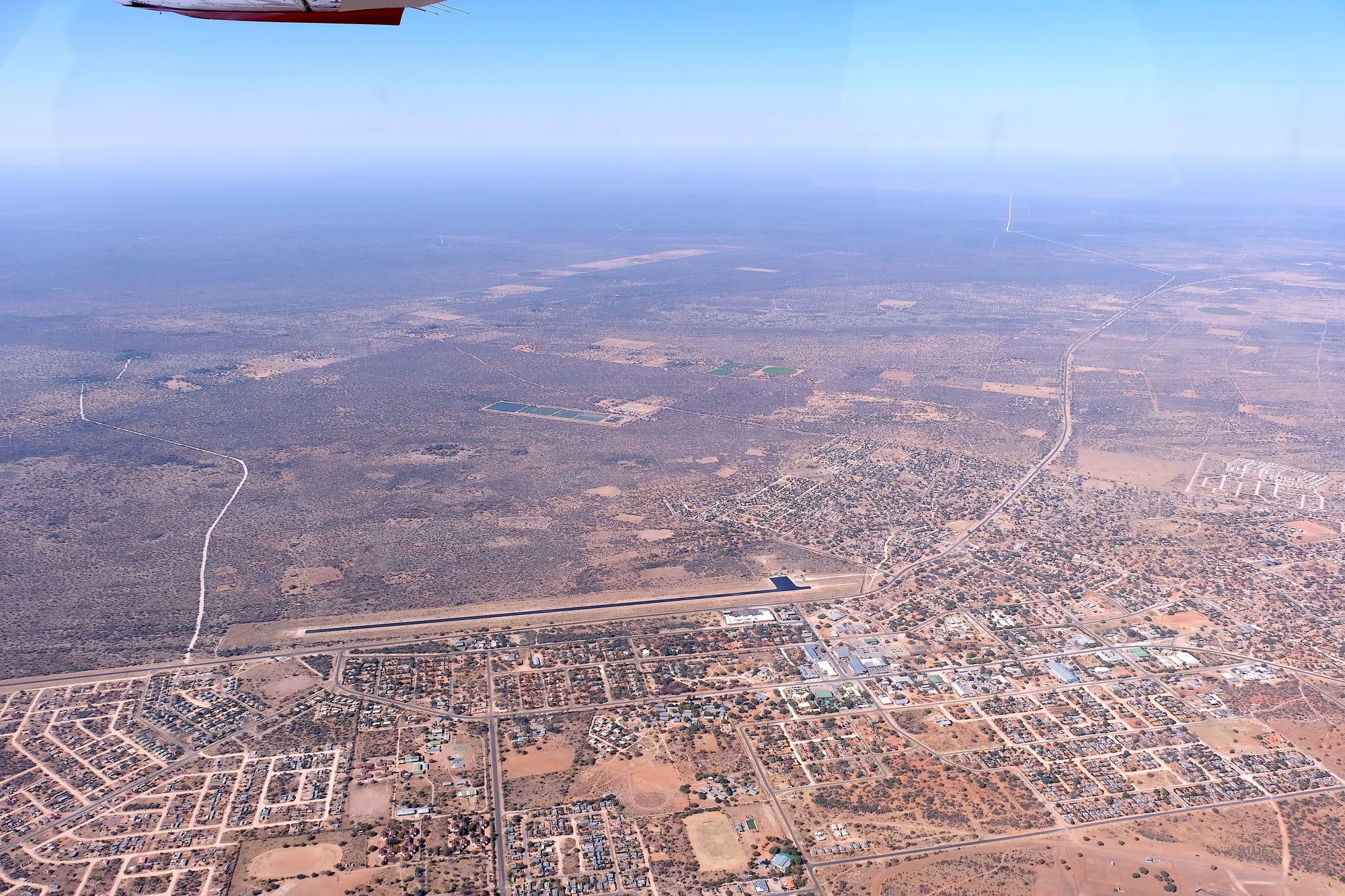
Aerial view of a low grid-plan town with an airstrip, surrounded by red sand and grey Kalahari scrub to the horizon

Gaborone, the Kalahari & the South, Botswana

Ghanzi

Ghanzi from the air, its grid of streets and airstrip set in the scrub of the western Kalahari. (Cindy Heppelmann & Hp.Baumeler / Wikimedia Commons · CC BY-SA 4.0)

The main town of the western Kalahari, set on a low ridge in the middle of Botswana's biggest cattle-ranching district and on the highway that crosses the Kalahari between Gaborone and the Namibian border. It is a small administrative and farming centre, and the usual base for visiting San communities and the reserves of the sandveld.

Neighbourhoods

  • The town centre
    • First-time visitors
    • Supplies and fuel
    • Local life

    A few blocks of government offices, banks, a hospital, supermarkets, filling stations and bottle stores around the main road. Everything practical in Ghanzi is here, and it is the last proper place to stock up before the Kalahari.

    Open in Maps
  • The guest farms on the highway
    • Camping
    • Quiet nights
    • Stopovers

    Lodges and campsites stand on the ranch land along the Trans-Kalahari Highway on either side of town, most of them working cattle farms with rooms, camping ground, bush walks and evening dances. They are where most travellers crossing the desert break the drive.

    Open in Maps
  • The cattle country and outlying settlements
    • Farm stays
    • Long views

    Beyond the town, fenced ranches run for tens of kilometres across the sandveld, interspersed with small settlements and San villages. Distances are long, tracks are sandy, and the land is open grass and thorn scrub grazed by cattle.

    Open in Maps

Things to do

In and around the town

  • Ghanzi Airporttransit hub

    The town's airstrip on the edge of the built-up area, used by light aircraft and charters serving the ranches and the Kalahari lodges.

    Open in Maps
  • Trans-Kalahari Highwaylandmark

    The paved road that crosses the Kalahari to the Namibian border at Mamuno, joined by the road from Ghanzi, the artery that ended the district's isolation when it was completed in the 1990s.

    Open in Maps

Short trips from the town

  • D'Karattraction

    A Naro San settlement about 40 km east of Ghanzi, home to the Kuru Art Project, whose painters and printmakers have exhibited across southern Africa and in Europe, and a shop selling San craft.

    Open in Maps
  • New Xadeattraction

    A village east of Ghanzi built for families moved out of the Central Kalahari Game Reserve from 1997, with a craft shop selling local work.

    Open in Maps

Seasonal events

  • Kuru Dance and Music FestivalAugust

    San groups from across the Kalahari gather at D'Kar for days of traditional dance, music, storytelling and craft.

  • Botswana Independence DaySeptember

    The anniversary of independence on 30 September, marked in the district with kgotla gatherings, sports, choirs and family feasts.

Eat and drink

Long-standing places and food districts in Ghanzi. Hours, ratings and directions come from your maps app, always current.

Ghanzi classics

  • Kalahari beefrestaurant

    This is cattle country, and beef — grilled over coals as a braai, stewed with pap, or dried into biltong — is the basis of almost every meal in town.

    Open in Maps
  • Seswaa and bogoberestaurant

    Salted beef boiled and pounded soft, served with a stiff porridge of sorghum or maize and a relish of greens, is the dish of gatherings and the standard plate at lunch counters.

    Open in Maps
  • Desert foodsmarket

    The Kalahari's gathered foods appear in season — the watery tsamma melon, morama beans, wild berries and desert truffles after good rains — long central to San and Bakgalagadi diets.

    Open in Maps

Where to shop and eat

  • The main road shopsneighborhood

    Supermarkets, butchers, takeaways and bottle stores along the central street supply the ranches and every vehicle crossing the desert; there is little to buy west or north of here.

    Open in Maps

Experience Ghanzi

History

Ghanzi grew up around a pan where cattle and game gathered for water, and San communities lived and hunted across this part of the Kalahari for thousands of years before any settlement existed. The area's pans and waterholes made it a meeting place on routes between the Okavango and the south.

European interest followed the cattle. The first substantial Afrikaner migration reached Ghanzi around 1897–1898, when trekkers took up farms on the ridge, and a scatter of remote ranches grew into a farming block that remained one of the most isolated parts of the Bechuanaland Protectorate. Supplies came by ox wagon and later by truck over sand; the district's people were separated from the east of the country by hundreds of kilometres of desert.

Ghanzi became the district's administrative centre, gaining offices, a hospital and schools after independence. The transformation came with boreholes, veterinary fences and the paving of the Trans-Kalahari Highway in the 1990s, which put Gaborone and the Namibian coast within a day's drive and turned a cattle outpost into a staging town. The same decades brought a long and contested resettlement of San communities from the Central Kalahari Game Reserve into villages such as New Xade to the east, a process a Botswana court ruled illegal in 2006, affirming the right to return to the reserve, and still argued over.

Culture & Customs

Ghanzi is one of the most mixed districts in Botswana. Naro and other San groups, Bakgalagadi, Batswana from the east and Afrikaans-speaking farming families live in the same small town, and Setswana, Naro, Afrikaans and English can all be heard in a morning on the main street. Ranch life shapes the calendar: branding, dipping, auctions and the constant work of boreholes and fences.

San cultural life has found an international audience through the art project at D'Kar, where painters and printmakers work in a style drawn from memory of the veld, and through the Kuru Dance and Music Festival, which brings groups from across the Kalahari together each August for trance dances, songs and games. Craft cooperatives in and around the town sell ostrich-eggshell beadwork, leather and baskets, and guided walks led by San trackers explain plants, snares and water-bearing roots.

Visitors are asked to approach these communities carefully. Much San craft and performance is presented for outsiders, while the everyday reality is one of poverty, land disputes and limited work, and the people themselves object to being treated as a spectacle. Beyond that, the ordinary Botswana courtesies hold: long greetings before business, respect for elders and the kgotla, and full churches on Sunday.

Daily Life

About 21,000 people lived in Ghanzi at the 2021 census, a small town by any measure but the largest settlement for hundreds of kilometres. Government is the main employer — the district administration, hospital, schools and police — followed by cattle, the shops and fuel stations that serve the highway, and a modest tourism trade based on the guest farms.

The rhythm follows the heat and the herds. Work starts early, the middle of the day is slow, and evenings on the veranda are long and cool. Households in town keep cattle at a post out in the sandveld, and a good rainy season is the difference between fat animals and a hard year. Water comes from boreholes, and drought and foot-and-mouth restrictions on beef exports hit the district hard when they come.

Outside town, ranches of several thousand hectares each employ small numbers of workers, many of them from San and Bakgalagadi families whose grandparents lived on the same land before it was fenced. Unemployment and alcohol are persistent problems, land and grazing rights are live political issues, and young people leave for Gaborone or the mines. What has improved is connection: a paved road, mobile coverage in the town, and a bus that can reach the capital in a day.

Food

Ghanzi eats beef. The district raises cattle for the national herd, and meat is cheap, fresh and central: steaks and boerewors sausage over coals, stews with pap, and biltong dried in strips in every kitchen. Seswaa, salted beef boiled until it shreds and then pounded, appears at every wedding, funeral and public holiday, served with bogobe, the stiff sorghum or maize porridge that is the country's staple, and morogo greens.

The Kalahari itself supplies an older set of foods, gathered rather than farmed. The tsamma melon holds drinkable water in the driest months; morama beans are roasted for their nutty kernels; truffle-like fungi push up after heavy rain; and wild berries, tubers and gum from acacia trees have long supported San households. Some of these appear in markets in season, and guided bush walks from the guest farms explain how they are found.

Everyday town food is the same as elsewhere in Botswana: magwinya, the fried dough balls sold in the morning; takeaway plates of chicken, rice and coleslaw; and supermarket bread and maize meal. Chibuku sorghum beer in cartons, home-brewed bojalwa and South African lagers fill the bottle stores, and the Afrikaans farming families keep their own traditions of braai, potjiekos stewed in a three-legged pot and rusks with morning coffee.

Planning tools

Budget

Ghanzi is inexpensive by Botswana standards for a bed and a meal — guest farms, a few small hotels and campsites cover most budgets — but the journey is the cost. Fuel for very long distances, a hire car or 4x4, and guided visits or park fees make up most of what a traveller spends here.

Daily Budget Midrange
USD 110–240 (guest farm or lodge room, meals, a share of a hire car, a guided bush walk)
Daily Budget Shoestring
USD 35–75 (camping or a basic room, supermarket food, shared transport on the highway)

Fill the tank and buy food and water in Ghanzi; fuel and supplies beyond the town are unreliable and far apart.

Best Time to Visit

May to August is the comfortable season: dry, clear days and very cold nights, good for driving the sand tracks. The rains from about December to March turn the sandveld green and bring the Kalahari's wildlife into the fossil valleys, but storms cut tracks. October and November are punishing, often above 38°C.

Suggested Number of Days

Most travellers stop for a night while crossing the Kalahari. Two or three days allow a stay on a guest farm, a guided bush walk with San trackers and a visit to the settlements north of town; reaching the reserves needs considerably longer.

First Visit
1 day
With Surroundings
2–3 days

Transportation

The Trans-Kalahari Highway is paved and carries buses and minibuses between Gaborone, Ghanzi and the Namibian border, with services north towards Maun; the town itself is small enough to walk. Everything off the highway is sand track, and a high-clearance or four-wheel-drive vehicle, carried fuel and water are needed for the ranches and reserves.

Cattle, donkeys and antelope stray onto the highway day and night; drivers should keep speeds moderate and avoid the road after dark.

Airport & Station Connections

Ghanzi sits about eight hours by road from Gaborone on the Trans-Kalahari Highway and a shorter drive from the Mamuno border post into Namibia, with Maun several hours to the north-east; long-distance buses run these routes. The airstrip on the edge of town handles light aircraft and charters rather than scheduled services.

Walkability

The centre is small and flat, and the shops, offices and bus stop are within a few minutes of one another on foot. The heat is the limit rather than the distance, and shade is scarce in the middle of the day. Guest farms outside town are too far to walk to, and there are no pavements on the highway.

Safety

Ghanzi is a quiet town with little crime beyond opportunistic theft, and the real risks are environmental. Heat, dehydration, enormous distances between settlements, patchy mobile coverage and breakdowns on sand tracks matter far more than crime, and livestock and game on the highway cause serious crashes.

Carry recovery gear, two spare tyres, extra fuel and water for the Kalahari parks, leave a route plan with the park office, and never walk outside camp at night. Carry more water than seems necessary and tell someone the route before leaving the highway. Check current official travel advice before travelling.

Climate

Hot semi-desert with a wide daily temperature range. Rain falls only in summer thunderstorms, mostly between December and March, and is lighter and less reliable than in eastern Botswana; the rest of the year is dry, dusty and cloudless. In the southern hemisphere summer runs December to February and winter June to August.

Summer
very hot, commonly 33–38°C by day, with occasional heavy afternoon storms
Winter
dry and sunny, around 22–26°C by day, with nights near or below freezing

Local Customs

The district mixes Setswana-speaking Batswana, Afrikaans-speaking ranching families whose forebears settled here in the 1890s, and Naro and other San communities, and greetings in Setswana — dumela rra, dumela mma — open any conversation. Visits to San settlements are best made through a community project or a guide from the village, so that payment reaches the people taking part, and photography should be asked for every time.

Ask before photographing people, buy craft directly from community workshops where possible, and avoid the word 'bushman' unless a community uses it of itself; dress modestly and greet elders first.

Common Payment Methods

The currency is the Botswana pula (BWP). Ghanzi has banks and ATMs and cards are taken in the supermarkets, fuel stations and larger lodges, but cash is essential for craft, small shops, campsites and anything outside town, and there is nowhere to draw money deeper into the Kalahari.