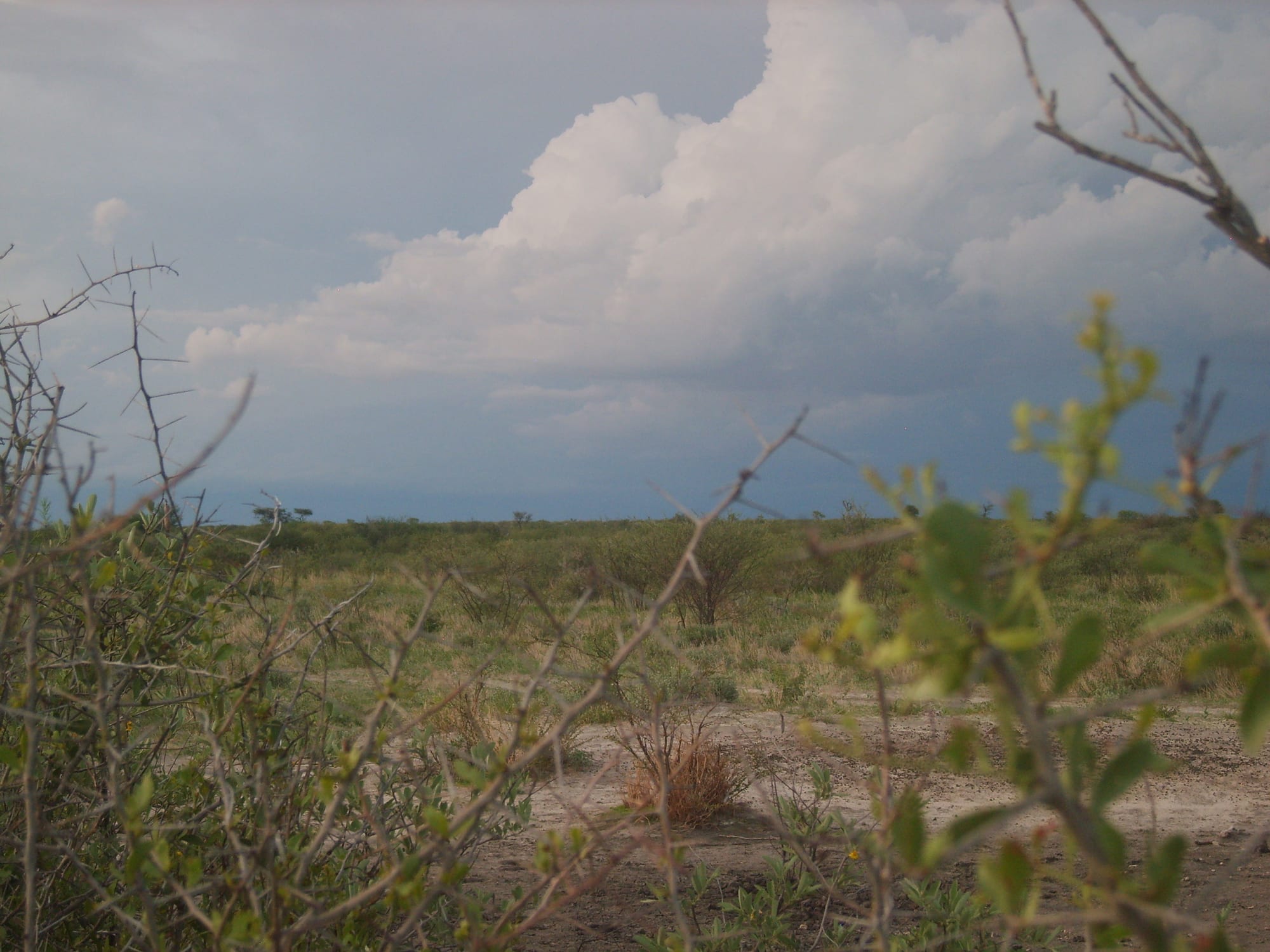
Flat green Kalahari scrubland under towering white thunderclouds, seen through thorny branches

Botswana

Gaborone, the Kalahari & the South

An afternoon thunderstorm building over the scrub of the Central Kalahari Game Reserve. (DVL2 / Wikimedia Commons · CC BY-SA 3.0)

Botswana's south and west, from the capital Gaborone and the old Tswana chiefdom towns along the South African border out across the Kalahari to Ghanzi, the Central Kalahari Game Reserve and the Kgalagadi Transfrontier Park — the country's political and diamond heartland on one side, its emptiest sandveld and San homelands on the other.

Explore Gaborone, the Kalahari & the South

History

The Kalahari's first people were the San, hunter-gatherers whose ancestors lived here for thousands of years, and the Bantu-speaking Bakgalagadi also made the western sandveld their home. Between the 15th and 18th centuries Tswana chiefdoms settled the better-watered east: the Bakwena at Molepolole, the Bangwaketse at Kanye, the Bakgatla at Mochudi, and smaller groups such as the Balete and Batlokwa around what is now Gaborone. David Livingstone ran a mission among the Bakwena at Kolobeng in the late 1840s and baptised their chief, Sechele I, his only known convert.

Pressure from Boer trekkers in the Transvaal led the chiefs to seek British protection, and in 1885 the Bechuanaland Protectorate was proclaimed. When the British South Africa Company tried to take over the territory, the Bangwaketse chief Bathoen I and the Bakwena chief Sebele I travelled to London in 1895 with Khama III of the Bangwato, and persuaded the government to keep them under the Crown. The Protectorate was run from Mafeking, outside its own borders, so at independence a new capital had to be built: Gaborone, laid out from 1964 near the chief Gaborone's village.

Independence in 1966 was followed by the opening of the Jwaneng diamond mine in 1982, which made the south the engine of the national economy. In the west, the Central Kalahari Game Reserve, created in 1961, became the focus of a long dispute when most of its San residents were relocated to settlements outside it from 1997 onwards; in 2006 the High Court ruled that the residents had been unconstitutionally removed, though disputes over access to water and hunting inside the reserve went on for years.

Culture & Customs

The eastern towns are the core of Tswana tradition. Each of the old chiefdoms still has its kgosi, its capital village and its kgotla, the open-air assembly where disputes are heard and community decisions are talked through, and the chiefs of Kanye, Molepolole and Mochudi keep a public role through the national House of Chiefs, the Ntlo ya Dikgosi. Setswana is the everyday language across the region, with Shekgalagadi spoken in the Kgalagadi villages and San languages such as Naro around Ghanzi.

Gaborone is where the country's modern culture is made: government, the University of Botswana, the national museum and gallery, the Maitisong performing arts festival, choirs, gospel and the local house and kwaito scenes. The Ghanzi district has a different character, with Afrikaans-speaking ranching families whose forebears arrived in the 1890s living alongside San communities. San art has found an international audience through the Kuru art project at D'Kar, and the annual Kuru Dance and Music Festival, held each August, brings San groups together to perform traditional dances and songs.

Churches are full on Sundays, weddings and funerals are large community events with cattle slaughtered for the guests, and greeting properly — dumela rra, dumela mma — is expected before any business.

Daily Life

Gaborone has about 250,000 people and, with its commuter villages of Tlokweng, Mogoditshane, Mmopane and Ramotswa, is by far the largest urban area in Botswana. Government, banks, retail and the university dominate, and the city has spread in low-rise blocks, malls and gated housing estates across the bush. Lobatse, a smaller town near the border, is home to the High Court and the Botswana Meat Commission's abattoir, the base of the beef export trade. Kanye, Molepolole and Mochudi are large traditional villages where many residents work in the capital.

Jwaneng is a company town built around Debswana's diamond mine, whose output underpins the national budget; a fall in diamond demand is felt here first. Out in the west, Ghanzi and Tsabong are modest district centres serving huge cattle ranches and scattered settlements where jobs are few.

Daily rhythms follow the heat: early starts, a midday slowdown and busy evenings. Weekends in the villages mean family visits, funerals and the cattle post, and many Gaborone residents still consider a home village their real home. Water is a constant concern, and dry years empty the Gaborone Dam.

Food

Southern Botswana eats as the country does, around bogobe, a stiff porridge of sorghum or maize, served with meat, morogo (wild or garden greens) or a tomato-and-onion relish. Seswaa, beef boiled with salt and pounded into shreds, is the dish for weddings, funerals and national days, and cooking it in three-legged iron pots over an open fire is a men's job at gatherings. Dikgobe, samp mixed with beans, and madila, soured milk, are everyday foods in the villages.

The Kalahari adds its own wild foods, long gathered by the San and Bakgalagadi: the tsamma melon, a wild desert melon valued for its water, the morama bean, and seasonal desert truffles after good rains. Cattle country around Ghanzi and Lobatse means beef is cheap and good, and a braai of steak and boerewors sausage is the standard social meal, especially among the region's Afrikaans-speaking families.

In Gaborone, magwinya — fried dough balls sold from roadside stalls at breakfast — and plates of chicken, pap and coleslaw keep office workers going, while the malls hold the international chains. Chibuku sorghum beer, home-brewed bojalwa and South African lagers are the usual drinks.

Attractions & Natural Wonders

Gaborone is a working capital rather than a sightseeing city, but it has enough for a day or two: the Three Dikgosi Monument in the central business district, the National Museum and Art Gallery, the view from Kgale Hill, and birdwatching at the Gaborone Dam. Mokolodi Nature Reserve, a short drive south, has rhino, giraffe and antelope on its game drives and walking trails, and Livingstone's mission ruins at Kolobeng lie to the west. The Phuthadikobo Museum in Mochudi tells the Bakgatla story in a hilltop building above the village.

Jwaneng, on the Trans-Kalahari Highway, is the diamond town at the centre of the south; the mine itself is closed to casual visitors, but the town marks the start of the long road into the sandveld. Ghanzi, near its far end, is the Kalahari's main town, and the San communities around it, above all D'Kar with its Kuru art centre, offer craft, bushwalks and guided introductions to tracking and gathering.

The great wildernesses lie beyond. The Central Kalahari Game Reserve, one of the largest protected areas in Africa, is best known for Deception Valley and its neighbouring fossil river beds, which after the rains fill with springbok, gemsbok and wildebeest followed by lions, cheetahs and brown hyenas; the smaller Khutse Game Reserve adjoins its southern edge. In the far south-west, the Botswana side of the Kgalagadi Transfrontier Park, formed with South Africa in 2000, holds the red dunes and grassy clay pans of Mabuasehube, where campsites look straight onto waterholes visited by gemsbok and Kalahari lions.

Cities in Gaborone, the Kalahari & the South

Planning basics

Budget

The south is the cheapest part of Botswana to move around, because it is where the towns, supermarkets and paved roads are: Gaborone has hotels and guesthouses at every level and minibuses link the eastern towns cheaply. The Kalahari is the opposite — the Central Kalahari and Kgalagadi parks are reached only by fully equipped 4x4, with campsites booked in advance, and the vehicle, fuel and park fees are the real cost. Ghanzi has a few lodges and guest farms at moderate prices.

Daily Budget Midrange
USD 130–320 (hotels or Kalahari lodges, a hire car or 4x4 share, park fees, guided activities)
Daily Budget Shoestring
USD 40–85 (guesthouses in Gaborone, minibuses and buses, supermarket food)

Stock up on fuel, water and food in Gaborone, Ghanzi or Tsabong before heading for the Kalahari parks; there is nothing to buy inside them.

Safety

Gaborone is calm by regional standards, with the usual urban risks of bag-snatching, car break-ins and occasional burglary. The Kalahari parks are safe from crime but unforgiving: distances are huge, there is no fuel, water or mobile signal inside, and breakdowns, heat and sand are the real dangers. Livestock and wildlife on unfenced roads cause serious crashes at night.

Carry recovery gear, two spare tyres, extra fuel and water for the Kalahari parks, leave a route plan with the park office, and never walk outside camp at night. Check current official travel advice before travelling.

Climate

Semi-arid and continental. The rains fall in thunderstorms between about November and April, heaviest in the east around Gaborone and lightest in the south-west Kalahari. Summer days are hot, and the Kalahari's clear winter nights are the coldest in the country, often dropping below freezing in June and July.

Summer
hot, 30–38°C, with afternoon thunderstorms; hotter and drier towards the Kgalagadi
Winter
dry and sunny, around 20–25°C by day; cold nights near or below 0°C in the Kalahari

Transportation

Gaborone's Sir Seretse Khama International Airport is the country's main gateway, and the city is a short drive from the South African border. The A1 runs north from Gaborone, and the Trans-Kalahari Highway crosses the west via Jwaneng and Kang towards Namibia, passing close to Ghanzi; buses and minibuses serve these paved roads. The Central Kalahari and Kgalagadi parks have sand tracks only and need a self-sufficient 4x4, ideally in convoy.

Allow about eight hours from Gaborone to Ghanzi by road, and more to reach the park gates; do not drive the Kalahari tracks after dark.

Best Time to Visit

For the Central Kalahari, the green season from about December to April is the time, when rain fills the pans and antelope and their predators gather in the fossil valleys. May to September brings cool, clear days that suit driving the Kalahari and visiting Gaborone, though nights are cold. October is hot and dusty everywhere.