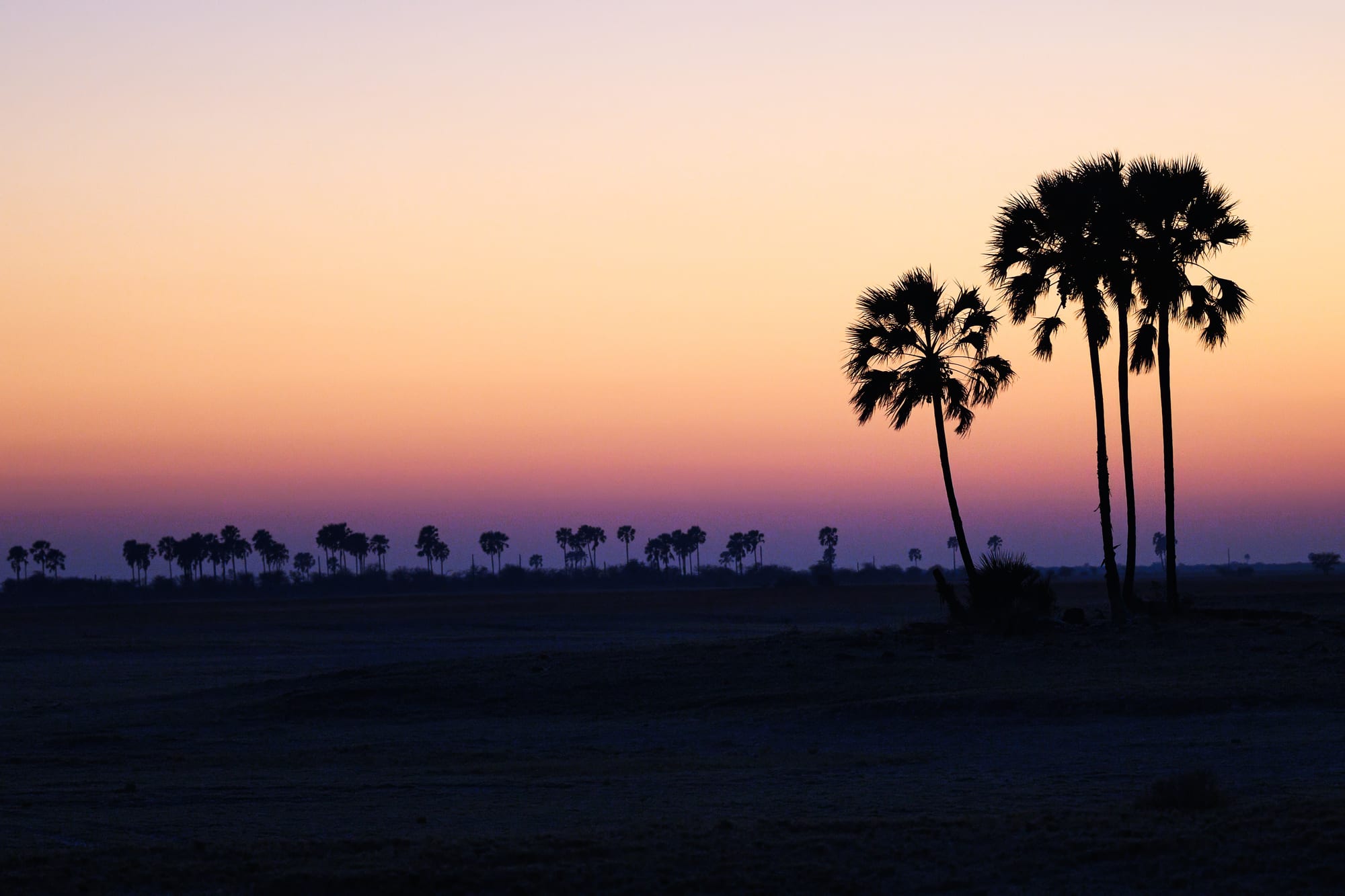
Silhouetted palm trees on a flat, dark plain beneath an orange and violet dawn sky

Botswana

Francistown & the Central District

Palms on the edge of the Makgadikgadi salt pans at sunrise. (Eric Kilby / Wikimedia Commons · CC BY-SA 4.0)

Botswana's broad middle and east, running from the Limpopo farms of the Tuli Block across the Bangwato heartland of Serowe to the Makgadikgadi and Nxai salt pans, with Francistown and the Kalanga country of the North East on the Zimbabwe border — the home of the Khama dynasty, the old gold fields and the Orapa diamond mines.

Explore Francistown & the Central District

History

The eastern hills were part of the world of the Zimbabwe-style stone builders: Domboshaba, near Masunga in the North East, is one of several walled sites from the centuries when Great Zimbabwe dominated the plateau, and the Kalanga, whose language is related to Shona, have lived here since. Further west, the Bangwato, a Tswana chiefdom, rose to dominate the region from their capital at Shoshong.

Their most famous ruler, Khama III, converted to Christianity, banned alcohol among his people and moved his capital first to Palapye and then to Serowe in 1902. He was one of the three chiefs who went to London in 1895 to keep Bechuanaland out of the hands of the British South Africa Company. The north-east took a different path: gold was found at Tati in the 1860s, a concession was granted to European prospectors, and Francistown was founded in 1897 as its town, named after the prospector Daniel Francis. Along the Limpopo, the Tuli Block was ceded to the company as a buffer strip and later sold off as farms.

Khama's grandson Seretse Khama, born in Serowe, caused a crisis in 1948 by marrying Ruth Williams, an Englishwoman; Britain exiled him under pressure from South Africa, but he returned, founded a party and became independent Botswana's first president in 1966. Diamonds were found at Orapa soon after, and Orapa, Letlhakane, the copper-nickel town of Selebi-Phikwe and the soda-ash works at Sowa made the region an industrial one. The Selebi-Phikwe mine closed in 2016, a hard blow to the town.

Culture & Customs

Two cultures share the region. The Bangwato of Serowe, Palapye and the central villages are Tswana, organised around their chiefly house, the Khamas, whose kgotla in Serowe remains a place of national importance; Seretse's son Ian Khama, president from 2008 to 2018, is recognised by many Bangwato as their kgosi and in 2025 took a seat in the Ntlo ya Dikgosi, the House of Chiefs. The Kalanga of Francistown and the North East speak their own language, Ikalanga, and have a strong sense of distinct identity, reflected in the annual Domboshaba cultural festival at the ruins.

Writers found material here: Bessie Head, the South African-born novelist, lived in Serowe from the 1960s until her death in 1986 and wrote about it in Serowe: Village of the Rain Wind and her novels. Traditional music includes Tswana choral singing and the Kalanga drum and dance traditions, and Francistown's bars are a centre of Botswana's popular music.

In the Boteti villages around the pans live Bakgalagadi, Bateti and San communities, with smaller Herero and Babirwa groups elsewhere. Across all of them, cattle carry social weight, respect for elders and the kgotla are taken seriously, and weddings and funerals bring whole villages together for days.

Daily Life

Francistown has about 100,000 people and is the commercial hub of the north, a trading and warehousing town on the rail line and the road to Zimbabwe, with a busy cross-border trade and a large Zimbabwean community. Serowe, Mahalapye and Palapye are large villages that have grown into towns; Palapye in particular has expanded around the Botswana International University of Science and Technology and the coal-fired Morupule power station.

Mining shapes the rest. Orapa is a diamond-company town, and nearby Letlhakane has another mine; Sowa Town houses workers at the soda-ash and salt plant on the edge of Sowa Pan. Selebi-Phikwe, built for its copper-nickel mine, has been trying to find new industries since the closure. Most rural people farm sorghum and maize in a good year and keep cattle and goats, and droughts hit hard. The Tuli Block is a thinly peopled belt of ranches, game farms and irrigated fields along the river.

Food

This is the heart of mophane country, and phane — the fat caterpillars of the mophane emperor moth, gathered in the woodlands after the rains, gutted, boiled and dried — are sold by the sackful in Francistown's markets and eaten fried with tomato and onion or as a crunchy snack. The harvest is an important source of income for rural families across the region.

Everyday meals are bogobe (sorghum or maize porridge) with beef stew or greens, seswaa (salted, pounded beef) at celebrations, and dikgobe, samp and beans. Kalanga households have their own dishes, such as tophi, and the North East grows more maize, sorghum, beans and melons than the dry west.

Wild fruits add to the diet in season: the marula tree's fruit is eaten fresh and brewed into a sweet, lightly alcoholic drink, and the woodlands yield wild berries and other gathered foods. In Francistown and along the A1, roadside stalls sell grilled meat, fat cakes and roasted maize to travellers, and Chibuku sorghum beer is the everyday drink.

Attractions & Natural Wonders

The Makgadikgadi is the region's great sight: a string of salt pans, above all Ntwetwe and Sowa, left by a lake that dried up long ago and now among the largest salt flats in the world. In the dry season they are blinding white and silent; Kubu Island, a granite outcrop on Sowa Pan ringed by baobabs, is a national monument with a campsite, and flamingos gather on the flooded pan in good wet years. The Nata Bird Sanctuary protects the pan's north-eastern edge. The Makgadikgadi Pans National Park, along the Boteti river, has the zebra and wildebeest migration in the wet season, and habituated meerkat colonies at the edge of the pans are visited from nearby lodges.

Nxai Pan National Park, to the north, is a grassy fossil pan where springbok, zebra and giraffe gather after the rains, and its Baines' Baobabs stand much as Thomas Baines painted them in 1862.

In the east, the Khama Rhino Sanctuary near Serowe, a community trust founded to bring rhinos back to the country, has white and black rhinos, antelope and birdlife around its pans; in Serowe itself are the royal graves and the Khama III Memorial Museum. Francistown's Supa Ngwao Museum tells the story of the Kalanga and the gold rush, and the Domboshaba ruins lie to the north. The Tuli Block, in the far east, holds the Northern Tuli game reserves where the Shashe meets the Limpopo, with big elephant herds, sandstone kopjes and Solomon's Wall.

Cities in Francistown & the Central District

Planning basics

Budget

The central region is moderately priced: Francistown, Palapye and Serowe have plenty of affordable hotels, lodges and guesthouses on the main road, and buses and minibuses are cheap. Costs rise at the salt pans, where the lodges on the edge of the Makgadikgadi and the private reserves of the Northern Tuli charge safari prices, and park entry and a 4x4 are needed for Nxai Pan and the Makgadikgadi national park.

Daily Budget Midrange
USD 130–320 (lodges at the pans or on the Tuli Block, a 4x4 hire share, park fees and guided drives)
Daily Budget Shoestring
USD 35–70 (town guesthouses, buses and minibuses, market food, camping at the rhino sanctuary)

Camping at the Khama Rhino Sanctuary or Nxai Pan keeps costs down; the luxury pan camps are priced like the Okavango.

Safety

The region is generally safe. Francistown has ordinary urban crime, and the busy A1 is dangerous at night because of trucks, cattle and donkeys on the road; elephants cross the Nata road. On the pans the main dangers are getting stuck or lost far from help, with no mobile signal, and heat and glare in the dry season.

Drive only in daylight, carry extra water and recovery gear onto the pans, and tell someone the route. Check current official travel advice before travelling.

Climate

Hot and semi-arid, with summer rains in thunderstorms from about November to March and a long dry season. The Limpopo valley of the Tuli Block is one of the hottest parts of the country in summer, and the open salt pans are glaring by day and cold at night in winter.

Summer
hot, 32–40°C, with storms; the pans flood shallowly in wet years
Winter
dry, 22–27°C by day; cold nights, sometimes near freezing on the pans

Transportation

The A1 runs the length of the region from Gaborone through Mahalapye and Palapye to Francistown, about five or six hours from the capital, and on to the Zimbabwe border; the A3 heads west from Francistown through Nata towards Maun, skirting the pans. Buses and minibuses serve these roads, and Francistown has flights to Gaborone. The pans, Kubu Island, Nxai Pan and the Tuli Block need a 4x4, and Kubu Island a GPS and some experience.

Keep to existing tracks on the pans; the crust can hide soft mud, especially after rain.

Best Time to Visit

The rains, from about December to March, bring the zebra and wildebeest migration to the Makgadikgadi grasslands and Nxai Pan and flamingos to Sowa Pan, but they also turn tracks to mud. April to October is dry and suits driving onto the pans and visiting Kubu Island, with game gathering on the Boteti river late in the season. The Tuli Block is best in the dry winter months.