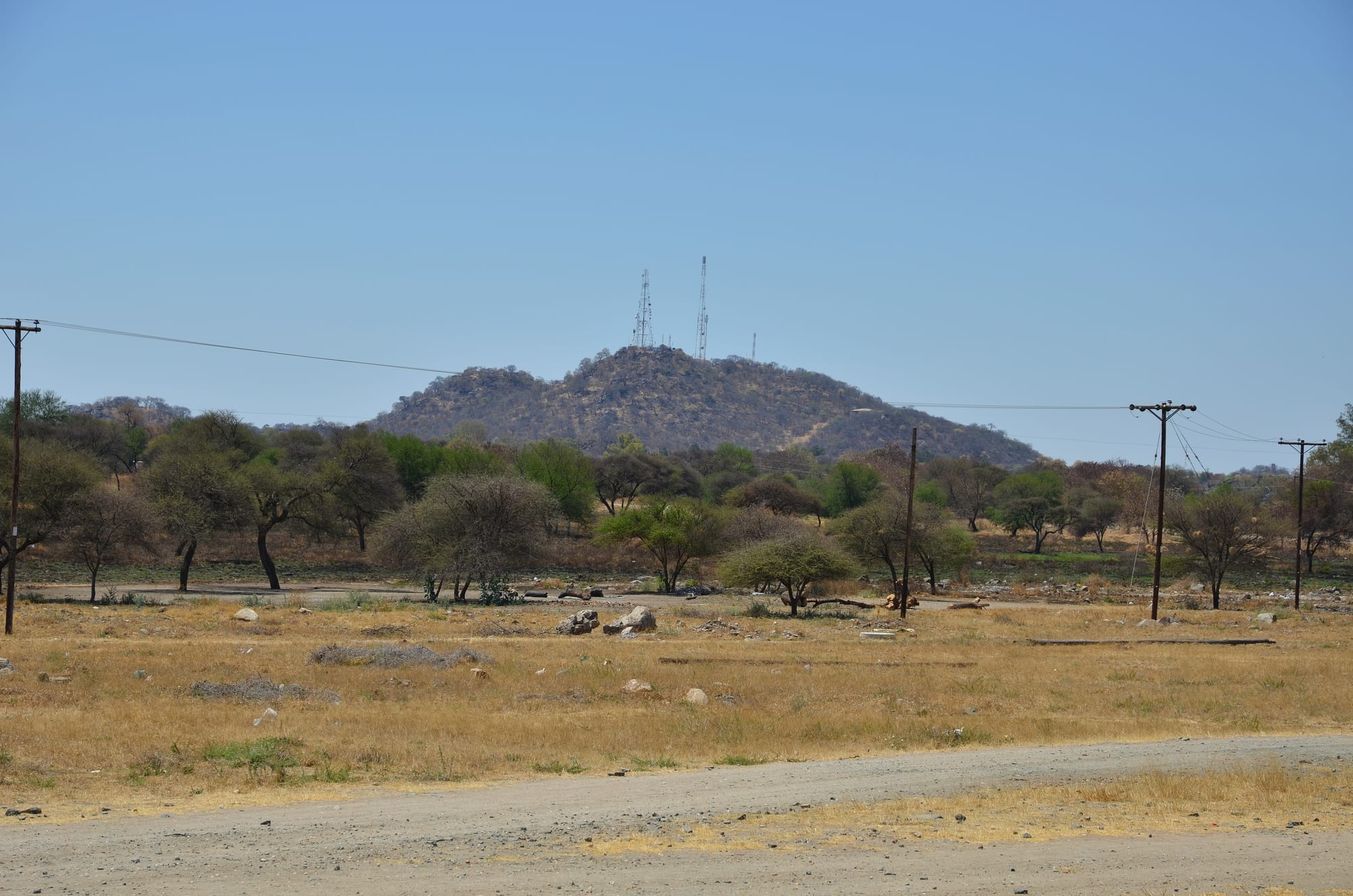
A rocky bush-covered hill topped with transmitter masts rising above dry grass, thorn trees and power lines

Francistown & the Central District, Botswana

Francistown

A masted hill above the dry bush on the edge of Francistown. (Pavel Špindler / Wikimedia Commons · CC BY 3.0)

Botswana's second city, on the Tati River in the north-east, founded in 1897 around the gold workings of the Tati district and grown into the commercial capital of the north. It is a working crossroads of rail, road and warehouses, with the Zimbabwe border an hour away, a museum of Kalanga and gold-rush history, and bush hills on its edges.

Neighbourhoods

  • The town centre and Blue Jacket Street
    • First-time visitors
    • Shopping
    • Close to transport

    The old commercial core around Blue Jacket Street, with banks, shops, the bus and taxi ranks, the railway station and street traders. It is busy and loud in the daytime and empties in the evening.

    Open in Maps
  • Tatitown
    • Local life
    • Markets

    An older residential area west of the centre, laid out as the town spread from its gold-camp beginnings, with small shops, bars and churches on sandy streets. It gives a sense of everyday Francistown away from the malls.

    Open in Maps
  • Monarch
    • Local life
    • Quiet and residential

    A large residential district north of the centre, named after one of the old mine workings nearby, with schools, clinics and shopping centres serving the surrounding housing.

    Open in Maps
  • Gerald Estate and Satellite
    • Hotels
    • Restaurants
    • Quiet and residential

    The greener, more spacious suburbs east and south of the centre, where most of the city's guesthouses, lodges and sit-down restaurants are, within a short drive of the main road and the malls.

    Open in Maps
  • The industrial and highway strip
    • Business travellers
    • Transport links

    Warehouses, transport yards, hardware wholesalers and fuel stations line the A1 and the rail corridor on the edge of town — the freight business that makes Francistown the supply point for northern Botswana and the border trade.

    Open in Maps

Things to do

Museums and arrival points

  • Supa Ngwao Museummuseum

    The regional museum for Francistown and the north-east, founded in 1986, with displays on the history, culture and crafts of the Kalanga and the town around them, and a craft shop.

    Open in Maps
  • Phillip Gaonwe Matante International Airporttransit hub

    The city's airport, also known as Francistown International, on the western edge of the built-up area, handling domestic flights along with charters, light aircraft and military traffic.

    Open in Maps

Water and open country

  • Shashe Damattraction

    The reservoir about 25 km south-west of the city on the Shashe River, built for the mining town of Selebi-Phikwe and the source of Francistown's water since 1982, used for fishing and sailing and rich in birds.

    Open in Maps

Short trips from the city

  • Domboshabalandmark

    A hilltop site of dry-stone walling from the era when the Zimbabwe plateau's stone-building culture reached this far west, and the setting for an annual Kalanga cultural festival.

    Open in Maps
  • Tonotaattraction

    A large village south of the city on the main road, spread along the Shashe River, with a college and a busy roadside trade.

    Open in Maps
  • Ramokgwebanaattraction

    The village at Botswana's main north-eastern border crossing, facing Plumtree in Zimbabwe, through which much of the city's cross-border trade passes.

    Open in Maps

Seasonal events

  • Domboshaba Cultural FestivalSpring (September)

    An annual gathering at the Domboshaba ruins celebrating Kalanga language, music, dance and food, drawing people from across the North East.

  • President's Day holidayJuly

    A long mid-winter public holiday weekend, with national competitions in choral singing, traditional dance and drama and heavy travel between city and village.

  • Botswana Independence DaySeptember

    The anniversary of independence on 30 September, marked with parades, church services, kgotla gatherings and family feasts.

Eat and drink

Long-standing places and food districts in Francistown. Hours, ratings and directions come from your maps app, always current.

Francistown classics

  • Phanemarket

    The dried caterpillars of the mophane moth, gathered in the surrounding woodlands after the rains and sold by the cup and the sack, fried with onion and tomato or eaten as a crunchy snack.

    Open in Maps
  • Seswaa and bogoberestaurant

    Salted beef boiled until it shreds and pounded soft, served with a stiff sorghum or maize porridge and greens — the dish of weddings, funerals and national days.

    Open in Maps
  • Roadside braai and fat cakesmarket

    Grilled meat, roasted maize and magwinya, the fried dough balls sold from stalls along the A1 and around the bus rank, are what travellers and workers eat on the move.

    Open in Maps

Food districts and markets

  • The Blue Jacket Street areaneighborhood

    Takeaway counters, bakeries, bars and stalls cluster around the main street, the ranks and the railway, feeding shoppers and cross-border traders through the day.

    Open in Maps
  • The shopping centresneighborhood

    The malls on the edges of the centre hold the city's sit-down restaurants — grills, South African chains, Indian and Chinese kitchens — and are where Francistown eats out in the evening.

    Open in Maps

Experience Francistown

History

Francistown owes its existence to gold. Workings in the Tati district, the country between the Shashe and Ramokgwebana rivers, had been mined long before Europeans arrived, and when prospectors confirmed the reefs in the 1860s a rush followed — often described as the first in southern Africa. A concession was granted over the district, and the town was founded in 1897 near the Monarch mine and named after Daniel Francis, an English prospector who held licences in the district and was a director of the Tati Concessions Company.

The railway from South Africa to Bulawayo arrived in the same years and fixed its future. Gold mining was never as rich as hoped and faded in and out through the 20th century, but the rail line, the road and the position near the Rhodesian border made Francistown a trading and transport town, with a small, tightly held commercial class and a working population drawn from the surrounding Kalanga villages.

Under the Bechuanaland Protectorate it was the territory's largest town for a period, and from the 1930s to the 1980s it was a recruiting and transit point for the Witwatersrand Native Labour Association, which moved workers by rail and air to the mines of South Africa. After independence the mines and industries of the central district — Selebi-Phikwe's copper and nickel, the diamond mines at Orapa and Letlhakane, the soda-ash plant at Sowa — made it their supply base, and it became the commercial capital of northern Botswana, with warehousing, wholesalers and cross-border trade at its core.

Culture & Customs

Francistown is the centre of Kalanga Botswana. Ikalanga, a language related to Shona, is spoken widely in the city and the villages of the North East alongside Setswana, and there is a sustained effort to keep it in use through choirs, radio, writing and the annual festival at the Domboshaba ruins, where Kalanga dance, dress and food are celebrated each year. Tswana, Babirwa and Zimbabwean communities live alongside, and many families have relatives on both sides of the border.

Weekend nights are lively along the main strips, where bars and halls put on live music. Football is followed closely: Francistown has several long-established clubs and grounds of its own, and matches draw crowds from the villages around the city.

Customs are those of the wider region and taken seriously: long greetings before any business, respect for elders, modest dress, and full churches on Sunday. Funerals are large, lengthy community affairs, and many city residents keep strong ties to a home village and a cattle post, returning at weekends and at Christmas. The kgotla still functions in the villages that the city has grown towards.

Daily Life

About 103,000 people lived in Francistown at the 2022 census, making it Botswana's second city and by far the largest place in the north. Its economy is trade and services: wholesalers, hardware and transport firms, shopping centres, banks, hospitals, colleges and the government offices of the district, with mining and agriculture supplying custom rather than jobs inside the city itself.

The border shapes daily life. Goods, buses and traders move constantly between the city and Zimbabwe through Ramokgwebana, and a large Zimbabwean community lives and works here, sending money and supplies home. Trucks on the A1 and the rail line keep the industrial edge of town busy through the night, while the centre is a daytime place, emptying after the shops close.

Residents live mostly in single-storey houses on serviced plots in districts that have spread north and west as the city has grown, with newer estates on the outskirts. Water supply, drawn from the Shashe Dam since 1982, is a recurring worry in dry years, and unemployment, especially among young people, is the constant local complaint. The closure of the copper-nickel mine at nearby Selebi-Phikwe in 2016 was felt in the city's trade, and the region's economy has been looking for replacements since.

Food

Francistown sits in mophane woodland, and phane — the caterpillars of the mophane emperor moth, gathered after the rains, gutted, boiled and dried — is the food most associated with the city. It is sold by the cup and by the sack in the markets, fried with onion and tomato, stewed, or eaten dry as a snack, and the harvest is an important seasonal income for rural households across the North East.

Otherwise the staples are the country's: bogobe, the stiff sorghum or maize porridge, with beef stew, goat or morogo greens; seswaa, salted beef pounded soft, at every gathering; dikgobe, samp cooked with beans; and madila, soured milk. Kalanga households keep their own dishes and their own names for them, and the wetter east grows more maize, beans, groundnuts and melons than the Kalahari districts to the west. Marula fruit is eaten fresh in late summer and brewed into a sweet, lightly alcoholic drink.

Street and roadside food is a genuine part of the city: magwinya, the fried dough balls sold from early morning; grilled meat and roasted maize cobs along the A1; and takeaway plates of chicken, rice, beans and coleslaw around the ranks. The shopping centres hold South African chains and grill houses, and the bars serve Chibuku sorghum beer in cartons alongside bottled lagers.

Planning tools

Budget

Francistown is an inexpensive city by Botswana standards, with guesthouses, lodges and mid-range hotels aimed at business travellers and cross-border traders, cheap minibuses and plenty of street and supermarket food. Costs rise only when a hire car or a trip out to the pans or the Tuli Block is added.

Daily Budget Midrange
USD 110–230 (hotel or lodge, restaurant meals, a hire car, museum entry)
Daily Budget Shoestring
USD 35–70 (guesthouse room, minibus fares, market and supermarket food)

Weekday rooms fill with business and government travellers and are often cheaper at weekends; the museum costs very little.

Best Time to Visit

May to August is the pleasant season — dry, clear days in the low to mid-20s °C and cool nights — and the best time to combine the city with the salt pans to the west. September to November is very hot before the rains. The wet months from December to March are humid and stormy but green, and the phane harvest falls in this period.

Suggested Number of Days

The city itself is a day. Three or four days suit a visit that also takes in the Kalanga country and ruins to the north, the Shashe valley and the long drive west towards the pans. Many travellers simply overnight here between Gaborone, Maun and the Zimbabwe border.

First Visit
1 day
With Surroundings
3–4 days

Transportation

Shared minibuses, called combis, run from the ranks in the centre out to the residential areas for a flat fare, and taxis wait at the malls, the station and the hotels. Long-distance buses to Gaborone, Maun, Kasane and the border leave from the main rank; the railway through the city carries freight, its passenger services suspended. A hire car is needed for the dam, the ruins and the villages.

Traffic drives on the left; the A1 carries heavy freight and cattle and donkeys stray onto it, so night driving between towns is best avoided.

Airport & Station Connections

The airport sits on the western edge of the city and handles domestic flights and charters, with international connections made through Gaborone or Johannesburg. Most arrivals are by road: the A1 runs south to Gaborone in about five or six hours and north-east to the Zimbabwe border at Ramokgwebana, while the A3 heads west through Nata towards Maun. Passenger rail services through the city are suspended.

Walkability

The commercial centre is compact and easily covered on foot, with the ranks, banks, market and main shops within a few blocks. Beyond it the city spreads out along wide roads and the rail corridor, distances between suburbs are long, pavements are patchy, and the heat discourages walking in the middle of the day. After dark most people take a taxi.

Safety

Francistown is a generally safe city with ordinary urban crime — pickpocketing and bag-snatching around the ranks and market, theft from parked cars, and burglary. The centre is quiet after business hours and poorly lit in places, and the busy A1 and the border road are the greater practical danger, with heavy trucks and livestock on the carriageway.

Drive only in daylight, carry extra water and recovery gear onto the pans, and tell someone the route. In the city, keep bags closed around the ranks and market, leave nothing visible in a parked car, and take a taxi after dark. Check current official travel advice before travelling.

Climate

Hot and semi-arid, a little wetter than western Botswana. Rain falls in summer thunderstorms from about November to March, and the rest of the year is dry, sunny and dusty with cool nights. In the southern hemisphere summer runs December to February and winter June to August.

Summer
hot and humid, commonly 32–36°C by day, with heavy afternoon storms
Winter
dry and bright, around 24–27°C by day, with nights that can fall close to freezing

Local Customs

This is Kalanga country as well as Tswana: Ikalanga is widely spoken alongside Setswana and English, and local identity is a matter of some pride. Greetings come before business, elders are addressed respectfully, and dress is modest, particularly for church, offices and any visit to a kgotla. Funerals and weddings take precedence over most other plans at weekends.

Tipping is not obligatory but about 10 per cent is welcome in restaurants; ask before photographing people or homesteads, and do not photograph the border post or government buildings.

Common Payment Methods

The currency is the Botswana pula (BWP). Banks and ATMs are easy to find in the centre and the malls, and cards are taken in supermarkets, fuel stations, hotels and chain restaurants. Cash is needed for combis, market stalls, street food and village shops, and South African rand and Zimbabwean traders' dollars circulate informally near the border.