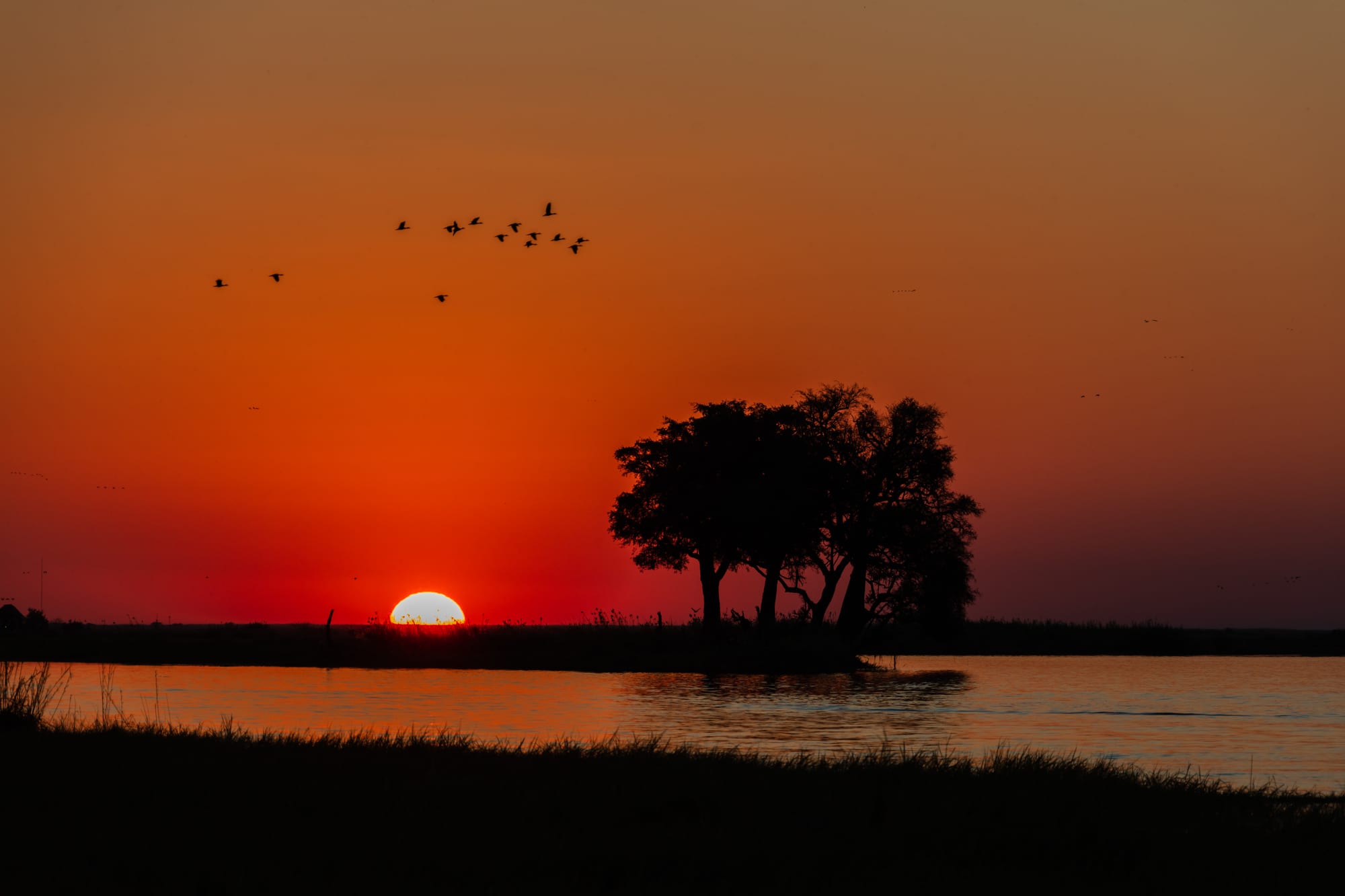
A red-orange sunset sky over a calm river, with a cluster of trees silhouetted on a low island and a flock of birds flying overhead

Botswana

The Okavango Delta, Chobe & the North

Sunset over the Chobe River in Chobe National Park. (Diego Delso / Wikimedia Commons · CC BY-SA 4.0)

Botswana's far north and north-west — Ngamiland and the Chobe district — where the Okavango river spreads into its inland delta around Maun and Moremi, and the Chobe and Linyanti rivers edge the Caprivi border past Savuti and Kasane; the country's wildlife heartland, home to much of the largest elephant population on Earth.

Explore The Okavango Delta, Chobe & the North

History

The north-west has one of the longest human records in southern Africa. The San lived here for tens of thousands of years, and the paintings of the Tsodilo Hills were added to over a very long period; farming peoples reached the Okavango panhandle more than a thousand years ago. From the late 18th century the Batawana, a Tswana group who broke away under their chief Tawana, built a state around Lake Ngami and the Delta that drew in the Bayei, the Hambukushu, the Basubiya of Chobe and the San as subjects.

European hunters and traders followed David Livingstone, who reached Lake Ngami in 1849, and ivory and ostrich feathers brought the region into the colonial economy. After the German war against the Herero in neighbouring South West Africa in 1904, Herero refugees crossed into Ngamiland, where their descendants still live. The Batawana moved their capital to Maun in 1915, and for most of the 20th century the north was remote, affected by the tsetse fly and kept apart from the rest of the country by veterinary fences built to control cattle disease.

Conservation changed everything. The Batawana created the Moremi Game Reserve on their own land in 1963, Chobe became the country's first national park in 1968, and from the 1970s Maun grew into a safari town. The Okavango Delta was declared a UNESCO World Heritage Site in 2014, and the region now sits within the Kavango–Zambezi transfrontier conservation area shared with Angola, Namibia, Zambia and Zimbabwe.

Culture & Customs

The north is Botswana's most mixed region. The Batawana are the ruling Tswana chiefdom of Ngamiland, with their kgotla in Maun; the Bayei, traditionally fishermen and makers of the dugout mokoro, live along the Delta's rivers; the Hambukushu hold the panhandle and include families who arrived as refugees from Angola from the late 1960s; the Herero keep their own language, cattle culture and the long Victorian-style dresses and horn-shaped headcloths of their women; the Basubiya live around Kasane; and San communities remain in the dry west and around Tsodilo.

The best-known craft is basketry. Women in Gumare, Etsha and the panhandle villages weave tightly coiled baskets from the fibre of the mokola palm, coloured with local dyes, and sell them through cooperatives and Maun's craft shops. Tsodilo's hills are sacred places where some people still come to pray.

Safari work has created a guiding culture of its own: many polers and guides are Bayei and Hambukushu who grew up on the water, and knowledge of animals and plants carries real standing. Local conversations turn on the flood, the cattle fences and hunting policy.

Daily Life

Maun, with about 85,000 people, is the region's town and one of Botswana's fastest growing: a spread-out place of cattle, donkeys, tin-roofed houses, supermarkets, air charter offices and 4x4 hire yards along the Thamalakane river. Kasane, far smaller, sits on the Chobe riverfront at the corner where Botswana meets Namibia, Zambia and Zimbabwe, and lives almost entirely from tourism and the border crossings. Shakawe, Gumare and Seronga are the main panhandle villages.

Tourism is by far the largest employer, from lodge cooks and pilots to guides and mechanics, and much of the Delta is leased to safari companies as concessions, some in partnership with community trusts. Outside it, people fish, farm floodplain fields of maize and sorghum, and keep cattle, whose exports are limited by the foot-and-mouth disease controls.

Life with wildlife is a daily issue. Botswana has the largest elephant population in the world, most of it in the north, and elephants raid fields and water points; hunting, banned in 2014 and later reopened, remains a heated national debate.

Food

The Delta adds fish to the national menu: bream (tilapia) and catfish caught by line, net and trap from the channels, fried, grilled over coals or dried for the dry season. The floodplain also yields water-lily tubers and seeds, and wild fruits are gathered in season.

Daily meals follow the Botswana pattern — bogobe (sorghum or maize porridge) with beef, goat or chicken stew, greens and beans — and seswaa, pounded salted beef, is cooked for weddings and celebrations. Phane, the dried mophane caterpillars, are gathered in the mophane woodlands of Chobe and eaten fried or as a snack. Wild fruits such as the marula and the monkey orange are eaten in season.

The safari camps serve international food, often cooked with considerable ambition in the bush, and lodge dinners around a fire are part of the visit. Maun and Kasane have a few cafés and grills catering to guides, pilots and travellers, and the usual drinks are lager, Chibuku sorghum beer and home brews.

Attractions & Natural Wonders

The Okavango Delta is the reason most people come. The river arrives from Angola through the narrow panhandle and fans out into a maze of channels, lagoons, papyrus and palm islands that floods most fully in the dry winter. Mokoro trips, poled by local guides, glide past water lilies, reed frogs and red lechwe; motorboats work the deeper panhandle channels, and scenic flights from Maun show the full pattern of water and game trails. Moremi Game Reserve, on the Delta's eastern side, combines water and dry land, with Xakanaxa, Third Bridge and the Khwai river among its best-known areas and lion, leopard, wild dog and buffalo common.

Chobe National Park covers the north-east. Its riverfront beside Kasane is famous for dry-season elephant herds crossing and drinking on the Chobe, best seen from a boat cruise at sunset with hippos, crocodiles and buffalo on the islands. Inland, the Savuti marsh is fed only in some years by the Savuti Channel, which has dried and flowed again within living memory; Savuti's lions are known for hunting large prey. The Linyanti swamps lie along the Namibian border.

In the far north-west, the Tsodilo Hills rise out of the Kalahari with thousands of rock paintings, a UNESCO World Heritage Site. Lake Ngami, south-west of Maun, fills in good flood years and draws flocks of waterbirds, and the Gcwihaba caves lie deep in the western desert.

Cities in The Okavango Delta, Chobe & the North

Planning basics

Budget

This is where Botswana's high prices are concentrated. Fly-in camps in the Delta's private concessions and on the Linyanti are among the most expensive safaris in Africa, quoted in US dollars per person per night. Cheaper routes exist: campsites and lodges in Maun and Kasane, mokoro trips from Maun or the panhandle villages, Chobe boat cruises from Kasane, and self-drive camping in Moremi and Chobe, though park and campsite fees are substantial.

Daily Budget Midrange
USD 250–630 (town lodges, guided day trips and scenic flights, or a mobile camping safari)
Daily Budget Shoestring
USD 65–130 (Maun or Kasane campsites and backpacker lodges, a shared mokoro or boat trip, park fees)

Campsites in Moremi, Savuti and on the Chobe riverfront are privately run and book out months ahead for the dry season.

Safety

Crime is low outside Maun and Kasane, where ordinary petty theft occurs. The dangers are wild ones: many camps are unfenced, and elephants, hippos, buffalo and lions pass through them, especially at night; the Chobe and Okavango hold crocodiles and hippos. Malaria is present, especially in and after the rains, and elephants on the Nata–Kasane road make night driving dangerous.

Take malaria precautions, never walk in unfenced camps after dark without an escort, keep well back from elephants and follow guides' instructions in a mokoro. Check current official travel advice before travelling.

Climate

Hotter and wetter than the south, with summer rains from about November to March and a long dry season. The Delta's own flood is out of step with the rains: water from the Angolan highlands arrives slowly and peaks in the dry winter months. October, before the rains, is the hottest month and often passes 40°C.

Summer
hot and humid, 30–40°C, with afternoon thunderstorms and green, dispersed game
Winter
dry and clear, 25–28°C by day; chilly nights of around 5–10°C, colder in open vehicles at dawn

Transportation

Maun and Kasane airports have regional flights from Johannesburg and elsewhere, and light aircraft link them to the Delta camps. Paved roads reach Maun from Nata and Ghanzi, and Kasane from Nata; the drive between Maun and Kasane through Moremi, Khwai and Savuti is a sandy 4x4 route taking a long day or two. Kasane is about 80 km from Victoria Falls, and the Kazungula Bridge crosses the Zambezi to Zambia.

In the wet season check with park offices before driving to Savuti or Moremi; deep sand and flooded crossings close routes.

Best Time to Visit

June to October is the classic season: the Delta flood is high, the bush is thin and elephants crowd the Chobe and the permanent water. September and October are superb for game but very hot. The green season from about December to March is cheaper, excellent for birds and newborn animals, and brings malaria risk and some flooded or closed tracks.