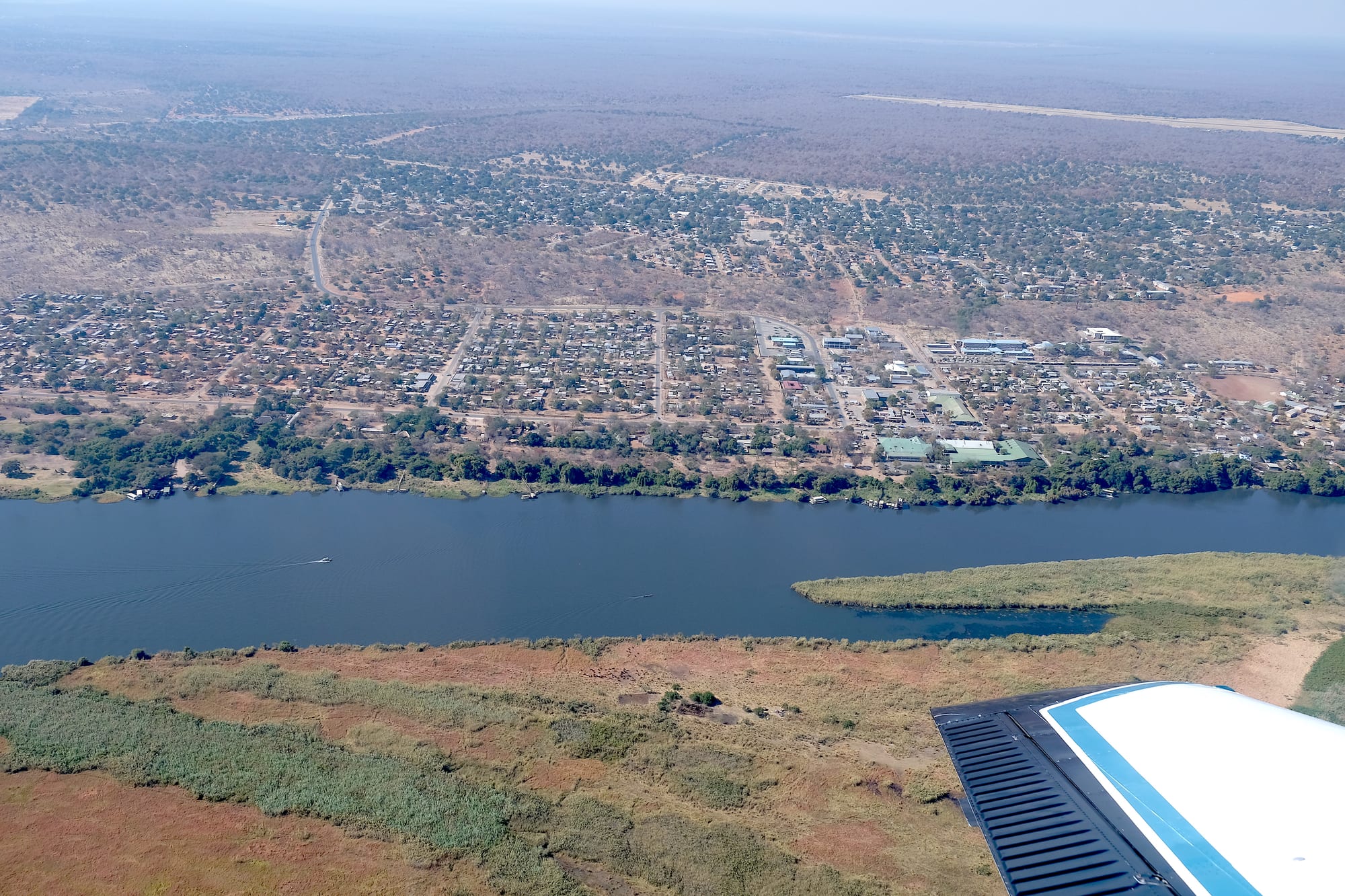
Aerial view of a low, tree-filled town spread along the far bank of a wide river, with dry bush stretching to the horizon

The Okavango Delta, Chobe & the North, Botswana

Kasane

Kasane from the air, strung along the south bank of the Chobe River. (Christine Scholer & Hp.Baumeler / Wikimedia Commons · CC BY-SA 4.0)

A small town on the south bank of the Chobe River in Botswana's far north-east, at the corner where the country meets Namibia, Zambia and Zimbabwe. It grew from a riverside settlement and administrative post into the gateway to Chobe National Park, whose gate stands at the edge of town, and it lives today on safari tourism and border traffic.

Neighbourhoods

  • The riverfront
    • First-time visitors
    • River views
    • Wildlife

    The strip of ground between the main road and the Chobe, where most of the town's lodges, campsites and boat jetties look north across the water to the Namibian floodplain. Elephants and hippos move along this bank, and gardens are fenced accordingly.

    Open in Maps
  • The town centre
    • Local life
    • Shops and services
    • Quiet and residential

    The strung-out centre along the main road holds the supermarkets, banks, filling stations, the clinic and government offices, with residential blocks of single-storey houses set back behind them. It is a working Botswana town rather than a resort, busy in the morning and quiet by mid-afternoon.

    Open in Maps
  • Kazungula
    • Border crossing
    • Close to transport

    The village about 8 kilometres east of Kasane at the point where four countries meet, and the site of the road and rail bridge over the Zambezi to Zambia. Trucks queue here for customs, and the crossing to Zimbabwe lies a short way on.

    Open in Maps
  • The Chobe gate side
    • Safari starts
    • Walks

    The western end of town, where the tarred road runs out at Sedudu Gate, the main entrance to Chobe National Park. Game-drive vehicles gather here at first light and in the late afternoon, and the bush begins immediately beyond the boom.

    Open in Maps

Things to do

The river and the park

  • Chobe National Parkpark

    Botswana's first national park, declared in 1968, whose riverfront section begins at Sedudu Gate on the edge of town and is widely known for its large elephant population, estimated at around 50,000.

    Open in Maps
  • The Chobe Riverattraction

    The lower Cuando, which runs east past the town to meet the Zambezi, and the water that animals cross and drink from through the dry months; boat cruises from Kasane work this stretch.

    Open in Maps
  • Sedudu Islandattraction

    A river island facing the town, awarded to Botswana by the International Court of Justice in 1999 after a boundary dispute with Namibia, and one of Chobe's best-known sights.

    Open in Maps

Around the town

  • Kazungula Bridgelandmark

    The curved road and rail bridge over the Zambezi to Zambia, opened in 2021, replacing the ferry that long carried traffic across at the four-country point.

    Open in Maps
  • Kasane Airporttransit hub

    The small airport just outside town, with regional flights and the light aircraft that connect Chobe with the Okavango camps.

    Open in Maps

Short trips from the town

  • Victoria Fallsattraction

    The waterfall on the Zambezi about 70 kilometres east, on the Zambia–Zimbabwe border, and a common day trip from Kasane with a passport and border formalities.

    Open in Maps
  • Impalila Islandattraction

    The Namibian island at the confluence of the Chobe and the Zambezi, opposite the town and reached by boat, where the four countries' borders very nearly meet.

    Open in Maps

Eat and drink

Long-standing places and food districts in Kasane. Hours, ratings and directions come from your maps app, always current.

Where people eat in Kasane

  • The town centre grills and takeawaysneighborhood

    The shops and small eating places along the main road serve the everyday Botswana plate — bogobe or pap with beef or chicken stew and greens — along with grilled meat, chips and takeaway rolls for people heading out on the road.

    Open in Maps
  • Supermarkets and roadside stallsmarket

    The supermarkets are where self-drive travellers stock up before the park gates and the long drives south, and stalls nearby sell fruit, vegetables, and seasonal items such as dried phane caterpillars.

    Open in Maps
  • Fish from the Chobeneighborhood

    Bream (tilapia) and catfish from the river are a local staple, fried or grilled over coals, and appear both on lodge menus and in ordinary kitchens in town.

    Open in Maps

Experience Kasane

History

The Chobe riverbank has been settled for a very long time, and the Basubiya are the people historically associated with this corner of the country. Their chieftaincy was established along the river, and the fishing, floodplain farming and hunting of the Chobe and the Zambezi supported communities well before any European arrived. The four-way meeting of borders here was fixed only in the colonial period, when the Caprivi Strip was drawn to give German South West Africa access to the Zambezi, leaving Kasane at the junction of what became Botswana, Namibia, Zambia and Zimbabwe.

Under the Bechuanaland Protectorate the settlement served as a small administrative and police post, remote from the rest of the territory. The region's economy turned on ivory, hides, timber and tsetse-fly control rather than on visitors, and the road links east and south were poor well into the second half of the twentieth century.

The change came with conservation. Chobe became Botswana's first national park in 1968, and Kasane, sitting at its gate, grew into the base for it. The tarred road from Nata, the airport and a rising number of lodges turned the town into one of the country's two safari hubs. Border traffic reinforced it: the Kazungula ferry across the Zambezi was replaced in 2021 by a road and rail bridge to Zambia, and the town remains a customs and transit point as much as a tourist one.

Culture & Customs

Kasane is a mixed town on a border. The Basubiya are the long-established community of the Chobe district, with Subiya widely spoken alongside Setswana and English, and there are Tswana, Kalanga and other Botswana families who came for work, along with Zambians, Zimbabweans and Namibians who cross the river routinely. Trade, marriage and kinship run across all four borders, and the mixture is audible in the languages heard in the shops.

Public life follows the national pattern — the kgotla for community meetings and customary matters, church on Sunday, funerals as major family occasions — but the working culture is shaped overwhelmingly by safari tourism. Guides, boat skippers, mechanics, pilots and lodge staff make up much of the workforce, and detailed knowledge of animals, birds and the river carries genuine standing. Many staff are from elsewhere in Botswana and go home to their villages at intervals, giving the town a transient edge.

Living alongside very large animals is the other constant. Elephants walk the verges and gardens, rubbish bins and fences are built with them in mind, and the national debate about elephant numbers, crop damage and hunting policy is discussed here with more direct experience than almost anywhere else. Visitors are expected to take that seriously rather than treat it as scenery.

Daily Life

About 9,000 people lived in Kasane at the 2011 census, with the neighbouring village of Kazungula adding some 4,000 more, which makes it small for a town of its reputation. Houses are single-storey and spread out under mopane and acacia, and the whole settlement is strung along one road between the river and the escarpment behind. Everything practical — banks, supermarkets, the clinic, schools, government offices — sits on that road.

The economy is tourism, government and the border. Lodges, camps, boat operators and vehicle workshops employ a large share of the town; customs, immigration and the freight traffic crossing to Zambia and Zimbabwe employ much of the rest. Fishing and small-scale farming continue along the river, though wildlife damage and park boundaries limit both. Wages in tourism are seasonal, and the quiet months of the rains are felt across the town.

The day starts early. Safari vehicles and boats go out at first light and again in the late afternoon, so the middle of the day is the still hour when the heat is heaviest and shops empty. Water, power and housing costs are perennial local concerns, as is the cost of living so far from the rest of the country: most goods arrive by truck on the long road from the south.

Food

Everyday food in Kasane is Botswana's: bogobe or pap, a porridge of sorghum or maize, eaten with a relish of beef, goat or chicken and morogo, the cooked wild greens. Seswaa — beef or goat boiled long and pounded soft with little more than salt — is the dish for weddings, funerals and kgotla gatherings, and dikgobe, samp and beans, is a common everyday plate. Braai, grilled meat over coals, is the social meal, as it is across southern Africa.

What the river adds is fish. Bream, the local name for tilapia, and catfish are caught from the Chobe and the Zambezi, fried, grilled or dried, and they appear on lodge menus as readily as in home kitchens. Seasonal foods include phane, the dried mophane caterpillars gathered in the surrounding woodland and eaten fried with onion and tomato, and wild fruits such as marula.

The lodges cook international food, often with some ambition, and dinner beside the river is part of what people come for. In town the eating is simpler: grills, takeaways and supermarket counters serving chips, rolls and stew to workers and to travellers stocking up for the park or the border. Drinks are bottled lager, Chibuku sorghum beer and home brews, with soft drinks and tea everywhere.

Planning tools

Budget

Kasane is one of the cheaper ways into Botswana's wildlife areas, because the park gate and the river are reached from an ordinary town rather than by charter flight. Campsites, guest houses and shared boat cruises keep costs down; riverfront lodges, private game drives and Victoria Falls day trips push them up quickly. Park entry and vehicle fees are charged separately, and lodges usually quote in US dollars.

Daily Budget Midrange
USD 250–630 (a riverfront lodge, guided boat and game drives, a day trip across the border)
Daily Budget Shoestring
USD 65–130 (a campsite or budget guest house, self-catering from the supermarkets, a shared boat cruise, park fees)

Book campsites and lodges months ahead for the dry season from June to October, when demand is highest.

Best Time to Visit

June to October is the classic season: the bush thins, the heat builds and animals crowd the river, which is what the town is known for. September and October are the best months for game and the hardest for heat, often above 40°C. The rains from about November to March bring green country, migrant birds, lower prices and a higher malaria risk.

Suggested Number of Days

Two or three days suit the town and the riverfront section of the park. Four or five allow a wider loop, a crossing to the falls, or time deeper inside Chobe. Wildlife viewing is unpredictable, so an extra day substantially improves what a visit is likely to see.

First Visit
2–3 days
With Surroundings
4–5 days

Transportation

The town is a single long road with everything on it, and most visitors move around by lodge transfer, safari vehicle or boat. Game drives and river cruises are run by operators rather than scheduled services. Hired 4x4s are common with self-drive travellers, and minibuses run the tarred road south towards Nata.

Avoid driving between towns after dark: elephants and cattle on the Nata–Kasane road are a serious hazard at night.

Airport & Station Connections

Kasane Airport is just outside town, with regional flights and light aircraft linking Chobe to Maun and the Okavango camps. A tarred road runs south to Nata and on to Francistown and Maun, a long day's drive. Many visitors arrive overland from Victoria Falls, about 70 kilometres away, or across the Kazungula Bridge from Zambia; all of these routes involve border formalities with Namibia, Zambia or Zimbabwe.

Walkability

The centre is flat and walkable in the cool hours, with shops, banks and offices strung along one road. Distances between the far ends of town are longer than they look, there is little shade, and wildlife — elephants above all — moves through the riverside strip and along the roads, so walking after dark is not sensible and lodges run transfers instead.

Safety

Botswana is one of the safer countries in Africa for visitors, with a stable government and low levels of violent crime; towns have ordinary urban theft that sensible precautions handle. In Kasane the greater risks are environmental: elephants, hippos and crocodiles along the river and in unfenced grounds, malaria, heat and long distances from help.

Take malaria precautions, never walk in unfenced camps after dark without an escort, keep well back from elephants, and follow guides' instructions on the water. Check current official travel advice before travelling.

Climate

Hot and semi-arid, with summer rains from about November to March and a long dry season in between. Because this is the southern hemisphere, summer falls in December to February and winter in June to August. October, before the rains break, is the hottest month of the year.

Summer
hot and humid, often 33–40°C by day, with afternoon thunderstorms and green, dispersed game
Winter
dry and clear, around 25–28°C by day, with chilly mornings near 5–10°C that are colder still in an open vehicle

Local Customs

Greetings matter: a handshake and an unhurried 'dumela' before business is normal, and English works everywhere alongside Setswana. Dress is modest in town, however casual the lodges are. Tipping guides, polers and lodge staff is customary and usually pooled. Photographing people, and government or border installations, calls for care.

Ask before photographing people, do not photograph the border posts or the bridge control points, and keep to the guide's instructions when close to wildlife.

Common Payment Methods

The currency is the Botswana pula (BWP). Cards are accepted at supermarkets, filling stations and lodges, and there are banks and ATMs in town, though machines can be out of service. Lodges and safari operators often quote and settle in US dollars. Pula cash is useful for stalls, tips and small purchases, and for the border crossings.