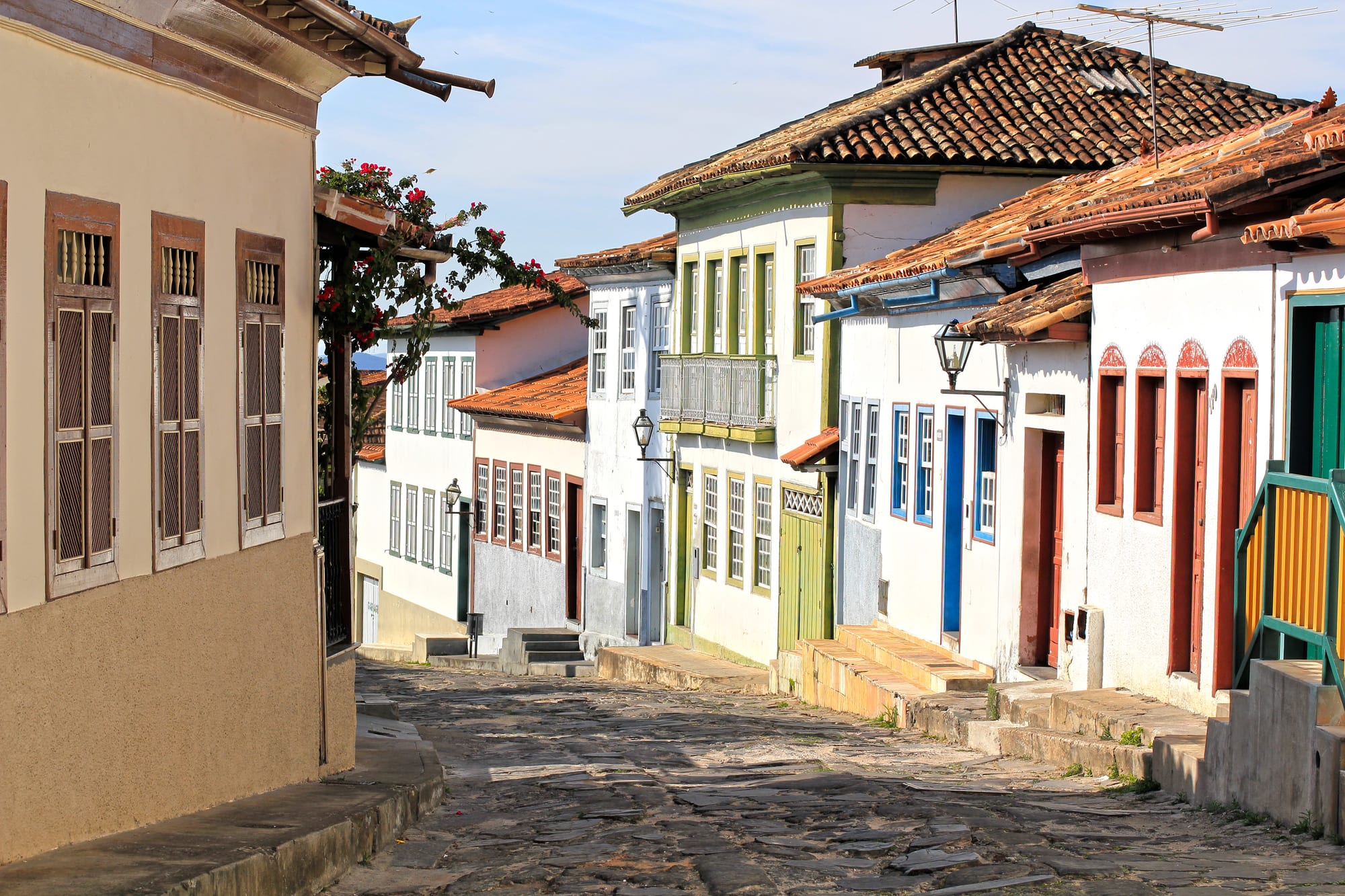
A cobbled street sloping downhill between whitewashed colonial houses with tiled roofs, coloured doors and a balcony

Minas Gerais & Espírito Santo, Brazil

Diamantina

Colonial houses on Rua do Rosário in the historic centre of Diamantina. (Zé Rocha / Wikimedia Commons · CC BY-SA 4.0)

A colonial town at about 1,100 metres in the Espinhaço mountains of northern Minas Gerais, built on the 18th-century diamond rush that the Portuguese Crown ran as a monopoly. Its whitewashed houses, painted balconies and churches form a UNESCO World Heritage Site; today a federal university, tourism and the Vesperata serenades keep the town of about 48,000 busy.

Neighbourhoods

  • Historic centre
    • First-time visitors
    • Historic district
    • Best for food

    The old Arraial do Tejuco around the cathedral: steep stone-paved streets of whitewashed two-storey houses with coloured window frames and balconies, baroque churches, the museums and most of the town's pousadas, restaurants and bars. Everything is within a short, hilly walk.

    Open in Maps
  • Newer districts
    • Quiet and residential
    • Local life

    The modern town spreads over the surrounding hills beyond the colonial core, with the bus station, supermarkets, the university campus and ordinary residential streets. Lodgings here are plainer but quieter, and a short ride or a climb from the centre.

    Open in Maps
  • Biribiri
    • Nature
    • Quiet and residential

    A tiny 19th-century textile-mill village inside Biribiri State Park, about 15 kilometres from town. The old workers' houses stand among cerrado-covered hills, with waterfalls and natural pools nearby.

    Open in Maps

Things to do

Churches and landmarks

  • St. Anthony Cathedrallandmark

    The seat of the Archdiocese of Diamantina, built between 1930 and 1940 on the site of the 18th-century mother church of Saint Anthony, around which the mining camp grew.

    Open in Maps
  • Igreja de Nossa Senhora do Carmolandmark

    One of the most important churches of the diamond district, founded by the lay Carmelite order in the 1750s and known for its carved and painted interior.

    Open in Maps
  • Igreja de Nossa Senhora do Amparolandmark

    One of the colonial churches of the historic centre.

    Open in Maps
  • Casa da Glórialandmark

    A colonial building in the historic centre that now houses the Eschwege Geology Centre of the Federal University of Minas Gerais.

    Open in Maps

Museums

  • Casa de Chica da Silvamuseum

    The 18th-century town house where Chica da Silva, a freed enslaved woman, lived with the diamond contractor João Fernandes de Oliveira from 1763 to 1771; it now holds the regional office of the national heritage institute, IPHAN, and paintings depicting her.

    Open in Maps
  • Museu Casa de Juscelino Kubitschekmuseum

    The modest childhood home of the president who built Brasília, now a museum dedicated to his life.

    Open in Maps
  • Museu do Diamantemuseum

    A museum in an 18th-century mansion devoted to the diamond cycle and to the history and society of the old Diamond District.

    Open in Maps

Short trips from the town

  • Biribiri State Parkpark

    Mountain cerrado with waterfalls such as the Cachoeira do Sentinela and Cachoeira dos Cristais, natural pools, the 20-kilometre Caminho dos Escravos trail and the abandoned textile village of Biribiri, about 13 kilometres inside the park from its entrance at Diamantina.

    Open in Maps
  • Rio Preto State Parkpark

    A protected area of cerrado around São Gonçalo do Rio Preto, with waterfalls, river beaches of white sand, rock paintings and traces of the colonial Estrada Real.

    Open in Maps

Seasonal events

  • VesperataAbout twice a month from April to October

    Musicians play from the windows and balconies of old houses while the audience listens in the street below, on the colonial Rua da Quitanda — one of Diamantina's best-known traditions.

  • CarnivalFebruary or early March

    Street carnival in the colonial centre, popular with the town's large student population.

Eat and drink

Long-standing places and food districts in Diamantina. Hours, ratings and directions come from your maps app, always current.

Food districts

  • Historic centre restaurantsneighborhood

    Restaurants in old town houses serving comida mineira — feijão tropeiro, tutu de feijão, pork dishes and couve — often as a self-service buffet at lunchtime.

    Open in Maps
  • Rua da Quitandaneighborhood

    The colonial street where the Vesperata is held, which fills with people on serenade nights.

    Open in Maps
  • Serro cheesemarket

    The artisanal cheese of neighbouring Serro, one of the best-known Minas cheeses, sold in shops around the centre.

    Open in Maps

Experience Diamantina

History

Diamantina began in 1713 as Arraial do Tejuco, a mining camp grouped around a chapel to Saint Anthony of Padua in the Espinhaço mountains; the name probably comes from a Tupi word for "rotten water". Gold brought the first settlers, but the town's fortune was made by diamonds, found in the streams around it in the 1720s and officially reported to Lisbon by the governor, Lourenço de Almeida, in 1729. Portugal reacted by sealing off the area: in 1734 the Intendency of Diamonds was created, an authoritarian regime that controlled who could live, trade and dig in the Diamond District, and the Crown's monopoly over the deposits lasted until 1845. The demand for labour in the diamond workings made Tejuco a centre for the import of enslaved Africans.

By the end of the 18th century Tejuco was the third-largest settlement in the captaincy, after Vila Rica, today Ouro Preto, with a population similar to that of São João del-Rei. Its best-known resident was Chica da Silva, a freed enslaved woman who lived with the diamond contractor João Fernandes de Oliveira, one of the richest men in colonial Brazil, and whose story later inspired a film and a television series. The town separated from the municipality of Serro only in 1831, taking the name Diamantina.

As the diamonds declined, Diamantina became a quiet regional centre, portrayed in the 1890s in the diary of Alice Brant, published as Minha Vida de Menina and later translated into English by Elizabeth Bishop. Juscelino Kubitschek, born here in 1902, went on to become governor of Minas Gerais and president of Brazil, and in 1999 the historic centre was inscribed as a UNESCO World Heritage Site.

Culture & Customs

Music is the centre of Diamantina's identity. The town is known across Brazil for its serestas, sentimental serenades sung in the streets, and above all for the Vesperata, when musicians play from the windows and balconies of colonial houses at night while the audience listens from the street below. The Vesperata grew out of that serenade tradition, and on Vesperata nights the steep streets fill with visitors, tables and applause.

The Catholic calendar still shapes the year. The churches, built by lay brotherhoods during the mining boom, host processions and feast days, and the cathedral stands where the camp's first chapel was built. Diamantina is also the seat of an archdiocese, and religious life remains visible in a way it has faded from in larger cities.

The town is proud of two figures above all. Chica da Silva, whose house is preserved in the centre, has become a symbol of Afro-Brazilian history and of the contradictions of colonial society. Juscelino Kubitschek, the president who built Brasília, is remembered as a local son, and his childhood home is a museum. A large student population, drawn by the federal university, adds a younger, livelier side, most visible at Carnival.

Daily Life

About 48,000 people lived in the municipality of Diamantina at the 2022 census, in a large, thinly populated territory of mountains and cerrado that also includes small villages. The town lies at an altitude of about 1,100 metres, some 290 kilometres from Belo Horizonte by road, in the Jequitinhonha valley, one of the poorer parts of Minas Gerais.

The economy rests on services and tourism, and the greatest change of recent decades came from the expansion of the Federal University of the Jequitinhonha and Mucuri Valleys (UFVJM) at the end of the 2000s. The university has become the main driver of the town's economy, bringing in students and staff from across Brazil and filling flats, cafés and bars. Diamond mining, which created the town, is far less important than it once was.

The rhythm of the day is that of a small mountain town. Shops and offices cluster around the historic centre, lunch is the main meal, and evenings are spent in the squares and bars. On Vesperata weekends and at Carnival the population swells with visitors, while quieter weeks belong to residents and students. Keeping the colonial houses in good repair under heritage rules, and spreading the benefits of tourism beyond the centre, are long-running local concerns.

Food

Diamantina eats comida mineira, the farmhouse cooking of Minas Gerais. Lunch in a typical restaurant means rice and beans with feijão tropeiro, beans mixed with cassava flour, bacon, sausage and egg; tutu de feijão, a thick bean purée; couve, finely shredded collard greens; and pork in many forms, from crisp torresmo, fried pork crackling, to slow-cooked loin. Frango com quiabo, chicken stewed with okra and served with angu, a soft cornmeal, is a classic of the region.

Pão de queijo, the small cheese breads made with cassava starch, are eaten at breakfast and with coffee through the day. Cheese is a point of pride: the artisanal cheese of neighbouring Serro is one of the most famous in Minas, and fresh queijo Minas appears on every table. Sweets are preserved and sugary — doce de leite, fruit preserves and goiabada, guava paste, eaten with cheese.

Cachaça, the cane spirit, is drunk neat or in a caipirinha, and Minas produces many small-batch brands. Many restaurants in the historic centre serve their food as a self-service buffet at lunchtime, and bars stay busy late on serenade nights.

Planning tools

Budget

Diamantina has one of the higher costs of living in Minas Gerais, driven by tourism, though a self-service lunch of local food costs little. Prices rise on Vesperata weekends, at Carnival and in the July holidays, when rooms in the historic centre fill quickly.

Daily Budget Midrange
USD 70–140 (colonial-house pousada, restaurant dinners, museum entries, a taxi to Biribiri)
Daily Budget Shoestring
USD 30–50 (hostel or simple pousada, self-service lunches, buses)

Check the Vesperata calendar before choosing dates — those weekends are the most atmospheric and the most expensive.

Best Time to Visit

April to October is the dry season in the Minas highlands and coincides with the Vesperata months: clear skies, cool nights and good walking. The summer months bring heavy afternoon rain and green hills, and Carnival fills the town in February or early March.

Suggested Number of Days

Two days are enough for the historic centre and its museums. Allow three or four to add the state parks in the surrounding mountains, or to time a stay with a Vesperata weekend. Arriving by a long bus ride also argues for at least two nights.

First Visit
2 days
With Surroundings
3–4 days

Transportation

The historic centre is best seen on foot. Taxis and app rides cover the newer districts, and a car or a taxi is the practical way to reach Biribiri. Buses run from the bus station on Largo Dom João to Belo Horizonte and nearby towns.

The roads into the mountains are unpaved in places and can be slippery after rain; drive them by day.

Airport & Station Connections

Diamantina is about 290 kilometres from Belo Horizonte by road, and frequent buses run between the two cities. The small Juscelino Kubitschek Airport is about 4 kilometres from town.

Walkability

The colonial centre is compact and entirely walkable, but the town sits on steep hillsides and the streets are paved with large, uneven stones that are slippery when wet. Most sights are a few minutes apart.

Safety

Brazil has high rates of crime, including violent crime, and it is the main practical concern for visitors — though very unevenly distributed. The colonial towns of Minas Gerais are generally calm, and Diamantina's centre is busy and sociable on event nights. The usual risks are pickpocketing in crowds, falls on the steep cobbles and driving on mountain roads.

Wear grippy shoes, keep phones and wallets secure in Vesperata and Carnival crowds, avoid night driving on mountain roads, and get a yellow fever vaccination before rural trips. Check current official travel advice before travelling.

Climate

A highland tropical climate with mild temperatures all year — the annual average is about 19°C — and rain concentrated in the summer months. Summer is December to February.

Summer
mild and wet — average temperatures of roughly 18–26°C, with frequent heavy rain
Winter
dry and sunny — averages of roughly 10–20°C, with nights that can fall below 10°C

Local Customs

Diamantina is a devout Catholic town: dress modestly inside churches and keep quiet during services. A service charge is usually added to restaurant bills. Greetings are warm, and visitors are welcomed into the music culture — applause and singing along at a Vesperata are normal.

Ask before photographing people in church or in private doorways; on Vesperata nights keep to the street and do not block house entrances.

Common Payment Methods

The currency is the Brazilian real (R$). Cards and the instant Pix transfer system are widely accepted in pousadas and restaurants. Carry some cash for small shops, church entry fees and street stalls, and withdraw it by day from ATMs inside banks.